· Surf Lifesaving
The sport, the rescue service, and the TV show — all three started here
Australia invented surf lifesaving in 1906. The red-and-yellow caps you see on any English-speaking beach trace directly to what happened at Bondi. The story the show Bondi Rescue tells every week is the modern continuation of the 120-year-old institution this spoke is about.
How a handful of Sydney watermen formalized a service the world now uses
Daylight swimming in the ocean was illegal in New South Wales until 1903. The reversal came after the newspaper editor William Gocher deliberately swam at Manly in midday and invited arrest (they did not arrest him). Legislation followed; by 1905, Sydney's eastern beaches — Bondi, Bronte, Tamarama, Manly, Coogee — were receiving weekend crowds that included large numbers of complete non-swimmers stepping into the Pacific for the first time in their lives. The drowning numbers became a public-safety crisis within eighteen months.
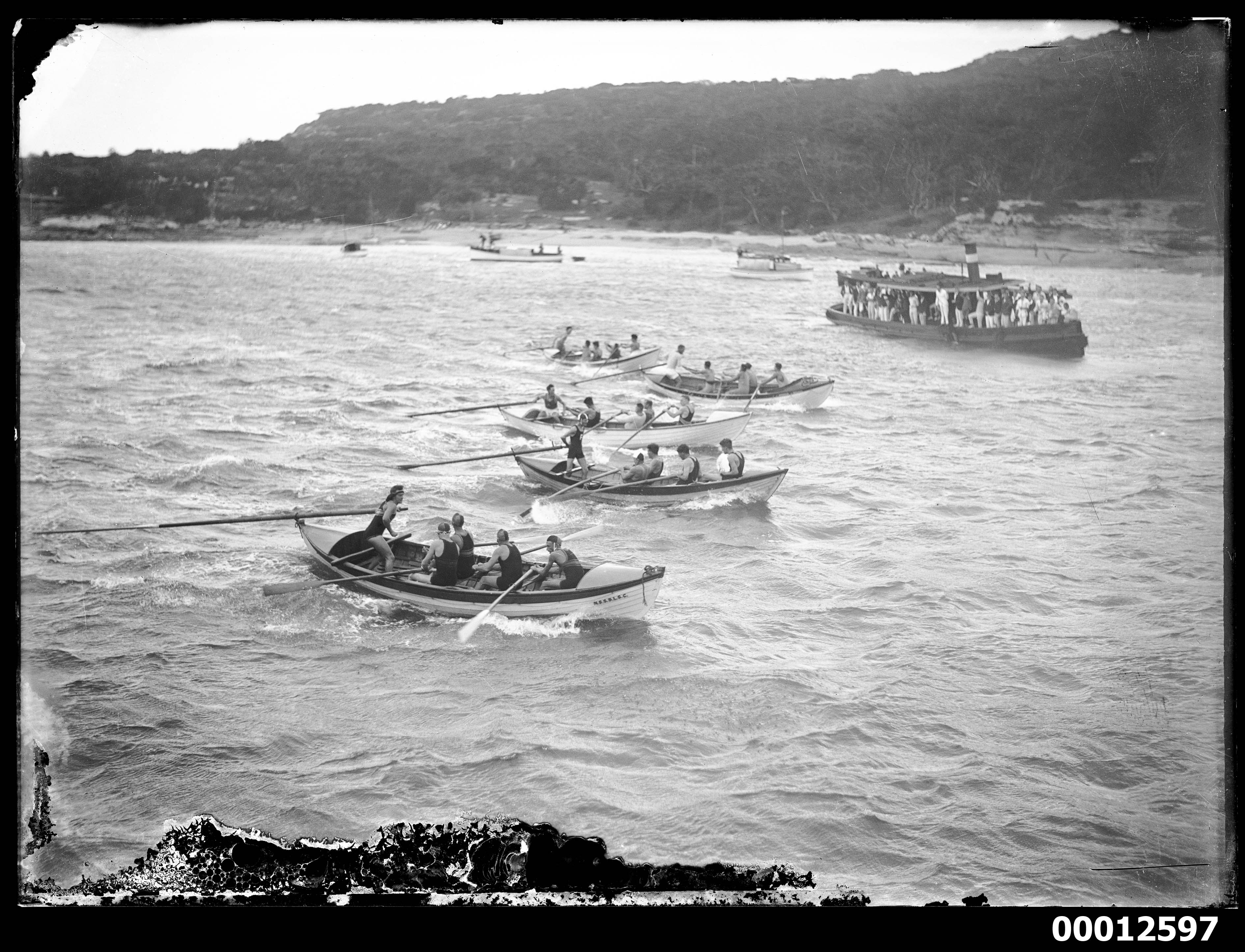
On 21 February 1906, a group of Bondi watermen — including surfers, spear-fishers, and beach residents — formalized themselves as the Bondi Surf Bathers' Life Saving Club. The founding committee included John Bond (first club captain), William John ("Happy") Eyre, and Arthur "Flossie" Lewis — names that still appear on the SBLSC's board of founding members. Approximately 30 men signed up in the first week; the club's first rescue, using the belt-and-line gear the founders had adapted from British fishing-village coastguard practice, was in March 1906.
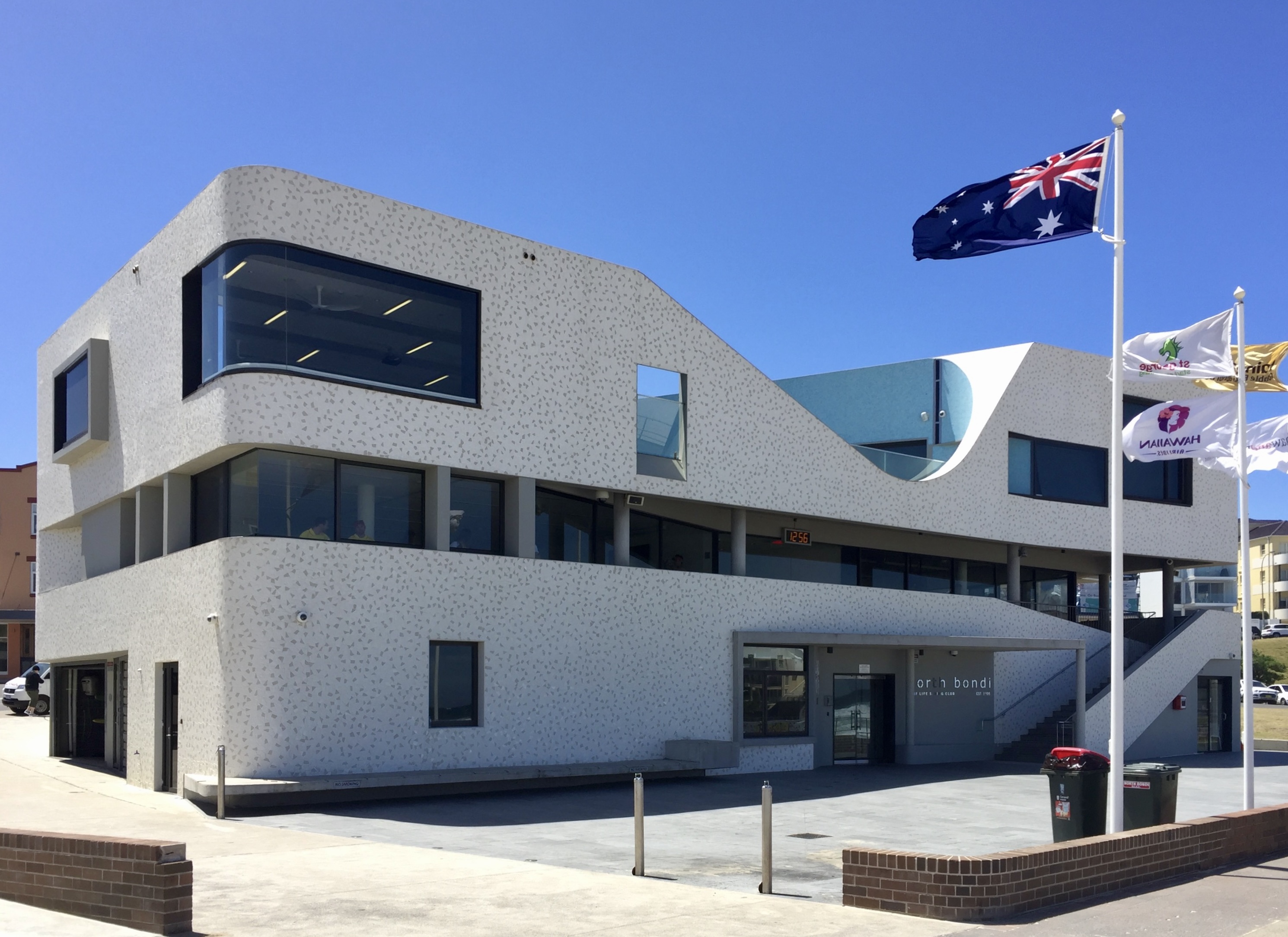
By 1907, Bronte, North Bondi, Manly, and Coogee had copied the model and founded their own clubs. By 1915, Sydney's entire eastern beaches circuit was patrolled every weekend by volunteer lifesavers in color-coded caps. By 1924 the national body — now called Surf Life Saving Australia — had absorbed all Australian clubs under a single rulebook, training scheme, and competition circuit. Approximately 314 clubs operate today along the Australian coast; Bondi's is number one in the register and is still the canonical institutional reference.
The afternoon the service became a sport
Thirty-five thousand on the sand. Three waves. Three hundred rescued. Five drowned. The defining day of Australian surf lifesaving and the origin of the international swim-between-the-flags rule.
The afternoon
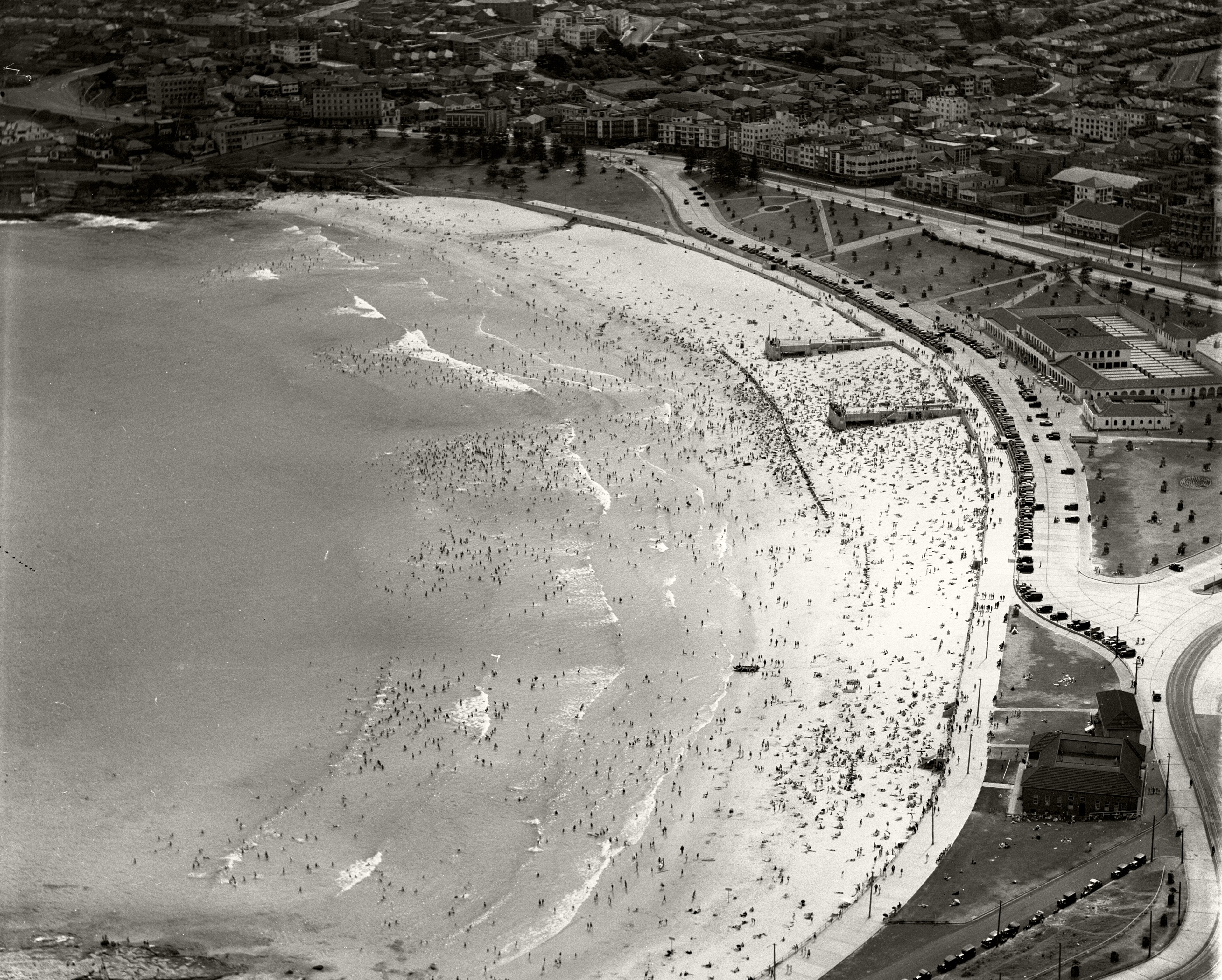
Sunday 6 February 1938 was a high-summer Sydney day — 32 °C, clear skies, a light onshore breeze. Bondi had an estimated 35,000 people on the sand, among the largest weekend crowds the beach had ever carried. The SBLSC patrol on duty — approximately 80 volunteer lifesavers from Bondi and neighboring clubs — had flagged the central swimming area between the two rescue-boat stations. The beach was operating at what passed in 1938 for standard summer density.
At approximately 3 p.m., a set of three larger-than-normal waves — later characterized variously as rogue set waves, as the leading edge of a distant unseasonal swell, or (in some later analyses) as a small localized seiche — struck the central beach. The first wave washed a sandbank out from under the waders standing on it, suddenly dropping several hundred people from knee-deep to neck-deep water. The second wave drove the panicked crowd backward toward the beach. The third — the largest of the set — pulled the resulting shorebreak water back out to sea on a strong return current, dragging an estimated 250–300 people into the depth beyond the breakers.
Four hours
The rescue effort that followed lasted approximately four hours and involved roughly 80 volunteer rescuers. The primary rescue apparatus of the 1930s was the reel, line, and belt: a beach-mounted wooden reel paid out 400+ meters of rope; a swimmer wearing a canvas-and-cork belt attached to the line swam out to a drowning victim, got the belt under the victim's arms, and was hauled back by a team hauling the reel on the sand. Bondi's two reel stations worked continuously through the afternoon. The additional rescue boats (4-person oared surf boats, a direct descendant of British fishing-village coastguard vessels) worked the outer impact zone.
The final count: approximately 300 people rescued, 5 drowned — all weak or non-swimmers who had been pulled too far out before the rescuers could reach them. In a disaster that would in a less-organized beach have killed dozens, the Bondi SBLSC's 32-year-old operational infrastructure demonstrated what volunteer surf lifesaving could do at scale under pressure.
What changed
Black Sunday became the most reported-on rescue in international press of the 1930s. Within eighteen months, surf lifesaving clubs patterned on the Australian model had been established at Cape Town, Durban, Muizenberg, and Cornish Coastguard beaches in the UK. The swim-between-the-flags rule — which the SBLSC had been using since the 1910s but had never exported formally — became the international standard beach-safety protocol it remains today. The red-and-yellow cap, chosen because those are the two most-visible colors against both ocean water and tan sand, became the global uniform of volunteer beach lifeguards.
The two services, the gear, the daily rhythm
Bondi in 2026 is patrolled by two overlapping services that work side by side across seven days a week. The red-and-yellow caps are still volunteers. The blue caps are paid. Both are on duty, and between them they perform roughly 4,500 rescues a year.
Volunteer lifesavers (red-and-yellow)
The Bondi SBLSC maintains a weekend volunteer patrol from October through April every year. Approximately 180 active patrolling members currently. Patrols run 8 a.m. to 6 p.m. Saturday and Sunday in peak season; shorter rotations in the shoulder months. Every patrolling volunteer is Bronze Medallion-qualified — a 40+ hour training program covering rescue, resuscitation, CPR, and first aid. Senior volunteers carry additional IRB (inflatable rescue boat) and beach-management qualifications.
Professional lifeguards (blue)
The Waverley Council Beach Services — the professional lifeguards — operate seven days a week, year-round, with 12–15 lifeguards on duty during the peak season. They are Waverley Council employees; base salary around AUD $75,000, senior lifeguards higher. Every professional is Bronze-qualified plus holds additional qualifications in advanced first aid, vehicle rescue, IRB driver, and (for senior staff) incident command. The professional service was expanded in the 1990s when beach attendance grew beyond what volunteer weekend patrols could safely cover on mid-week summer days.
The rescue gear
- Rescue tubes — the flexible foam flotation device trailed by a line. The Baywatch-era replacement for the 1906 cork belt. Still the default rescuer-to-victim tool.
- IRBs (inflatable rescue boats) — outboard-motored zodiacs that handle rescues beyond the surf zone. Introduced in Australia in the 1960s; the Bondi fleet runs 4 boats in rotation.
- Rescue boards — longboard-like hard boards the professional lifeguards use for fast response inside the surf zone.
- Jet-skis with sleds — for heavy-surf rescue; the tow-in big-wave equipment that Nazaré uses for tow-in surfing was, in its early days, adapted from Australian lifesaving-service jet-ski rescue protocols.
- Drones — the Bondi service has run drone surveillance since 2018; drones now drop inflatable rescue pods to swimmers in distress outside the surf zone, which is a genuine 21st-century addition to the rescue inventory.
The TV show, the ethics, and what it is for
Bondi Rescue premiered on Network Ten in 2006, produced by Cordell Jigsaw Productions. The format was straightforward: camera crews embedded with the Waverley Council professional lifeguards for the peak summer months, following them through rescues, medical emergencies, minor crime (wallet theft is the canonical Bondi summer crime), and the chronic comedy of managing a beach that receives 40,000 visitors on a Saturday. The show has run continuously since — approaching 20 seasons — and is syndicated in more than 100 countries.
The lifeguards as characters
The long-running Bondi Rescue figures — Bruce "Hoppo" Hopkins, Anthony "Harries" Carroll, Trent "Maxi" Maxwell, Kerrbox, Whippet, Hutchy, Jesse — are recognizable figures across Australia and in English- speaking countries. The show's consistency of personnel (most of the named lifeguards have been on the show since its first or second seasons) has produced a character continuity that scripted television struggles to match. Hoppo runs the team; Harries is the emotionally-open one; Maxi is the surf-champion one. This level of personality consistency is what turns a workplace documentary into something viewers return to.
The ethics question
The show documents, by design, people having among the worst moments of their lives — drownings, heart attacks, drug overdoses, minor-crime arrests. The Australian Commercial Television Code of Practice and internal Cordell Jigsaw policies require informed consent from rescued individuals before footage airs, and the show has demonstrably blurred or cut footage in cases where consent was refused. That said: the show is on television for entertainment, its ratings depend on drama, and the line between documentary public-safety education and exploitative spectacle is genuinely ambiguous. This is worth naming rather than glossing over.
As training material
Inside the surf-lifesaving industry globally, Bondi Rescue has become an unexpectedly important training resource. The show's library of real rescues — with tide conditions, victim behavior, rescuer decisions, and outcomes all visible on camera — is used in SLS Bronze Medallion instruction in Australia, in RNLI beach-lifeguard training in the UK, and in equivalent programs in South Africa and New Zealand. A TV show made for mass entertainment has become, in parallel, one of the single largest public archives of beach-rescue technique. The surf-lifesaving community has mixed feelings about this — it is not the archive they would have chosen to compile — but it is genuinely useful.
The rest of Bondi
Bondi →
Australia's image of itself — the crescent of sand, the red-and-yellow flags, and the Gadigal country under both.
Visiting →
Getting to Bondi from Sydney CBD, the 6 km Bondi-to-Coogee coastal walk, where to stay, what to eat, and Icebergs as the anchor destination.
Gadigal Country →
Eora Nation country, the Bondi rock engravings, the Uluru Statement arc and the 2023 Voice referendum, and how to visit an Australian beach that was never ceded.
Written by Erin Rose. Founding-era SBLSC detail from the Bondi SBLSC centennial archive (2006) and Surf Life Saving Australia's official history. Black Sunday reconstruction from Tony Saunders's Black Sunday (Mitchell Beazley, 1988) and contemporary Sydney Morning Herald reporting 7–10 February 1938. Modern operational detail from Waverley Council Beach Services and from several Bondi Rescue season recap documents. Rescue numbers are published annually; verify current figures at slsnsw.com.au. Corrections welcome, especially on Portuguese-language framings and on the named practices of Nazaré. Version v0.9.