Patong's spike is not a wave or a war or a species. It is a transformation — the conversion of a quiet agricultural fishing bay into the single most intense tourism-and-nightlife strip in Thailand — and the one morning, 26 December 2004, when the sea came back into that strip and took it apart. To understand Patong you have to hold both of those at once: the strip as a triumph of mass tourism, and the strip as the most exposed thing on the coast when the ocean turned. They are the same place.
The bay before the strip. Patong is a roughly 2.85-kilometer crescent on the west coast of Phuket, inside Kathu District, opening directly onto the Andaman Sea. For most of its history the mountains behind it isolated it: this was banana plantations and a fishing community, reachable only over a pass. In 1959 the first dirt road was cut through to Phuket Town. That single road is the hinge of the entire story. Everything that Patong became required access, and access arrived in stages — the dirt road in 1959, the first hotels and bungalows in 1976, a paved road and reliable electricity in the early 1980s, and the opening of Phuket International Airport in 1984. Each step widened the pipe. By the late 1980s the pipe was wide enough to carry European package tourism at volume, and the bay filled.
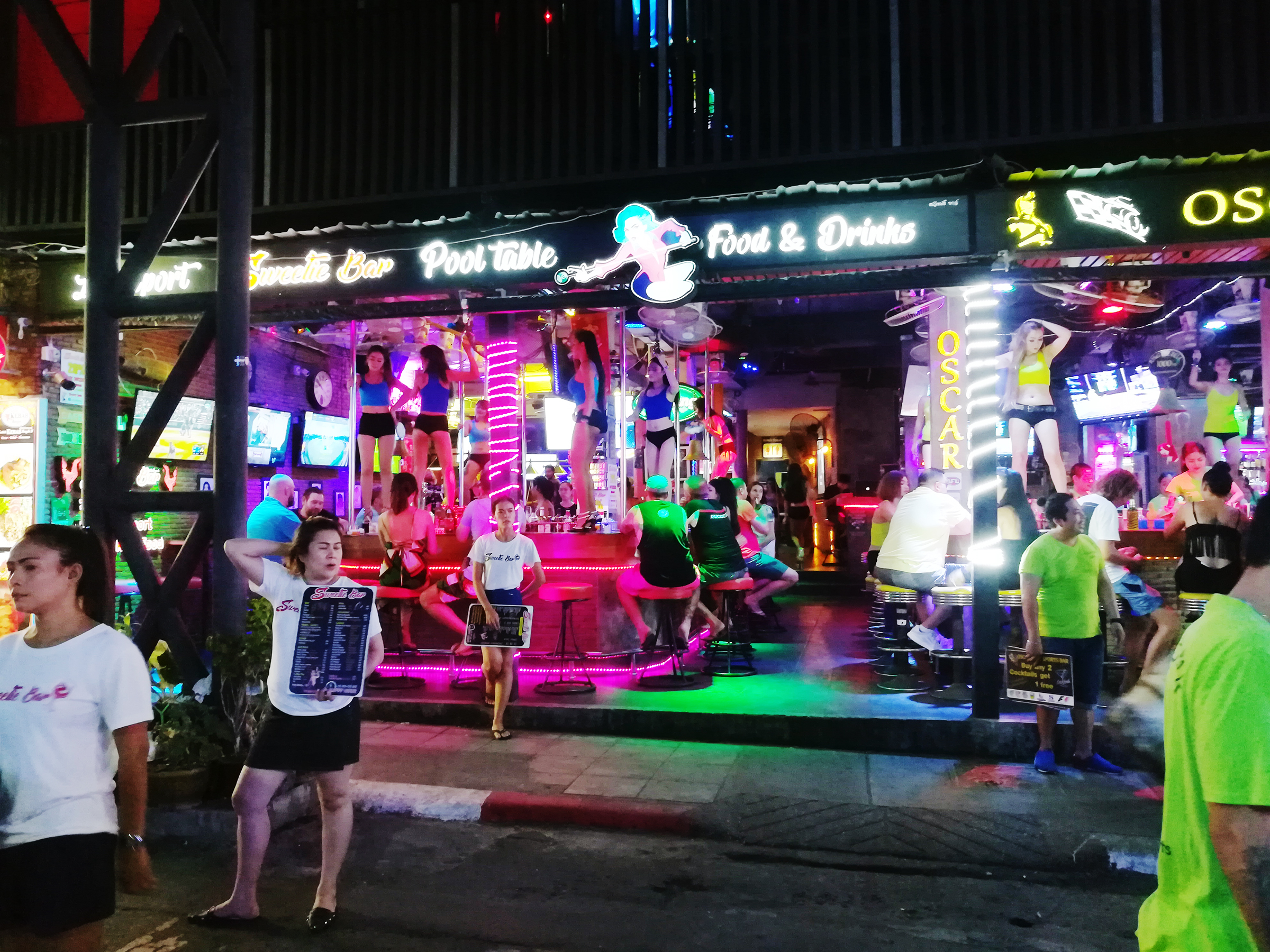
The anatomy of Bangla Road. The strip's nucleus is Bangla Road — Soi Bangla — a street of about 400 meters running inland from the beach road. By day it is an ordinary, slightly tired commercial street. At dusk it is barricaded to traffic and becomes a pedestrian canyon of neon: beer bars where hostesses are paid to keep customers buying drinks, go-go bars, discotheques stacked above street level, ladyboy cabarets, and a dense layer of touts steering foot traffic into doorways. Branching off Bangla are the sois — Soi Crocodile, Soi Easy, Soi Sea Dragon, Soi Tiger — each a sub-economy of its own. Adjacent is the Paradise Complex, Patong's gay nightlife district. The geometry matters: the beach faces the sunset and the families; the strip behind it faces midnight. A visitor can spend a week in Patong and experience the two as entirely separate places, because in operational terms they are.
The tourism economy and its scams. Patong does not merely host tourists; it runs a set of predatory micro-economies on them that have been documented for years and have survived every crackdown. The jet-ski scam is the most notorious: an operator rents a craft, then after the ride claims expensive pre-existing damage and demands compensation — often hundreds of US dollars — sometimes backed by intimidation. The pattern broke into international view through the 2009 British television series *Big Trouble in Tourist Thailand*, which filmed a Patong operator confronting British marines over fabricated damage; the documentary changed nothing on the ground, and operators kept working. The timeshare scam — a stranger on a motorbike, or a survey that turns into a high-pressure sales pitch for a holiday club — has worked the beach road for two decades. Layered on top is the sex-tourism economy, the bar-fine system, and the exploitation that travels with it. These are not aberrations the strip is fighting; they are part of how the strip earns. That is the uncomfortable claim Patong forces you to make.
The 2014 clearance. The Thai state has periodically tried to discipline the beach. The most dramatic intervention came in July 2014, two months after the military coup. The junta's National Council for Peace and Order ordered the beaches cleared, and more than 100 soldiers in full combat uniform walked onto Patong sand to evict the vendors, masseuses, deckchair and umbrella operators, and food stalls — by Patong officials' own count, roughly 32 umbrella operators, 200 masseuses, 100 mobile vendors, and 100 jet-ski workers had been operating on the beach. A 2015 rule then capped beach vending at 10 percent of any Phuket beach's sand. Photographs of soldiers chasing sunbed vendors off a tourist beach circulated worldwide. The clearance restored the open sweep of the sand and is genuinely why Patong's beach photographs better now than it did in 2013. It also displaced the livelihoods of people who had no other ones, and the scam operators it was partly aimed at largely returned.
The rupture: 26 December 2004. Then there is the morning the story breaks in half. The magnitude-9.1 Sumatra–Andaman earthquake struck at 07:58 local time off the northwest coast of Sumatra. The tsunami it generated crossed the Andaman Sea and reached Phuket's west coast roughly two hours later. Patong, a wide flat bay facing the open sea with hotels built right up to the beach road, was among the most exposed places on the island. The water withdrew, exposing the seabed — and then returned as a series of surges that crossed the beach road and flooded the ground floors of the hotels, dragging sunbeds, vehicles, and people inland. In Phuket province the early official toll was around 117 dead, including roughly 35 foreigners, with hundreds injured and missing. That number is small only by comparison: across Thailand 5,395 were confirmed dead and nearly 3,000 listed missing, with the resort strip at Khao Lak in neighboring Phang Nga province accounting for over 4,000 of the deaths — the deadliest single area in the country. Phuket lost less because its bays are slightly more sheltered and its buildings slightly more solid, not because it was spared.
What Patong did next is itself the point. It rebuilt at speed. Within roughly two years the bars on Bangla Road were open again and the package flights were full. Thailand built a real warning system afterward — offshore buoys, a warning tower on the coast, evacuation signage — and that system is a genuine improvement. But the rebuilding reproduced the same exposed pattern: dense construction on a low flat bay facing the open Andaman, the same economy, the same strip. The 2012 film *The Impossible*, based on a Spanish family's real ordeal at Khao Lak, fixed the Thai tsunami in the global imagination as something that happened to tourists on this coast.
What Patong reveals. Patong is a clean case study in what unmanaged mass beach tourism produces. The transformation that made it — a fishing bay converted in one generation into a 24-hour strip — also made it fragile: economically dependent on a single industry, environmentally strained (Patong's coastal water has repeatedly exceeded bacterial pollution standards), socially hollowed out into a place where almost no one on the strip at night actually lives there. The tsunami exposed the physical version of that fragility in two hours. The scams, the sex economy, and the periodic combat-uniform clean-ups expose the social version every day. None of this means you should not go. It means you should go without the brochure. The sand is real and the sea is warm, and a few hundred meters inland is the most honest argument in Thailand about what a beach becomes when it is asked to be an industry.