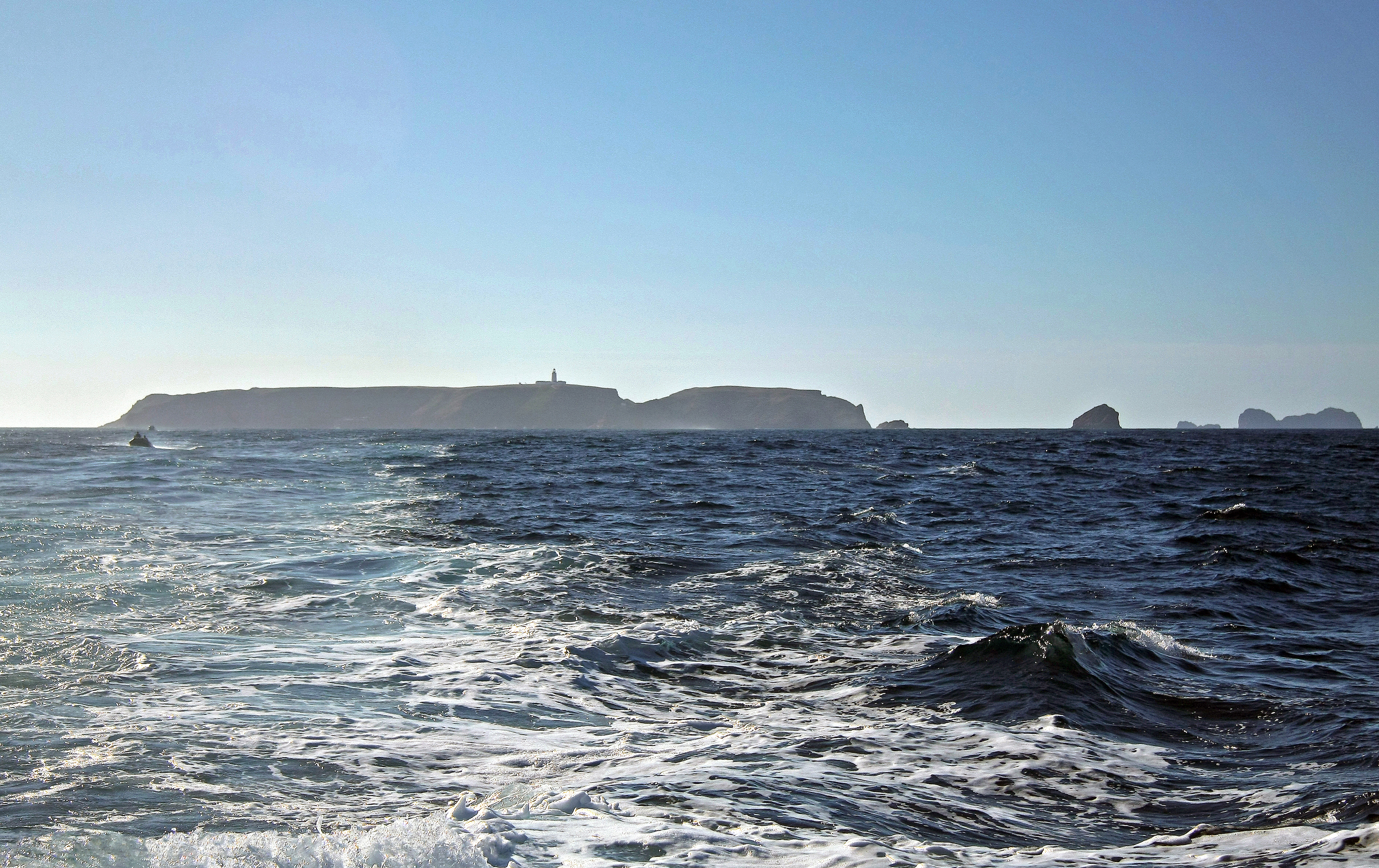
· The Berlengas
The UNESCO biosphere archipelago ten kilometers offshore
A 40-minute boat ride from Peniche harbor, a permit-limited daily cap on visitors, a 17th-century island fortress operating as a basic guesthouse, and some of the last breeding colonies of Atlantic seabirds on the Iberian coast.
Precambrian granite, Atlantic endemics, 550 million years of isolation
The Berlengas are geologically unrelated to the Peniche peninsula. They are the exposed tops of an ancient granite ridge that has been an island throughout the Quaternary — which means their biota has evolved in relative isolation.
The archipelago is three small islands — Berlenga Grande (78 hectares, the only inhabitable one), Estelas, and Farilhões — plus associated rocks and shallow banks. Geologically they are Precambrian granite, roughly 550 million years old — among the oldest exposed rock in Portugal and an entirely different lithology from the Jurassic limestone of the Peniche peninsula ten kilometers east. The islands were above sea level during the entire Pleistocene; they have never been connected to mainland Iberia in any evolutionarily meaningful timeframe.
That isolation has produced endemic species. The Berlengas thrift (Armeria berlengensis) is a small flowering plant found nowhere else. The islands host one of the Atlantic's last significant Bulwer's petrel breeding colonies (~500 pairs; a pelagic seabird that spends most of its life at sea and comes ashore only to nest). Mainland Portugal's largest shag / European cormorant colony (~200 pairs) is here. The surrounding waters hold some of the healthiest subtidal macroalgal forests on the Portuguese coast and the clearest Atlantic visibility available for diving.
Designated a Portuguese natural reserve in 1981, upgraded to a UNESCO Biosphere Reserve in 2011, the archipelago is under tight visitor management. Daily visitor caps during peak season protect the nesting colonies and the delicate dune vegetation; the permit system is the mechanism that keeps the islands in the state you came to see.
The boat from Peniche harbor and the permit system
Access to Berlenga Grande is by boat from Peniche, with numerical limits enforced through advance-booking concessions. In July and August the daily cap is reached most days; in shoulder seasons, availability is usually walk-up.
The licensed operators
Several licensed boat operators run daily summer trips between Peniche harbor and Berlenga Grande. The canonical names:
- Viamar — the long-established passenger-ferry operator. €20–25 adult round trip. Larger boat, more stable in rough seas. Runs 3–5 departures daily in peak summer.
- Berlenga Turismo — smaller, faster RIB-style boats. Shorter crossing (25–30 min vs 40+ for the ferry), but rougher ride and wetter on windy days. €30–40 round trip.
- Cabo Avelar Pessoa — traditional fishing-vessel-style operator with longer, more scenic routes including coastal-cave tours around the island before landing. €30–45 depending on package.
Booking ahead
In July and August, the island's daily visitor cap (~400 visitors) is reached on most weekdays and essentially all weekends. Book 2–4 weeks ahead through the operator websites. In May–June and September–October, walk-up bookings at the harbor ticket office the morning of are usually fine. The boat service runs May through September; there is no scheduled winter service.
The crossing
The Atlantic between Peniche and the Berlengas is an open- ocean channel with genuine wave exposure. On calm days the crossing is pleasant. On rough days (onshore wind ≥ 25 knots) operators may cancel; you get a full refund. On intermediate days, the ride is bumpy and seasickness is common. Take a Dramamine an hour before boarding if you are prone to motion sickness; the boats do not carry them. Don't plan a heavy breakfast.
What to do with four hours (or one night) on Berlenga Grande
The standard day visit
A typical day-visit arrival at 10 a.m. and return at 4 p.m. gives you roughly 5 hours on the island. The canonical sequence:
- The Forte de São João Baptista — the 17th-century Portuguese fortress on a small rocky outcrop connected to the main island by a stone causeway. Walk across, explore the ramparts, see the guesthouse interior if not fully occupied.
- The island walking loop — a marked roughly-2-hour circuit covering the major viewpoints, the lighthouse at the south end, the bird-cliff observation platforms, and the central valley. The trail is well-marked but not paved; wear grip-soled shoes.
- Lunch at the island café — the one restaurant near the dock. Limited menu (seafood, fresh catch, Portuguese salads); moderately priced for a captive-market restaurant. Reservations useful in July–August.
- A swim — the Carreiro do Mosteiro beach, a small cove with clear Atlantic water. Water temperature 16–19 °C in summer; colder than mainland beaches because the deeper surrounding water doesn't warm up.
- Return boat — catch it. The last return runs at 5 p.m. or 6 p.m. in peak season; miss it and you're sleeping in the fort whether you planned to or not.
Overnight in the fort
The Forte de São João Baptista guesthouse — operated as a basic-level hostel-style accommodation by a local concessionaire — offers some of the most unusual overnight-lodging you can book in Europe. Roughly 20 beds, shared rooms, minimal amenities, reservations open in January and fill within weeks for the July–August window. You sleep inside a 17th-century Portuguese fortress, the Atlantic on three sides, the lighthouse sweeping the island all night, the seabird colonies audible at dawn. Cost is modest (€25–45 per person per night) but the experience is logistically challenging — you bring all your food except breakfast, the bathrooms are basic, the electricity comes from island-scale solar and may be intermittent.
Worth it if you are prepared. Not worth it if you are expecting hotel amenities.
Diving and kayaking
The shallow-water perimeter of Berlenga Grande has some of the clearest diving visibility on the Portuguese coast — 10–15 m on good days. Several licensed operators (Haliotis Dive Center, Acualand) run day-trips from Peniche harbor with boat transfer, two tank dives, and return. €80–110. Kayak rentals are available on the island for paddling the cave-and-arch system on the western cliffs; €15–25 per hour. These are the most interesting non-beach activities on the archipelago.
What the permit system expects of you
Breaking these rules is not theoretical — the Portuguese nature-reserve authority (ICNF) has wardens on the island during peak season, and fines are routinely issued.
- Stay on marked paths. The island's vegetation — including the endemic thrift — is fragile. Off-trail walking damages it.
- Do not approach seabird colonies. The observation platforms are placed at non-disturbing distances. Flushing a nesting petrel or shag is a federal wildlife offense.
- No drones. Banned for the nesting disturbance they cause.
- No collecting. Shells, plants, rocks, fossils — none of it leaves the island. The same principle that protects Hawaiian lava rocks applies here.
- Pack out what you pack in. Basic wilderness-use ethic. The island's waste-handling infrastructure cannot absorb day-tripper scale.
- Swimming is permitted only at Carreiro do Mosteiro. The rest of the island's coast is dangerous rocky shoreline; do not snorkel off the path.
The rest of Peniche
Peniche →
The peninsula, the fortress, Supertubos, and the Berlengas — the full argument.
Surfing Peniche →
The WSL Championship Tour stop. Which break for which level, why Supertubos barrels the way it does, the competition calendar, and the surf-camp inventory at Baleal.
Visiting →
Getting to Peniche from Lisbon, where to stay, what to eat, and the Fortaleza as the Peninsula's serious afternoon.
Written by Erin Rose. Ecological data from ICNF (Instituto da Conservação da Natureza e das Florestas) and the UNESCO Biosphere Reserve documentation. Boat operator schedules and pricing from operator websites; verify for the current season. Fort guesthouse availability from the Câmara Municipal de Peniche; book through the licensed concessionaire when reservations open each January. Corrections welcome, especially on Portuguese-language framings and on the named practices of Nazaré. Version v0.9.