Australia's image of itself. One kilometer of sand. A hundred years of surf-lifesaving. Sixty-five thousand years of Gadigal country under it.
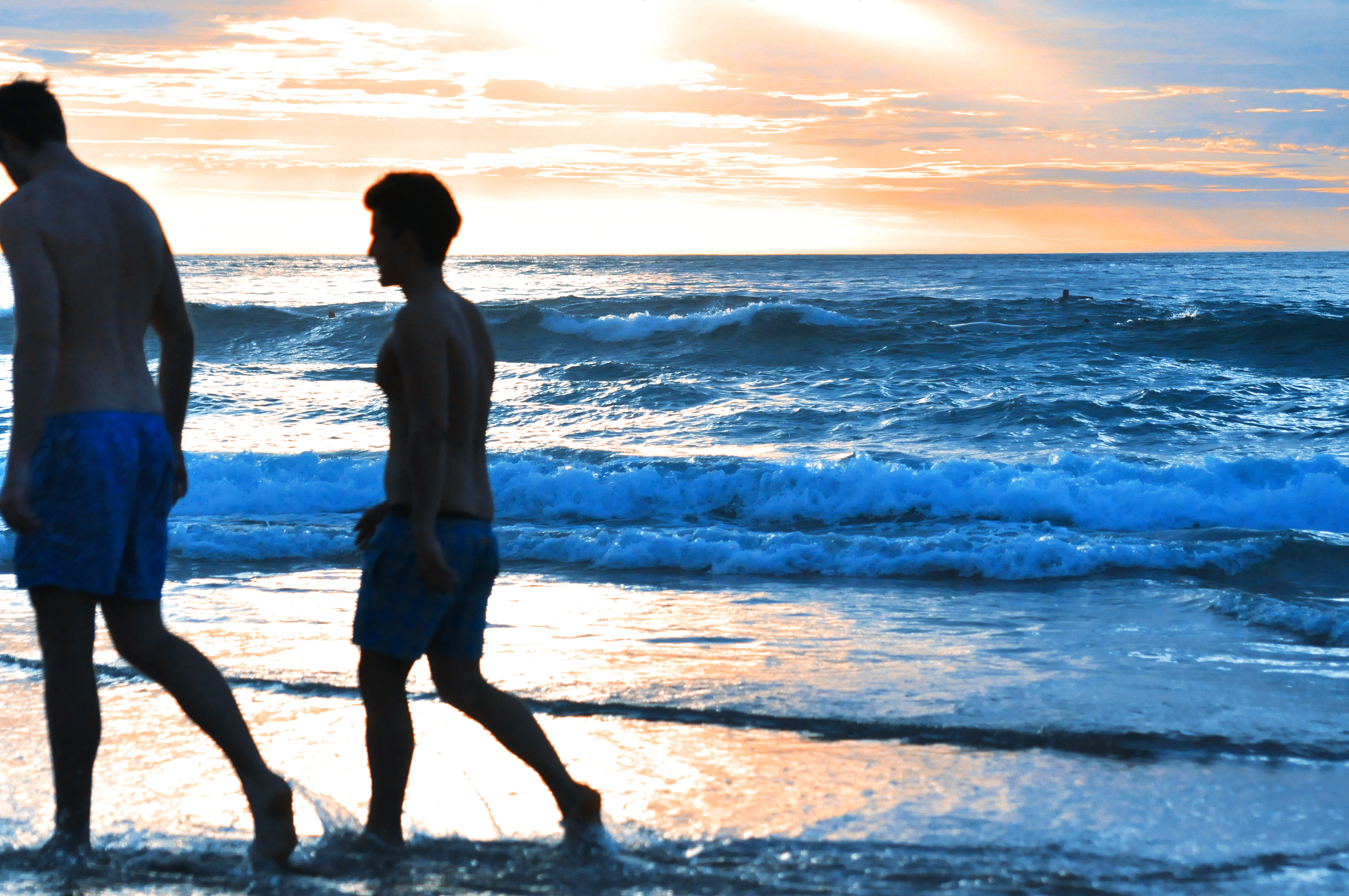
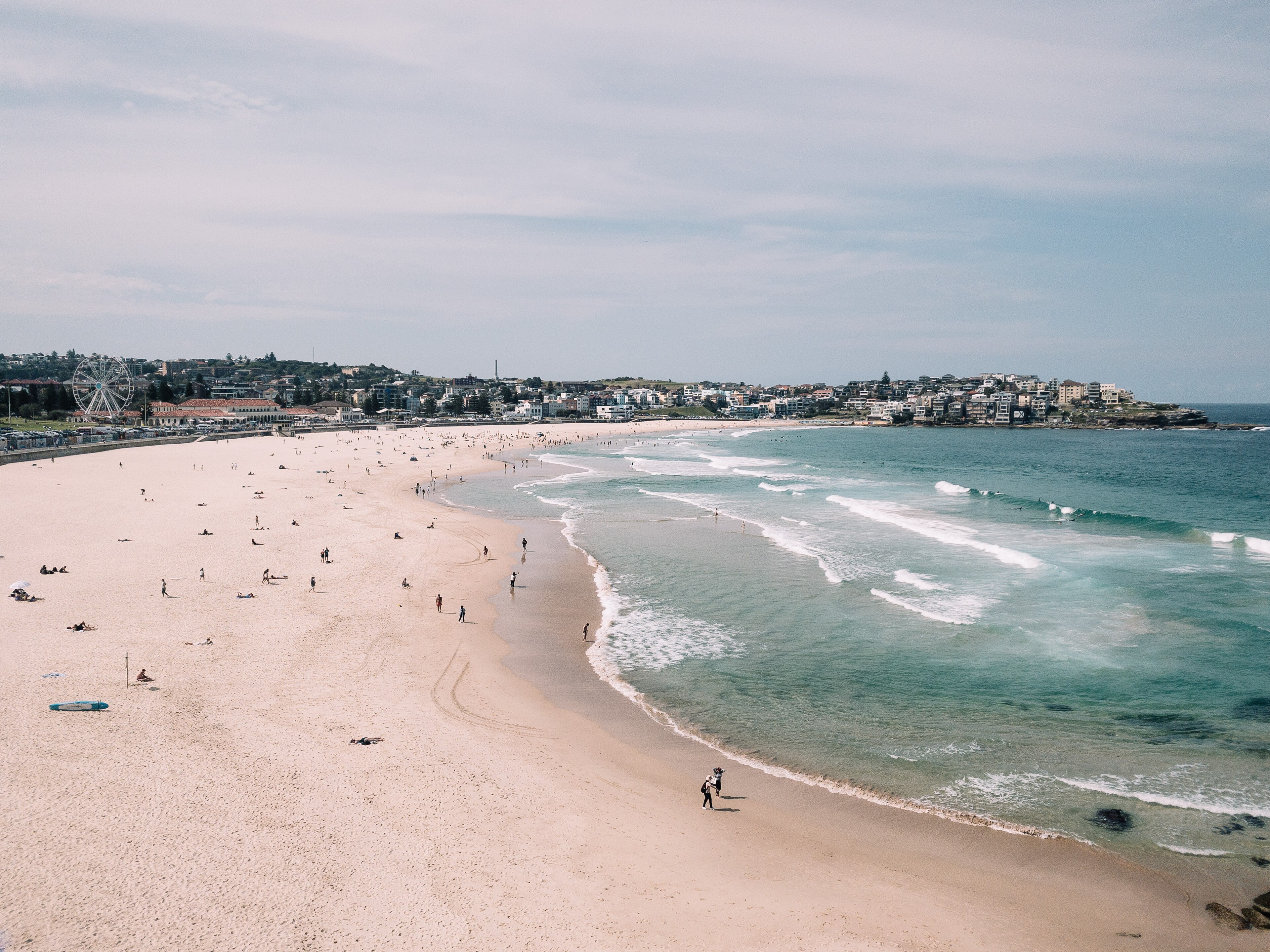
Bondi Beach at dawn — the full crescent · Maurizio Costantino · CC BY-SA 2.0
· Story
Bondi Beach is Australia's identity-image beach — a one-kilometer crescent of gold sand at Sydney's eastern edge where the city's apartment blocks end and the Pacific begins with almost no transition. This is where the Australian beach myth lives in its densest form: the lifesavers in their red-and-yellow caps, the Icebergs winter-swim club plunging into the ocean pool at the southern headland, the morning runners on the Bondi-to-Coogee coastal walk, and — overhead and underfoot — the cultural machinery that has made the word "Bondi" legible across the world.
The beach is short by Australian standards. Only a kilometer from headland to headland. But it is wide — up to 90 meters of sand at low tide — and it curves almost perfectly, which is what makes it photograph so well. Ben Buckler at the north, Mackenzie's Point at the south. Above each sits a suburb that operates as a social zone the way Copacabana's *postos* do in Rio. Which rock you walk toward, which end of the sand you settle on, tells a local exactly what kind of day you are planning to have.
Australia invented surf lifesaving — the organized, uniformed volunteer service that patrols beaches — at this beach in the first decade of the 20th century. The Bondi Surf Bathers' Life Saving Club, founded in 1906, is the oldest such club in the world. On the Sunday afternoon of 6 February 1938 — known ever since as Black Sunday — a series of rogue waves struck the crowded beach; three hundred people were rescued here in four hours and five drowned. Bondi Rescue, the Australian television program running since 2006 and syndicated into more than a hundred countries, has turned the lifeguards of this beach into global figures. The red-and-yellow flags, and the people in the caps between them, are the single most recognizable Australian image that is neither a kangaroo nor the Opera House.
Bondi is on Gadigal country, unceded land of the Eora nation. Aboriginal rock engravings — kangaroos, marine animals, a whale — still exist on the cliff top at North Bondi, unmarked and accessible. The sand below them has not been reclaimed; it has been here since the Last Glacial Maximum. The Gadigal people were fishing, diving, and carving this headland for at least 20,000 years before Captain Cook sailed past in 1770. Australia's Bondi is 240 years old. The place it sits on is significantly older.
· Surf Lifesaving
How one Sydney beach invented a global sport, a global uniform, and a global TV format
Australia invented surf lifesaving at Bondi in 1906. The red-and-yellow flags that now mark safe swimming on every English-speaking beach in the world — Cornwall to Cape Town to Kuta Beach — are an Australian export. The people who wear the caps at Bondi today are the lineal descendants of the volunteer watermen who trained on this sand a hundred and twenty years ago.
Before 1906 — why the sport had to be invented
Daylight swimming at Bondi was illegal until 1903. For most of the Victorian era, swimming in the ocean during daylight was prohibited in New South Wales on decency grounds; the ban was challenged publicly in 1902 by William Gocher, a newspaper editor who deliberately swam at Manly in midday and invited arrest. The law was amended in 1903 to permit daylight swimming if "neck-to-knee" costumes were worn. Within two years Bondi had become a mass-participation beach for the first time in its history.
It was also immediately a drowning beach. The Pacific surf at Bondi is genuine Pacific surf — rip currents, shorebreak, outside sets — and the 1903–1906 weekend crowds had no clue. Published drowning figures for the Sydney eastern beaches in those years are not precise but were understood by contemporary Sydney press as an urgent public- safety problem. Local watermen — surfers, spear-fishers, beach residents — organized informal voluntary patrols.
On 21 February 1906, a group of these watermen formalized themselves as the Bondi Surf Bathers' Life Saving Club. It is the oldest surf lifesaving club in the world. The Bronte and Manly clubs followed within the same year. The sport — the volunteer-patrol model, the uniform, the reel-and-line rescue apparatus, the national competition circuit — expanded out from Bondi through the Sydney eastern beaches to the Australian national scheme that is now run by Surf Life Saving Australia. Approximately 314 SLS clubs operate on the Australian coast today; Bondi's is number one in the register.
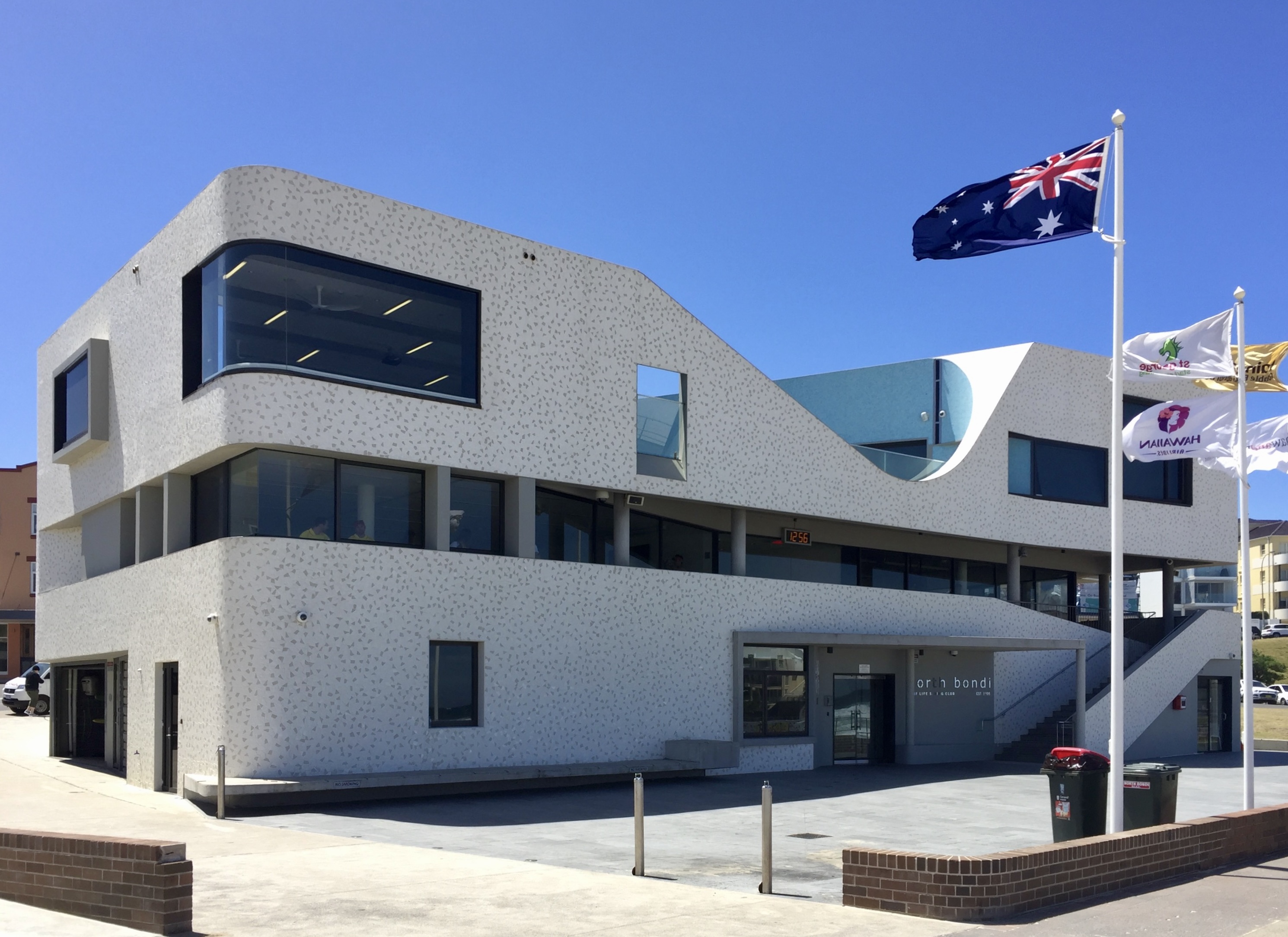
The Bondi Surf Bathers' Life Saving Club building — the 1936 Art Deco clubhouse at the northern end of the beach. The 1906 founding predates the building by thirty years; the club originally met in the Pavilion and in temporary shelters.· Kgbo
6 February 1938 — Black Sunday
The defining single day in Bondi's surf-lifesaving history. On the afternoon of Sunday 6 February 1938, with an estimated 35,000 people on the sand, a series of three unusually large waves struck the central beach within a short period. The first wave washed a sandbank out from under the waders standing on it. The subsequent waves drove the panicked crowd back, then sucked a section of the shorebreak out to sea on the return. An estimated 250–300 people were suddenly in the water at depths they could not manage.
What happened in the following four hours is the origin event of modern surf rescue. Every Bondi SBLSC lifesaver on the beach, plus members of the Bondi Surf Club, North Bondi, Bronte, Tamarama, and Waverley clubs who had been watching from the shore or had raced in from adjacent beaches — roughly 80 volunteer rescuers total — went in. They pulled people out on reels and lines, on rescue tubes, and under their own arms. The final rescued count was roughly 300 people. Five people drowned — all weak or non-swimmers who had been sucked too far out before the rescues could reach them.
The immediate consequence was that surf lifesaving had demonstrated, in a single afternoon and on a beach already identified with the sport, a rescue capability no other country could match. The global press coverage of Black Sunday made the Australian surf-lifesaving system a point of national pride and exported the red-and-yellow cap and the swim-between-the-flags rule to other English-speaking coastlines. A generation of subsequent beach-safety infrastructure — everywhere from Cornish Coastguard RNLI beach lifeguards to the English- speaking Caribbean — descends directly from what happened at Bondi that Sunday afternoon.
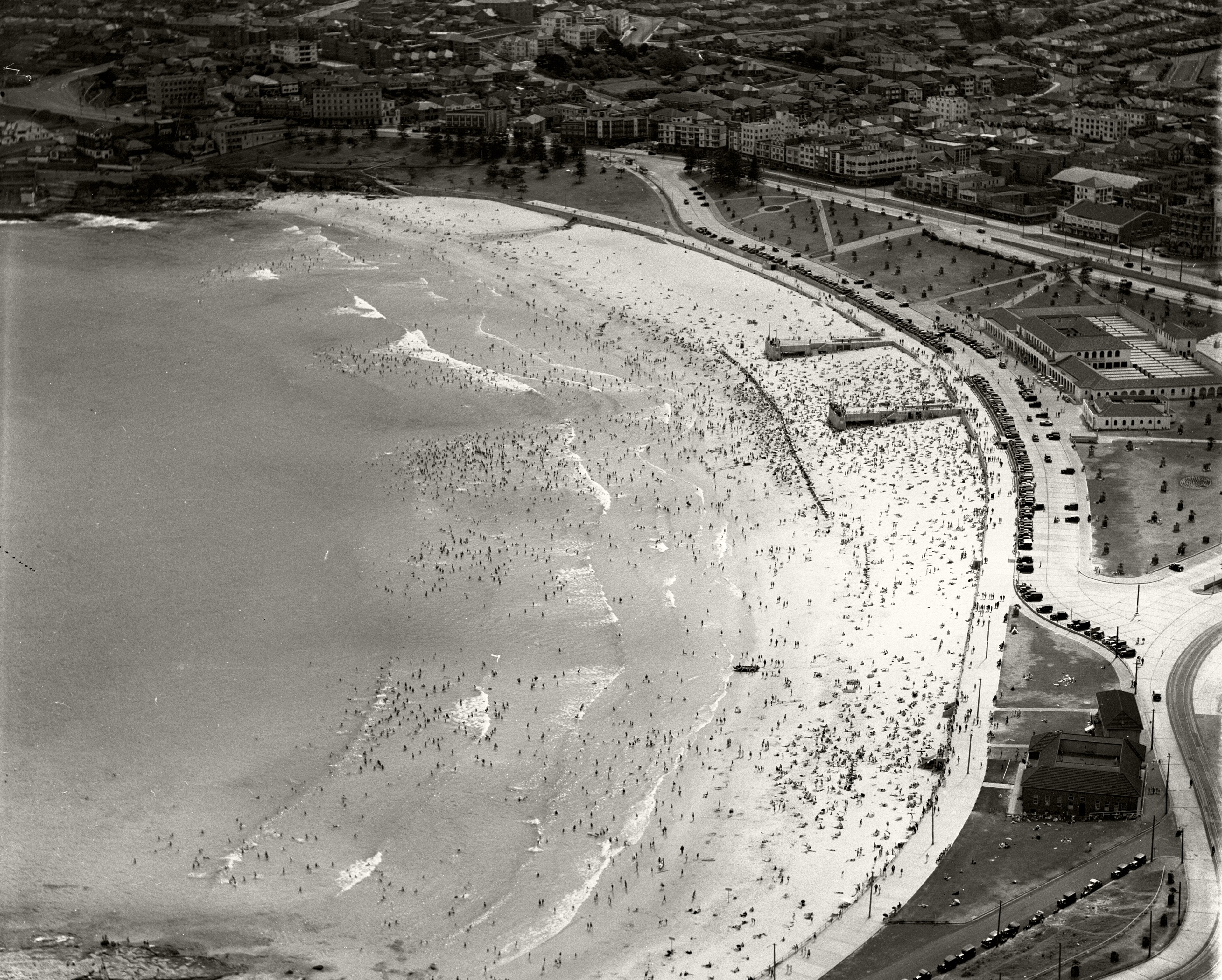
1937. Bondi in 1937, one year before Black Sunday. The Bondi Pavilion (1928) is visible center; the beach is at typical weekend-summer density. The volunteer surf lifesavers — in their red-and-yellow caps — had by this point been patrolling here every weekend for thirty-one years.· Royal Australian Historical Society
Modern operation — and Bondi Rescue
Bondi today is patrolled by two overlapping services. The volunteer surf lifesavers of the Bondi SBLSC (red-and-yellow caps, weekends October through April, unpaid) are the original 1906 institution. The professional lifeguards (blue caps, seven days a week year-round, paid employees of Waverley Council) were added in the 1990s as beach attendance grew beyond what a volunteer weekend patrol could safely cover. The two services work side by side; the lifeguards take point on weekday patrols, the volunteers dominate summer weekends and holiday periods.
The Bondi Rescue television program — made by Cordell Jigsaw Productions, airing since 2006 on Network Ten, syndicated into more than 100 countries — has turned the professional lifeguards into global figures. The show follows the lifeguard team through real rescues, medical emergencies, and the chronic comedy of managing a beach that receives up to 40,000 visitors on a peak summer day. Across its run it has documented approximately 4,500 rescues per year at Bondi — a number that predates the TV era and has remained broadly stable for decades. The show is a TV format that some critics have found exploitative of people's worst moments; it is also, internally, the best-documented public record of what lifeguarding at a major urban beach actually involves.
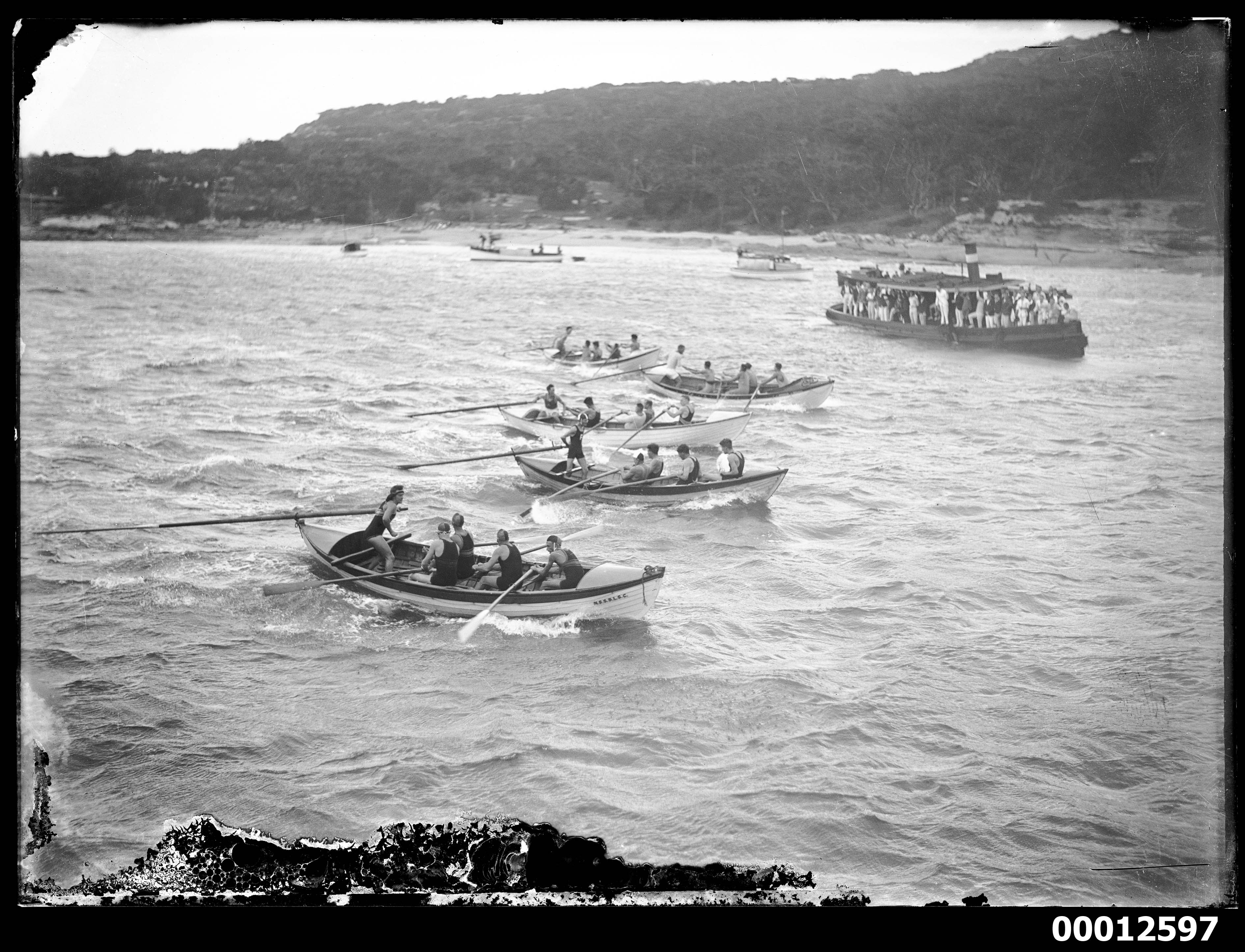
Surf boat racing — an SLS competition discipline still contested at Bondi and around Australian beaches. The teak-hulled boats, the beach-start sprint into the surf, the return through shore break, are a direct inheritance from the rescue-boat practice the 1906 clubs used.· Australian National Maritime Museum
· Gadigal Country
What was here for sixty-five thousand years before this beach was a beach
Bondi is unceded Gadigal land. Aboriginal rock engravings still sit on the North Bondi clifftop — kangaroos, marine animals, a whale — accessible, unmarked, older than any European memory of this coast. The beach is two hundred and forty years old as a European place. What it sits on is significantly older.
Sixty-five thousand years
Aboriginal and Torres Strait Islander peoples have lived in what is now Australia for at least 65,000 years, possibly longer. The Gadigal (or Cadigal) people of the coastal strip between Bondi and what is now Sydney Harbour were one clan of the wider Eora Nation — a coastal grouping of related clans whose territory covered roughly the stretch of coast from Botany Bay north to Pittwater. The word Bondi itself is an anglicization of an Eora word — probably boondi, meaning either "water breaking over rocks" or "a place where a flight of nullas (throwing sticks) took place," depending on the elder you ask. Both readings are attested in 19th-century records.
1788 and what followed
British colonization began in January 1788 with the arrival of the First Fleet at Sydney Cove — seven kilometers west of this beach. The consequences for the Eora were catastrophic on a timeframe that has no parallel in most colonization histories. Within two years, smallpox had killed roughly half of the Eora population. Within five, the remaining Gadigal had been largely displaced from the harbour lands by settler occupation. The specific brutality of Australian colonization — the 1788–1920s Frontier Wars, the Stolen Generations of government child removal (1910s–1970s), and the legal fiction of terra nullius ("empty land") that denied Aboriginal sovereignty until the 1992 Mabo High Court decision — is documented in AIATSIS (the Australian Institute of Aboriginal and Torres Strait Islander Studies) and the National Museum of Australia.
There was never a treaty. Australia is one of the only Commonwealth countries never to have concluded one with its Indigenous peoples. The 2017 Uluru Statement from the Heart — a consensus document produced by a First Nations Constitutional Convention — requested three reforms: a constitutionally- recognized Voice (advisory body) to Parliament, a treaty- making Makarrata process, and a truth-telling commission. The October 2023 referendum on the Voice specifically failed 60-40 against. The legal and political conversation about Indigenous sovereignty, land rights, and reconciliation is unfinished and ongoing.
What's here now
At Bondi specifically, Aboriginal presence did not disappear and is not invisible if you know what you are looking at. The rock engravings at the Ben Buckler clifftop are the most direct physical testimony — a half-dozen carved figures on a weathered sandstone platform, reached by a short walk north from the North Bondi SLSC, unsignposted because Waverley Council chose after community consultation to keep them so. The Bondi Rescue production team has Gadigal cultural consultants on retainer. Waverley Council formally acknowledged Bondi as Gadigal country in official proceedings in 2016; the acknowledgment is read before every Council meeting. The annual Yabun Festival on Gadigal land in central Sydney every January 26 (Invasion Day / Australia Day — the date itself is contested) is the largest ongoing public Aboriginal cultural event in the country.
· The Three Ends
North, Central, South — each a different Bondi
One kilometer of sand, three named stretches, three different demographic and behavioral codes that every Sydney local reads at a glance.
Central Bondi on a summer weekend. The red-and-yellow flags mark the lifeguarded swimming zone; the attendance can reach 40,000+ on the peak days of January.· VirtualWolf
NORTH
North Bondi
The family/local end. Calmer water, North Bondi Surf Club, the rock pool at Ben Buckler, the golf course on the headland above. The Aboriginal rock engravings are a short walk up from here. Quieter than the south end at all times of year.
Best for
Families with kids, the rock pool, walking to the engravings, the Sunday morning coffee scene at Porch and Parlour
Local note
The rock engravings are unmarked; look for them near the golf course tee.
CENTRAL
Central Bondi / The Flags
Where the lifeguards put up the red-and-yellow flags. The safest swimming. Most of Bondi Rescue is filmed here. The tower is Tower 1. Always the most crowded stretch.
Best for
First-time swimmers, the TV-show reference, the peak-hour experience
Local note
Swim between the flags — it's not a suggestion.
SOUTH
South Bondi / Icebergs end
The surfer end. Waves break bigger here off the southern headland. Icebergs pool is directly above. Parking is easier; the steps up to the Bondi-to-Bronte coastal walk start here.
Best for
Surfing, ocean pool, starting the coastal walk, sunset drinks at Icebergs Bistro
· A Day Here
Dawn runners to the Pavilion at night — hour by hour in January
Bondi early morning — the beach at roughly 6 a.m. before the summer crowds arrive. The Bondi-to-Bronte coastal path is busier at this hour than a non-local visitor expects.· Maurizio Costantino
Dawn
Before six a.m., the Bondi-to-Bronte path is busier than it looks in the photographs. Runners in high-vis, stroller pushers who started too early, retirees walking the clifftop to Mackenzie's Point and back. Down on the sand, the ocean-pool swimmers at Bondi Icebergs have already done their 400 meters in cold water. Surfers pull on wetsuits in the South End parking lot. Sulphur-crested cockatoos scream from the Norfolk pines. The lifeguards do not yet have the red-and-yellow flags up; the sand is still officially unpatrolled. Nobody is drunk. It is one of the quietest moments Australia offers anywhere.
Midday
Between 11 a.m. and 3 p.m. from November through February, Bondi carries every Australian-beach cliché at full volume and does so earnestly. The lifeguards have been up for four hours; they've already pulled two swimmers from rips. Red-and-yellow flags mark the patrolled area, maybe 150 meters of water between the tents. Kids run in sets of nine and ten from the changing rooms. The summer line at Speedos at the corner of Ramsgate and Campbell is forty people deep. The smell is sunscreen, salt, charcoal barbecues from the headland picnic tables, and — specifically, unmistakably — the hot concrete of the promenade. Three helicopters pass overhead in an hour.
Golden
From 5 p.m. the light on the Pavilion's pale stucco turns the color of honey. Surfers paddle out at the south end for the evening session. The Icebergs pool glows turquoise against the black rock and the sunset. Icecreams at Gelato Messina across Campbell Parade. The kite flyers at the North Bondi end. And the promenade walkers — the thousand or two people who descend to walk the Bondi-to-Bronte path just before dusk. Every Saturday night in summer, there is at least one wedding photography session at Icebergs. Always.
Night
By 9 p.m. the sand has emptied. The Pavilion is lit. The bars of Campbell Parade — Rashays, The Bucket List, North Bondi RSL — are loud. Late-night joggers loop the clifftop by headlamp. The Bondi Beach Public School's courts get used as a skating rink by the teenagers the council hasn't quite managed to displace. On a moonless night you can sometimes see the Milky Way over the ocean from the Pavilion steps; light pollution from the city pushes it offshore, but not by much. The ocean does not get truly dark here. There is always a container ship somewhere on the horizon.
· Icebergs and the Coastal Walk
The southern-end infrastructure that makes Bondi Bondi
Two institutions bracket the southern end of the beach: the Icebergs Club winter-swim ritual, founded 1929 and operating every Sunday of every winter since; and the Bondi-to-Coogee coastal walk, six kilometers of clifftop path that has been Sydney's most-used outdoor leisure infrastructure since it was formally connected in the 1990s.
The Icebergs — since 1929
In 1929 a group of Bondi lifesavers decided they needed a way to keep their winter fitness up through the Australian off-season (May–September). They formed the Bondi Icebergs Winter Swimming Club and made a vow: a member must swim in the open-air sea pool at the southern end of the beach three out of every four Sundays, between May and September, for five consecutive years. If you miss one too many, you're out. The club has been running this structure continuously since 1929.
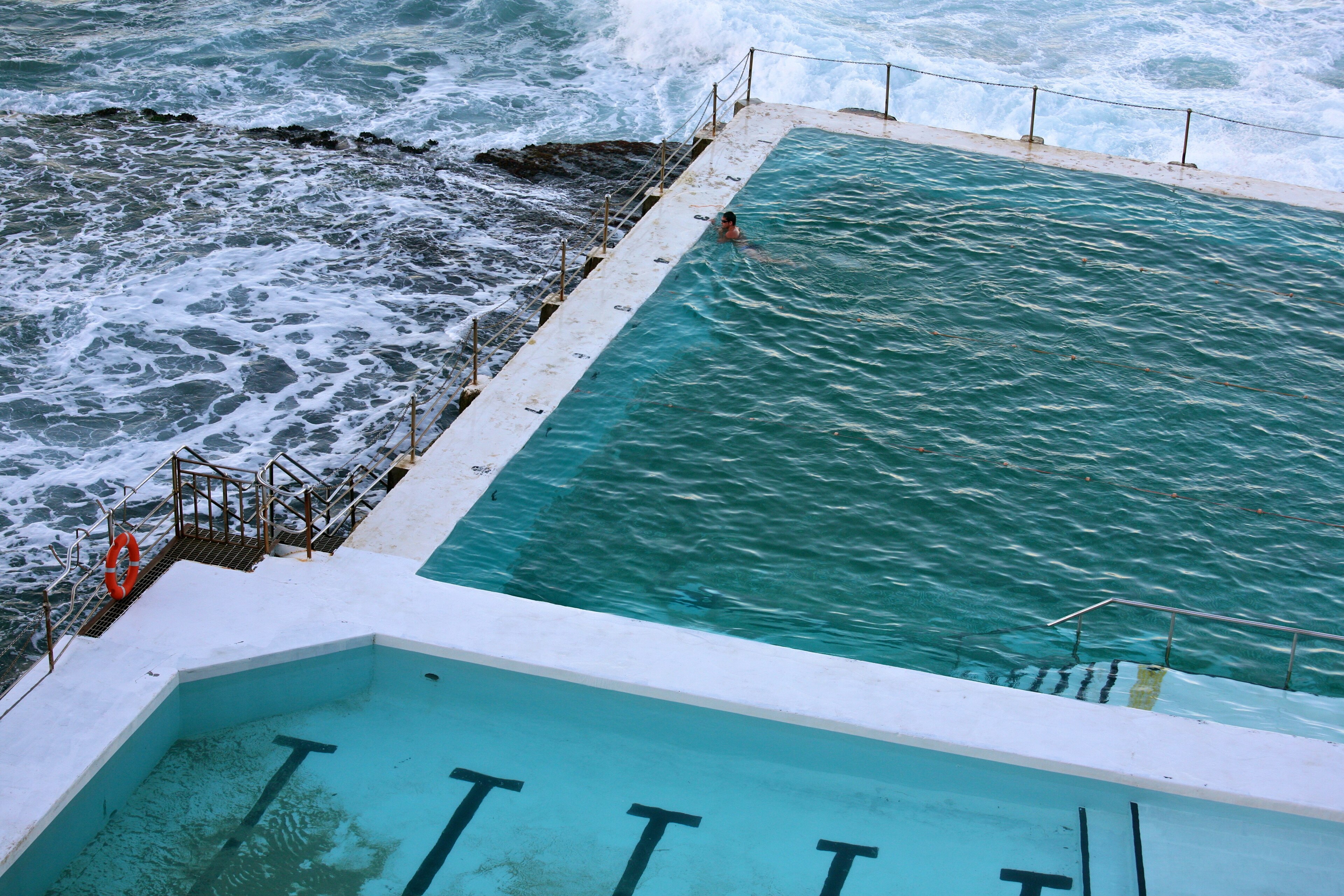
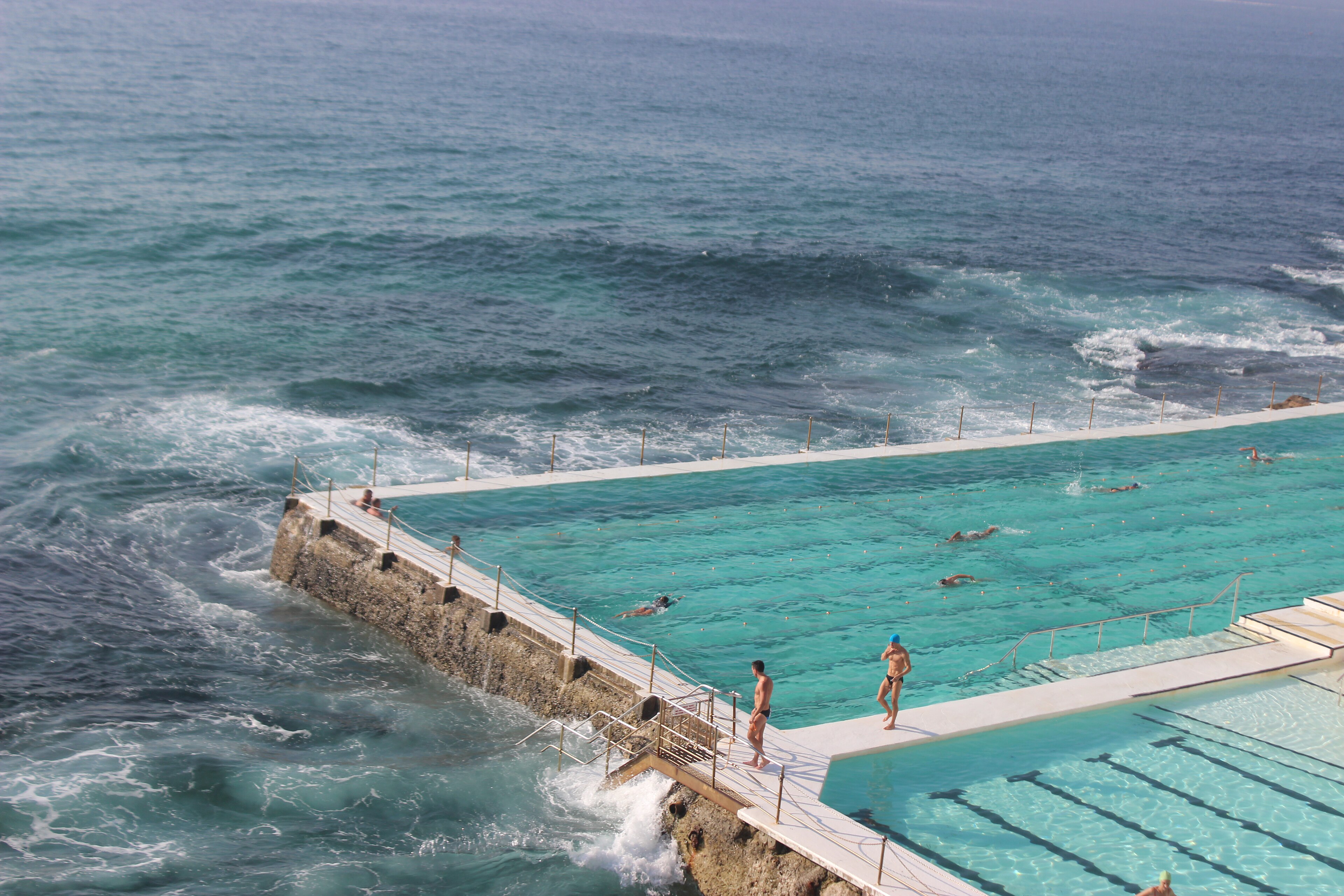
The Icebergs pool itself — a concrete rock pool built into the southern headland below the club's 1920s clubhouse, filled by Pacific swell washing over its seaward wall — is the beach's most-photographed single object. Turquoise against the black basalt, open-air, flooded daily by the incoming tide, it is publicly accessible for a modest admission fee outside club hours. Swimming laps in it while a winter swell crashes over the outer wall and sprays you is one of the genuinely unusual Australian-beach experiences.
The Icebergs pool — concrete saltwater rock pool on the southern headland, flooded by every incoming tide. Publicly swimmable (modest admission) outside dedicated Icebergs Club hours.· Alex Proimos
The Icebergs Club and restaurant
The Icebergs Dining Room — the Italian restaurant that sits above the pool with floor-to-ceiling glass looking straight down into it and out to the ocean — is one of Sydney's half-dozen architecturally canonical restaurants. Opened in its current form 2002 after a substantial clubhouse renovation, run by chef Monty Koludrovic and group Maurice Terzini. The Italian menu is serious (antipasti, hand-made pasta, whole grilled fish from the market). Bookings open 30 days ahead and go fast. It is the closest thing Sydney has to a restaurant with a view of an ocean pool that was built by the lifesavers who invented the sport your evening is built around.
The Icebergs Dining Room at golden hour — the floor-to-ceiling glass looks directly down into the pool and out past it to the Pacific. Opened in its current form in 2002; the building has been on the site since the 1920s clubhouse era.· Prajwal433
The Bondi-to-Coogee coastal walk
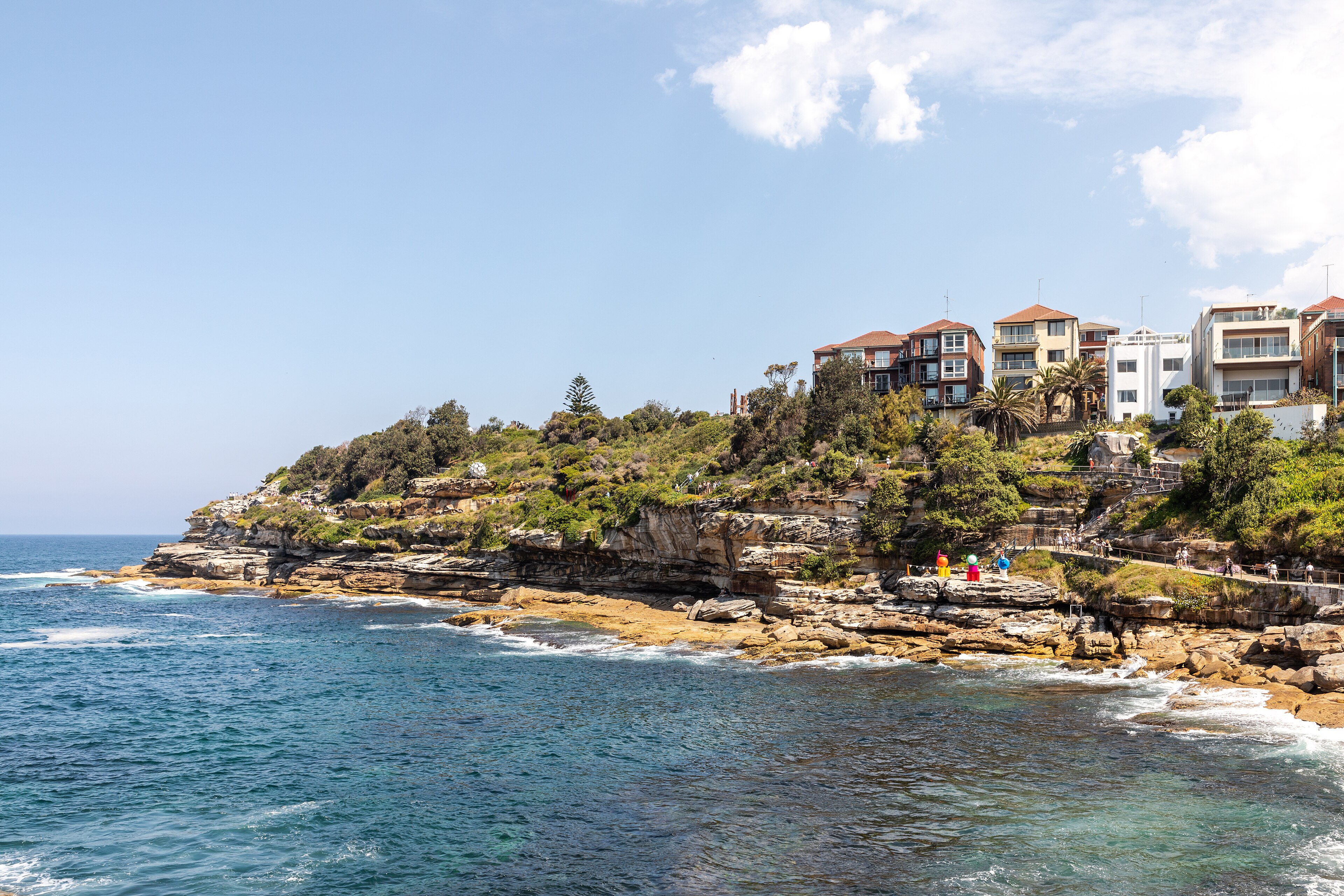
The clifftop path from Bondi's south end — starting at the Icebergs Club — runs six kilometers south through Tamarama, Bronte, Clovelly, Gordons Bay, and ends at Coogee. It is one of the great short urban coastal walks in the world: rocky headlands, a half-dozen smaller beaches most visitors never see, a couple of genuine cliff dives, and — through the southern sections — views back north toward the distant Bondi crescent. Allow two to three hours at walking pace, plus time for a swim or two. A single bus route (the 400) runs the return from Coogee.
The Bondi-to-Coogee coastal walk — 6 km of clifftop path through Tamarama, Bronte, and Clovelly. Sydney's most-used urban coastal walking infrastructure.· Dietmar Rabich
Sculpture by the Sea — every October
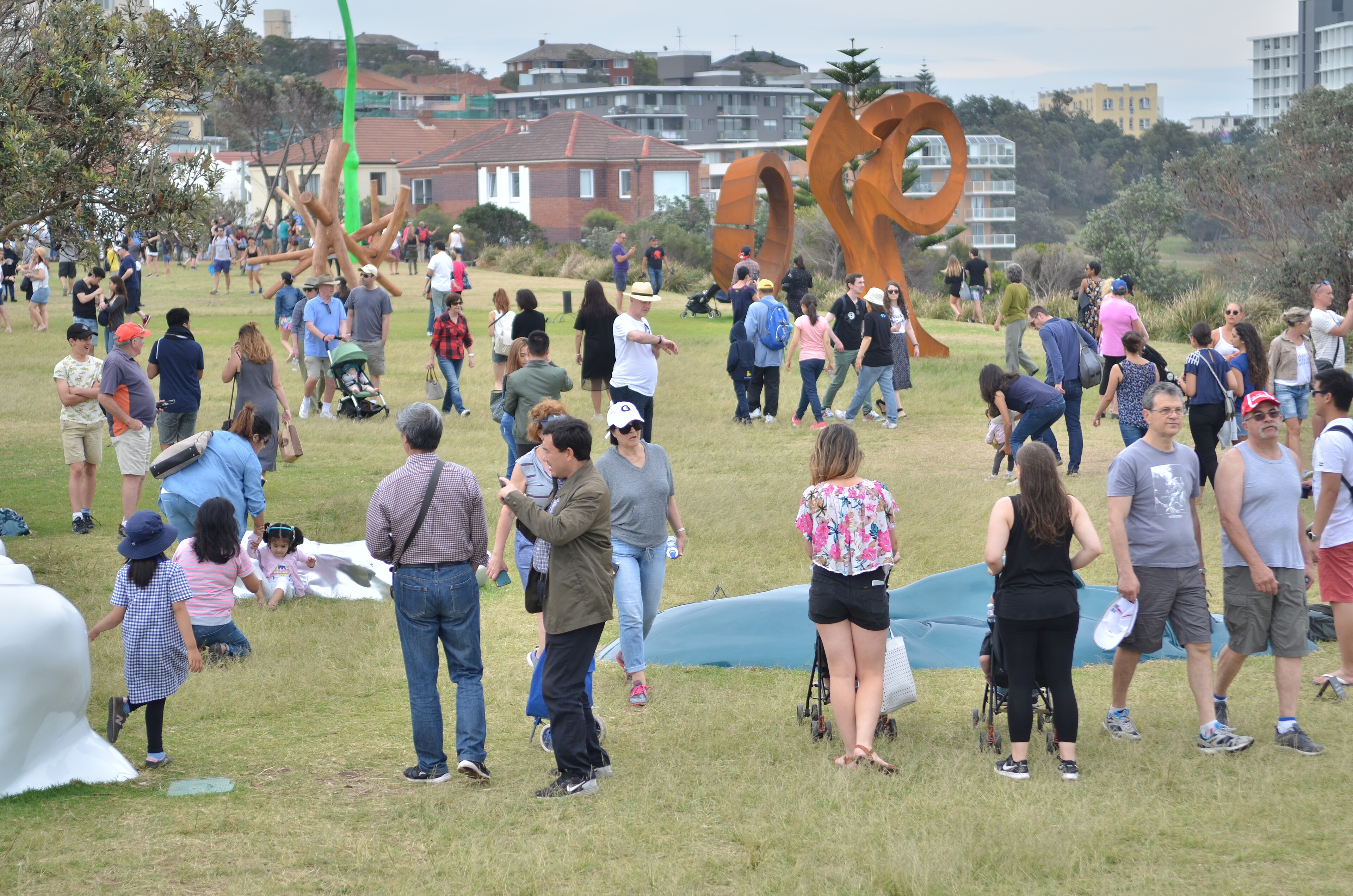
Since 1997, the first three weeks of October convert the coastal walk between Bondi and Tamarama into the Sculpture by the Sea open-air exhibition — around a hundred sculptures installed along the clifftop by Australian and international artists, free to the public, 500,000+ visitors across its three-week run. It is one of the world's largest outdoor sculpture exhibitions by attendance. The works are commissioned, site-specific, and rotate yearly; some stay on permanent loan. If you are in Sydney in October, this is the genuine reason to come to Bondi that week.
Sculpture by the Sea — the annual October exhibition running since 1997 along the Bondi-to-Tamarama coastal walk. Free, outdoor, ~100 works per year, ~500,000 visitors.· Ashishlohorung
· History
From 20,000 BCE to the 2023 referendum
The seven dates that made Bondi Bondi, in order. Each is a subdivision, variation, or turning point on the beach the others produced.
20000 BCE · cultural
Gadigal presence begins
The Gadigal people of the Eora Nation have lived on the Sydney coastal strip, including what is now Bondi, for at least 20,000 years (conservative estimate; the broader Aboriginal presence on the continent is dated to 65,000+ years). Rock engravings at North Bondi remain as physical evidence.
The First Fleet arrives at Sydney Cove, 7 km west of Bondi. Within two years, smallpox reduces the Eora population by roughly half. British possession of the continent is asserted under the legal fiction of *terra nullius* — 'empty land' — overturned only in 1992 by the Mabo decision.
After growing public protest against O'Brien's admission fees, the New South Wales government formally declares Bondi Beach a public place. Access becomes free and Bondi begins its transformation from pastoral edge to metropolitan playground.
The world's first surf lifesaving club is founded at Bondi on 21 February 1907 (per official records) or late 1906 (per some accounts). The red-and-yellow-quartered cap becomes the Australian surf-lifesaving uniform.
On 6 February 1938, three freak waves hit Bondi and sweep 200+ bathers off the sandbar. Lifesavers rescue approximately 250; five drown. The day becomes the founding trauma of Australian surf lifesaving and a reference point in every lifeguard's training since.
A series of fatal shark attacks along Sydney's eastern beaches creates a public panic. The Bondi Council convenes a committee that will ultimately recommend the installation of meshing nets off the coast.
1929 · Jan · sport
Bondi Icebergs Winter Swimming Club
Founded at the southern headland by a group of men who wanted year-round ocean swimming. Initiation required swimming every Sunday of the winter; ice was added to the ocean pool. The club is still active; the building was rebuilt in 2002 and is an internationally photographed icon.
Bondi Rescue (2006–present) — the surf-lifeguard reality format
Since 2006 the television program Bondi Rescue has followed the Waverley Council professional lifeguards through their days at the beach — real rescues, real medical emergencies, the chronic comedy of managing an urban beach that receives up to 40,000 visitors on the peak Saturdays of January. The show is a straightforward documentary-style production — no contrived setups, no manufactured rivalries — and it has been syndicated into more than 100 countries. The run is approaching two decades without a drop in viewership. The show's durability has become a study-object in itself: a straightforwardly useful public-information program (demonstrating beach-safety principles) that happens to function also as engaging television. The Bondi lifeguards who have been on the show since its first season — Bruce "Hoppo" Hopkins, Kerrbox, Maxi, Whippet, Hutchy — are recognizable figures across Australia and in English- speaking countries that pick up the syndication.
The Bondi Pavilion — opened 1928, refurbished 2022. The Beaux-Arts beachfront building that carried the community-hall, changing-room, and public-entertainment functions for a century and that still does, post-restoration.· Sardaka
Puberty Blues (1981) — the Australian beach novel
Kathy Lette and Gabrielle Carey's 1979 novel Puberty Blues — filmed by Bruce Beresford in 1981, remade as a Network Ten television series in 2012–2014 — is the defining Australian beach-culture literary text. Set at the Sydney eastern beaches (Cronulla in the original novel, spread across the inventory including Bondi in the film and series), it follows two teenage girls negotiating the violently gendered Australian surf subculture of the 1970s. The book's clear-eyed cruelty about what Australian beach masculinity asks of women was unusual at publication and is still considered the beginning of a certain kind of honest Australian- adolescent writing. Tim Winton's own beach novels, Helen Garner's Sydney-based fiction, every Tim Rogers lyric descending from this tradition — all of it owes something to the Lette-Carey model.
The Pavilion, Sculpture by the Sea, and the Bondi 2000
The beach's third cultural layer is visual-arts infrastructure. The Bondi Pavilion (1928) has been a municipal community-hall-and-public- baths building for almost a century; after a 2022 restoration it is the local exhibition and performance venue and hosts the Bondi Short Film Festival annually. Sculpture by the Sea (since 1997) occupies the Bondi-to-Tamarama coastal walk each October. The 2000 Sydney Olympic beach volleyball tournament was held at Bondi in a specially- constructed 10,000-seat stadium on the sand — an Olympic event in a city-park-beach, a combination no Games had staged before and few have since. The Games left Bondi briefly and vividly as a global venue; what remained afterwards was the memory of the beach at full capacity for the first time, and a generation of Sydney locals with a specific Olympics-era relationship to this specific sand.
· What the Postcard Doesn't Show
Unceded land, a failed referendum, and what comes next
Australia's identity-image beach is on land taken from the Gadigal people of the Eora Nation. The legal, political, and moral work of that sentence is not finished. What follows are the specifics.
Bondi is on Gadigal country — unceded land of the Eora nation, one of the several hundred Aboriginal nations whose territories collectively cover the Australian continent.
Aboriginal and Torres Strait Islander peoples have lived in what is now Australia for at least 65,000 years — possibly longer. The Gadigal (or Cadigal) people of the coastal strip between what is now Bondi and Sydney Harbour were one of several clans of the Eora Nation. The word Bondi itself is an anglicization of an Eora word — probably *boondi*, meaning either "water breaking over rocks" or "a place where a flight of nullas (throwing sticks) took place," depending on the elder you ask. Both meanings are attested in 19th-century records.
British colonization began in January 1788 with the arrival of the First Fleet at Sydney Cove — 7 kilometers west of here. Within two years, smallpox had killed roughly half of the Eora population. Within five years, the remaining Gadigal had been largely displaced from the harbour lands by settler occupation. The specific brutality of Australian colonization — the 1788–1920s Frontier Wars, the Stolen Generations (government removal of Aboriginal children from their families, 1910s–1970s), and the legal fiction of *terra nullius* ("empty land") that denied Aboriginal sovereignty until the 1992 Mabo decision — is documented in the Australian Institute of Aboriginal and Torres Strait Islander Studies (AIATSIS) and the National Museum of Australia.
There was never a treaty. Australia is one of the only Commonwealth countries to have never concluded a treaty with its Indigenous peoples. The 2023 national referendum on an Aboriginal and Torres Strait Islander Voice to Parliament — a constitutionally-recognized advisory body — failed 60-40 against. The legal and political conversation about Indigenous sovereignty, land rights, and reconciliation is ongoing.
At Bondi specifically, Aboriginal presence did not disappear. The Bondi Aboriginal Rock Engravings — carvings of kangaroos, fish, a large whale, a male figure, and marine shapes — sit on the sandstone cliff top at North Bondi, near the golf course. They are at least several hundred years old (possibly much older), unfenced, and easily visited on foot from the beach. They are not signposted in the way a Euro-American historical marker would be. This is deliberate: Aboriginal cultural heritage sites are often kept under-marked to prevent vandalism and to let people who know where to look see them, and people who don't, not.
Waverley Council (the local government for Bondi) has since 2000 formally acknowledged Gadigal country in its public statements. Welcome to Country ceremonies — performed by a Gadigal elder at the start of formal events — are standard at municipal functions. The Aboriginal flag flies alongside the Australian flag at Bondi Pavilion. None of this is reparative; all of it is necessary.
You can walk the coastal path, swim in the pools, ride the waves, and never encounter any of this. The council does not force you to. But the engravings are there. The name is there. The country is there. Knowing it is the difference between visiting Bondi and being present at it.
· On Sydney's Eastern Edge
Four places within an hour
8 km west
Sydney CBD
The 333 bus from Bondi Junction takes 25 minutes to the city centre. The Opera House and the Harbour Bridge are 10 minutes apart on foot from Circular Quay. Half a day to do both properly. A full CBD day adds the Art Gallery of NSW (free admission), the Royal Botanic Garden, and — genuinely worth it — the Museum of Contemporary Art at The Rocks.
6 km south (end of the coastal walk)
Coogee
The other end of the Bondi-to-Coogee coastal walk. Smaller, quieter, more residential. The McIver's Ladies' Baths at the southern end of Coogee beach is a women-and-children-only ocean pool dating to 1876 — one of the last of its kind. A more relaxed afternoon than Bondi Central.
Ferry from Circular Quay
Taronga Zoo
Australia's best-sited zoo — across the harbour from the CBD, reached by ferry, with views back across the water to the Opera House and Bridge. Strong native-animal collections (koala, kangaroo, Tasmanian devil). Half-day visit; the ferry component is the best part.
30 min ferry from Circular Quay
Manly
The other Sydney beach-on-a-headland. Manly was where William Gocher's 1902 daylight-swimming protest happened — the legal precursor to Bondi's surf-lifesaving era. Now: a more resort-like beach than Bondi, with a longer boardwalk and a shorter drive from the ferry terminal. Worth a day if you have time for a second Sydney beach.
Written by Erin Rose. Surf-lifesaving historical material follows Surf Life Saving Australia's published centenary documentation and the Bondi SBLSC archive. Black Sunday 1938 detail from contemporary press accounts reproduced in the SLSA archive and from Tony Saunders's Black Sunday (Mitchell Beazley, 1988). Gadigal and Eora material follows AIATSIS published scholarship, the Yarra / Eora map of Aboriginal Australia, and the Uluru Statement from the Heart (2017). Version v0.9. Corrections particularly welcome on Gadigal-specific framing, on the exact attribution of Bondi's rock engravings, and on current-decade Waverley Council acknowledgments.