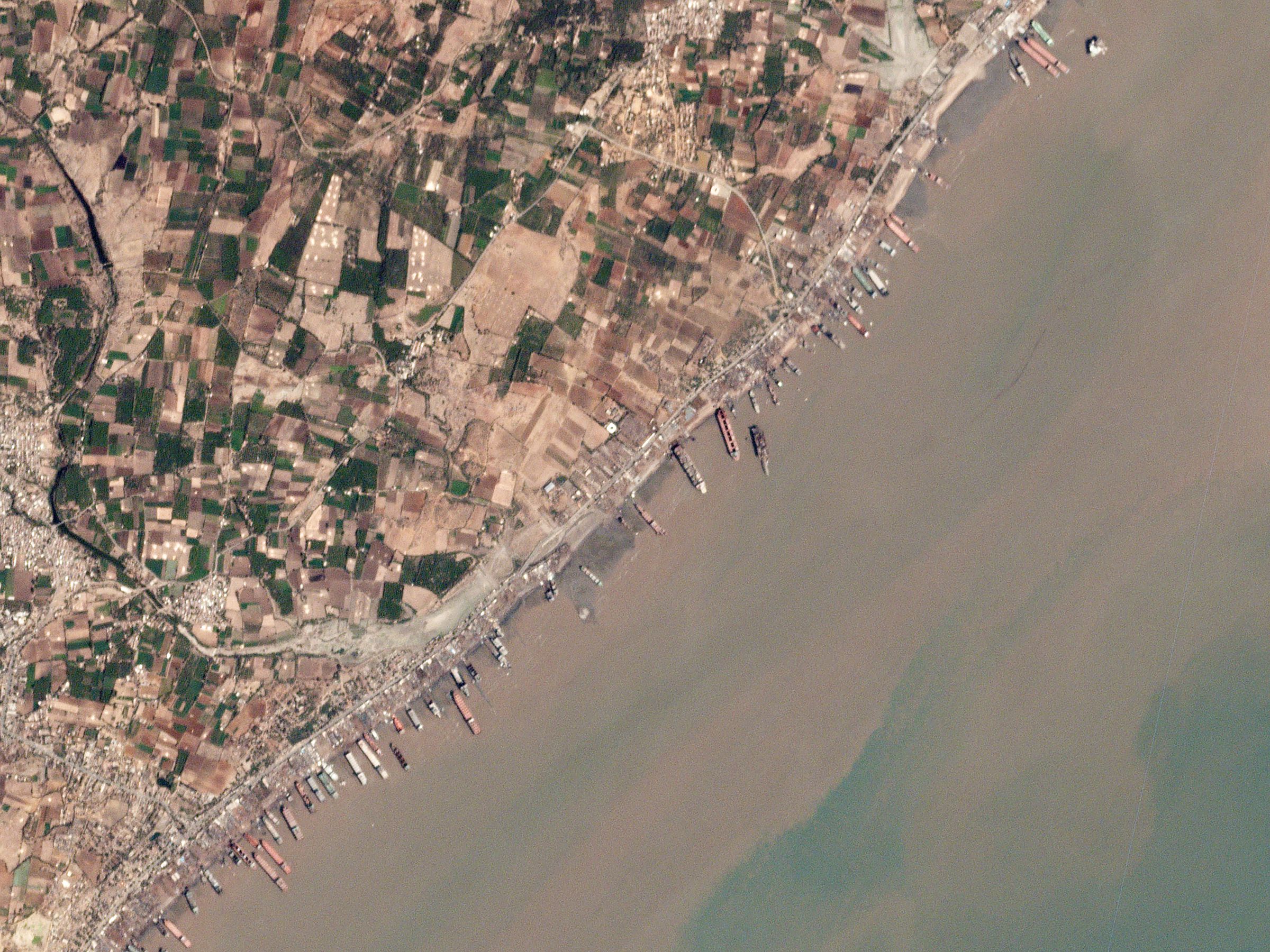
Alang is not a beach anyone swims at. It is a 14-kilometer stretch of tidal mudflat on the Gulf of Khambhat, in Bhavnagar district, Gujarat, and it is the largest ship-breaking yard on Earth. More than a third of the world's retired cargo ships, tankers, and bulk carriers end their lives here, driven onto the mud and taken apart. The yard opened in 1983, when the MV Kota Tenjong was beached on 13 February, and it grew into a 14-kilometer line of some 183 cutting plots that scrap millions of tonnes of steel a year.
What makes Alang work is the tide. The Gulf of Khambhat funnels one of the highest tidal ranges in the world, around 13 meters, up its narrowing throat. At high tide a condemned ship is run aground at full speed, bow-first, as far up the mud as its momentum will carry it. As the tide falls, the ship is left high and dry, and the work begins: crews of laborers swarm the hull with cutting torches and cranes, stripping it from the top down, salvaging everything and reducing the rest to scrap that feeds India's steel mills.
The work is done by hand and it is dangerous. Alang employs on the order of 20,000 workers, most of them migrants from poorer states, Uttar Pradesh, Bihar, and Odisha, who live in shanties near the yards and return to their villages to farm during the monsoon. Between January 2009 and October 2012, local union figures recorded at least 54 workers killed in accidents. The hazards are falling steel, explosions in fuel tanks, and asbestos and heavy metals; the recycling pollutes the mud and water with heavy metals, and until Alang Hospital opened in March 2019 the nearest full-service hospital was 50 kilometers away in Bhavnagar.
This is where the most storied ships in the world come to die. The Seawise Giant, the longest ship ever built, was broken up here in December 2009. The Exxon Valdez, renamed Oriental Nicety, was scrapped at Alang in August 2012, twenty-three years after the Prince William Sound oil spill. And in 2006 the decommissioned French aircraft carrier Clemenceau, laden with asbestos, was turned back by India's Supreme Court before it could reach the yard, a case that put Alang at the center of a global argument about who is allowed to dump a toxic ship on whose coast.
That argument is slowly reshaping the place. After years of pressure under the Basel Convention, the Hong Kong International Convention for the Safe and Environmentally Sound Recycling of Ships entered into force on 26 June 2025, and 115 of Alang's 128 active plots now hold compliance certification, backed by Japanese-funded upgrades begun in 2017. And yet, by late 2025, Alang faced a deepening downturn, fewer ships, idle plots, a yard that observers began calling a dying industry. Alang is the recycling end of global shipping, kept cheap for forty years by a tide and by the men who work the mud, now being formalized and undercut at the same time.