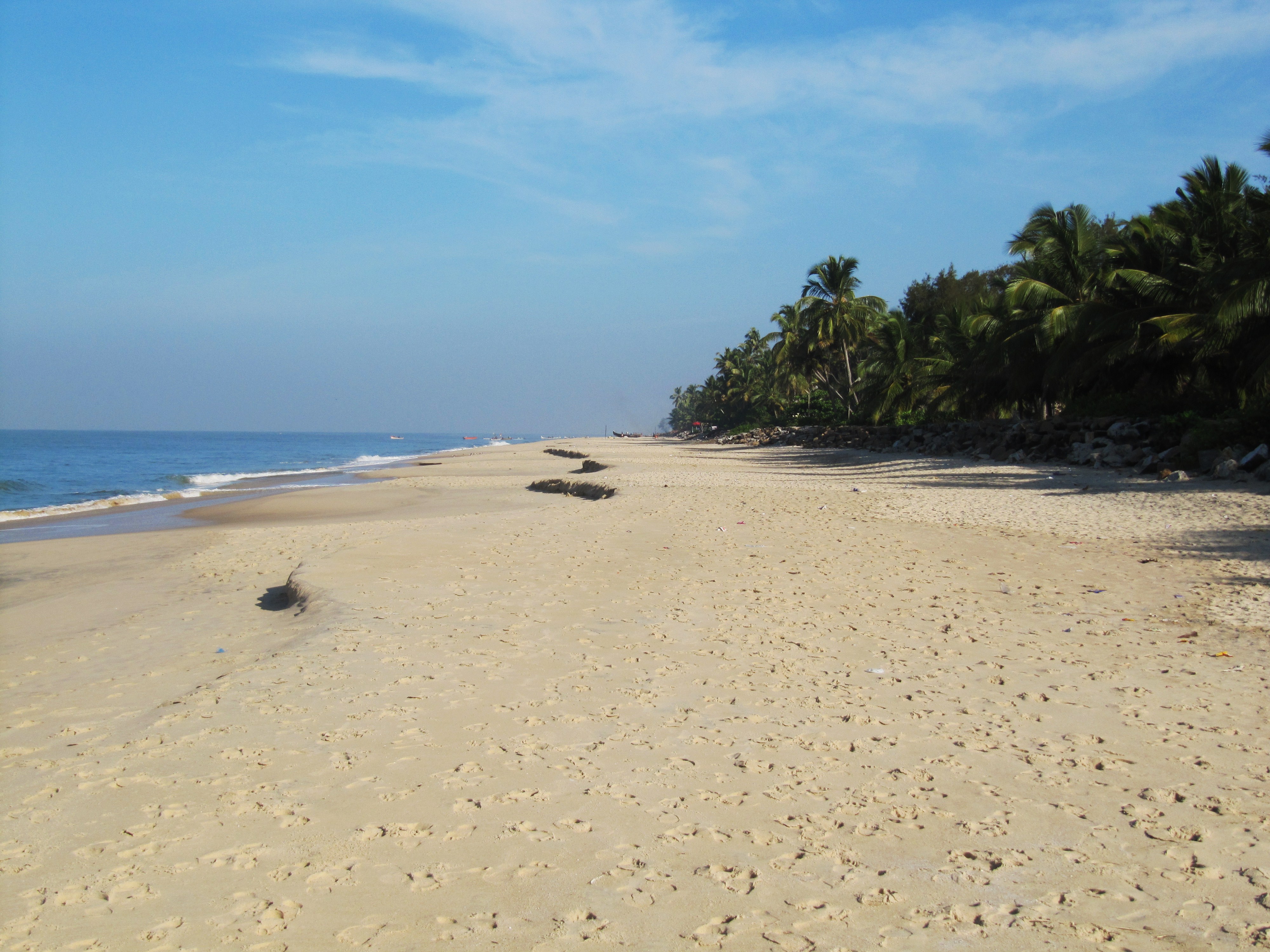
Alappuzha Beach's central fact is administrative, not scenic. The Kerala Maritime Board's own listing for Alappuzha Port describes a "387m long Sea pier constructed over cast-iron pillar foundation in a dilapidated condition" and states plainly that "there is no port operations since 1989." A government agency, on its own website, calls its own infrastructure derelict. That sentence is more honest than most tourism copy about this beach, and it is the place to start.
Why a pier existed here at all. Alappuzha's stretch of the Kerala coast has no natural harbor deep enough for cargo ships to dock. The port opened in 1762 for the coir trade; Dewan Raja Kesavadas, Diwan of Travancore from 1789 to 1798 and remembered as the "Maker of modern Alleppey," later built it into a planned port town, cutting parallel canals and commissioning three trading ships for Calcutta and Bombay — cargo still had to cross open water to reach ships anchored offshore. The fix, built out in 1862, was a pier: 387 meters of cast-iron pillars driven into the Arabian Sea, eventually fitted with three rail lines so goods could run straight from warehouse to ship without another handling step, according to Wikivoyage. The same year, 1862, Alappuzha's lighthouse was commissioned down the coast, a 28-meter tower marking the port for ships approaching after dark.
What moved across that pier. Coir — the fiber stripped from coconut husk, spun into rope, mats, and matting — was Alappuzha's export. The town's first mechanized coir factory opened in 1859, three years before the pier, under a manufacturer recorded in Wikipedia as James Durragh. By the 20th century Kerala's coir industry, centered on Alappuzha, employed hundreds of thousands of people; published estimates for the statewide workforce range from roughly 350,000 to more than 700,000 depending on the source and the year counted. The workers who beat and spun that fiber, and likely helped load it onto the pier's rail cars, were also the base of the region's most violent labor confrontation. In October 1946, coir workers organized by the Communist Party rose against C. P. Ramaswami Iyer, the Diwan of Travancore, at the coastal villages of Punnapra and Vayalar, up this same coast. The Diwan declared martial law on 25 October, and Travancore's army and navy crushed the revolt within days. Wikipedia's infobox records 40 Travancore soldiers killed; the article's own text says the army killed 470 communists in the main confrontation at Vayalar alone, with at least 130 more reported killed in army firings elsewhere in the district that day — and the communist side's own claim for total dead ran past 1,000. Whatever the true number, it is the coir economy's other legacy — not the export statistics, but the workers who moved that cargo and what it cost them to organize against the state that profited from their labor.
The pier's afterlife. Cargo shipping through the pier ended in 1989. No dramatic account of why survives in the sources checked here — port traffic had likely been shifting north to Cochin Port for decades before the formal stop — but the effect is unambiguous. A structure engineered to move a colonial and postcolonial export economy sat unused and untended for more than three decades, long enough that the state's own maritime authority now files it under "dilapidated" rather than "operational." Visitors today walk out onto cast-iron pilings that once carried loaded rail cars, not because the government preserved the pier as a monument, but because nobody tore it down either.
What's being built to replace it. As of 2023, reporting on the Alappuzha Heritage Project described plans for a new sea pier, built parallel to the dilapidated original — a tacit admission that the 1862 structure is beyond repair, not beyond replacement. No completion date has been confirmed. Nearby, a different infrastructure project has already stumbled in public: on 3 March 2025, four concrete girders of a still-unfinished flyover on the Alappuzha Bypass, the elevated road running along part of this beach, collapsed near Vijay Beach Park. No one was hurt, and authorities ordered a structural inspection, but the incident sits in the same category as the old pier — public infrastructure along this beach that is visibly, admittedly, not finished.
The honest version. Alappuzha Beach is not primarily a place people go to swim; the water runs deep close to shore with real currents, and nobody stages this beach as a swimming destination. It is a place where a 19th-century cargo pier, built to move an extraction economy that also produced a 1946 workers' uprising the state suppressed by force, now stands administratively abandoned next to a modern highway project that briefly failed in public. The sunset over the open Arabian Sea is real, and people do gather on the promenade to watch it. But the pier they stand near to watch it from is not preserved. It is, per the government agency that owns it, simply still there.