Washington, US

Alki Beach

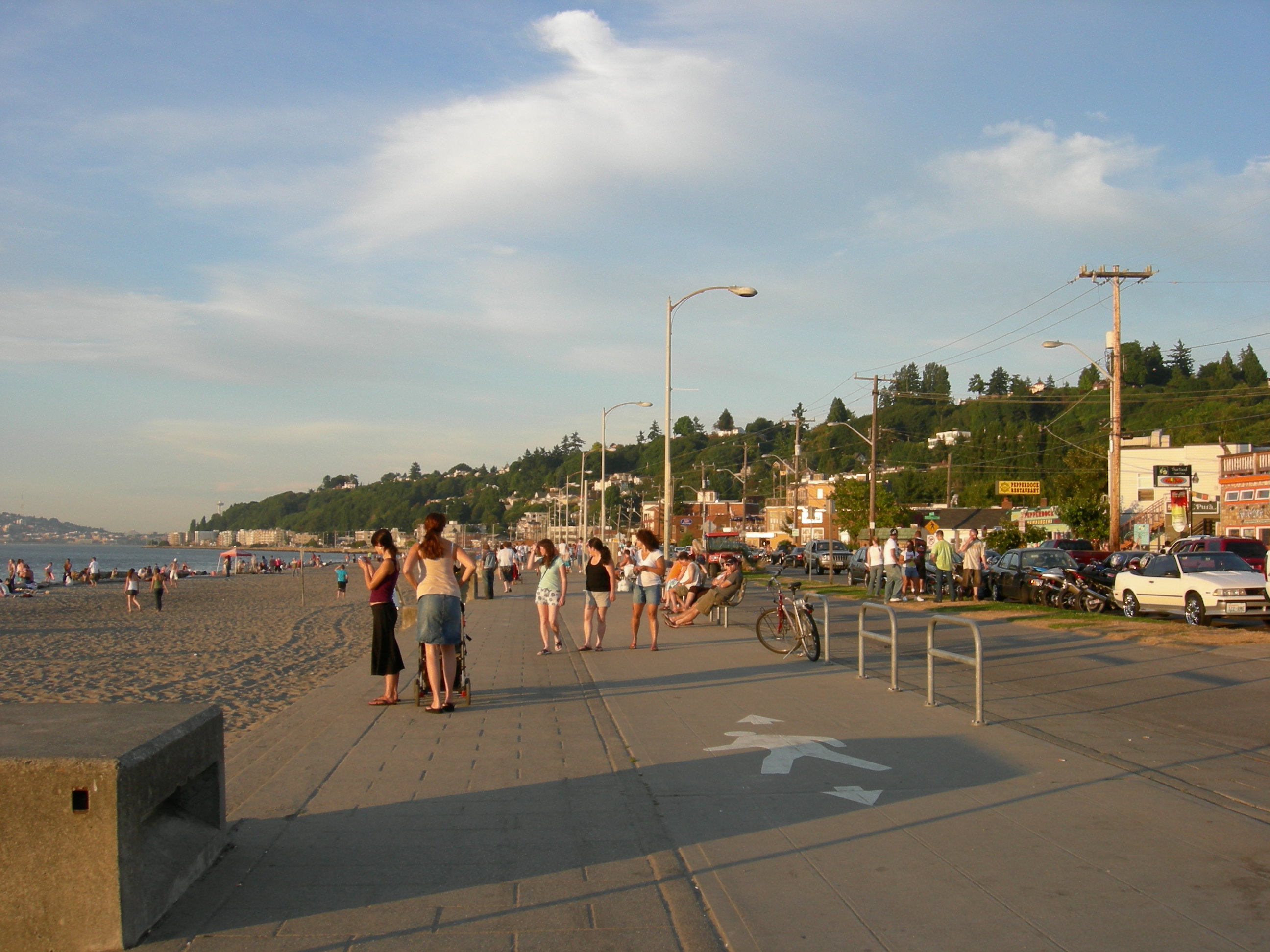
West Seattle Statue of Liberty 02.jpg

Washington, US

Alki Beach

On a rainy November 13, 1851, the schooner Exact put twelve adults and twelve children ashore here, and Seattle dates its founding to this beach.

West Seattle Statue of Liberty 02.jpg · <a href="//commons.wikimedia.org/wiki/User:Jmabel" title="User:Jmabel">Joe Mabel</a> · CC BY-SA 3.0
Substrate
sand
Nearest airport
BFI · 10 km
Tier
Featured
I’m here for
Story

Alki Beach runs along the southwest shore of Elliott Bay in West Seattle, a strip of sand and driftwood about half a mile long inside a 135.9-acre park the city created in 1907. It faces across Puget Sound toward the downtown Seattle skyline and, on clear days, the Olympic Mountains beyond. The water is cold year-round, between roughly 9 degrees Celsius in winter and 16 in summer, and the waves are small, averaging under 0.2 meters. Its claim is not the water but the date.

On November 13, 1851, the schooner Exact, captained by a man named Folger and bound for the Queen Charlotte Islands gold fields, put a party of settlers ashore at Alki Point. The group is remembered as the Denny Party, after its leader Arthur A. Denny, and numbered twenty-four people: twelve adults and twelve children. They had left Portland on November 5 and stopped at Astoria. The cabin that John Low and Lee Terry had started was still roofless when they arrived, and it was raining. David Denny, already on the ground and ill, is said to have greeted the boat with the words, "I wish you hadn't come."

The settlers named their six-block plat "New York Alki." "New York" was an ambition borrowed from settlers' home state; "Alki" is Chinook Jargon for "by and by" or "eventually," so the name reads as a wry promise: New York, someday. The someday city did not stay here. Within a year most of the party crossed Elliott Bay to the deeper harbor at what is now Pioneer Square, and Seattle grew on the far shore. The founding date stuck to the beach, and the city has marked it here ever since.

The land was not empty when the Exact arrived. Alki Point is sbaqʷabqs, "prairie point," in Lushootseed, and the Duwamish had maintained the prairies behind the beach for generations, burning them to keep them open for gathering. Chief Si'ahl, the dxʷdəwʔabš leader whose anglicized name, Seattle, the city would later take, was among those who met the newcomers. The monument on the beach lists the settler families. It does not list the people who were already there, and the displacement that followed is the part of the story the bronze leaves out.

Two objects now anchor the beach's memory of itself. The Birthplace of Seattle Monument, a stone pylon, was erected on November 13, 1905, on the landing's fifty-fourth anniversary. A few hundred meters east stands a roughly two-meter Statue of Liberty replica, given by the Boy Scouts in 1952 and recast in bronze and reinstalled on September 11, 2007. Together they make Alki a beach visited less for swimming than for what happened on its sand.

The spike

On a rainy November 13, 1851, the schooner Exact put twelve adults and twelve children ashore here, and Seattle dates its founding to this beach.

Alki Beach is where Seattle says it began. The city's official founding date, November 13, 1851, is the day the schooner Exact put a party of settlers ashore on this sand, and almost everything about the beach as a destination flows from that one fact rather than from the water.

The landing itself. The Exact was not a settlement ship. It was a schooner under a Captain Folger, bound for the gold fields of the Queen Charlotte Islands, that agreed to drop passengers at Puget Sound on the way. It had left Portland on November 5, 1851, touched at Astoria, and rounded into Elliott Bay on November 13 to land the Denny Party: twenty-four people, twelve adults and twelve children, led by Arthur A. Denny. They came ashore in the rain to a cabin that was still missing its roof. David Denny, already on the ground and unwell, is remembered for greeting the boat with "I wish you hadn't come." It is, by any measure, an unglamorous founding, and the beach has never entirely scrubbed that out of the story.

The name is a joke that came true elsewhere. The settlers platted six blocks and called the place New York Alki. "New York" was borrowed ambition; "Alki" is Chinook Jargon for "by and by" or "eventually." So the name promises a New York, someday. The punchline is that the someday city did arrive, but not here. Within a year most of the party crossed Elliott Bay to the deeper harbor at present-day Pioneer Square, and Seattle grew on that far shore. Alki kept the date and lost the town. The beach is therefore the birthplace of a city that is somewhere else, which is exactly the kind of fact that gives the place its slightly wry character.

The monuments do the remembering. Two objects carry the spike. The Birthplace of Seattle Monument, a stone pylon, was raised on the fifty-fourth anniversary, November 13, 1905, and names the founding families. A few hundred meters east stands a Statue of Liberty replica, given by the Boy Scouts in 1952 under the Strengthening the Arm of Liberty campaign; after years of vandalism the original was pulled in July 2006, recast in bronze in Tacoma for about $140,000, and reinstalled on September 11, 2007, on a new pedestal. People come to Alki to stand next to these, photograph the skyline behind them, and read the date.

What the bronze leaves out. The landing was not an arrival in empty country. Alki Point is sbaqʷabqs, "prairie point," in Lushootseed, and the Duwamish had maintained the prairies behind the beach for generations by seasonal burning. Chief Si'ahl, whose name the city took as Seattle, met the newcomers at the water. The 1855 Treaty of Point Elliott ceded Duwamish land; the Duwamish Tribe is still federally unrecognized and has no reservation. So the spike is double. Alki is a genuine founding site and a genuine site of erasure, and the older name of the point is the cleanest reminder that something was here before the Exact.

Why the spike, not the surf. The waves at Alki average under 0.2 meters and the water sits between about 9 and 16 degrees Celsius; nobody travels here for the swimming. They travel for the date on the pylon and the story it compresses: a rain-soaked landing of twenty-four people who named a six-block townsite after a city it would never become, on an inhabited shore, and a century later cast it all as a beginning.

Alki Beach - man with duck float 01.jpg
Culture

Where it shows up

History
  • "New York Alki" · 1851

    The name the Denny Party gave their six-block plat: "New York" for ambition, "Alki" being Chinook Jargon for "by and by" or "eventually." The name survives in the beach's name and reads as a wry note on a city that grew across the bay instead.

  • "I wish you hadn't come" · 1851

    The greeting attributed to David Denny when the Exact landed the party in the rain at an unfinished cabin on November 13, 1851. It is the line most often quoted to deflate the heroic-founding version of the day.

Other
  • Strengthening the Arm of Liberty · 1950
    Boy Scouts of America

    The national Boy Scouts campaign that placed scale Statue of Liberty replicas across the United States in the early 1950s. The Alki replica, donated in 1952, is one of them.

Alki Beach 1.jpg
History

What happened here

  1. 1851founding

    The Denny Party lands at Alki Point

    On November 13, 1851, the schooner Exact, under Captain Folger and bound for the Queen Charlotte Islands, puts the Denny Party ashore at Alki Point: twenty-four people, twelve adults and twelve children. They had left Portland on November 5 and stopped at Astoria. It is raining, and the cabin meant to receive them is unfinished.

    Wikipedia →
  2. 1851cultural

    The settlement is named New York Alki

    The party plats a six-block townsite and names it New York Alki. "New York" reflects settlers' state of origin; "Alki" is Chinook Jargon for "by and by" or "eventually," naming the place for the city they hoped it would become.

    Wikipedia →
  3. 1852cultural

    Settlers cross to Elliott Bay

    Within a year most of the party leaves the exposed Alki shore for the deeper, more sheltered harbor on the east side of Elliott Bay, at what becomes Pioneer Square. Seattle grows there; Alki keeps the founding date but loses the town.

    Wikipedia →
  4. 1855policy

    Treaty of Point Elliott cedes Duwamish land

    The Treaty of Point Elliott cedes the lands of the Duwamish and other Puget Sound peoples. The Duwamish, whose leader Si'ahl gave the city its name, are left without a reservation and remain federally unrecognized.

    Wikipedia →
  5. 1905cultural

    Birthplace of Seattle Monument erected

    On the fifty-fourth anniversary of the landing, November 13, 1905, the Washington University State Historical Society erects the Birthplace of Seattle Monument at Alki, a stone pylon naming the founding families. It is presented by Lenora Denny.

    Wikipedia →
  6. 1907founding

    Alki Beach Park created

    Seattle establishes Alki Beach Park, eventually 135.9 acres with about half a mile of beachfront. It is described as the first public salt-water bathing beach on the West Coast of the United States.

    Wikipedia →
  7. 1913founding

    Alki Point Lighthouse built

    The current Alki Point Lighthouse is completed in 1913 at the southwest tip of the beach, succeeding an 1887 post light and a private lantern that Hans Martin Hanson had hung in the 1870s.

    Wikipedia →
  8. 1952cultural

    Statue of Liberty replica installed

    A scale Statue of Liberty replica is donated by Reginald H. Parsons and the Seattle Area Council of the Boy Scouts of America, part of the national Strengthening the Arm of Liberty campaign, and placed on the Alki promenade.

    Wikipedia →
  9. 2006policy

    Vandalized replica removed for recasting

    After repeated vandalism, the original 1952 replica is removed in July 2006 and sent to a Tacoma foundry to be recast in bronze and finished in copper green, in a roughly $140,000 project. The battered original goes to the Log House Museum.

    Wikipedia →
  10. 2007cultural

    Bronze replica reinstalled on September 11

    The recast bronze statue is reinstalled at Alki Beach on September 11, 2007, on a new 4.5-foot pedestal. A redesigned plaza, funded partly by inscribed bricks, is dedicated the following year.

    Wikipedia →
The honest part
A settlement of twenty-four people named an inhabited shore after a city it would never become, and a century later cast the moment as an origin.

The monument on Alki Beach is called the Birthplace of Seattle, and it names eight settler families: Arthur Denny and wife, John Low and wife, Carson Boren and wife, David Denny, and Charles Terry. It was erected on November 13, 1905, and the city has treated November 13, 1851, as its founding date ever since. The word that frames all of it, "Alki," is Chinook Jargon, a trade language, and the point itself carries an older name, sbaqʷabqs, "prairie point," in the Lushootseed of the people who were already here.

The Duwamish maintained the prairies behind this beach by seasonal burning and had occupied the lower Duwamish River, Elliott Bay, and the lakes from at least seventeen villages and dozens of longhouses. Chief Si'ahl met the Denny Party at the water's edge; the city took his name and gave him no treaty-recognized homeland. The 1855 Treaty of Point Elliott ceded Duwamish land, and the Duwamish Tribe remains federally unrecognized today, without a reservation, operating a longhouse and cultural center across the river from this beach.

So the honest version of "birthplace" is narrower than the bronze. A settlement of twenty-four people landed on an inhabited shore, named it after a city it would never become, mostly left within a year for a better harbor, and a century later cast the moment as an origin. The beach is a real founding site and a real act of erasure at once, and the older name of the point is the cleanest evidence of the second.

Alki - beach volleyball 01 (cropped).jpg
Anatomy

The shape of the place

Birthplace of Seattle Monument

35%

The stone pylon marking the November 13, 1851 landing, erected in 1905 and naming the founding families. The fixed point the whole beach is organized around.

Best for The founding story

Names settler families only; the Duwamish presence is not recorded on the monument.

Central beach and promenade

50%

The paved waterfront path and main sand crescent fronting the Alki Avenue SW restaurant strip, with volleyball courts, picnic areas, restrooms, and showers. The busy core of the park.

Best for Swimming, volleyball, food, people-watching

First public salt-water bathing beach on the West Coast; dogs banned on the sand.

Statue of Liberty replica plaza

55%

The roughly two-meter bronze Liberty replica on its 4.5-foot pedestal, set in a redesigned plaza on the promenade. The beach's most photographed object after the skyline itself.

Best for Photographs and orientation

Recast in 2007 after the 1952 original was repeatedly vandalized; reinstalled September 11, 2007.

Alki Point and Lighthouse

95%

The southwest tip of the beach, sbaqʷabqs or "prairie point" in Lushootseed, where the 1913 lighthouse stands. Quieter than the central beach, with the open Sound beyond.

Best for Quiet walking and the lighthouse

The point the Exact rounded in 1851; the Duwamish maintained prairies behind it.

Landmarks

Birthplace of Seattle Monument · 1905

monument

Stone pylon on Alki Beach erected by the Washington University State Historical Society on November 13, 1905, marking the 1851 Denny Party landing and naming the founding settler families. Presented by Lenora Denny.

Wikipedia →

Statue of Liberty replica · 1952

monument

Scale Statue of Liberty replica, about two meters tall, donated by the Boy Scouts of America in 1952 under the Strengthening the Arm of Liberty campaign. Recast in bronze in 2006-07 after vandalism and reinstalled on a 4.5-foot pedestal on September 11, 2007.

Wikipedia →

Alki Point Lighthouse · 1913

lighthouse

Active lighthouse at the southwest tip of Alki, completed in 1913, succeeding an 1887 post light and a private lantern hung by Hans Martin Hanson in the 1870s.

Wikipedia →
A day here

From first light to dark

Dawn

At first light the Sound is usually flat and grey and the tide is doing most of the work, exposing a wide band of sand and barnacled rock at low water. Early walkers, dog owners kept off the sand by the $500 fine, and a few cold-water swimmers have the promenade to themselves before the downtown skyline across the bay catches the sun.

Midday

By late morning the paved waterfront path fills with cyclists, joggers, and families working the half-mile between the bathhouse and the lighthouse. Volleyball nets go up on the sand, the food counters along Alki Avenue SW open, and on a warm weekend the free lots fill by mid-morning.

Golden hour

Late afternoon is the beach's best hour: the low sun lights the Seattle skyline and backlights the Olympics across the water, and the Statue of Liberty replica throws a long shadow. Photographers know the angle. This is when the promenade is busiest and the parking hardest.

Night

After dark the beach empties under a no-fires, no-alcohol regime and a park closing time of 11:30 p.m. The skyline glows across Elliott Bay, the lighthouse beam turns at the point, and on summer nights the cruise and container traffic moves in the shipping lanes offshore.

Alki Beach 8A.jpg
Sea & surf

What the water does

JFMAMJJASONDmetres (significant wave height)

Solid = typical monthly wave height; pale = the bigger days (90th pct). Offshore/regional swell from Open-Meteo Marine (ERA5 Ocean reanalysis, 2023–2024); a sheltered cove may sit calmer than this.

Calm — gentle swimming water most of the year
Typical wave height
0.17 m
Biggest swell
Apr · 0.22 m
Calmest
Jul · 0.1 m
Typical period
2.8 s (wind chop)
Before you go

Things to know

Cost

The beach and park are free, with free parking and street parking along Alki Avenue SW; lots fill by mid-morning on sunny weekends.

Water

Cold year-round, about 9-16 degrees Celsius, with small waves under 0.2 meters; no lifeguards, so swim at your own risk and consider a wetsuit.

Rules

Dogs are banned on the sand with a $500 fine; no open fires or alcohol on the beach; the park is open 4 a.m. to 11:30 p.m.

Tides

Tidal range runs roughly 8-10 feet, so low tide exposes a much wider beach; check a tide table before visiting.

Swimming

Usually calm water — among the gentler beaches for a swim.

Sharks

No incidents on record in the global shark-attack file.

Plan

If you go

Getting there
Nearest airport
King County International Airport - Boeing Field (BFI) · 10 km
Nearest town
Seattle · 6 km

Alki Beach is about 6 km west of downtown Seattle on the West Seattle peninsula. Drive via the West Seattle Bridge, take King County Metro Route 50 from downtown, or use the seasonal West Seattle Water Taxi to Seacrest, then walk or bus along the shore. The nearest airport is Boeing Field (BFI), about 10 km; Sea-Tac (SEA) is about 19 miles.

What to eat & drink
Alki Avenue SW restaurant strip

The waterfront road behind the beach carries a continuous run of casual restaurants, ice-cream counters, and cafes facing the Sound. It is the eating district for the beach; nothing is on the sand itself.

Alki Avenue SW, fronting the beach

Pacific Northwest seafood

Salmon, Dungeness crab, oysters, and fish and chips are the regional standards served along the Alki strip and across West Seattle, drawn from Puget Sound and Washington waters.

West Seattle and the Alki waterfront

Picnic from the beach

Alki Beach Park has picnic areas and was the first public salt-water bathing beach on the West Coast; many visitors bring food, though open fires and alcohol are prohibited on the beach.

Alki Beach Park picnic areas

Sources & references
  1. Wikipedia: Alki Point, Seattle · cited 6×
  2. Seattle Times · cited 3×
  3. Wikipedia: Alki Beach Park · cited 2×
  4. Wikipedia: Denny Party · cited 2×
  5. Wikipedia: Denny Party; Schooner Exact
  6. Wikipedia: Denny Party; HistoryLink
  7. Wikipedia: Duwamish people
  8. Wikipedia: Alki Point, Seattle; Seattle Times
  9. Wikipedia: Schooner Exact
Colophon · Provenance

Where this page comes from

Geography, facilities
OpenStreetMap (ODbL) for geometry and facility tags within 500 m of the beach centroid. GeoNames for city/airport distances.
Climate & ocean
Open-Meteo ERA5 + Marine archive, 2014–2023 monthly normals.
Photography
Archival, original tone (Tier B — Wikimedia Commons). Each image licensed per its own terms; attribution visible inline.
History & culture
Every factual claim is linked to its source in the prose above. Wikipedia citations inline. Non-wiki sources named where relevant.
Editorial voice
Register: wry. Written to pass a local's nod test; corrections welcome.
Written by Erin Rose
Last reviewed 2026-04-19
v0.9in editorial development toward v1.0