England, GB

Camber Sands

Camber Beach (14178868463).jpg

England, GB

Camber Sands

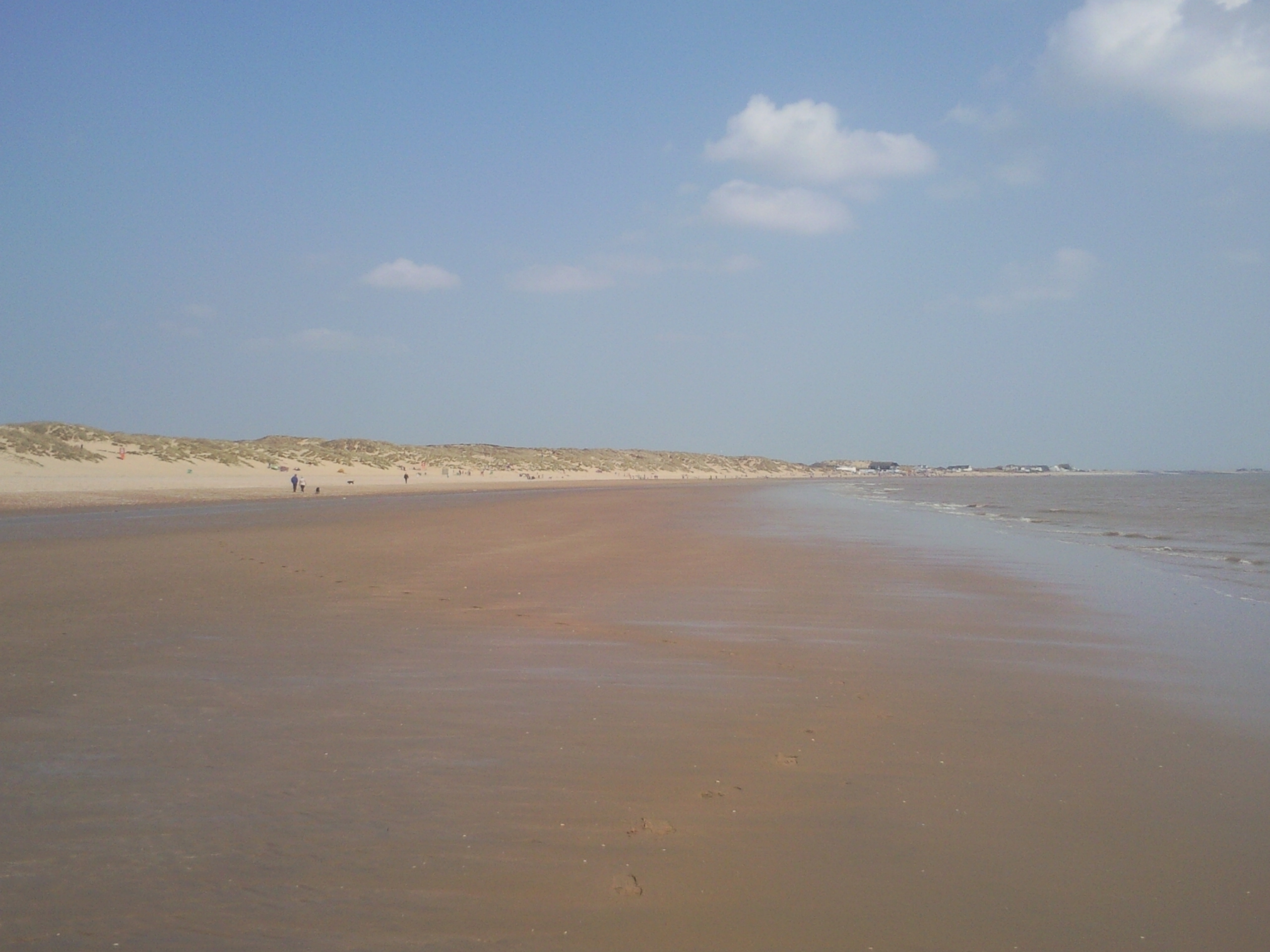
Camber holds East Sussex's only dunes and a tide that retreats almost a kilometre, then races back over sandbars that drowned seven men in 2016.

Camber Beach (14178868463).jpg · <a rel="nofollow" class="external text" href="https://www.flickr.com/people/31363949@N02">Leonard Bentley</a> from Iden, East Sussex, UK · CC BY-SA 2.0
Length
4.6 km
Substrate
sand
Spring tide
6.97 m
Nearest airport
LYX · 11 km
Tier
Featured
I’m here for
Story

Camber Sands is a 3-mile (4.8 km) stretch of sand on the East Sussex coast, running east from the mouth of the River Rother to the Kent border, in the village of Camber near the medieval town of Rye. It is the only sand dune system in East Sussex. The dunes are wedge-shaped, about 1 km wide at the western end and tapering to roughly 10 metres wide in the east over a distance of 3 km, and they are growing: the system accretes around 7,500 cubic metres of sand a year.

The dunes form through a daily mechanism you can watch. When the tide goes out at Camber it retreats almost a kilometre, leaving a vast flat of wet sand. The sun and wind dry that exposed surface, and the prevailing south-westerly wind lifts the loose grains and drives them inland, where marram grass traps and holds them. The western dunes sit inside the Camber Sands and Rye Saltings Site of Special Scientific Interest (SSSI); the rest is a Site of Nature Conservation Importance. The dunes support over 250 species of plants and wildlife, including a beetle found nowhere else in the county.

The same flatness that makes Camber feel endless at low tide is what makes it dangerous. The beach shelves so gently that on an outgoing tide you can walk far out across sandbars, and on the incoming tide the water rushes back across those bars fast — filling the channels behind you before you notice the sand you are standing on has become an island. On 24 August 2016, five young men drowned here on a single afternoon. Two others had drowned a month earlier, in July. All seven deaths were ruled misadventure. There were no lifeguards on the beach at the time; the RNLI brought a seasonal lifeguard service to Camber for the first time in 2017.

Camber has a second life as a film set. Its wide, empty, building-free sand has stood in for the Sahara in 'Follow That Camel' (shot 1967), for the beaches of Dunkirk in the 1958 film of that name, and for occupied France when George Clooney's 'The Monuments Men' (2014) came ashore. A British beach that can be a desert one week and a 1944 invasion coast the next is a useful thing, and location managers have used Camber for sixty years.

The village itself is small and seasonal. Holiday parks — Pontins operated here until it closed on 30 November 2023, and Park Holidays runs a large site nearby — bring tens of thousands of people on a hot summer weekend to a place with three car parks and a handful of cafes. The eastern end, near the Jury's Gap car park, is given over to kitesurfers, kite buggies, and landboarders, who need the wide flat sand and the steady south-westerly. Rye, with its cobbled Mermaid Street, its harbour history, and its railway station, sits about 5 km inland and absorbs the overflow.

Camber is honest about what it is: a working stretch of accreting dune and tidal sand that is beautiful and useful and, on the wrong tide, lethal. The best of it and the worst of it come from the same fact — the sea here goes a long way out, and it comes back fast.
The spike

Camber holds East Sussex's only dunes and a tide that retreats almost a kilometre, then races back over sandbars that drowned seven men in 2016.

Camber Sands is defined by three things that are really one thing: the dunes, the tide, and the camera. All three exist because the beach is enormous, flat, and open, with nothing built on the sand itself.

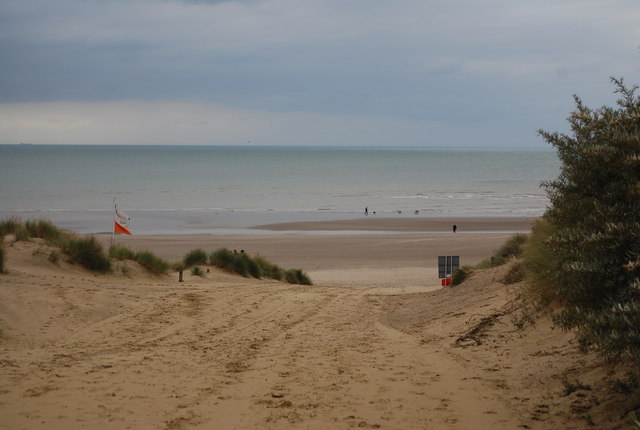
Start with the dunes, because they are the rarest feature. Camber holds the only sand dune system in East Sussex — a genuine geological scarcity on a coast that is otherwise shingle (Dungeness, a few miles east, is one of the largest shingle expanses in Europe). The Camber dunes are wedge-shaped, roughly 1 km wide where they meet the River Rother estuary in the west and narrowing to about 10 metres wide at the Kent end, three kilometres away. They are not static. The system is accreting at around 7,500 cubic metres of sand a year, which means the dunes are physically getting bigger over time. The mechanism is a conveyor belt powered by the tide and the wind. At low water the sea pulls back almost a kilometre, exposing a huge apron of damp sand. The sun and the prevailing south-westerly wind dry the surface and then lift the loose grains and carry them landward, where marram grass — the dune-builder, with roots that bind sand and stems that survive burial — catches and anchors them. Layer by layer, year by year, the dunes climb. The western core is protected as the Camber Sands and Rye Saltings SSSI; it carries over 250 species of plants and animals, including a beetle that exists nowhere else in the county. The dunes are fragile in the way all dunes are — a single trampled path can blow out into a gap that the wind then enlarges — so management here means fencing, boardwalks, marram planting, and the annual cutting and burning of invasive sea buckthorn.

The tide is the same fact seen from the water. The gentle shelf that makes Camber feel like you can walk to the horizon at low tide is exactly what makes the incoming tide a killer. Because the beach is so flat, the rising water does not climb a slope — it floods sideways across the sand at speed, filling the runnels and channels between the sandbars. People walk a long way out at low water onto a bar that feels solid and dry, and then the tide returns behind them, drowning the channel they crossed and cutting them off on a shrinking island of sand while the water around them rises and the current runs. This is not a rip-current beach in the surf sense; at the 2016 inquest an oceanographer testified that there was insufficient wave activity to build classic rip currents, and that the men got into trouble in a fast incoming tide over the sandbar topography. Five friends — Kenugen Saththiyanathan (18) and his brother Kobikanthan (22), Nitharsan Ravi (22), Inthushan Sriskantharasa (23), and Gurushanth Srithavarajah (27), all from the London area and of Sri Lankan origin — drowned on 24 August 2016, seen earlier playing in the shallows. They were fit, competent swimmers. A month before, on 24 July 2016, two more men had died: Mohit Dupar, 36, lost his life trying to reach 19-year-old Gustavo Silva Da Cruz, a Brazilian visitor in difficulty. Coroner Alan Craze held a five-day inquest in Hastings and recorded misadventure on all seven. He found it could not be known whether lifeguards would have prevented the deaths. Camber had had none; the RNLI had recommended a lifeguard service years earlier, but it had not been funded. After 2016, Rother District Council found the money — about £51,000 for the first season — and the RNLI began a seasonal lifeguard service in 2017, with red-and-yellow flags marking the patrolled swimming area. The flags are the whole point: on a beach this flat, where to enter the water is not obvious, and the safe zone is wherever the lifeguards have decided the tide and the bars are least lethal that day.

The camera is the third face of the same flatness. A beach that is wide, level, and free of buildings is a film location that can be almost anywhere on Earth. Camber has been the Sahara: 'Follow That Camel' was shot here in 1967, and filming had to stop repeatedly because the dunes kept getting covered in snow. It has been a war coast over and over — standing in for the beaches of Dunkirk in the 1958 film 'Dunkirk', and for occupied France when 'The Monuments Men' (2014), with George Clooney and Matt Damon, came ashore. It appears in 'The Loneliness of the Long Distance Runner' (1962), in 'The Theory of Everything' (2014), and in the closing scenes of the 2016 thriller 'Criminal'. Sixty years of location managers have used the same asset: a horizon of clean sand five kilometres from the antique-shop streets of Rye, where a film crew can build a desert or an invasion and strike it again before the next tide comes in. The dunes, the deadly tide, and the desert-double all come from one geography — the sea here goes very far out, and it comes back very fast.

The beach at Camber from a footpath - geograph.org.uk - 1504182.jpg
Culture

Where it shows up

Film
  • Dunkirk (1958) · 1958
    Leslie Norman (director)

    The Operation Dynamo war drama used Camber's wide, building-free sand to stand in for the beaches of Dunkirk in northern France — the earliest of the beach's many wartime-coast roles.

  • Follow That Camel (1967) · 1967
    Gerald Thomas (director)

    The Carry On spin-off used the Camber dunes as the Sahara; filming was repeatedly stopped because snow kept covering the 'desert'. The beach's signature party trick — a British coast doubling as desert.

  • The Monuments Men (2014) · 2014
    George Clooney (director)

    Clooney and Matt Damon's WWII art-recovery film shot its beach-arrival scenes in 'France' on location at Camber Sands — the beach again playing an occupied European coast.

  • The Theory of Everything (2014) · 2014
    James Marsh (director)

    The Stephen Hawking biopic filmed a beach scene at Camber, one of several mainstream productions to use the wide flat sand in the 2010s.

  • The Loneliness of the Long Distance Runner (1962) · 1962
    Tony Richardson (director)

    The British New Wave classic features a beach scene shot at Camber in early 1962 — an early, non-wartime use of the location.

Camber Beach (14155315731).jpg
History

What happened here

  1. 1908development

    Rye and Camber Tramway opens

    A narrow-gauge tramway linking Rye to Camber Sands opened on 13 July 1908, carrying day-trippers and golfers to the beach and the dunes. It closed at the outbreak of the Second World War in September 1939 and was never reopened, leaving the car as the only practical access.

    Wikipedia →
  2. 1958cultural

    Camber stands in for Dunkirk on film

    The 1958 war film 'Dunkirk', dramatising the 1940 Operation Dynamo evacuation, used the wide, building-free sands at Camber to represent the beaches of northern France — the first of many times the beach doubled for a foreign or wartime coast.

    Wikipedia →
  3. 1967cultural

    'Follow That Camel' filmed as the Sahara

    The Carry On spin-off 'Follow That Camel' was shot at Camber in early 1967 with the dunes standing in for the Sahara Desert. Filming was repeatedly halted because the 'desert' kept being covered in snow — a frequently retold piece of the beach's film lore.

    Wikipedia →
  4. 2014cultural

    'The Monuments Men' lands at Camber

    George Clooney's 'The Monuments Men' (2014), with Matt Damon, filmed its beach-landing scenes in 'France' on location at Camber Sands — the beach again playing a wartime European coast. 'The Theory of Everything' also filmed a beach scene at Camber the same year.

    Wikipedia →
  5. 2016disaster

    Two men drown in July

    On 24 July 2016, Mohit Dupar (36) drowned trying to reach 19-year-old Brazilian visitor Gustavo Silva Da Cruz, who also died, in difficulty in the water at Camber. The two deaths came a month before the larger tragedy and formed part of the same inquest.

    Wikipedia →
  6. 2016disaster

    Five young men drown on 24 August

    On 24 August 2016, five friends — Kenugen Saththiyanathan (18), Kobikanthan Saththiyanathan (22), Nitharsan Ravi (22), Inthushan Sriskantharasa (23) and Gurushanth Srithavarajah (27), all from the London area — drowned on one afternoon, caught by a fast incoming tide over the sandbars. They were competent swimmers.

    Wikipedia →
  7. 2017policy

    Inquest verdicts and first lifeguards

    In June 2017 coroner Alan Craze recorded verdicts of misadventure on all seven deaths after a five-day inquest in Hastings, finding it could not be known whether lifeguards would have saved them. Rother District Council funded a seasonal RNLI lifeguard service (~£51,000), which began at Camber for the first time in 2017.

  8. 2023development

    Pontins Camber Sands closes

    The Pontins holiday park at Camber, a fixture of the village's seaside trade for decades, closed permanently on 30 November 2023. Park Holidays' large nearby site continues to operate, but the closure marked the end of an era for the resort village.

    Wikipedia →
The honest part
The same flat sand that lets you walk to the horizon at low tide is what lets the sea race back and cut you off on a sinking bar.

Camber Sands has killed people, and recently. On 24 August 2016, five young men — Kenugen and Kobikanthan Saththiyanathan, Nitharsan Ravi, Inthushan Sriskantharasa and Gurushanth Srithavarajah, aged 18 to 27, all from the London area and of Sri Lankan origin — drowned here in a single afternoon. They were fit and competent swimmers. A month earlier, on 24 July 2016, Mohit Dupar (36) drowned trying to save Gustavo Silva Da Cruz (19). Seven deaths in one summer; all ruled misadventure at a five-day inquest by coroner Alan Craze in 2017. The killer is the beach's signature feature: the sand shelves so gently that the tide goes out almost a kilometre, and on the way back in the water floods sideways across the sandbars at speed, filling the channels behind anyone who has walked out and cutting them off on a sinking island of sand. An oceanographer told the inquest this was a fast incoming tide over the bars, not a classic rip current. Camber had no lifeguards in 2016; the RNLI had recommended them years before, but the cost had not been met. After the deaths, Rother District Council funded a seasonal service (about £51,000 for the first year) and the RNLI began patrolling in 2017. The lesson the families paid for is simple and worth repeating: check the tide times before you walk out, swim only between the red-and-yellow flags when lifeguards are on, and never assume the dry bar you are standing on will still be reachable in an hour. The second, quieter tension is the dunes themselves — a rare, protected, accreting SSSI that has to absorb tens of thousands of summer visitors, whose feet and parked cars and trampled paths are exactly what blows a dune system out.

Camber Sands (144268089).jpeg
Anatomy

The shape of the place

Western dunes and Rother estuary end

10%

The widest part of the dune system (~1 km), nearest the River Rother mouth and protected as part of the Camber Sands and Rye Saltings SSSI. Quieter, more about the dunes and the estuary view than the beach crowd.

Best for Dune walking, birdwatching, the SSSI flora, escaping the central crowds

Keep to marked paths and boardwalks — this is the fragile, protected core of the only dune system in East Sussex.

Central beach and main access

45%

The busy heart of Camber, reached from the main car parks, with the beach cafes and the bulk of summer families. Where the RNLI lifeguards patrol and set the red-and-yellow swimming flags in season.

Best for Families, swimming between the flags, the classic wide-sand day out

Swim only between the flags when lifeguards are on; this is also where dogs are banned 1 May to 30 September.

Eastern flats and Jury's Gap kite zone

85%

Where the dunes narrow toward Kent and the wide flat sand near the Jury's Gap car park is given over to kitesurfers, kite buggies, and landboarders working the south-westerly. Quieter for swimming, busier with kites.

Best for Kitesurfing, kite buggying, landboarding, walking toward Dungeness

Kite activity is concentrated here for a reason — keep clear of the lines and rigs if you are walking through.

Landmarks

Camber Sands dune system (SSSI)

natural

The only sand dune system in East Sussex, accreting ~7,500 cubic metres of sand a year. The western dunes form the Camber Sands and Rye Saltings Site of Special Scientific Interest, holding over 250 species including a county-endemic beetle.

Wikipedia →

Rye, East Sussex

historic_town

The medieval Cinque Ports town ~5 km inland, with cobbled Mermaid Street, the Ypres Tower, a long smuggling history, and the nearest railway station (on the Marshlink line). The arrival and service base for most Camber visitors.

Wikipedia →

Avon brig wreck

wreck

The timbers of a shipwreck exposed on the sand at low tide, tentatively identified as the brig Avon, which sank in 1852. One of the features the long retreating tide reveals on the flats.

Wikipedia →
A day here

From first light to dark

Dawn

At low water before the crowds, Camber is at its most cinematic — a kilometre of wet, mirror-flat sand reflecting the sky, the dunes a low gold ridge behind. Dog walkers and dawn photographers have the beach; the eastern kite zone near Jury's Gap is quiet until the wind builds. This is when the beach looks most like the desert and invasion-coast doubles film crews come for.

Midday

On a hot summer day the car parks fill by late morning and the central beach near the main access fills with families. If lifeguards are on duty, the red-and-yellow flags mark the only sensible place to swim; outside them the sandbars and channels are unpatrolled. Check the tide table — at low water the sea is a long walk out, and you do not want to be on a far bar when it turns.

Golden hour

Late afternoon is the kite hour: the south-westerly steadies and the eastern end fills with kitesurfers, buggies, and landboarders working the wide flat sand. The light rakes low across the dunes and the marram. As the tide pushes back in, the bars disappear one by one — the cue for anyone walked out at low water to come back in well ahead of it.

Night

Out of season and after the lifeguards have gone, Camber empties fast. The village is small and quiet, the holiday park lit but contained, and the dunes go dark. Rye, 5 km inland, holds what nightlife there is — pubs in the old town rather than a beach strip. The beach itself at night, with the tide moving unseen across the flats, is exactly the place the safety signs tell you not to be.

Compare

How it ranks

Peak warmth
Warmer than 96% of beaches in its country
Peak-month high ≈ 22°C
Beach season
Longer beach season than 80% of beaches in its country
5 comfortable months a year

Ranked against every beach in our database — 228,000+ worldwide.

Camber Sands (89823821).jpeg
Sea & surf

What the water does

JFMAMJJASONDmetres (significant wave height)

Solid = typical monthly wave height; pale = the bigger days (90th pct). Offshore/regional swell from Open-Meteo Marine (ERA5 Ocean reanalysis, 2023–2024); a sheltered cove may sit calmer than this.

Mixed — usually swimmable, with a livelier season
Typical wave height
1.19 m
Biggest swell
Dec · 1.66 m
Calmest
May · 0.76 m
Typical period
6.1 s (wind chop)
Before you go

Things to know

The incoming tide is the real danger

The beach is so flat the sea goes out almost 1 km and races back across the sandbars, filling channels behind you and cutting you off. Check tide times before walking out; come back in well ahead of the turn. This is what drowned seven people in 2016.

Swim between the flags

RNLI lifeguards patrol the central beach in season (roughly late May to the end of the summer holidays) and set red-and-yellow flags. Swim only inside them when on duty; the rest of the beach is unpatrolled.

Dog rules by season

From 1 May to 30 September dogs are banned from the central and eastern (busiest) sections; the western dunes end is the dog-friendly part. Out of season dogs are allowed across the beach.

Parking and crowds

There are three main car parks (Western/New Lydd Road, Central, Old Lydd Road). They fill early on hot days and the western park typically closes around 8pm in summer. There is no realistic free parking option in high season.

Sharks

No incidents on record in the global shark-attack file.

Lifeguard

No lifeguard service — swim within your limits.

Plan

If you go

Getting there
Nearest airport
Lydd London Ashford Airport (LYX) · 11 km
Nearest town
Rye · 5 km

Camber has no railway station of its own; the nearest is Rye, about 5 km inland on the Marshlink line between Ashford and Hastings, with onward bus or taxi to the beach. By car, Camber is reached via the A259 and Lydd Road; the three beach car parks are paid and fill early on summer days, with no realistic free option in high season.

When to go
  • RNLI seasonal lifeguard patrols · Roughly late-May bank holiday to end of the summer holidays

    Since 2017 the RNLI has run a seasonal lifeguard service at Camber's central beach, funded by Rother District Council. Lifeguards set the red-and-yellow flags marking the patrolled swimming area; outside those times and zones the beach is unpatrolled.

  • Summer holiday peak · School summer holidays, late July to August

    Hot summer weekends bring tens of thousands of day-trippers and holiday-park visitors to a village with three car parks, straining parking and the small village's infrastructure. The busiest and, historically, the most dangerous time on the water.

What to eat & drink
Camber beach cafes and kiosks

The beach access points have seasonal cafes and kiosks selling the British seaside staples — chips, ice cream, tea, bacon rolls. Busy and basic in summer, mostly shut in winter. The substantial eating is inland in Rye, not on the sand.

Beach car park access points, Camber

Rye Bay fish and seafood

Rye Bay scallops are a celebrated local catch, landed at Rye Harbour and feted each winter at the Rye Bay Scallop Week. Rye's restaurants and pubs serve local fish; the bay's small fishing fleet still works out of the harbour at the mouth of the Rother.

Restaurants and pubs in Rye and Rye Harbour, ~5 km inland

The Mermaid Inn, Rye

A historic inn on Rye's cobbled Mermaid Street, rebuilt in 1420 with cellars dating earlier, long associated with the 18th-century Hawkhurst smuggling gang. A landmark stop for food and drink after the beach rather than a beachside option.

Mermaid Street, Rye

Sources & references
  1. East Sussex County Council: Camber dunes management plan · cited 3×
  2. Wikipedia: Camber Sands · cited 2×
  3. Wikipedia: Rye and Camber Tramway; Wikipedia: Camber Sands
  4. Beside the Sea Holidays; Best UK Beaches
  5. Wikishire; Beside the Sea Holidays
  6. Beside the Sea Holidays
  7. BBC News; ITV News
  8. BBC News; Kent Online
  9. BBC News; ITV News; Rother District Council
  10. BBC News; RNLI; Kent Online
  11. BBC News; Rother District Council
  12. East Sussex County Council; Visit 1066 Country
  13. Wikipedia: Camber Sands; Wikipedia: Rye, East Sussex
Colophon · Provenance

Where this page comes from

Geography, facilities
OpenStreetMap (ODbL) for geometry and facility tags within 500 m of the beach centroid. GeoNames for city/airport distances.
Climate & ocean
worldclim_v2.1_2.5m
Tides
eot20
Photography
Archival, original tone (Tier B — Wikimedia Commons). Each image licensed per its own terms; attribution visible inline.
History & culture
Every factual claim is linked to its source in the prose above. Wikipedia citations inline. Non-wiki sources named where relevant.
Editorial voice
Register: romantic. Written to pass a local's nod test; corrections welcome.
Written by Erin Rose
Last reviewed 2026-04-19
v0.9in editorial development toward v1.0