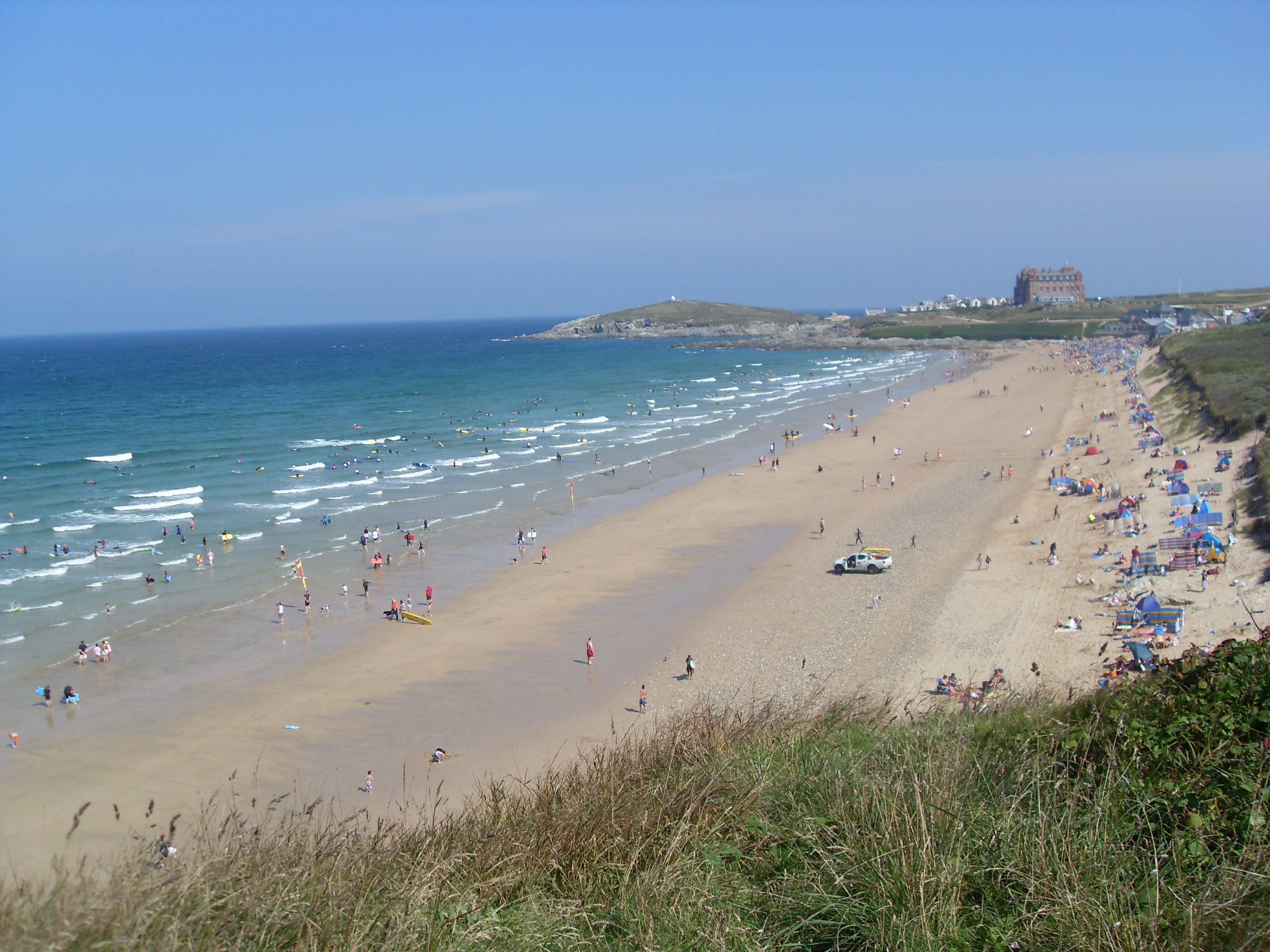
Fistral Beach carries two identities that do not fit together comfortably, and neither one is exaggerated for effect. It is the beach where organized British surfing began, the base of the country's best-known surf festival, and the site of a reef wave with a fifty-eight-year mythology. It is also the specific beach at the center of a 2026 legal claim against South West Water, brought by nearly 1,900 people, over sewage discharged into the surf.
How the surfing identity was built. In April 1962 four Australian lifeguards, Bob Head, Ian Tiley, John Campbell, and Warren Mitchell, arrived in Newquay carrying fiberglass performance boards, a technology British beach-goers had not seen. In 1965, Head partnered with Bill Bailey, Doug Wilson, and Freddie Blight to found Bilbo Surfboards, Britain's first serious surfboard manufacturer. The following year, in September 1966, during a swell British surf historians still call the Great September Swell, the Cribbar reef at Fistral's northern tip broke at an estimated twenty feet and was ridden for the first time, by American Jack Lydgate, who learned to surf in Hawaii, and Australians Pete Russell, Johnny McIlroy and Rick Friar, without wetsuits or leashes, in front of a small crowd watching from Towan Head. The wave only breaks in the largest winter groundswells and has stayed rare enough that each session is still individually documented. That mythology, plus the 2003 construction of an International Surfing Centre at the beach's north end and the growth of Boardmasters from a 1981 surf contest into a festival with a 58,000-person capacity by 2024, is what built Fistral's claim to be the home of British surfing.
What the water actually carries. South West Water operates the sewer network serving Newquay, and its combined sewer overflows discharge into the sea during heavy rain, a legal but heavily criticized practice across the UK water industry. In the Newquay area specifically, South West Water recorded 221 sewage discharges in 2024, totaling 376 hours, an average of a bit more than four discharges every week. Surfers Against Sewage, the campaign group, separately logged 162.8 hours of discharge against Fistral in 2025 and ranked it sixth among the UK's ten most sewage-affected surf spots, noting that a beach this prominent placing so high on the list was, in the group's own description, "a travesty." Burst pipes and pumping-station failures near the Esplanade have caused additional spills that turned the water visibly brown. The pollution is not constant, but it is frequent enough that events get cancelled with little warning: an annual charity surf scheduled for late November 2024 was called off the day before because of a discharge.
Why a lawsuit became possible. For decades, English nuisance law treated water companies as effectively shielded from private claims over statutory sewage discharges, on the theory that the discharges were permitted under their operating licenses. That changed in July 2024, when the UK Supreme Court ruled in Manchester Ship Canal Company Ltd v United Utilities Water Ltd that a private nuisance claim could proceed against a water company despite the existence of a statutory discharge regime. The ruling did not create new facts about pollution; it created new legal standing for people already living with it. Leigh Day, a law firm that had already built a large group claim against South West Water focused on Exmouth — following wild swimmer Jo Bateman's own action, and enrolling more than 1,400 claimants there — used the ruling to expand the case, and on 6 February 2026 issued a 58-page Letter Before Action covering Dawlish, Sidmouth, Teignmouth, Newquay, and Penzance, with roughly 1,900 claimants enrolled overall; the Newquay arm will initially address sewage incidents at Fistral Beach specifically before widening to the rest of Newquay. The letter invites South West Water to admit liability and propose settlement terms. South West Water has three months to respond, until 6 May 2026, or the firm says it will issue court proceedings.
Two things that are both true. Justine Taylor of the local group Clean Sea Newquay put the complaint plainly: "Sewage in the sea ruins living here for everybody. Instead of working to protect the health of the public and the environment, South West Water has prioritised turning pollution into profit." Local surfer Rob Abrams framed the stakes in ordinary terms, not abstractions: kids who waited all year having their surf trip ruined, wild swimmers no longer wanting to get in, dog-walkers whose pets keep getting sick, and anxious beachside business owners. None of that erases what Fistral also is. The beach that produced Bilbo Surfboards, the Cribbar's 1966 first ride, and a festival that fills to 58,000 people is the same beach where residents are now suing a utility company over what comes out of the pipes. Both facts describe the same 750 meters of sand, at the same time, and the lawsuit exists precisely because the surf culture around Fistral is prominent enough that its sewage problem became a national story rather than a local one.
What it actually is. Fistral is not a beach where the pollution story has replaced the surf story, or the reverse. It is a working case study in a wider UK problem: aging Victorian-era sewer infrastructure, storm overflows built as an emergency valve now firing routinely, and a 2024 court ruling that finally gave residents of Britain's best-known surf beach a legal path to challenge it directly. The waves that made Fistral famous are unaffected by any of this. The water underneath them is the argument.