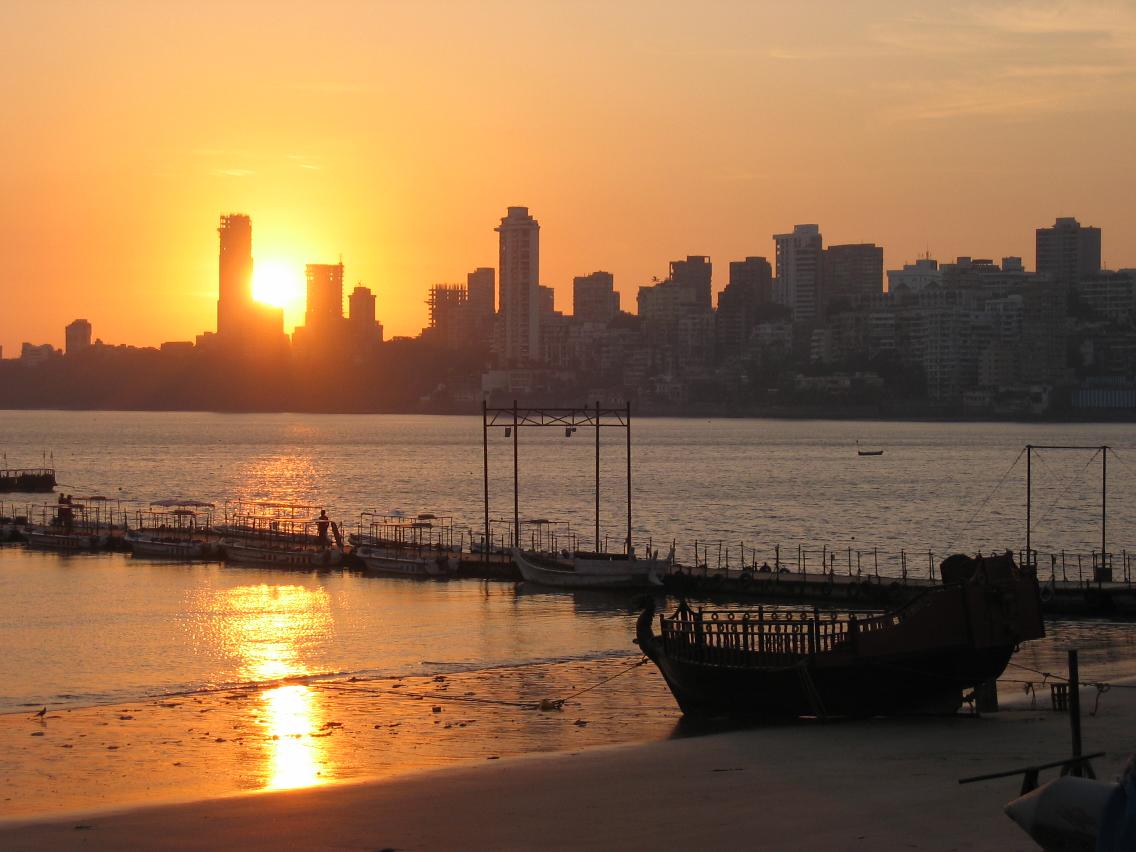
Most legendary beaches earn the word "legendary" by being beautiful. Girgaum Chowpatty earns it by being useful — to a degree almost no beach on Earth matches. This is not a place you go to be alone with the sea. It is a civic instrument: a flat, public, sea-facing acre that a city of twenty million reaches for whenever it needs to do something collectively and out loud. To understand Chowpatty you have to stop thinking of it as scenery and start thinking of it as Mumbai's largest open room.
The cremation that set the template. When Lokmanya Tilak died on 1 August 1920, the problem his mourners faced was logistical before it was emotional: no enclosed crematorium in Bombay could hold the crowd. The decision to cremate him on Chowpatty sand — with a funeral procession that contemporary accounts put well above a million people, and Gandhi and Nehru among the pall-bearers — fixed an idea in the city's mind. Chowpatty was where Bombay assembled when no building was big enough. The Tilak Samadhi memorial that marks the spot is not a tourist landmark in the ordinary sense; it is the deed to that idea.
The protest that proved it. The salt is the second proof. In April–May 1930, while Gandhi walked to the sea at Dandi to make salt in defiance of the British monopoly, the women of Bombay — Gandhi had refused to let them join the Dandi march — made their own salt here. Kamaladevi Chattopadhyay and the Captain sisters set up pans on Chowpatty and boiled Arabian seawater down to crystals, an act of civil disobedience staged precisely because it was the most public sand in the city. You do not commit symbolic crimes in private. Chowpatty's whole value to the freedom movement was that everyone could see you do it.
The festival that was engineered. The third proof is the one most visitors mistake for ancient folk tradition. The mass public Ganesh festival — the one that fills Chowpatty with hundreds of thousands of people and ends with colossal idols going into the sea — is, in its current communal form, barely older than the cremation. Tilak revived and rebuilt Sarvajanik Ganeshotsav as a public event starting in 1893, explicitly to give Indians a legal reason to gather after the colonial government's anti-assembly legislation; a religious festival was harder to ban than a political meeting. The immersion of the famous Lalbaugcha Raja at Girgaum Chowpatty is the spectacular endpoint of a tradition that was, from the start, half devotion and half political organising. The same man stands behind the cremation ground and the festival. That is not a coincidence; it is the thesis.
Why the water doesn't matter to the argument. A travel writer is supposed to talk about the swimming. At Chowpatty there is effectively none worth recommending — fecal coliform in the surf was measured at 1,455 per 100 mL in 2013, nearly three times the safe limit of 500, fed by storm drains, raw sewage, and the Mithi-estuary discharge that drains a vast catchment into this corner of the bay. And yet the beach's significance is undiminished, because its significance was never about the water as a thing to enter. The sea here is a backdrop, a disposal site, and a stage — not a swimming pool. Chowpatty is one of the few world-famous beaches whose fame is entirely decoupled from water quality. Bondi is about surf; Copacabana is about sand and bodies; Chowpatty is about what the city does in front of the water.
The food layer. Underneath the monuments runs the everyday reason most Mumbaikars actually come: this is one of the city's founding khau gallis. The chaat canon that the rest of India calls "Bombay food" — bhelpuri, sevpuri, ragda pattice, pav bhaji finished in obscene quantities of butter, kulfi shaved off a block — was standardised on seafront sand exactly like this. The eating happens on the promenade and the open beach after sunset, when the heat drops and the families arrive, and it has the texture of a nightly street fair rather than a dining destination.
The terror chapter, which belongs to the same logic. Even the night of 26 November 2008 fits the pattern of Chowpatty-as-civic-stage, in the bleakest possible way. The roadblock that stopped Ajmal Kasab's hijacked car was here; Assistant Sub-Inspector Tukaram Omble grabbed the barrel of Kasab's firing rifle with his bare hands and took the bullets into his own body so that Kasab would be captured alive. He was — the only one of the ten attackers taken alive, and therefore the spine of the entire prosecution. Omble was awarded the Ashoka Chakra, India's highest peacetime gallantry decoration, posthumously on 26 January 2009. A beach where a city cremates its leaders, makes its salt, drowns its gods, and stops its attackers is not a beach you measure by sand quality. It is a beach you measure by what a city is willing to do in public — and Chowpatty has held more of that than almost anywhere with sand under it.