Lisbon, PT

Guincho Beach

Guincho February 2010-2.jpg

Lisbon, PT

Praia do Guincho

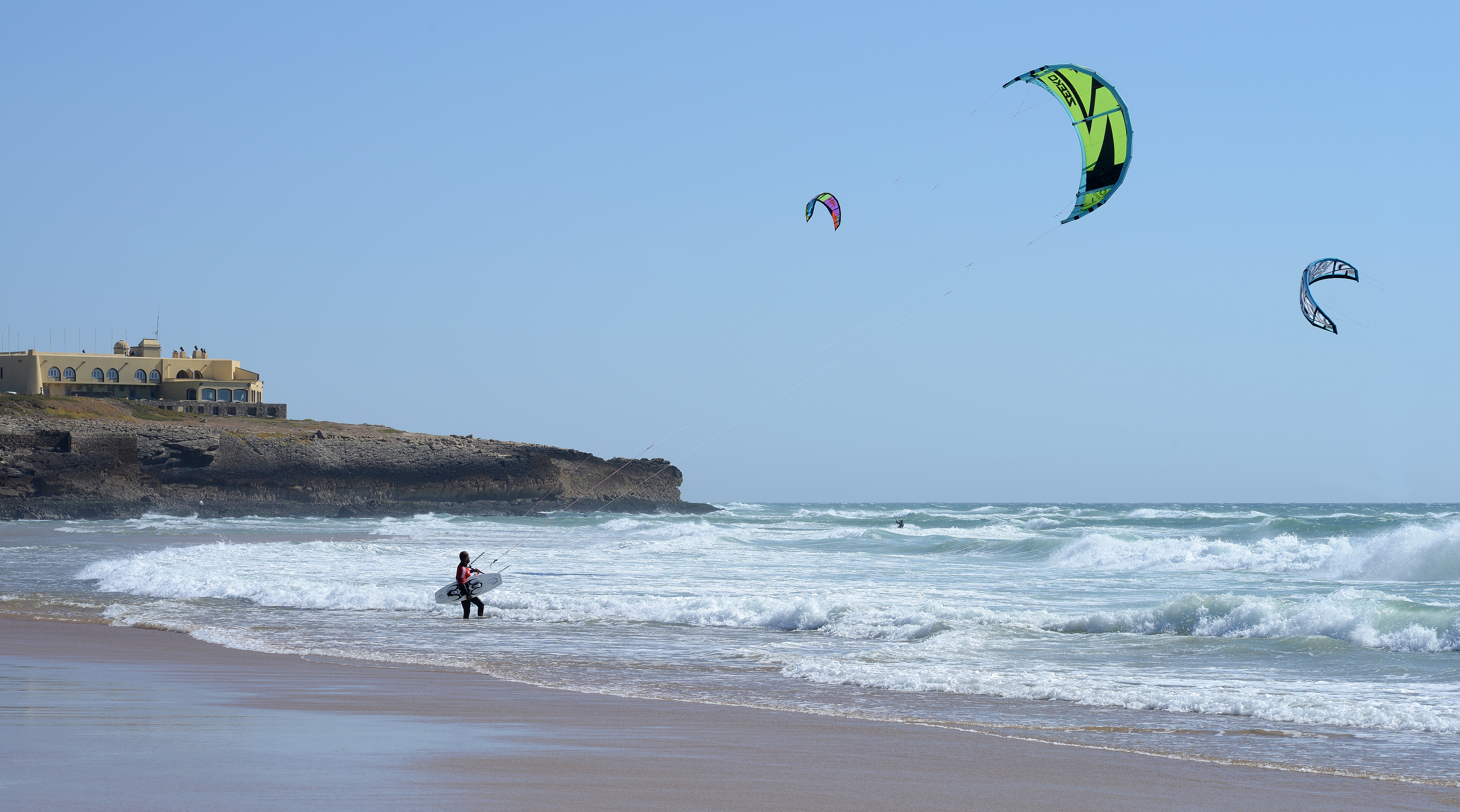
The Serra de Sintra funnels a hard summer north wind, the nortada, onto Guincho, making this Atlantic beach Portugal's home of wave-sailing.

Guincho February 2010-2.jpg · <a href="//commons.wikimedia.org/wiki/User:Alvesgaspar" title="User:Alvesgaspar">Alvesgaspar</a> · CC BY-SA 3.0
Nearest airport
CAT · 10 km
I’m here for
Story

Praia do Guincho is an exposed Atlantic beach on the Estoril coast, about 5 km northwest of Cascais and on the western edge of the Sintra-Cascais Natural Park, in the District of Lisbon. It runs roughly 800 metres of open sand between rocky headlands, facing the ocean with no bay or island to shelter it. Its defining feature is not the sand but the wind: through the summer the north-to-northwest nortada blows almost daily, strengthened by the thermal low over the Iberian interior and channelled past the Serra de Sintra and Cabo da Roca onto the beach. It carries a Blue Flag.

That reliable summer wind is why Guincho became the centre of Portuguese wave-sailing. The beach hosted the country's first major international windsurfing event in the summer of 1986, with riders including Robby Naish, and through the 1990s and 2000s it was a stop on the Professional Windsurfers Association (PWA) World Cup tour. The PWA World Cup Guincho Wave Contest of June 2005 ran 15-19 June for €55,000 in prize money. The same conditions draw kitesurfers and surfers.

The exposure that makes Guincho a wind-sports venue makes it a poor swimming beach. The Wikipedia entry and Portuguese surf sources describe strong currents, a powerful shore break, and rapidly changing wind, and warn inexperienced swimmers and families with young children to stay out of the water. This is a working beach for people on boards, not a calm bay for wading.

The wind also moves the land. Guincho sits at the seaward end of the Guincho-Cresmina-Oitavos dune system, a 66-hectare body of mobile sand that the prevailing northwest wind pushes inland at about 10 metres a year, carrying grains roughly 5 km south across the rocky ground near Cabo Raso before they return to the sea near Guia. A dune park with close to 2 km of raised boardwalk, opened in 2011, keeps visitors off the drifting sand.

The beach carries a cinematic and culinary footnote. The opening sequence of the 1969 James Bond film On Her Majesty's Secret Service, in which George Lazenby's Bond pulls Diana Rigg's Contessa Tracy from the surf and fights off two attackers, was filmed on this sand. At the south end, the 17th-century coastal fort Fortaleza do Guincho is now a Relais & Chateaux hotel whose restaurant has held a Michelin star since 2001. Cabo da Roca, the westernmost point of mainland Europe, is a short drive north.

Guincho is, in short, a wind machine an hour from a capital: an Atlantic beach whose value is the thing most beaches try to escape.

The spike

The Serra de Sintra funnels a hard summer north wind, the nortada, onto Guincho, making this Atlantic beach Portugal's home of wave-sailing.

Most beaches close to a capital city are sold on their calm: sheltered water, a sun-trap bay, an easy swim. Praia do Guincho, about 40 km west of Lisbon, is sold on the opposite. Its single defining feature is the wind, and the beach's whole identity, from the athletes who fill it in July to the currents that keep families out of the water to the dune marching inland behind it, follows from that one fact. Guincho is where the summer nortada meets an unsheltered Atlantic beach, and that meeting made it the home of Portuguese wave-sailing.

What the nortada is. The nortada is the prevailing north-to-northwest wind of the Portuguese west coast in summer. It is driven by the semi-permanent Azores High offshore and the thermal low that forms over the heated interior of the Iberian Peninsula, which together set up a persistent pressure gradient that pulls air down the coast from the north. Most of the coast feels it. Guincho feels it harder because of its geography: the Serra de Sintra rises behind the beach, and the coastline turns at Cabo da Roca just to the north, so the airflow is compressed and accelerated as it rounds the high ground and funnels onto this stretch of open sand. The result is a wind that, through June, July, and August, blows reliably and strong on days when much of the Mediterranean is glassy and dead.

Why that reliability is rare and valuable. Wave-sailing needs two things at once: waves to ride and wind to sail on. Most powerful surf coasts get their biggest swell in winter, when local winds are unreliable and often blowing the wrong way; most reliably windy places lack real ocean swell. Guincho is unusual in delivering both together, and in delivering the wind in the summer months when a competition can actually be scheduled and an audience can actually stand on the beach. That is why the sport found it early. The beach hosted Portugal's first major international windsurfing event in the summer of 1986, drawing riders including Robby Naish, and through the 1990s and 2000s it was a fixture on the PWA World Cup wave tour. The PWA World Cup Guincho Wave Contest held 15-19 June 2005 offered €55,000 in prize money. The nortada, not the scenery, is what put Guincho on the world tour.

The waves underneath. The reanalysis wave record for this stretch (Open-Meteo, drawing on ERA5) puts the annual mean significant wave height at about 2.29 metres, the biggest month in March at 3.34 metres, the calmest in July at 1.57 metres, and a peak modelled day of 5.68 metres, with a typical swell period around 10 seconds. The beach breaks over a shifting sand bottom and produces both left and right-breaking waves. The seasons split the disciplines: winter brings easterly offshore winds and larger swells for surfing, while the summer nortada, blowing side-shore to onshore over smaller northwest swell, is the classic wave-sailing setup. It is a demanding beach in both modes, better suited to riders who already know what they are doing than to first-timers.

The cost of the exposure. The same open Atlantic that feeds the wind and swell makes Guincho dangerous to swim. Its own Wikipedia entry and Portuguese surf references list strong currents, a heavy shore break, and quickly shifting wind, and specifically caution inexperienced swimmers and families away from the water. This is the honest tension of the place: the property that makes it worth a page is the property that makes it unsafe for the thing most people go to a beach to do. Guincho is a Blue Flag beach, but the flag is about facilities and water quality, not about calm.

The wind builds the land, too. Behind the sand, the nortada and its northwest cousins do slower work. Guincho anchors the seaward edge of the Guincho-Cresmina-Oitavos dune system, 66 hectares of mobile sand that the wind drives inland at roughly 10 metres a year, moving grains about 5 km south over the low rocky ground near Cabo Raso until they wash back into the sea near Guia. The dune is a living transport belt powered by the same wind the sailors ride. To stop foot traffic from breaking it up, Cascais and Portugal's nature-conservation institute opened a dune park in 2011 with close to 2 km of raised boardwalk across the sand.

Why it earns a page. Plenty of beaches are windy and plenty are beautiful. Guincho's singular claim is the combination and the reliability: a hard, dependable summer wind on an unsheltered Atlantic beach within an hour of Lisbon, arriving in exactly the months a sport can use it. That is what drew the world tour, what built the dune, and what the camera caught in 1969, when the opening of On Her Majesty's Secret Service filmed George Lazenby's Bond wading into this same surf. The wind is the beach.

Guincho May 2012-1.jpg
Culture

Where it shows up

Film
  • On Her Majesty's Secret Service · 1969
    Peter R. Hunt

    The sixth James Bond film opens on Praia do Guincho, with George Lazenby's Bond rescuing Diana Rigg's Contessa Tracy di Vicenzo from the surf and fighting off two attackers before the title sequence. Bond's hotel scenes were shot at the Hotel Palacio in nearby Estoril.

Other
  • The nortada

    The prevailing summer north-to-northwest wind of the Portuguese west coast, the physical fact around which Guincho's identity as a wave-sailing beach is built. It is accelerated onto the beach by the Serra de Sintra and the coastal turn at Cabo da Roca.

History
  • Guincho and Portuguese wave-sailing · 1986

    The beach hosted Portugal's first major international windsurfing event in 1986 with riders including Robby Naish, and became a PWA World Cup wave tour venue through the 1990s and 2000s, making it the recognised home of the sport in the country.

Guincho June 2013-3.jpg
History

What happened here

  1. 1969cultural

    On Her Majesty's Secret Service films its opening at Guincho

    The pre-title sequence of the sixth James Bond film, in which George Lazenby's Bond rescues Diana Rigg's Contessa Tracy di Vicenzo from the surf and fights off two attackers with improvised weapons, is shot on Praia do Guincho, with Bond's hotel scenes filmed at the Hotel Palacio in Estoril.

    Wikipedia →
  2. 1986cultural

    Portugal's first major international windsurfing event

    Guincho hosts the country's first major international windsurfing competition, drawing riders including Robby Naish, and establishes the beach as the centre of Portuguese wave-sailing.

  3. 2001founding

    Fortaleza do Guincho restaurant earns a Michelin star

    The restaurant inside the 17th-century coastal fort at the beach's south end, then under chef Antoine Westermann, is awarded its first Michelin star, a distinction it has held every year since.

  4. 2005cultural

    PWA World Cup Guincho Wave Contest

    The PWA World Windsurfing Tour holds its Guincho Wave Contest from 15 to 19 June 2005 for €55,000 in prize money, part of a run of PWA World Cup stops the beach hosted through the 1990s and 2000s.

  5. 2011policy

    Guincho-Cresmina dune park opens

    Cascais municipality, with Portugal's nature-conservation institute, opens a managed dune park across the mobile Guincho-Cresmina dune system, with close to 2 km of raised boardwalk built to keep foot traffic off the drifting sand.

    Wikipedia →
  6. 2018natural

    Fire damages the dune boardwalk

    A fire on 6 October 2018 damages the northern section of the Cresmina dune walkway; the damaged section is subsequently repaired.

    Wikipedia →
  7. 2025cultural

    Guincho Wave Classic announced

    Organizers announce the Guincho Wave Classic, promoted as the return of tour-level wave-sailing to Guincho; as of mid-2026 no event dates or results have been published.

The honest part
“The thing that makes Guincho remarkable is the thing that makes it dangerous.”

The comfortable way to describe Guincho is as a wild Atlantic beach with a famous wind and a James Bond cameo. The honest version keeps the same facts but reads them differently: the thing that makes Guincho remarkable is the thing that makes it dangerous. The nortada and the open-ocean swell that draw windsurfers and kitesurfers from across Europe also produce strong currents and a heavy shore break, and the beach's own references warn inexperienced swimmers and families with young children out of the water. This is not a swimming beach that happens to be windy; it is a wind-and-wave arena that happens to have sand.

It is also a beach under slow physical stress. The dune system behind it is mobile by nature, marching inland about 10 metres a year, and the wider Estoril coast faces the erosion and development pressure common to a shoreline an hour from a growing capital. The 2011 dune park and its 2 km of boardwalk exist because unmanaged foot traffic was breaking the dunes apart. Guincho rewards people who arrive on its terms, with the right board and a healthy respect for the water, and punishes those who treat it as a calm-water resort beach.

Guincho June 2013-4.jpg
Anatomy

The shape of the place

South end, the fort, and free parking

10%

The southern approach to the beach, closed by the Fortaleza do Guincho, the 17th-century fort now run as a hotel and Michelin-starred restaurant, sandwiched between Praia do Guincho and Praia da Cresmina immediately to the south. Free parking sits a short 2-5 minute walk from the sand, along with the bus stop for Cascais services.

Best for The fort's dining and views, free parking, and bus access

Free parking fills early on windy summer days; local bus 15 runs from Cascais.

Cresmina dune and boardwalk

20%

The inland edge of the beach where the mobile Guincho-Cresmina dune system begins. A managed dune park with close to 2 km of raised boardwalk crosses the sand, opened in 2011.

Best for Walking the dune boardwalk and reading the wind-built landscape

Stay on the boardwalk; the dune is active and protected, advancing inland about 10 metres a year.

The main sand

50%

The central sweep of open Atlantic sand where windsurfers, kitesurfers, and surfers rig and launch. Fully exposed to the nortada and the swell, with a shifting sand-bottom break producing both lefts and rights.

Best for Windsurfing, kitesurfing, and experienced surfers

Strong currents and a heavy shore break; not a safe swimming beach for the inexperienced or for young children.

North end parking

90%

The rocky northern headland, where the beach's main paid parking (around 500 spaces) sits.

Best for Parking and views over the beach

Paid parking at the north end; some spaces are free in winter.

Landmarks

Fortaleza do Guincho

fort

A 17th-century coastal fortification at the beach's south end, part of the line of forts defending the approaches to Lisbon, now run as a Relais & Chateaux hotel. Its restaurant has held a Michelin star continuously since 2001.

Cresmina Dune

dune

The 66-hectare mobile dune at the seaward end of the Guincho-Cresmina-Oitavos dune system, driven inland by the prevailing northwest wind at about 10 metres a year. A dune park with close to 2 km of boardwalk opened in 2011.

Wikipedia →

Cabo da Roca

cape

The westernmost point of mainland Europe, on the Sintra-Cascais coast a short drive north of Guincho, marked by a lighthouse and a cliff-top monument. It is part of the same headland geography that funnels the nortada onto the beach.

Wikipedia →
A day here

From first light to dark

Dawn

Mornings are often the calm window. In summer the nortada typically softens overnight and builds through the day, so dawn is when surfers get the cleanest, least wind-blown waves before the sailors take over. The light comes over the Serra de Sintra behind the beach rather than off the water.

Midday

By early afternoon in summer the nortada is up and the water fills with windsurf and kite sails working the side-shore wind across the swell. The sand streams with blown grains, and the open beach offers little shelter from wind or sun.

Golden hour

Late afternoon holds the strongest, steadiest wind of the day and the busiest water. As the sun drops toward the Atlantic the sails keep working; Guincho faces roughly west, so the sunset falls straight down the beach into the ocean.

Night

After dark the beach empties and the wind usually eases. The Fortaleza do Guincho at the south end and the lights of Cascais to the southeast are the only markers; the surf keeps breaking against an unlit shore.

Guincho May 2012-2.jpg
Sea & surf

What the water does

JFMAMJJASONDmetres (significant wave height)

Solid = typical monthly wave height; pale = the bigger days (90th pct). Offshore/regional swell from Open-Meteo Marine (ERA5 Ocean reanalysis, 2023–2024); a sheltered cove may sit calmer than this.

Heavy — a powerful, surf-driven coast
Typical wave height
2.29 m
Biggest swell
Mar · 3.34 m
Calmest
Jul · 1.57 m
Typical period
10.2 s (groundswell)
Before you go

Things to know

It is a wind-sports beach, not a swimming beach

Strong currents, a heavy shore break, and shifting wind make Guincho dangerous for inexperienced swimmers and families with young children. It is best used for windsurfing, kitesurfing, or experienced surfing, or for watching.

The wind builds through the day in summer

The nortada is usually lightest in the morning and strongest in the afternoon and early evening. Surfers favour the calmer dawn; sailors favour the windy afternoon. Plan your visit around which you want.

Stay off the dunes

The Guincho-Cresmina dune is an active, protected, moving landscape. Use the 2 km of raised boardwalk in the dune park; walking on the dune itself damages it and is discouraged.

Bring wind protection

The beach is fully exposed, with little natural shelter from wind or sun. Blown sand is normal on strong nortada days; a windbreak and layers make a long visit far more comfortable.

Surf & rip

Powerful water — strongest around Mar, gentlest in Jul. Mind rip currents; this isn't a wade-in-anywhere beach.

Sharks

No incidents on record in the global shark-attack file.

Plan

If you go

Getting there
Nearest airport
Cascais Airport (CAT) · 10 km
Nearest town
Cascais · 6 km

Praia do Guincho is about 5 km northwest of Cascais and roughly 40 km west of central Lisbon; the practical arrival airport is Lisbon Humberto Delgado (LIS), as the nearer Cascais aerodrome handles only general aviation. From Cascais, local bus 15 runs to the beach, and a single access road serves it. There is paid parking (around 500 spaces) at the north end and free parking a short walk from the sand at the south end, some of which is free in winter.

When to go
  • Summer wave-sailing season · Daily through June-August, wind building through the afternoon

    The reliable summer nortada makes Guincho a daily gathering point for windsurfers and kitesurfers through the high season, the everyday version of the competitions the beach has hosted since 1986.

What to eat & drink
Fortaleza do Guincho tasting menus

The restaurant inside the 17th-century fort at the beach's south end has held a Michelin star since 2001, first under chef Antoine Westermann and, since 2018, under Gil Fernandes. It serves a la carte and set tasting menus built around Atlantic seafood, overlooking the beach and Cabo da Roca.

Fortaleza do Guincho, south end of Praia do Guincho

Grilled Atlantic fish and seafood

The restaurants strung along the Guincho access road and cliff specialise in the day's Atlantic catch, grilled whole, alongside percebes (goose barnacles) and other shellfish from this exposed coast. This is the standard Cascais-coast seafood meal, eaten with the wind in view.

Restaurants along the Estrada do Guincho behind the beach

Travesseiros and queijadas de Sintra

The pastry specialities of nearby Sintra, a short drive inland: travesseiros, flaky almond-and-egg pillows, and queijadas, small cinnamon cheese tarts. They are a Sintra tradition, not a beach product, and are bought in the historic town rather than on the sand.

Bakeries in Sintra town, inland from the beach

Sources & references
  1. Wikipedia: Praia do Guincho · cited 3×
  2. Wikipedia: On Her Majesty's Secret Service; onthetracksof007.com · cited 2×
  3. PWA World Tour · cited 2×
  4. PWA World Tour; Boards Windsurfing · cited 2×
  5. Wikipedia: Cresmina Dune · cited 2×
  6. Michelin Guide; Relais & Chateaux
  7. Wikipedia: Cresmina Dune; Climate-ADAPT
  8. guinchowaveclassic.com
  9. Open-Meteo Marine (ERA5 reanalysis, 2023-2024)
Colophon · Provenance

Where this page comes from

Geography, facilities
OpenStreetMap (ODbL) for geometry and facility tags within 500 m of the beach centroid. GeoNames for city/airport distances.
Climate & ocean
Open-Meteo ERA5 + Marine archive, 2014–2023 monthly normals.
Photography
Archival, original tone (Tier B — Wikimedia Commons). Each image licensed per its own terms; attribution visible inline.
History & culture
Every factual claim is linked to its source in the prose above. Wikipedia citations inline. Non-wiki sources named where relevant.
Editorial voice
Register: clinical. Written to pass a local's nod test; corrections welcome.
Written by Erin Rose
Last reviewed 2026-04-19
v0.9 — in editorial development toward v1.0