Ontario, CA

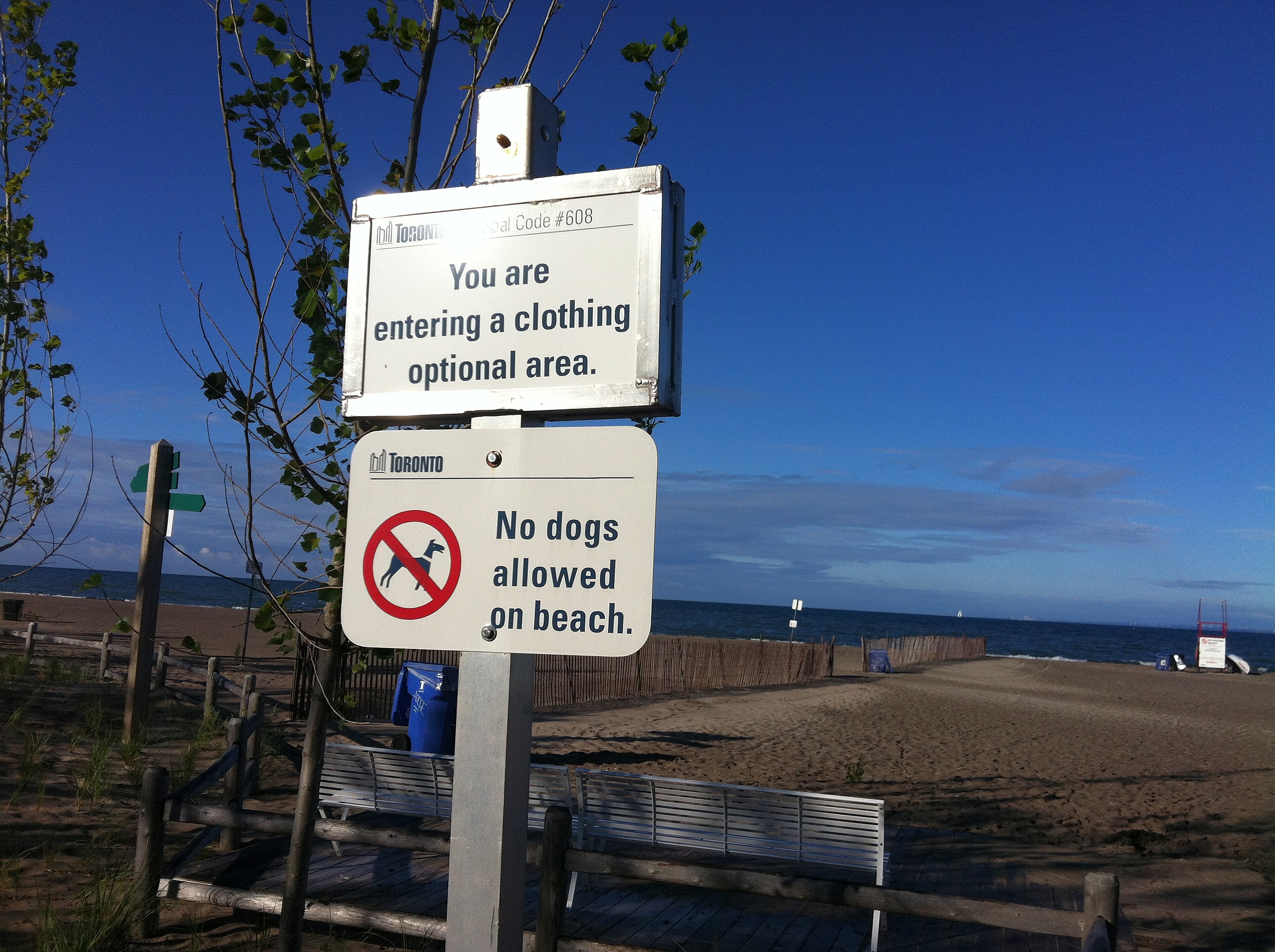
Hanlan's Point Beach

Hanlans Point nudist.jpg

Ontario, CA

Hanlan's Point Beach

Toronto's 1894 by-law legalizing nude bathing on a 200-by-50-foot strip here is called the world's oldest official nude-beach zoning.

Hanlans Point nudist.jpg · <a href="https://en.wikipedia.org/wiki/User:Jgera5" class="extiw" title="w:User:Jgera5">Jgera5</a> (<a href="https://en.wikipedia.org/wiki/User_talk:Jgera5" class="extiw" title="w:User talk:Jgera5">ta · CC BY-SA 3.0
Nearest airport
YTZ · 1 km
I’m here for
Story

Hanlan's Point Beach sits at the western tip of the Toronto Islands, a chain of islands and sandbars in Lake Ontario just offshore from downtown Toronto, reached by a roughly 15-minute ferry crossing from the Jack Layton Ferry Terminal at the foot of Bay Street. Billy Bishop Toronto City Airport sits 1.4 km away in a straight line, close enough that arriving aircraft are visible from the sand. The point and beach take their name from Ned Hanlan, world sculling champion from 1880 to 1884, whose father John built a small hotel on this shoreline after an 1865 storm pushed the family west along the island.

On 17 July 1894, Toronto City Council passed By-law No. 3268, designating a 200-by-50-foot strip of this beach where bathing without a suit was legally permitted, a response to complaints about undressed swimmers on the wider waterfront. The International Naturist Federation calls it the world's oldest official nude-beach designation, predating other recognized legal nude beaches by decades. The city reversed the permission in 1930.

Between 1897 and 1925, Hanlan's Point Stadium stood on the same point, home to the minor-league Toronto Maple Leafs. On 5 September 1914, a 19-year-old Providence Grays pitcher named Babe Ruth threw a one-hitter here and hit his first professional home run in a 9-0 win. The stadium and its amusement park were demolished in 1937 for what is now Billy Bishop Toronto City Airport; 37 cottages were removed for the airport, and 31 of them were moved by barge to Algonquin Island (then Sunfish Island) in 1938.

By the 1940s the same beach had become an established gathering place for gay and lesbian Torontonians. On 1 August 1971, organizers held the Gay Day picnic here, generally counted as Canada's first Pride event. In August 1975, city police raided the beach and charged 62 people, 59 of them men, with indecent exposure, as The Globe and Mail reported that month. The city restored clothing-optional status via a 1999 pilot, extended it in 2000, and made the designation permanent in 2002.

In 2023, Toronto City Council expanded the clothing-optional zone to the entire beach and formally recognized Hanlan's Point as one of the ten oldest surviving queer spaces in the world, adding a Pride flagpole and pledging ecological restoration. That recognition arrived alongside a newer problem: by 2026, erosion had stripped much of the beach's sand, and the city's restoration plan had not yet broken ground.

The spike

Toronto's 1894 by-law legalizing nude bathing on a 200-by-50-foot strip here is called the world's oldest official nude-beach zoning.

Hanlan's Point Beach is a nude beach because 19th-century Toronto wanted to stop people from complaining about naked swimmers, not because the city set out to build a landmark of sexual freedom. The paper trail runs through a single, oddly specific piece of municipal law, and it is that law, more than any physical feature of the shoreline, that makes this stretch of the Toronto Islands historically singular.

The 1894 by-law. On 17 July 1894, Toronto City Council passed By-law No. 3268, setting aside a 200-by-50-foot section of the beach at Hanlan's Point where bathing without a suit was legally permitted. Nineteenth-century Toronto had no shortage of complaints about undressed swimming along its waterfront, and council's solution was not to ban the practice outright but to zone it: contain it to one small, defined patch of sand, away from the more genteel excursion crowds using the rest of the island. City archives hold the original text as By-law No. 3268, vol. 1 (1894), App. B. The International Naturist Federation, writing on the designation in 2025, calls it the world's oldest official legal nude-beach zone, predating other recognized nude beaches by decades. That claim rests on a single naturist advocacy organization's research rather than an exhaustive global survey, but no older municipal nude-bathing law has been documented to contradict it.

A reversal, then a stadium, then an airport. The permission did not last unchallenged. A 1930 by-law eliminated the clothing-optional zone, and for the next several decades Hanlan's Point's public identity was built on other things entirely: the Toronto Maple Leafs' baseball stadium, built in 1897 and rebuilt after fires in 1903 and 1909, where a 19-year-old Providence Grays pitcher named Babe Ruth hit his first professional home run on 5 September 1914; an amusement park; a regatta course; and a small community of waterfront cottages. The stadium and park were demolished in 1937 to build what became Billy Bishop Toronto City Airport (opened 1939 as Port George VI Island Airport); 37 cottages were removed from the site, and 31 of them were moved by barge to Algonquin Island (then Sunfish Island) in 1938. The point that had briefly been a legal nude beach spent the interwar decades as sports and transportation infrastructure instead.

The queer history that outlasted the by-law. What survived the 1930 reversal was informal, not legal: by the 1940s, gay and lesbian Torontonians had begun using the same stretch of shoreline as an unofficial gathering place, a pattern activist George Hislop was describing as an established fact by 1958. That informal use became explicitly political on 1 August 1971, when the Community Homophile Association of Toronto and allied groups organized a Gay Day picnic at Hanlan's Point, an event now generally counted as Canada's first Pride gathering. The tolerance was not official: in August 1975, city police raided the beach and charged 62 people, 59 of them men, with indecent exposure, as The Globe and Mail reported that month, a case that ran through the courts into 1976 alongside further arrests and confrontations. The queer community kept using the beach anyway.

From pilot project to permanent recognition. The city did not restore legal clothing-optional status until more than a century after the original by-law. A one-year pilot project in 1999 permitted nude use again; council extended it in 2000 and made the designation permanent in 2002. In 2023, council went further, expanding the clothing-optional zone from a defined section to the entire beach and formally recognizing Hanlan's Point as one of the ten oldest surviving queer spaces anywhere in the world, a designation that folds the 1894 by-law, the 1971 picnic, and the 1975 raid into a single continuous claim on the site rather than three disconnected episodes.

What the throughline actually proves. None of this makes Hanlan's Point unusually large, scenic, or well-maintained as a beach; erosion documented through 2026 has left much of the sand gone, and a promised restoration plan had not started. Reporting on that erosion in 2026, including coverage from CityNews Toronto and CTV News Toronto, described advocates pressing the city over the slow pace of its response, a pattern not unlike the decades between the 1930 repeal and the 1999 pilot project: the physical space keeps getting used long before the city's paperwork catches up to how it is actually used. What the throughline proves is narrower and more specific: a 19th-century zoning compromise aimed at silencing swimwear complaints created, by accident, the physical conditions for one of the world's oldest continuously used queer gathering spaces, more than a century before the city got around to saying so officially. The by-law's authors were not building a monument, and neither were the airport planners who paved over the stadium in 1937, or the police who raided the beach in 1975. The monument built itself, out of whoever kept showing up on that 200-by-50-foot strip of sand after the rest of the point had been used for baseball, a fair, and then an airport.

Hanlan's Bay (52805631946).jpg
Culture

Where it shows up

History
  • By-law No. 3268 (1894) · 1894
    Toronto City Council

    The municipal by-law that legalized nude bathing on a 200-by-50-foot strip of Hanlan's Point, called by the International Naturist Federation the world's oldest official nude-beach designation.

  • Gay Day picnic, 1971 · 1971
    Community Homophile Association of Toronto

    Held at Hanlan's Point on 1 August 1971, generally counted as Canada's first Pride event.

Other
  • Babe Ruth's first professional home run · 1914

    Hit at Hanlan's Point Stadium on 5 September 1914 while Ruth pitched for the Providence Grays against the Toronto Maple Leafs.

  • World's oldest surviving queer space designation · 2023
    City of Toronto

    Toronto City Council's 2023 recognition names Hanlan's Point one of the ten oldest surviving queer spaces anywhere in the world.

Rainbow Road, Hanlan's Point Beach.jpg
History

What happened here

  1. 1855cultural

    Ned Hanlan is born

    Ned Hanlan, later five-time World Sculling Champion, is born in Toronto on 12 July 1855; his father's waterfront hotel gives the point its name.

    Wikipedia →
  2. 1894policy

    Toronto legalizes nude bathing on a 200×50 ft strip

    Toronto City Council passes By-law No. 3268 on 17 July 1894, designating a 200-by-50-foot section of Hanlan's Point where bathing without a suit is legally permitted, later called the world's oldest official nude-beach zoning.

    Wikipedia →
  3. 1914cultural

    Babe Ruth hits his first professional home run

    On 5 September 1914, Providence Grays pitcher Babe Ruth throws a one-hitter and hits his first professional home run at Hanlan's Point Stadium in a 9-0 win over the Toronto Maple Leafs.

    Wikipedia →
  4. 1930policy

    Clothing-optional zone repealed

    A new by-law eliminates the clothing-optional section created in 1894, ending the beach's legal nude-bathing status for nearly seventy years.

    Wikipedia →
  5. 1937founding

    Stadium demolished, cottages moved for the airport

    Hanlan's Point Stadium and its amusement park are demolished to build what is now Billy Bishop Toronto City Airport; 37 cottages are removed for the airport, and 31 of them are moved by barge to Algonquin Island (then Sunfish Island) in 1938.

    Wikipedia →
  6. 1971cultural

    Canada's first Pride event

    On 1 August 1971, the Community Homophile Association of Toronto and allied groups hold the Gay Day picnic at Hanlan's Point, generally counted as Canada's first Pride gathering.

    Wikipedia →
  7. 1975policy

    Police raid the beach

    In August 1975, Toronto police raid Hanlan's Point and charge 62 people, 59 of them men, with indecent exposure, as The Globe and Mail reports that month.

    Wikipedia →
  8. 2002policy

    Clothing-optional status made permanent

    After a one-year pilot in 1999 and a two-year extension in 2000, the city makes Hanlan's Point's clothing-optional designation permanent in 2002.

    Wikipedia →
  9. 2023policy

    Recognized as one of the world's oldest queer spaces

    Toronto City Council expands the clothing-optional zone to the full beach and formally recognizes Hanlan's Point as one of the ten oldest surviving queer spaces in the world, adding a Pride flagpole and committing to ecological restoration.

    Wikipedia →
The honest part
“The 2023 recognition arrived only after decades in which showing up at Hanlan's Point could mean arrest.”

The honest complication is that Hanlan's Point's celebrated history and its current condition are pulling in opposite directions. The 1894 by-law was not tolerance; it was containment, a way to keep undressed swimmers out of sight of the excursion crowds on the rest of the island, and for most of the 20th century the city treated the same use it now honors as a prosecutable offense: the 1930 repeal stood for nearly seventy years, and the August 1975 raid that charged 62 people with indecent exposure happened well within living memory of adults who use the beach today. The 2023 recognition as one of the world's oldest surviving queer spaces arrived only after decades in which showing up at Hanlan's Point could mean arrest.

Meanwhile the physical beach the history is attached to has been disappearing. By 2026, erosion had stripped much of Hanlan's Point down to a fraction of its former sand, and the restoration plan the city committed to alongside its 2023 heritage designation had not started construction. The place being commemorated as a historic queer landmark is, in the same period, at risk of not functioning as a beach at all without intervention the city has not yet delivered.

Clothing optional beach.jpg
Anatomy

The shape of the place

Airport boundary

5%

The fenced edge of Billy Bishop Toronto City Airport, built in 1937 on the site of Hanlan's Point Stadium and its amusement park; there is no public path from the beach into the airport grounds.

Departing and arriving aircraft are visible and audible from the beach.

North end / family section

20%

The northern stretch toward the airport boundary functions as a standard textile (clothed) beach used by families and casual visitors.

Best for Families, swimming in suits

Eroded shoreline

50%

The stretch of sand most visibly narrowed by erosion documented through 2026, where the city's proposed restoration plan had not broken ground.

Extent of sand loss varies with season and Lake Ontario water levels.

Clothing-optional south end

70%

The southern section, near Gibraltar Point and expanded to cover the full beach in 2023, is Toronto's clothing-optional zone and the direct descendant of the 1894 legal strip.

Best for Clothing-optional swimming and sunbathing

Formal recognition as one of the world's oldest surviving queer spaces dates to 2023.

Landmarks

Billy Bishop Toronto City Airport · 1939

airport

Built on the site of Hanlan's Point Stadium, its amusement park, and dozens of cottages, the airport opened in 1939 as Port George VI Island Airport at the point's northwest edge.

Wikipedia →

Ned Hanlan statue · 1926

monument

A bronze statue of rower Ned Hanlan, unveiled in 1926 at the Canadian National Exhibition, was relocated to the Hanlan's Point ferry dock in 2004.

Wikipedia →

Hanlan's Point Stadium site · 1897

historic site · Charles F. Wagner (1910 rebuild)

Home of the minor-league Toronto Maple Leafs from 1897–1901 and 1908–1925, and the site of Babe Ruth's first professional home run in 1914; demolished in 1937 for the airport.

Wikipedia →
A day here

From first light to dark

Dawn

Early ferries reach Hanlan's Point before most of the clothing-optional crowd arrives; the sand is coldest and quietest, with Lake Ontario typically calm and airport traffic across the water just beginning for the day.

Midday

By late morning, when summer ferries run roughly every 30 minutes, the beach fills: clothing-optional bathers on the southern section, families and swimmers in suits on the north end, both crowded closer together than in past decades by the erosion-narrowed sand.

Golden hour

Late afternoon sun sets over the open lake on this west-facing shoreline, with no skyline in view — just Billy Bishop's runway lights to the north and the Gibraltar Point treeline to the south. The wave record for this stretch of Lake Ontario shows its calmest water of the year in July, with a typical wave period near 3.3 seconds, meaning flat, warm late-day swims through peak season.

Night

Ferries stop running around midnight in summer and earlier off-season; after the last boat, the beach empties and Billy Bishop's runway lights are the main illumination across the water, with no lifeguard or vendor presence overnight.

GP Lighthouse ALD.jpg
Sea & surf

What the water does

JFMAMJJASONDmetres (significant wave height)

Solid = typical monthly wave height; pale = the bigger days (90th pct). Offshore/regional swell from Open-Meteo Marine (ERA5 Ocean reanalysis, 2023–2024); a sheltered cove may sit calmer than this.

Calm — gentle swimming water most of the year
Typical wave height
0.51 m
Biggest swell
Jan · 0.71 m
Calmest
Jul · 0.24 m
Typical period
3.3 s (wind chop)
Before you go

Things to know

No food or water on-site

Hanlan's Point has no vendors; pack food and water before the ferry, and carry out what you bring in.

Two beach cultures share one strip

The southern section is clothing-optional, expanded citywide in 2023; the northern end is a standard textile beach used by families — both share the same eroded, narrowing shoreline.

No path to the airport

Billy Bishop Toronto City Airport is 1.4 km away by straight-line distance and visible from the sand, but there is no public route from the beach into the airport grounds; reaching it requires the mainland ferry route.

Ferries stop overnight

Toronto Island ferries run on a schedule that ends around midnight in summer and earlier off-season; missing the last boat means being stuck on the island.

Swimming

Usually calm water — among the gentler beaches for a swim.

Sharks

No incidents on record in the global shark-attack file.

Plan

If you go

Getting there
Nearest airport
Billy Bishop Toronto City Airport (YTZ) · 1 km
Nearest town
Toronto · 10 km

Hanlan's Point Beach is reached by Toronto Island ferry from the Jack Layton Ferry Terminal at the foot of Bay Street, a roughly 15-minute crossing to the Hanlan's Point dock. Billy Bishop Toronto City Airport (YTZ) sits 1.4 km away in a straight line at the point's northwest edge, but has no public pedestrian connection to the beach; travelers must use the mainland ferry route. There is no vehicle bridge to this part of the island chain.

When to go
  • Pride season gatherings · Late June, coinciding with Toronto Pride

    Hanlan's Point sees increased crowds during Toronto's Pride Month events in late June, continuing a use of the beach as a queer gathering site that dates to the 1940s.

What to eat & drink
No vendors on the beach

Hanlan's Point has no food or drink concessions of its own; visitors pack in what they need before the ferry crossing.

On-site: none

St. Lawrence Market stalls

Toronto's historic St. Lawrence Market, on the walk between Union Station and the ferry terminal, sells prepared food and groceries and is a common pre-ferry stop for beach picnics.

92 Front St E, near the Jack Layton Ferry Terminal

Centre Island seasonal concessions

Toronto Island Park's Centre Island section runs seasonal snack concessions; Hanlan's Point itself has none, so some visitors island-hop east for food.

Centre Island, a walk or bike ride east of Hanlan's Point

Sources & references
  1. Wikipedia: Hanlan's Point Beach · cited 7×
  2. Wikipedia: Ned Hanlan · cited 2×
  3. Wikipedia: Hanlan's Point Stadium · cited 2×
  4. Wikipedia: Billy Bishop Toronto City Airport; Toronto Islands · cited 2×
  5. City of Toronto Archives, By-law No. 3268; Wikipedia: Hanlan's Point Beach
  6. The Globe and Mail, 8 August 1975, via Wikipedia: Hanlan's Point Beach
  7. City of Toronto Archives; Wikipedia: Hanlan's Point Beach
  8. The Globe and Mail, 8 Aug 1975, via Wikipedia: Hanlan's Point Beach
Colophon · Provenance

Where this page comes from

Geography, facilities
OpenStreetMap (ODbL) for geometry and facility tags within 500 m of the beach centroid. GeoNames for city/airport distances.
Climate & ocean
Open-Meteo ERA5 + Marine archive, 2014–2023 monthly normals.
Photography
Archival, original tone (Tier B — Wikimedia Commons). Each image licensed per its own terms; attribution visible inline.
History & culture
Every factual claim is linked to its source in the prose above. Wikipedia citations inline. Non-wiki sources named where relevant.
Editorial voice
Register: reverent. Written to pass a local's nod test; corrections welcome.
Written by Erin Rose
Last reviewed 2026-04-19
v0.9 — in editorial development toward v1.0