Antalya, TR

Konyaaltı Sahili

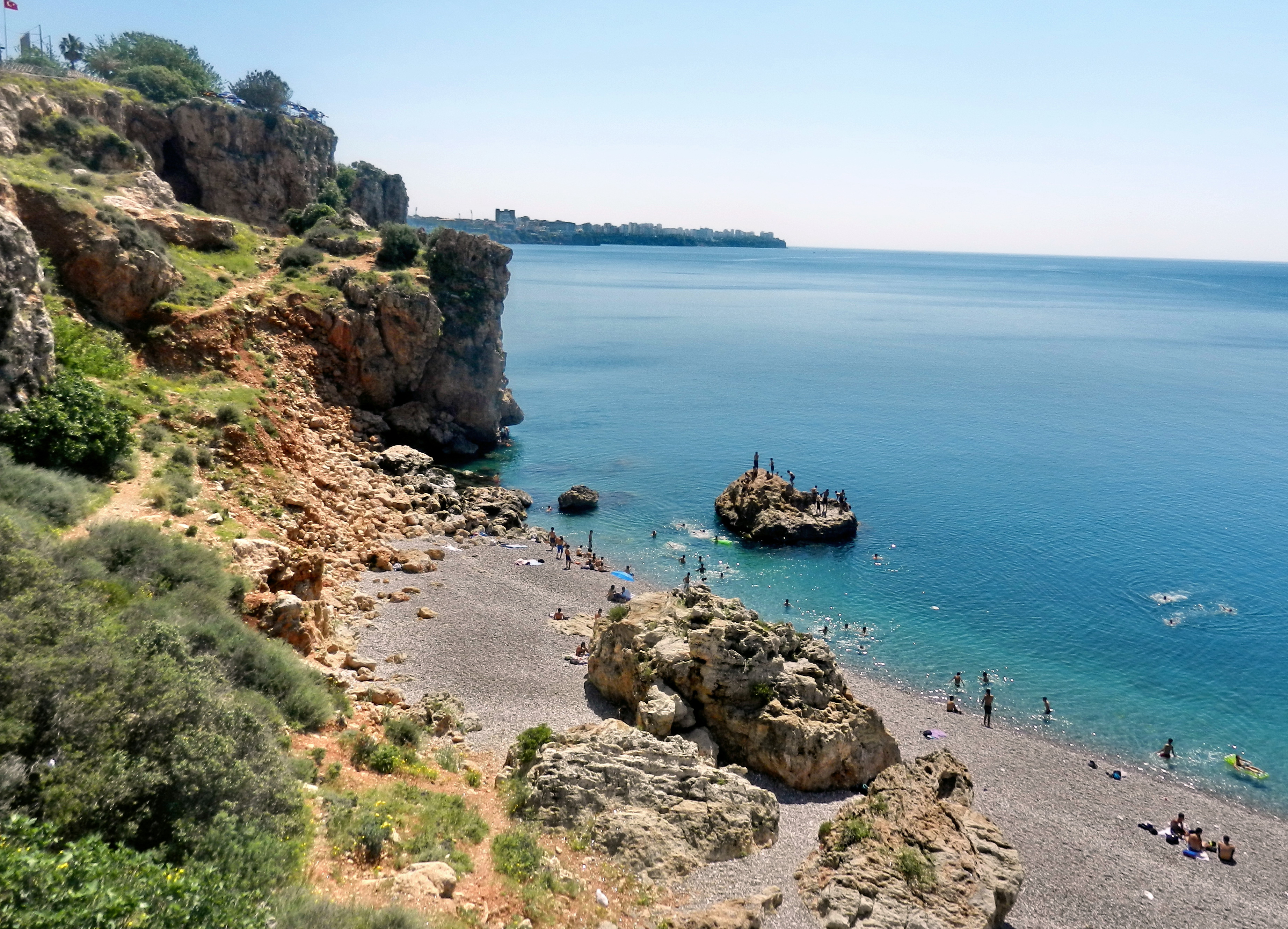
Falezlerden Antalya Konyaaltı Plajına doğru bir görünüm.jpg

Antalya, TR

Konyaaltı Beach

The pebble city beach of Antalya under the Taurus mountains — the Blue-Flag shore of one of the most-visited cities on Earth, 17 million tourists a year, ahead of Paris.

Falezlerden Antalya Konyaaltı Plajına doğru bir görünüm.jpg · <a href="//commons.wikimedia.org/wiki/User:Esginmurat" title="User:Esginmurat">Esginmurat</a> · CC BY-SA 4.0
Substrate
gravel
Nearest airport
AYT · 14 km
Tier
Featured
I’m here for
Story

Konyaaltı Beach is the western of Antalya's two great city beaches, a long pebble shore on the Turkish Mediterranean that runs beneath one of the most dramatic backdrops of any urban beach in the world: the Beydağları, the coastal wall of the Taurus mountains, rising almost straight out of the sea behind the bay. Sources put its length at anywhere from about seven to thirteen kilometers, and it carries a Blue Flag for its clear, clean water. On a good day the combination, turquoise sea, pale pebbles, pine and hibiscus along the front, and snow-capped mountains behind, is genuinely spectacular.

The first thing to be honest about is the sand, because there mostly isn't any. Konyaaltı is a pebble beach, fine pebbles with some sand mixed in, and visitors expecting the powder of a tropical resort are routinely surprised. That is the standard local distinction: Konyaaltı, on the west under the mountains, is the pebble beach; Lara, on the east, is the sandy one. Water shoes are the quiet local secret, and the trade-off is real, the pebbles keep the water famously clear.

The second thing to be honest about is the scale of what surrounds it. Konyaaltı is not a quiet cove; it is the front yard of one of the most-visited cities on the planet. Antalya welcomed 17.12 million tourists in 2025, a record, and has ranked among the top handful of cities on Earth for international arrivals, by some measures fourth globally, ahead of Paris. The beach is backed by the Konyaaltı Beach Park, a long strip of bars, cafés, nightclubs, hotels, and the Aqualand waterpark, and in summer it carries the load of a mass-tourism economy built largely on Russian, German, and British package holidays. This is the engine room of the Turkish Riviera, not a secret.

And the third thing is the depth of time underneath all of it. Antalya was founded in roughly 150 BCE as Attaleia, by Attalos II, king of Pergamon, whose scouts, sent to find the best harbor on the south Anatolian coast, reported back that the site was heaven on earth. The old walled town, Kaleiçi, sits on the travertine cliffs, the falez, just east of the beach, and the same cliffs send the Düden waterfalls plunging into the sea nearby. The city has been a prized Mediterranean harbor for over two thousand years.

So Konyaaltı is a beach of honest contradictions: a pebble shore that disappoints sand-seekers and rewards everyone else with clear water; a place of real natural grandeur that is also one of the busiest tourist machines in the world; and a modern resort strip on a coast that an ancient king's scouts already called paradise. The mountains do not care about any of it, and on the right evening, with the sun going down behind the Beydağları into the sea, neither will you.

The spike

The pebble city beach of Antalya under the Taurus mountains — the Blue-Flag shore of one of the most-visited cities on Earth, 17 million tourists a year, ahead of Paris.

Konyaaltı is the city beach of Antalya, and to understand it you have to hold three facts at once: it is genuinely spectacular, it is genuinely not what many visitors expect, and it is one of the busiest tourist places on the planet. All three are true on the same pebble shore, under the same mountains.

The setting. Start with what is undeniable. Konyaaltı runs along the western side of Antalya beneath the Beydağları, the coastal front of the Taurus mountains, which rise almost straight out of the Mediterranean behind the bay and hold snow into late spring. Few urban beaches anywhere have a backdrop like it. The water is clear enough to carry a Blue Flag, the long shore is lined with Turkish pine and hibiscus, and the beach stretches for kilometers, sources give figures ranging from about seven to thirteen, depending on where they start and stop measuring. On the right evening, with the sun dropping behind the mountains into the sea, it is one of the great city-beach views in the Mediterranean.

The pebbles. Now the surprise. Konyaaltı is a pebble beach, fine pebbles with some sand mixed in, not the soft powder that the phrase 'Mediterranean beach' conjures for a lot of visitors. This is the standing local distinction: in Antalya, Konyaaltı in the west, under the mountains, is the pebble beach, and Lara in the east is the sandy one. People arrive expecting sand and find shingle, and the quiet local wisdom is to bring water shoes. The trade is real and worth it: pebbles do not cloud the water the way fine sand does, which is a large part of why Konyaaltı's sea is so clear. It is a small but telling negotiation: the beach trades the comfort sand-seekers want for the transparency that, with the mountains behind it, is the thing photographers actually come for.

The scale. The third fact is the one the brochures soft-pedal. Konyaaltı is not a quiet discovery; it is the front yard of one of the most-visited cities on Earth. Antalya drew a record 17.12 million tourists in 2025 and has ranked among the very top cities globally for international arrivals, by some measures fourth in the world, ahead of Paris. The beach is backed by the Konyaaltı Beach Park, a long strip of bars, cafés, nightclubs, hotels, and the Aqualand waterpark, and in summer it carries the full weight of a mass-tourism economy built largely on Russian, German, and British package holidays. This is the engine room of the Turkish Riviera, and the crowds, the development, and the resort monoculture come with the territory. A visitor who understands that arrives in the right frame of mind; one who expects an undiscovered cove does not.

The depth of time. What keeps Konyaaltı from being just another resort strip is the age of the place behind it. Antalya was founded around 150 BCE as Attaleia by Attalos II, king of Pergamon, who sent scouts to find the best harbor on the south Anatolian coast; they came back reporting that the site was heaven on earth, and the city has been a prized Mediterranean port ever since. The walled old town of Kaleiçi sits just east of the beach on the travertine cliffs, the falez, that define this coast, layered with Roman, Seljuk, and Ottoman history, and the same cliffs send the Düden waterfalls straight into the sea nearby. The beach belongs to a real and ancient city, not a manufactured one.

Why it matters. Konyaaltı earns its place as a portrait of the modern Mediterranean city beach, and of Turkey's, precisely because it refuses to be simple. It is beautiful in a way that needs no defense, the mountains and the clear water do all the work, and it is also a pebble beach that disappoints the sand-seekers, and a Blue Flag shore experienced at the volume of one of the planet's biggest tourism machines, on a coast an ancient king's scouts already called paradise. The honest way to enjoy it is to take it on its own terms: wear the water shoes, accept the crowds, look up at the Beydağları, and remember that people have been calling this exact stretch of coast heaven on earth for more than two thousand years, long before the package flights arrived.

Antália Beach - panoramio (13).jpg
Culture

Where it shows up

History
  • Ancient Attaleia and 'heaven on earth' · -150

    The founding of the city around 150 BCE by Attalos II of Pergamon, whose scouts called the harbor site heaven on earth, an origin story that still frames how Antalya sells itself.

Other
  • The Turkish Riviera

    Antalya as the capital of the Turkish Riviera, one of the world's largest beach-tourism regions, the mass-package-holiday economy that defines the modern Konyaaltı experience.

  • Pebble versus sand: Konyaaltı and Lara

    The standing local distinction between pebble Konyaaltı in the west, under the mountains, and sandy Lara in the east, a defining choice for Antalya beachgoers and the source of many surprised first impressions.

Antália Beach - panoramio (12).jpg
History

What happened here

  1. -150founding

    Attaleia is founded

    Around 150 BCE, Attalos II, king of Pergamon, founds the city of Attaleia (modern Antalya) after his scouts, sent to find the best harbor on the south Anatolian coast, report that the site is heaven on earth. The beach has been part of a prized harbor city ever since.

    Wikipedia →
  2. 1207historic

    Antalya becomes a Seljuk port

    In 1207 the Seljuk Turks take Antalya, making it a major Mediterranean port of their sultanate. Roman, Byzantine, Seljuk, and Ottoman layers all survive in the Kaleiçi old town above the beach.

    Wikipedia →
  3. 1985other

    The Turkish Riviera boom

    Through the late twentieth century Antalya is transformed into the capital of the Turkish Riviera, as mass package tourism, hotels, and beach development reshape Konyaaltı and the surrounding coast into a major international resort region.

    Wikipedia →
  4. 2025other

    17 million tourists

    Antalya welcomes a record 17.12 million tourists in 2025, ranking among the most-visited cities on Earth for international arrivals, by some measures fourth globally, ahead of Paris. Konyaaltı is the city beach at the center of that scale.

The honest part
It is a beautiful, clean, mountain-framed beach experienced at industrial tourist volume.

The honest reckoning at Konyaaltı is about scale, not flaw. The beach itself is genuinely good, clean Blue Flag water, a spectacular mountain backdrop, well-run public amenities, and there is nothing wrong with a pebble beach except the expectations people bring to it. The real thing to understand is that this is the city beach of one of the most-visited cities on the planet. Antalya drew 17.12 million tourists in 2025 and has ranked among the top few cities on Earth for international arrivals, ahead of Paris; its economy runs heavily on Russian, German, and British package tourism. In summer, Konyaaltı and the wider Antalya coast carry crowds, development, and a tourism monoculture at a scale that has reshaped the entire region, and a visitor should arrive understanding they are joining a very large machine, not discovering a hidden shore.

The counterweight is that Antalya has carried this kind of significance for a very long time, and the beach sits inside a real and ancient place rather than a purpose-built resort. The founding of Attaleia around 150 BCE, the survival of the Kaleiçi old town on its travertine cliffs, the Roman and Seljuk and Ottoman layers, and the mountains and waterfalls around the bay give Konyaaltı a context that most mass-tourism beaches lack. The fair summary is that it is a beautiful, clean, mountain-framed beach experienced at industrial tourist volume, and that the honest pleasure of it is found by leaning into the setting, the Beydağları, the clear water, the two thousand years of harbor, rather than expecting solitude or soft sand.

Antália Beach - panoramio (1).jpg
Anatomy

The shape of the place

The falez cliffs (toward Kaleiçi)

12%

The eastern end toward the city, where the travertine cliffs (falez) rise along the shore beneath the old town of Kaleiçi, with the small Mermerli Beach tucked by the historic harbor and the Düden waterfalls plunging off the cliffs into the sea nearby.

Best for The cliff scenery, the old harbor, the link to ancient Attaleia

Antalya sits on travertine cliffs; the falez define the city's coastline.

Konyaaltı Beach Park

50%

The main developed stretch: the long pebble beach backed by the Beach Park strip of bars, cafés, nightclubs, hotels, and the Aqualand waterpark, with lifeguards, free showers and changing rooms, and an accessible section. The busy heart of Konyaaltı.

Best for Swimming in clear water, the beach-park amenities and nightlife, the mountain views

Pebble beach, not sand; water shoes recommended. Blue Flag water.

The mountain end

85%

The western end of the bay where the Beydağları rise straight from the sea, the most scenic and slightly less crowded stretch, with the mountains at their most dramatic right behind the shore.

Best for The biggest mountain-and-sea views; a quieter pebble stretch

The Beydağları are part of the Taurus range and hold snow into late spring.

Landmarks

The Beydağları (Taurus mountains)

mountains

The coastal wall of the Taurus range that rises almost directly out of the sea behind Konyaaltı, giving the beach its spectacular backdrop and holding snow into late spring.

Wikipedia →

Kaleiçi (old Antalya / ancient Attaleia) · -150

old town · Attalos II of Pergamon (founder)

The walled old town on the travertine cliffs east of the beach, the core of the ancient city of Attaleia founded around 150 BCE, layered with Roman, Seljuk, and Ottoman history above the harbor.

Wikipedia →

Düden Waterfalls

waterfall

The waterfalls that plunge off Antalya's travertine cliffs directly into the Mediterranean near the city, one of the distinctive sights of the same coastline the beach belongs to.

Wikipedia →
A day here

From first light to dark

Dawn

Early, before the heat and the crowds, the pebbles are cool and the sea is glassy and clear, and the Beydağları stand sharp behind the bay in the morning light. Swimmers and walkers have the long shore to themselves; it is the quietest the beach gets in season.

Midday

By midday in summer Konyaaltı is full: umbrellas the length of the beach park, families on the pebbles, the clear water busy with swimmers, the bars and cafés behind doing steady trade. The mountains shimmer in the heat and the scale of the place, beach and city and tourism, is on full display.

Golden hour

Late afternoon is the payoff. Konyaaltı faces roughly west and southwest, and the sun goes down behind the Beydağları and into the Mediterranean, lighting the mountains and the water. It is one of the great urban-beach sunsets, and the front fills with people for it.

Night

After dark the beach park takes over, bars, cafés, and clubs running along the front, the lights of Antalya curving around the gulf and the dark mass of the mountains behind. The pebble shore empties; the night belongs to the strip behind it.

Antalya, konyaaltı beach - panoramio.jpg
Sea & surf

What the water does

JFMAMJJASONDmetres (significant wave height)

Solid = typical monthly wave height; pale = the bigger days (90th pct). Offshore/regional swell from Open-Meteo Marine (ERA5 Ocean reanalysis, 2023–2024); a sheltered cove may sit calmer than this.

Calm — gentle swimming water most of the year
Typical wave height
0.42 m
Biggest swell
Jan · 0.69 m
Calmest
Oct · 0.24 m
Typical period
4.5 s (wind chop)
Before you go

Things to know

It's pebbles, not sand

Konyaaltı is a pebble beach (with some sand), not the soft sand many expect; that is the trade for its famously clear water. Bring water shoes. If you specifically want sand, Lara Beach on the east side of Antalya is the sandy option.

This is mass tourism at scale

Antalya is one of the most-visited cities on Earth (17+ million tourists in 2025). In summer Konyaaltı is busy, developed, and package-tourism-driven; come for the setting and the clean water, not for solitude, and book ahead in peak season.

The water is genuinely clean

Konyaaltı holds a Blue Flag for water quality and is lifeguard-patrolled, with free public showers and changing rooms and an accessible section. The clear water is the real reward of the pebbles.

Getting there

Antalya International Airport (AYT) is one of the busiest in the region, about 14 km away, and the city of Antalya is about 7 km from the beach. The city tram (Antray) and buses connect central Antalya and Kaleiçi to Konyaaltı easily.

Swimming

Usually calm water — among the gentler beaches for a swim.

Sharks

No incidents on record in the global shark-attack file.

Plan

If you go

Getting there
Nearest airport
Antalya International Airport (AYT) · 14 km
Nearest town
Antalya · 7 km

Konyaaltı Beach runs along the western shore of Antalya, on Turkey's Mediterranean coast. Antalya International Airport (AYT), one of the busiest in the region, is about 14 km away, and central Antalya about 7 km. The city tram (Antray) and buses link Kaleiçi and the center to the beach. Lara Beach, the sandy alternative, lies on the eastern side of the city.

When to go
  • The summer tourist season · Roughly May to October

    The long, hot Mediterranean summer is when Konyaaltı and Antalya operate at full tourist volume, with the beach park, hotels, and waterpark at capacity and the city carrying millions of visitors.

  • Antalya Golden Orange Film Festival · Autumn (annual)

    Antalya's long-running Golden Orange (Altın Portakal) Film Festival, held in the city each autumn since 1964, one of Turkey's most important cultural events and part of the city's identity beyond the beaches.

What to eat & drink
The beach park bars and cafés

The Konyaaltı Beach Park behind the shore is a long strip of bars, cafés, and restaurants serving everything from Turkish staples to international tourist fare and cocktails, the social engine of the beach as much as the swimming.

Konyaaltı Beach Park, behind the beach

Antalya and Kaleiçi

The old town of Kaleiçi and central Antalya offer the real regional cooking: Turkish meze, kebabs, fresh Mediterranean fish, piyaz (Antalya's signature white-bean salad), and tea, eaten in the historic streets above the harbor.

Kaleiçi old town and central Antalya

Turkish Riviera tourist fare

Honestly, much of the immediate beach strip is geared to package tourism, with international menus and resort buffets alongside the Turkish food. For the best eating, head into Kaleiçi or the city rather than the beachfront chains.

Along the Konyaaltı tourist strip

Sources & references
  1. Wikipedia: Konyaaltı Beach · cited 5×
  2. Wikipedia: Antalya · cited 2×
  3. Wikipedia: Antalya; Kaleiçi
  4. Wikipedia: Antalya (late-20th-century tourism growth)
  5. Hürriyet Daily News; Antalya tourism statistics (2025)
  6. Hürriyet Daily News; Antalya tourism stats
  7. Beach data
Colophon · Provenance

Where this page comes from

Geography, facilities
OpenStreetMap (ODbL) for geometry and facility tags within 500 m of the beach centroid. GeoNames for city/airport distances.
Climate & ocean
Open-Meteo ERA5 + Marine archive, 2014–2023 monthly normals.
Photography
Archival, original tone (Tier B — Wikimedia Commons). Each image licensed per its own terms; attribution visible inline.
History & culture
Every factual claim is linked to its source in the prose above. Wikipedia citations inline. Non-wiki sources named where relevant.
Editorial voice
Register: wry. Written to pass a local's nod test; corrections welcome.
Written by Erin Rose
Last reviewed 2026-04-19
v0.9in editorial development toward v1.0