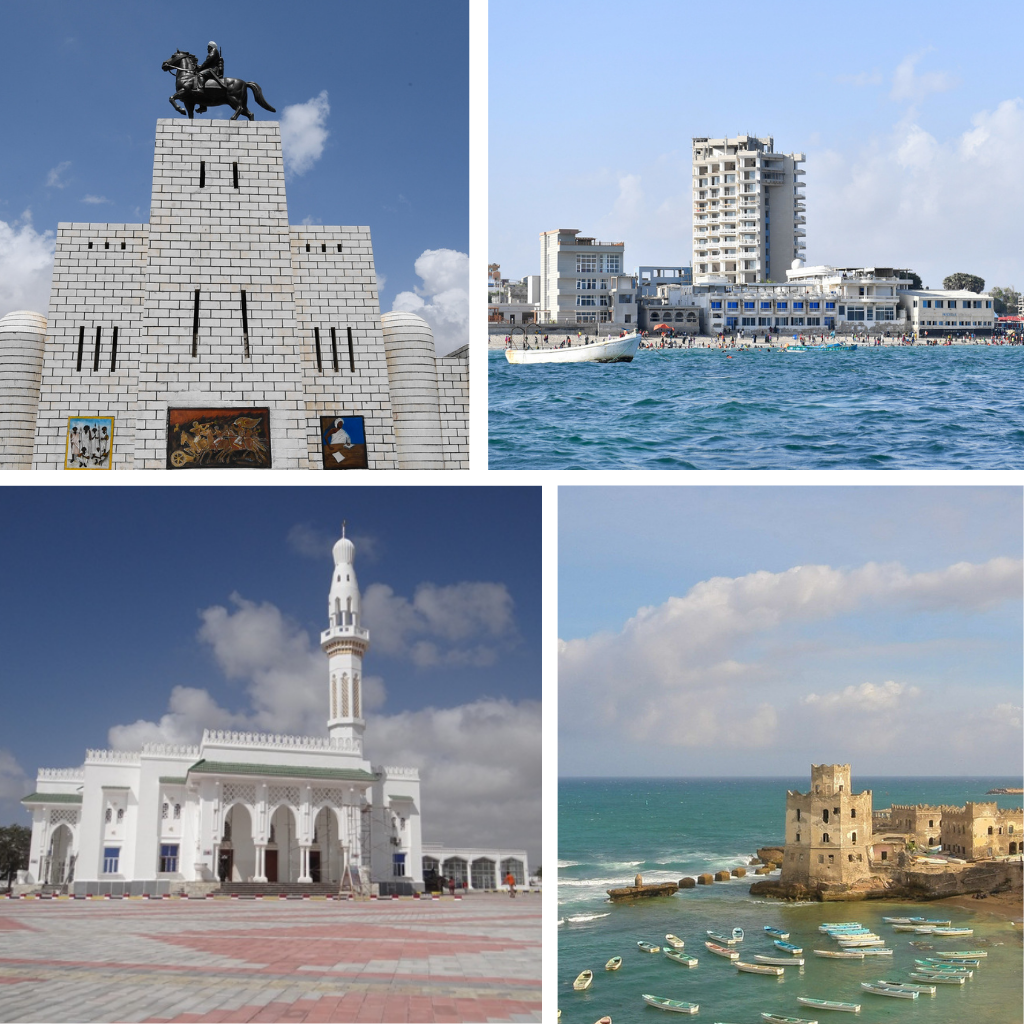
Lido Beach is Mogadishu's most bombed public space, and that fact is not incidental to what the beach is — it is the whole story. Al-Shabab has attacked it at least five times since January 2016, killing roughly 90 people combined, and the beach has reopened after every one of them. Understanding why requires going back to what the beach represented before anyone was bombing it, because the reason it keeps getting hit is the same reason it was, for years, banned outright.
A colonial beach that became a national one. Lido takes its name from the Italian word for "beach," laid out for Italian colonists on Mogadishu's Indian Ocean shorefront starting in the late 1930s and expanded in the 1950s under the postwar Italian trusteeship, when a nearby hotel briefly stood as the city's tallest building. After independence in 1960, the beach did not stay a colonial relic. Under Siad Barre's government from 1969 on, it became the country's most visible symbol of secular, mixed-gender public leisure: women unveiled on the sand, beach clubs serving lunch on wooden decks a short walk from nightclubs that filled up after dark. It was, by multiple accounts of that period, the place in Mogadishu where the city's cosmopolitan self-image was most on display.
The ban. That self-image did not survive the 1991 collapse of the Somali state or the decades of clan warfare and Islamist insurgency that followed. As Al-Shabab extended its control over large parts of Mogadishu in the years after 2006, it enforced a strict reading of Islamic law that prohibited the kind of unsegregated public gathering Lido had always hosted. The beach that had been the city's leisure landmark went largely unused under that occupation. It was not until Al-Shabab abruptly withdrew its fighters from Mogadishu on 6 August 2011 — a retreat, not a defeat, driven by African Union and government pressure — that residents began returning to the sand. Within a relatively short time, Lido was again a crowded weekend destination, exactly the kind of scene Al-Shabab had spent years suppressing.
Then the bombs started. On 21 January 2016, a car bomb hit the gate of the Beach View Café, a seafood restaurant on Lido, followed by gunmen who fought a siege with government troops; around 20 people died. It was not a one-off. On 16 August 2020, five Al-Shabab fighters bombed and shot up the newly opened Elite Hotel on Lido, killing 16 and wounding 43 in a four-hour standoff. On 22 April 2022, a suicide bomber killed six people at the Pescatore Seafood Restaurant, newly opened on Lido, during an Iftar dinner attended by the Somali police commissioner. On 9-10 June 2023, seven gunmen stormed the upmarket Pearl Beach Hotel, killing six civilians and three soldiers — including a World Health Organization staff member — before all seven attackers were killed. And on 2 August 2024, on a Friday night when the beach was at its most crowded, a suicide bomber and gunmen hit the Beach View Hotel a second time, killing at least 32 people and wounding 63, the deadliest single attack Mogadishu had seen in nearly two years.
Five attacks in eight years, all at the same roughly 500-meter stretch of coastline, all against hotels and restaurants rather than government or military targets. Analysts who cover Somalia, including Matt Bryden, have called the 2024 attack "a massive security failure," but the targeting pattern itself is not really a security failure so much as a message, repeated deliberately: Al-Shabab is telling Mogadishu that the normal life it wants back — mixed crowds, alcohol-free but otherwise unregulated leisure, tourists and diaspora visitors mingling with locals — remains a legitimate military target as far as the group is concerned. The beach's civilian, secular character is not what the attackers overlook. It is what they are attacking.
What makes this a spike and not just a tragedy list is what happens after. Within a month of the August 2024 bombing, families were back on the sand at sunset. Guhad Mohamed, a 22-year-old survivor, told reporters simply that Lido was "my favorite hangout place in Mogadishu; it's my hometown." Kassim Abdi, who lost his best friend Kamil Mohamed in the blast, said plainly that Al-Shabab's goal is to "instill fear and drive people away" — and kept coming back anyway. A Friday-dawn cleanup crew that started with six volunteers in roughly 2022 had grown to more than 300 by 2023, working the sand before the day's swimmers arrive. None of this erases the deaths. It does mean that the group's strategy of bombing the beach into abandonment has not, after five attempts over eight years, worked.
The reckoning that resilience narratives usually skip is that safety here is not really improving. Security around Lido's hotel row is heavier than it has ever been — checkpoints, barriers, armed details — and in February 2025 that same security apparatus shot and killed a teenage boy while clearing the beach for a foreign dignitary's visit. Lido today is not a beach that has been made safe. It is a beach where a city has decided, repeatedly, that showing up anyway is worth more than the risk of not.