Maho Beach is a short crescent of white sand on the Dutch side of Saint Martin, in the territory of Sint Maarten, pressed against the western threshold of Princess Juliana International Airport (IATA SXM, ICAO TNCM). A single two-lane public road, Beacon Hill Road, and a chain-link fence separate the beach from the runway. Aircraft approaching from the sea line up on Runway 10 and descend a standard 3-degree glide slope; because the threshold sits metres from the waterline at an airport elevated just 4 metres above sea level, jets cross the sand 10 to 20 metres overhead. That single number is why Maho exists as a destination.
The runway is 2,300 metres long (7,546 feet), designated 10/28, renumbered from 09/27 in 2008 to track magnetic drift. KLM ran a Boeing 747-400 from Amsterdam until the type's last scheduled appearance here on 28 October 2016, after which the route moved to the Airbus A330. The first commercial flight landed on 3 December 1943, when the field was still a wartime airstrip, and Queen Juliana of the Netherlands, for whom it is named, visited in 1944. In 2015 the airport moved 1,829,543 passengers.
There is no vegetation behind the sand to speak of. Jet blast and storm surge scour the beach, and the dune line that would normally hold it together has been stripped repeatedly. The sand comes and goes: Hurricane Irma flattened it in 2017, and as recently as August 2025 swell from Hurricane Erin scraped the beach back to rock before longshore drift returned the sand. What people picture as a permanent stage is an unstable ledge the sea rebuilds and erases on its own schedule.
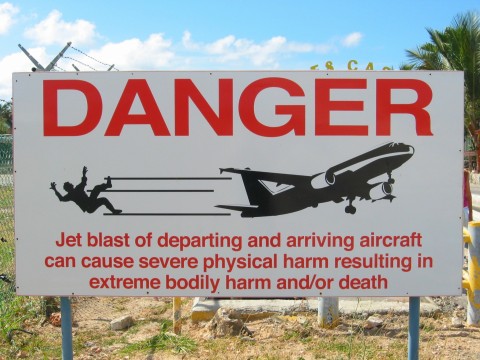
The crowd organises itself around the airport schedule and the Sunset Bar and Grill, which posts arrival and departure times on boards and over a speaker. People wade in, hold cameras overhead, and brace against the noise as a turbofan passes at landing thrust a few storeys up. The other ritual happens at the fence at the departure end: tourists grip the chain-link to feel the jet blast of a plane spooling up for takeoff. The airport authority has bolted warning signs to that fence for years. They are not decorative.
Maho is one of a small set of places where commercial aviation is staged as spectacle rather than hidden behind a terminal. It is loud, genuinely dangerous at the fence, and sits on an island whose economy was nearly severed when Irma destroyed the terminal in September 2017. Everything that makes the beach famous, the proximity, the noise, the blast, is also the thing that has killed and injured people here.