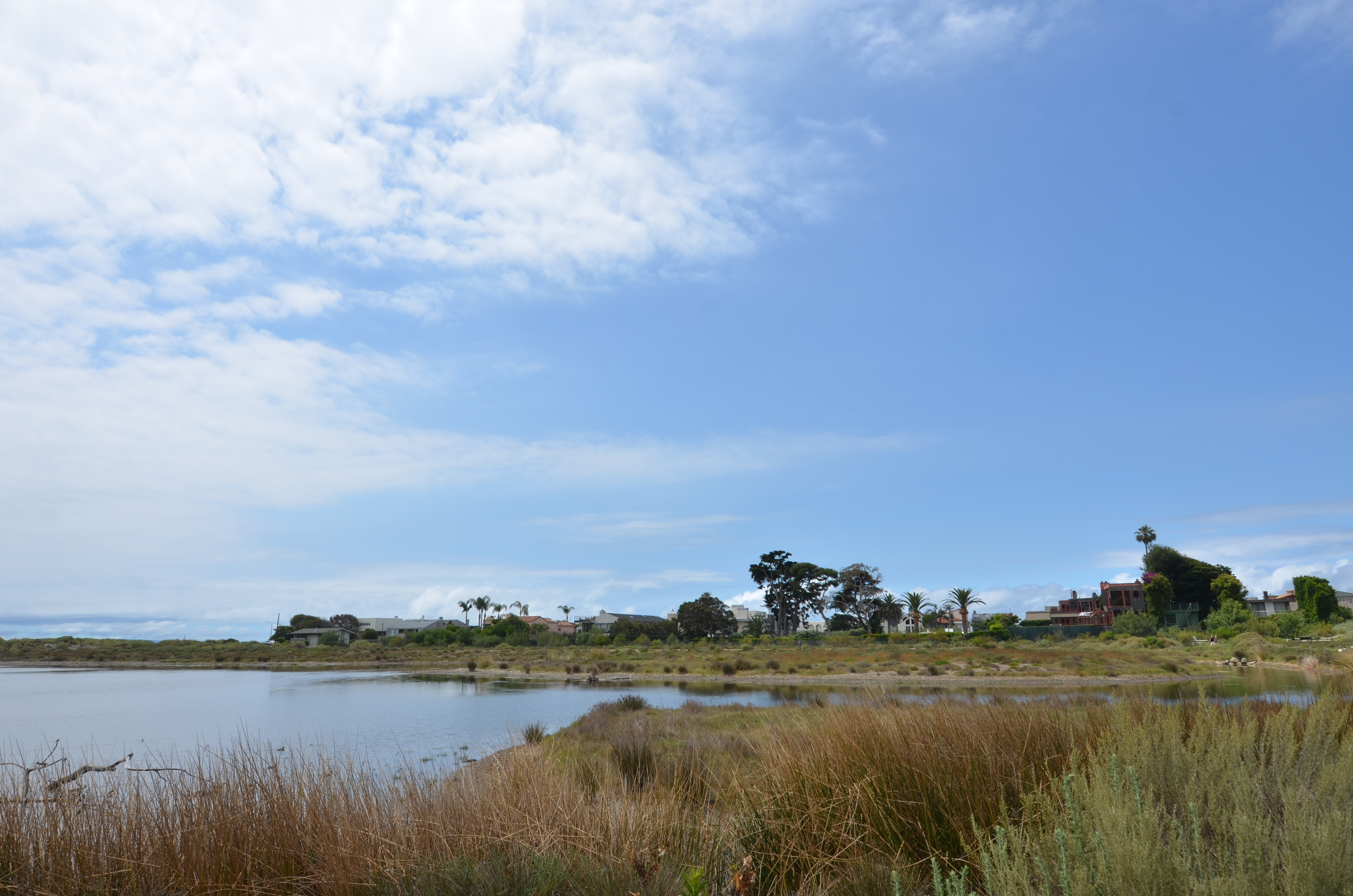
The mile of California sand that accidentally became a language the rest of the planet now speaks.
· Story
Malibu has been performing itself since 1957, and the performance has not stopped for a single summer. This is the three-point cobblestone right-hander where the longboard canon was written, where modern surf culture was packaged for export, and where the Clean Water Act grew the teeth it had been waiting thirty years to grow. A mile of sand at the mouth of Malibu Creek that accidentally became a language the rest of the planet now speaks.
The shorthand is absurd when you list it out. A 5'1" Brentwood teenager named Kathy Kohner spent the summers of 1956 through 1959 riding First Point in a one-piece and keeping a notebook. Her Austrian-emigré father read the notebook and wrote a novel. The novel sold two million copies. Columbia made a film. Then two more films. Then a TV show with Sally Field. Meanwhile a Hawthorne garage band called the Beach Boys released three albums between 1961 and 1963 that name-checked Malibu until "Malibu" no longer described a place so much as a posture. Bruce Brown pointed a 16mm camera at First Point and cut *The Endless Summer*. Miki Dora trimmed the inside so cleanly that every longboarder since has been quoting him without knowing it. In August 1984, three surfers incorporated a nonprofit in response to a proposed breakwater, and within seven years the Surfrider Foundation had filed the largest Clean Water Act citizen suit in history.
Under all of it is a different story. Two thousand years before Dora came down from the bluff and slid across First Point on a balsa board, the Ventureño Chumash at Humaliwo — the village whose name the Spanish filed down into the word *Malibu* — had already named the place for the sound of the wave. The wave was never undiscovered. It had a name. That name is still its name, under a Spanish-mouthed layer of pronunciation. The archaeological site, CA-LAN-264, is registered immediately adjacent to the lagoon and the First Point parking lot. Every surfer here parks on top of it.
That is the résumé. The wave itself is calmer than the résumé, and older, and — if you know where to stand on the bluff at six in the morning — genuinely beautiful in the way the résumé is not. So look at the wave.
· Quick facts
Coordinates
34.04° N, 118.68° W
Length
~1 mile (3 points)
Substrate
Cobblestone + sand
Swell window
S / SW · Apr–Oct
Ideal wave
3–6 ft · 16–18 sec
Water temp
14–19°C year-round
Crowd, summer AM
50–70 surfers
World Surfing Reserve
2010 · first ever
· The wave
Cobblestone, slowness, and the board the wave asked for
First Point is a cobblestone point break, which is a tidy geological way of saying that Malibu Creek has spent the last several thousand years washing river rock down out of the Santa Monica Mountains and depositing it, stone by stone, into a submerged ramp that angles out from the headland. The ramp is the wave.
Nothing else at Malibu is the wave. The sand on the inside is incidental, the pier is a reference point, the mountains are a windbreak — but the cobblestone ramp is the architecture, and it is the only reason any of this exists.
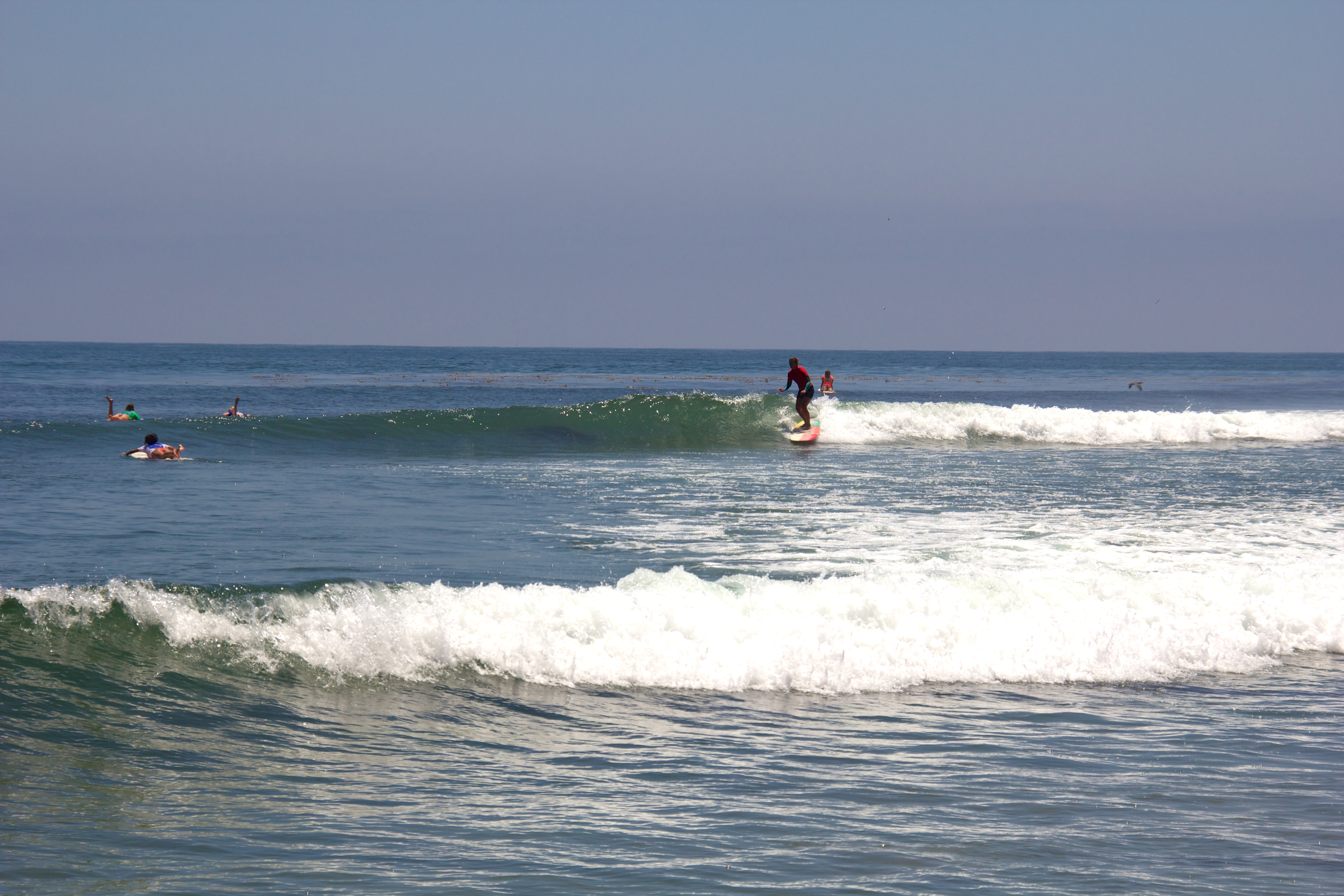
When a south or southwest swell generated in the Southern Hemisphere — the season runs April through October, with the cleanest pulses in June and July — reaches that ramp at the correct angle, the swell refracts across the cobblestone and peels north toward the pier as a long, shoulder-high, tapered right. It does not close out. It is almost impossible to make it close out. The shoulder travels across the stones at a pace that is, famously and accurately, slow. Slow here is a mechanical description, not a complaint. The wave’s face moves at a speed that rewards a surfer who can trim a long board along the pocket rather than one who needs to generate thrust through short, violent turns.
The wave dictates the board. This is the fact that produced everything downstream. In 1947, three shapers — Bob Simmons, Joe Quigg, and Matt Kivlin— began building lighter balsa boards specifically for First Point. The boards became known as Malibu chips. The name survived the era. A “Malibu board” is a shaper term now, in workshops from Biarritz to Byron Bay, and it means a specific silhouette the wave at First Point asked for seventy-nine years ago.
The second gift of the geography is the wind. The Santa Monica Mountains block the prevailing afternoon onshores until mid-morning, which opens a window — offshore at dawn, sideshore by nine, soft-onshore by noon — that on a good June swell can hold glassy conditions until almost eleven.
The dark side is hydrology. Malibu Creek drains a watershed that includes the Tapia wastewater plant’s historic discharge zone, decades of hillside septic, and the lagoon behind First Point. The creek mouth empties directly into the surf zone. After any winter rain, the inside section becomes a bacterial plume, and Heal the Bayhas listed Surfrider Beach among California’s most polluted stretches of coast more years than anyone on the point would care to count. The wave and the pollution come from the same watershed. They are not separable, and the page that tries to separate them is lying.
Trim, not thrust. The wave dictates the board, and the board's silhouette has survived almost eighty years.· Radness.com.au
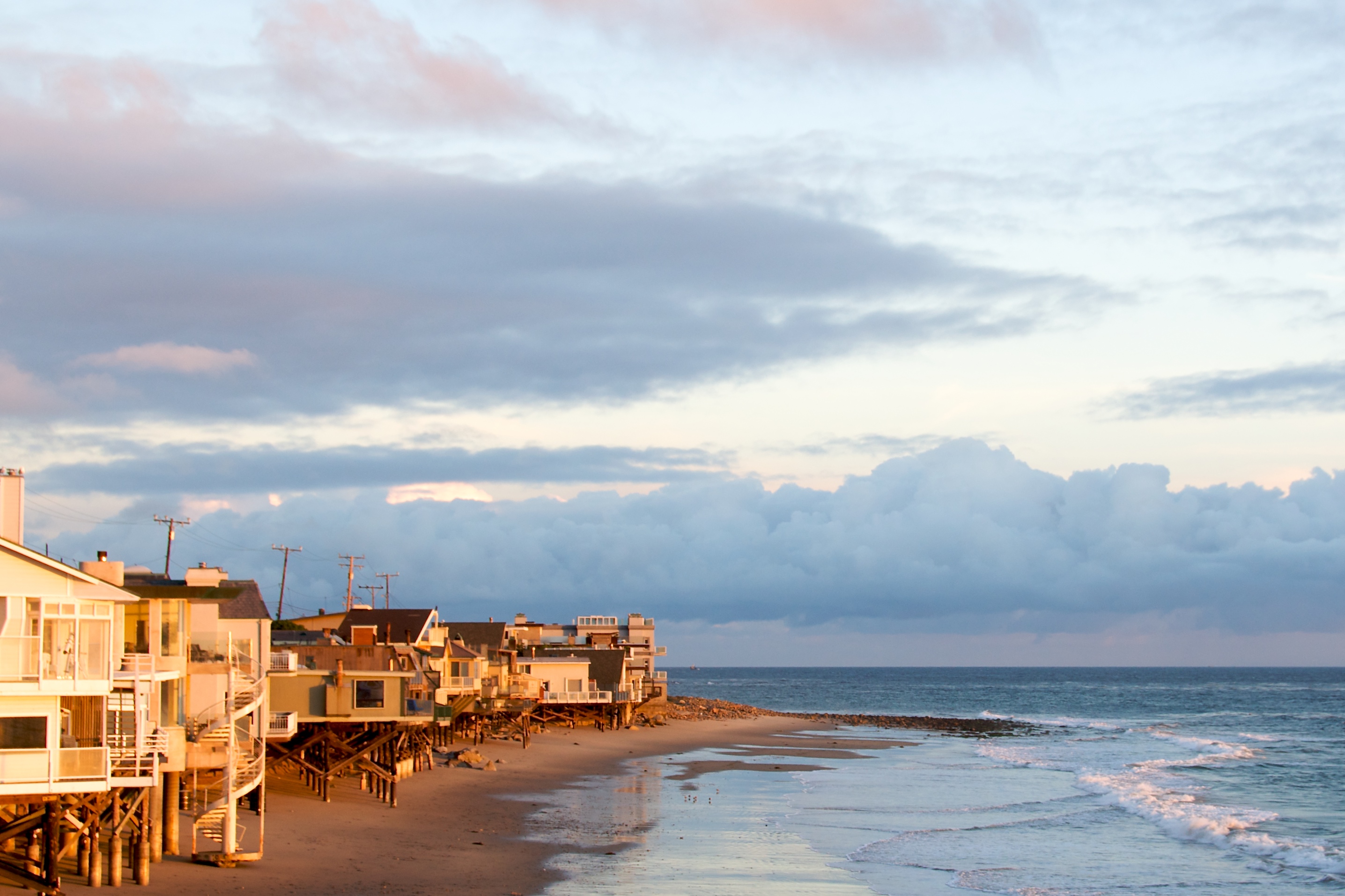
A perfect summer dawn, minutes up the coast from First Point. Offshore until nine, glass until eleven.· Vladimir Kudinov madbyte
· The mechanics
How a pile of round rocks makes a mile of wave
Every other California point break is a rock shelf, a sandbar, or a reef. First Point is a cobble ramp — a sheet of water-tumbled Santa Monica Mountain stone deposited by Malibu Creek over ten thousand years into a shallow, consistent bottom contour angled away from the headland. The wave is a refraction event, not a break event.
Top-down schematic. SW swell lines arrive at a shallow angle to the headland; the submerged cobblestone ramp (dashed) refracts the lines, bending them around the point and pushing them back toward the pier as a peeling right. Malibu Creek (blue arrow) delivers the cobble that makes the ramp. Each point — Third, Second, First — sits along the same shelf, progressively south, closer to the creek mouth and more consistent on smaller swells.
The three mechanical facts
· One · Sediment
Malibu Creek carries cobble out of the mountains. Ten thousand years of sediment delivery built the ramp. The 2013 Lagoon Restoration did not touch it.
· Two · Refraction
SW swell lines hit the ramp at a shallow angle and bend. Bending stretches the wave face and slows its peel rate. The physics is why the wave is “slow.”
· Three · Consistency
Cobble does not reconfigure week to week. The wave breaks the same way it broke last summer. A wave that remembers its own shape can be designed against.
The 1983 El Niño was the one historical exception. Storm force rearranged the stones. Every old-timer on the point divides the wave’s memory into “before ’83” and “after ’83.”
· Six stretches, one mile
Park at the lagoon, walk east to Third Point
Malibu Lagoon State Beach plus the three points plus the pier is a continuous mile of shoreline with six distinct zones. A visitor who only stands at the pier has seen fifteen percent of it.
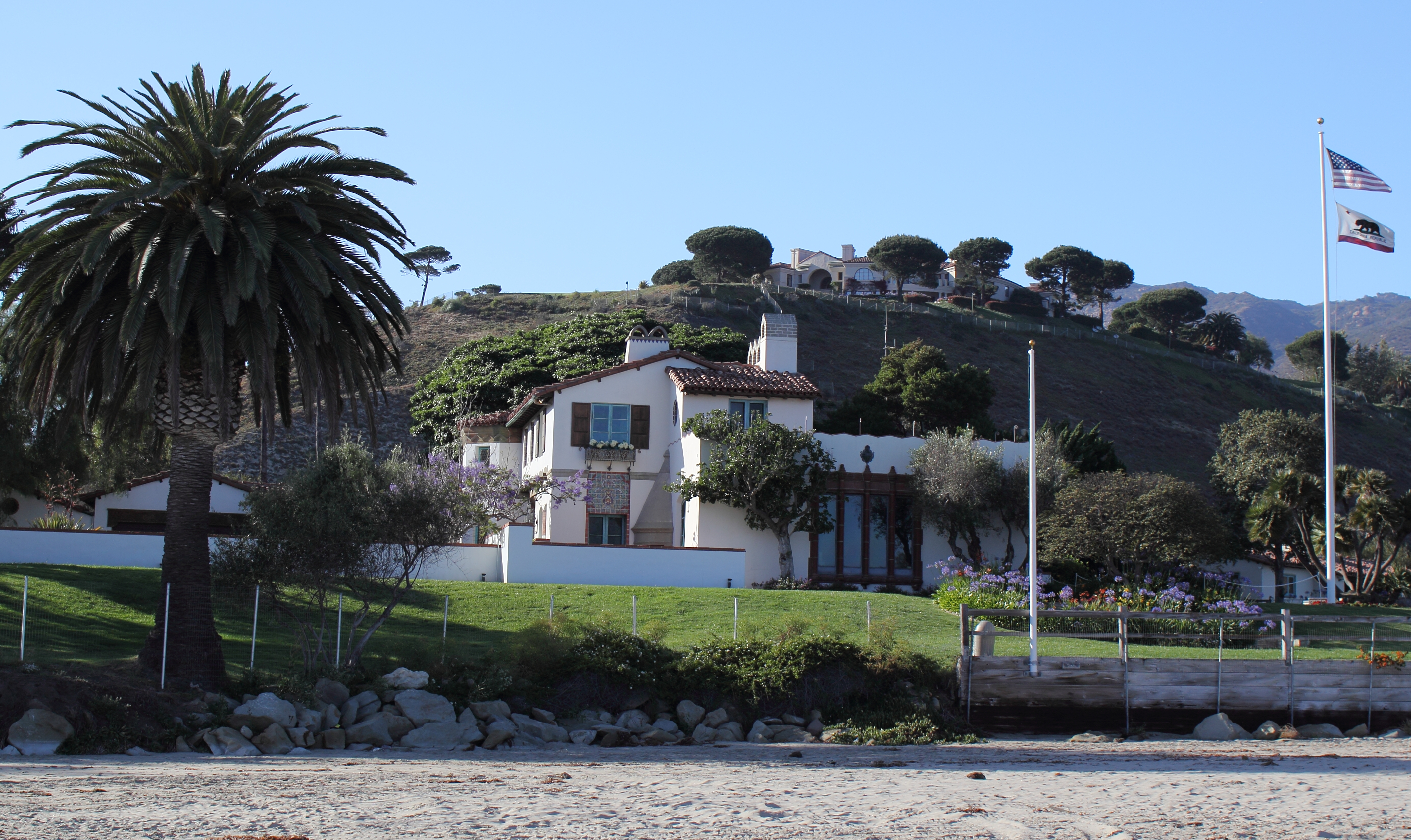
Adamson House, 1929. The tile-crusted California State Historic Monument on Vaquero Hill between the lagoon and First Point. The cheapest history lesson on the coast.· Սէրուժ (Serouj Ourishian)
Z1
Malibu Lagoon State Park lot
The asphalt starting point. $12–15 parking, interpretive signage (modest, for the significance), Surfrider Beach World Surfing Reserve plaque, snack kiosk. The unmarked edge of CA-LAN-264 — Humaliwo — is where you just parked.
Best for
Entry point for all three points. Read the plaque before walking to the sand.
Local note
Arrive before 8am on any summer weekend if you want a spot. Metered PCH above the break is the fallback; read the tow signs.
Z2
Adamson House bluff
The Rindge-Adamson family's 1929 Malibu-Potteries-tiled landmark sits on Vaquero Hill between the lagoon and First Point. California State Historic Monument. Small Gidget display inside. The bluff behind it is the best free viewing bench on the entire coast.
Best for
First-time visitors; anyone who wants the Malibu story told by docents who know more than most books.
Local note
Tours most days; schedule varies by season. The tile work is as good as anything in Spain.
Z3
First Point (the rock)
The wave. Forty yards north of the pier. The rock — an unnamed submerged feature the regulars triangulate by pelican and piling — is where the takeoff sits. Fifty to seventy surfers on a clean summer morning. The shoulder travels at the pace of a relaxed conversation.
Best for
Longboarders at first light on a mid-May weekday. Spectators any time — the wave is visible from the bluff and the pier.
Local note
Etiquette is specific and unwritten. The deepest surfer has priority; drop-ins are a negotiation. Learn the lineup before paddling out.
Z4
Malibu Pier
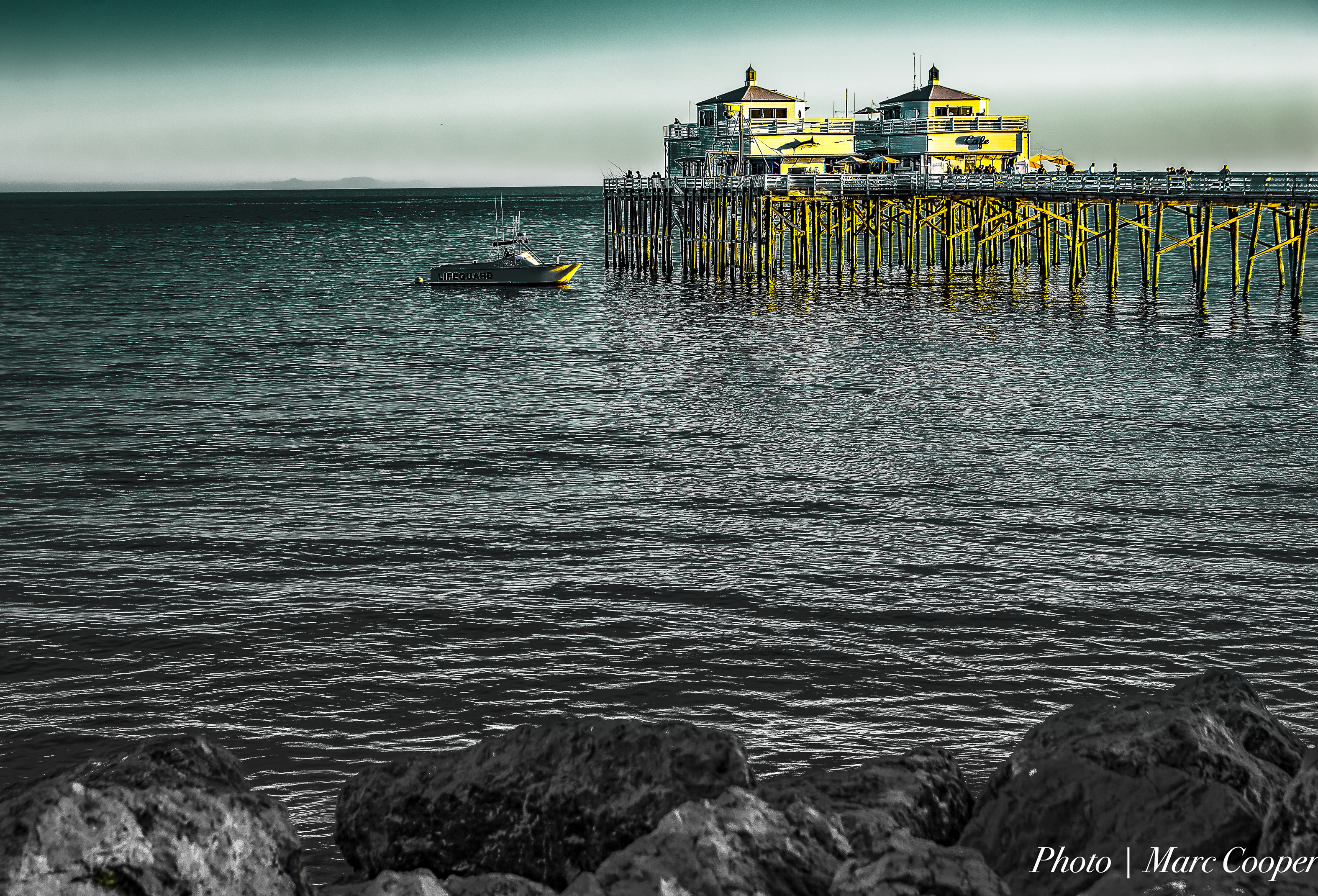
1905 Rindge freight landing, 1926 public. The southern anchor of the three points. Malibu Farm restaurants on the deck, sport-fishing charters, a California State Parks pier-walkers' economy that has adapted over a century of the Rindge wall cracking and resealing.
The pier itself is not the wave. The wave is the right, peeling north off the cobblestone, visible from the pier railing.
Z5
Second Point
Between First and Third. Shorter, steeper, faster. Needs four feet minimum to turn on. The shortboard crew's release valve when First Point clogs.
Best for
Shortboarders on a moderate south swell.
Local note
Quieter lineup than First. Historically where the faster rides happen.
Z6
Third Point & the Colony fence
The northernmost of the three. Needs the biggest south swell to connect. The Malibu Colony's fence line runs directly behind the takeoff zone — a century of Hollywood money pressing against California's Coastal Act. Least ridden wave on the mile, partly because of conditions, partly because of the fence.
Best for
Experienced surfers on a real south pulse — six feet, long period, the kind that arrives two or three times a season.
Local note
Walk the wet sand only. The Colony boundary is enforced. Do not trespass above the tide line.
· A day here
Dawn surfers to pier neon, hour by hour
Malibu sunset. Golden-hour Malibu is a specific frequency of orange that Bruce Brown filmed in 1966 and Instagram has been trying to replicate since.· BriYYZ from Toronto, Canada
Dawn · 5:45–8:30am
The mountains are still cool, the water is still glass. The first longboarder of the morning paddles out from the lagoon side with a white board under one arm. The Santa Monica Mountains hold the westerly off the water. You can count the pelicans — they fly a line so low the wing tips touch the back of the swell. Offshore winds until about nine. If you are going to surf First Point in 2026, this is the hour.
Midday · 11–3
The thermal gradient flips around 11am and the westerly fills. The glass breaks up into texture; the shoulder-hop crowd — fifty, sixty, seventy surfers by now — ties itself into a floating knot at the peak. Beach traffic on PCH is heavy. The Adamson House docents are leading their first tour. The pier is full of sport-fishing charters going out and coming back.
Golden · 6–7:30pm
An hour before sunset the light goes soft, orange, and a specific Malibu-golden that Bruce Brown understood in 1966 and Instagram has been trying to replicate ever since. The surfers thin. A last wave. The regulars walk up to Duke's or the pier deck. The pelicans get another loop. If you have ever wondered why Malibu is an image before it is a place, you are inside the answer.
Night · after 9
The pier neon goes on. The Colony lights up like a row of small galaxies behind Third Point. The wave keeps peeling but nobody is surfing it. Coyotes come down the canyon after the parking lot empties. On certain nights when the swell is up and the wind is right, you can stand in the empty lot and hear what the Chumash heard two thousand years ago. The village was named for it.
· Cultural footprint
The list is almost embarrassing
Frederick Kohner’s Gidget: The Little Girl with Big Ideas (1957) and its four sequels. Columbia’s 1959 film Gidget with Sandra Dee, followed by Gidget Goes Hawaiian (1961) and Gidget Goes to Rome(1963). The ABC series from 1965 to 1966 with a nineteen-year-old Sally Field. The Beach Boys’ Surfin’ (1961), Surfin’ Safari (1962), and Surfin’ U.S.A.(1963), the last of which catalogues Malibu by name on the first chorus. Jan and Dean’s Surf City (1963) and Ride the Wild Surf (1964).
Bruce Brown’s three films — Slippery When Wet (1958), Barefoot Adventure (1960), and the one that colonized a generation, The Endless Summer(1966). Greg MacGillivray and Jim Freeman’s Five Summer Stories(1972). William Finnegan’s Barbarian Days(2015), which won the Pulitzer and whose Malibu chapters are the most honest English-language prose anyone has written about the place. Matt Warshaw’s Encyclopedia of Surfing and History of Surfing (2010), where the Malibu entry is the reference everyone else borrows from.
The shaper vocabulary is Malibu’s. The Malibu chip, after the 1947 Simmons-Quigg-Kivlin boards; the Malibu board silhouette that survived into the 2020s; the Malibu Surfing Association, founded 1961 and still paddling out. Craig Stecyk and Glen E. Friedman made the photographs. Dewey Weberturned his own name into the first surfboard brand — the commercial prototype was Malibu’s, too.
The archetypes are Malibu’s. Gidget. Moondoggie. The Kahuna. The Black Knight. Four nicknames that became American shorthand before most of America could place the beach on a map.
Here is the observation with teeth. The beach sold an image of California to America so successfully that most of America still thinks California looks like this mile. It does not. California has 840 miles of coast; this is one of them. But the pier, the palms, the longboard peeling glass-smooth toward the Adamson House tiles — that is the image, and it has held the frame for seventy years.
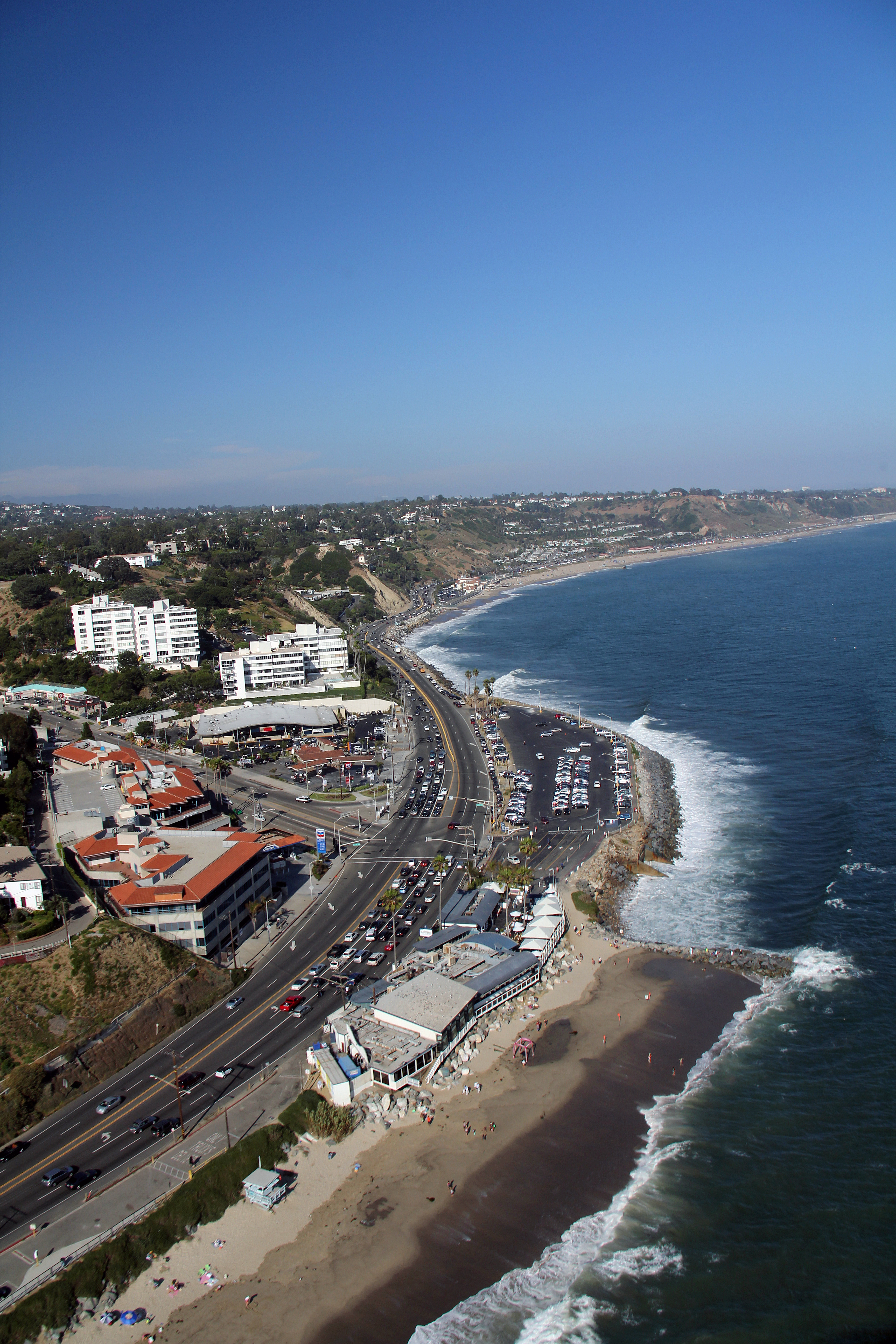
Pacific Coast Highway at Malibu. The road May Rindge lost at the US Supreme Court in 1923. Every image of Malibu since has assumed it is there.· JCS
· The longboard lineage
Four generations on the same wave
First Point has produced named surfers continuously for seventy-nine years — shapers, stylists, rivals, exiles, revivalists. The lineage is specific, visible, and arguably the most densely canonized of any surf break on Earth.
The stance. Hand off the rail, trim over thrust, the hang-five as a pause rather than a maneuver — Lance Carson set the template and every longboarder since has been quoting it.· Radness.com.au
· Generation 1 · 1947–1959
The shapers who answered the wave
Bob Simmons (1919–1954) — Caltech-trained, one-armed, a mathematician about boards more than an artist. Died surfing Windansea, age 35. Joe Quigg (1925–2023) and Matt Kivlin — Simmons’s collaborators, the other two thirds of the team that produced the Malibu chip in 1947. Dale Velzy opened the first commercial surf storefront in Manhattan Beach in 1949 and shaped for Malibu from day one. Hap Jacobs— the shop Velzy-Jacobs that carried the Malibu aesthetic through the fifties. This generation’s accomplishment was not riding. It was the craft. They put the tools in the water that the next three generations would use.
· Generation 2 · 1958–1973
The stylists who defined the wave
Miki Dora (1934–2002) — the Black Knight, the most photographed surfer of the era, the man whose trim line every longboarder has been copying without attribution since. Brilliant, contradictory, corrupt; credit-card fraud across three continents, France 1995, Montecito 2002. Lance Carson (b. 1942) — the other defining stylist. The hang-five as pause. The relaxed upright posture. The hand trailing just off the rail. If you have ever watched a longboarder and thought that is what one looks like, you were watching a Carson echo. Mickey Munoz (b. 1937) — five foot four, goofyfoot, inventor of the Quasimodo and El Spontaneo, Sandra Dee’s wig-wearing stunt double in the 1959 Gidget. Johnny Fain (b. 1945) — the Little Prince of Malibu, Dora’s principal rival, on-wave fistfights through the mid-sixties, the soap opera that First Point localism inherited. Dewey Weber (1938–1993) — the Little Man on Wheels, a former Buster Brown child model who became the first surfer to turn his own name into a surfboard brand.
· Generation 3 · 1970s–1980s · the shortboard years
The enforcement era and its bridge figure
The shortboard revolution of the late sixties broke the longboard canon. Longboards vanished from First Point for most of a decade. The wave kept peeling. Into that gap stepped Allen Sarlo(b. 1959) — the bridge figure between Dora’s Malibu and the modern lineup, a dominant shortboarder through the mid-seventies and into the eighties, and the embodied figure of the point’s enforcement culture during those years. The localism that had been an undercurrent in Dora’s era became explicit: who belonged in the water, who didn’t, and what happened if you were in the wrong category. The question was not resolved. It was simply absorbed back into the wave when the next generation arrived and changed the instrument.
· Generation 4 · 1990s–present · the log revival
The pilgrimage crew
In the nineties the longboard returned. When it returned, First Point was still the reference. Joel Tudor (b. 1976) rode it with a reverence that verged on re-enactment — every Carson trim and Munoz hang-five visible in his posture. Kassia Meador, Alex Knost, Tyler Warren, CJ Nelson — the modern log crew paddled out at Malibu not because it offered the best wave of any given day but because surfing a nine-six at First Point is a pilgrimage. It is where the template was written. The scene at First Point in 2026 is a living conversation between four generations: the shapers’ craft, the stylists’ trim, the enforcement era’s inheritance, and the revivalists who arrived to quote all of them. Every clean summer morning the lineup contains all four at once.
· History
1892 to 2018, in twenty pieces
The chronology matters because the story only makes sense when the ownership, the architecture, the surf, the culture, the activism, and the ecology are laid next to each other on the same axis.
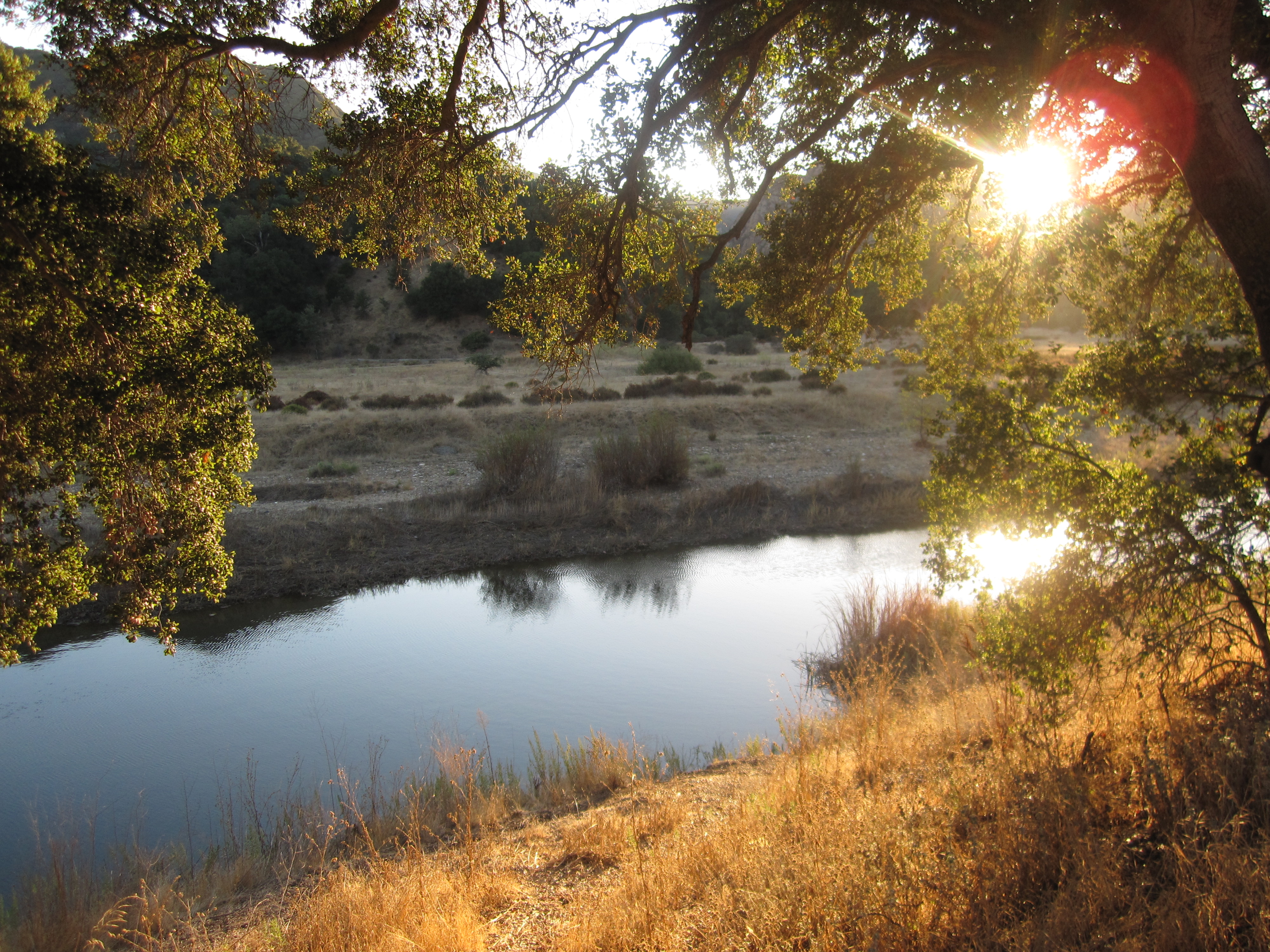
Malibu Creek. Carries cobble down from the Santa Monica Mountains — the sediment source that built the wave, and the watershed that carries Tapia discharge, hillside septic, and post-fire ash to the surf zone.· Santa Monica Mountains National Recreation Area
1892
Frederick Hastings Rindge buys Rancho Topanga Malibu Sequit — 13,315 acres of Mexican land grant — for about $300,000. The ownership lineage every modern Malibu deed traces back to.· land
1905
Rindge dies. May Knight Rindge inherits and spends three decades waging one of California's longest private-land legal campaigns.· land
1923
The US Supreme Court rules against May Rindge; PCH construction through the ranch follows through the late 1920s.· infrastructure
1926
The Malibu Pier, originally the Rindge family's private freight landing, opens to public fishing. The Malibu Colony begins leasing beachfront parcels to Hollywood figures.· infrastructure
1928
Adamson House completed on Vaquero Hill between First Point and the lagoon — Rhoda Rindge Adamson's Malibu-Potteries-tiled landmark.· architecture
1947
Bob Simmons, Joe Quigg, and Matt Kivlin begin shaping the 'Malibu chip' — the lighter balsa board designed specifically for First Point's slow peel.· surf
1956
Kathy Kohner begins summers at the First Point shack. Terry 'Tubesteak' Tracy nicknames her Gidget.· culture
1957
Frederick Kohner publishes Gidget: The Little Girl with Big Ideas. Two million copies, forty languages.· culture
1959
Columbia's Gidget, with Sandra Dee. Mickey Munoz doubles Dee in a wig; Miki Dora doubles James Darren.· culture
1961–63
The Beach Boys' three-album run — Surfin', Surfin' Safari, Surfin' U.S.A. — names Malibu into the American vocabulary.· culture
1966
Bruce Brown's The Endless Summer reaches national theatrical release. First Point becomes the reference point against which all other global breaks are measured.· culture
1967
Dora drops his trunks mid-wave during the Malibu Invitational in protest of contest-ification. Founding scripture of surf anti-commercialism.· surf
1983
An El Niño of historic violence rearranges First Point's cobblestones. Locals mark the break 'before '83' and 'after '83.'· geology
1984
Glen Henning, Tom Pratte, and Lance Carson incorporate the Surfrider Foundation in response to a proposed breakwater at First Point.· activism
1991
Surfrider Foundation v. Louisiana-Pacific — at the time the largest Clean Water Act citizen suit in US history. The template for the modern coastal lawsuit is written.· law
1995
Miki Dora, after two decades as an international fugitive on fraud charges, is arrested in France and extradited.· culture
2002
Miki Dora dies of pancreatic cancer in Montecito. Obituaries in the LA Times, NYT, and Surfer canonize him as surfing's patron anti-saint.· culture
2010
Save The Waves Coalition designates Surfrider Beach the world's first World Surfing Reserve.· heritage
2013
Malibu Lagoon Restoration Project completes after a contentious multi-year fight. Bulldozers yards from the lineup.· ecology
2018
The Woolsey Fire burns to the edge of the Malibu coast. Ash and debris flows degrade First Point water for months.· ecology
· The three points
First, Second, Third — stacked south to north on the same shelf
The three points sit along the same submerged cobblestone shelf. You can walk First to Third in ten minutes along the sand. The wave each one produces is, nonetheless, genuinely different, and locals sort them in a hierarchy that tracks swell size rather than prestige.
· Point
First Point
Southernmost, just north of Malibu Pier
The wave of the canon. The slowest, longest, most forgiving, most crowded. Breaks on almost any south swell April–October. The longboard wave. Sixty surfers on a clean Saturday, without remorse.
· Point
Second Point
Middle of the three
Shorter, steeper, faster. Needs four feet minimum to turn on. Rewards a shorter board and commitment to the drop over negotiation of the trim. Historically the shortboard escape from First Point.
· Point
Third Point
Northernmost, closest to the Malibu Colony fence
Needs the biggest south swell of the three to connect. When a real pulse arrives — six feet, long period — Third holds up past the Colony decks. Least ridden, partly because of conditions, partly because of the fence.
Four uncomfortable truths this page will not route around
The register shifts. Humaliwo, the water, the Colony, the lineup, and Dora folded into all of it — the facts are not decorative.
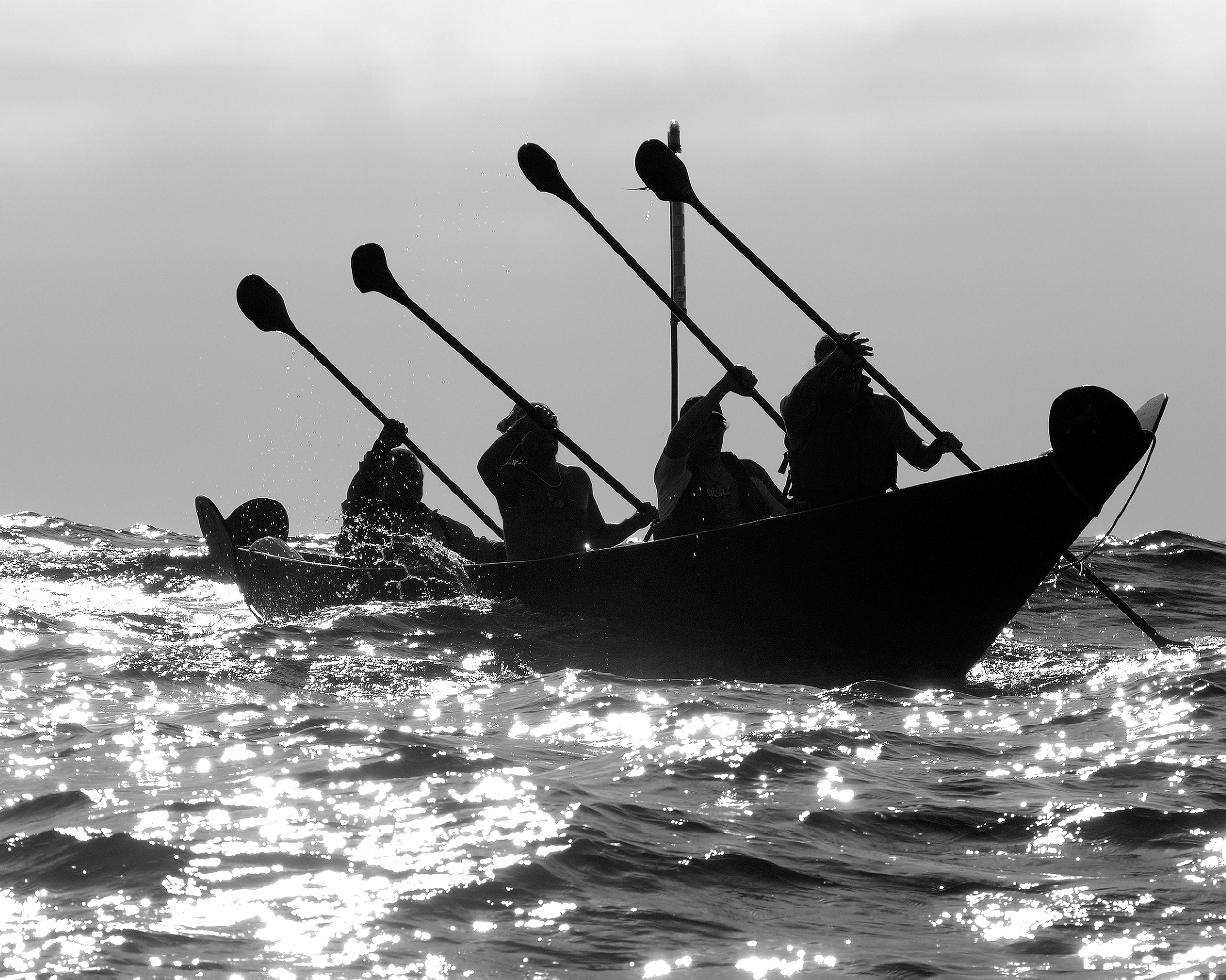
A Chumash tomol — the sewn-plank canoe, the oldest plank-built watercraft documented in North America. The maritime tradition predates every other element of the story on this page.· National Marine Sanctuaries
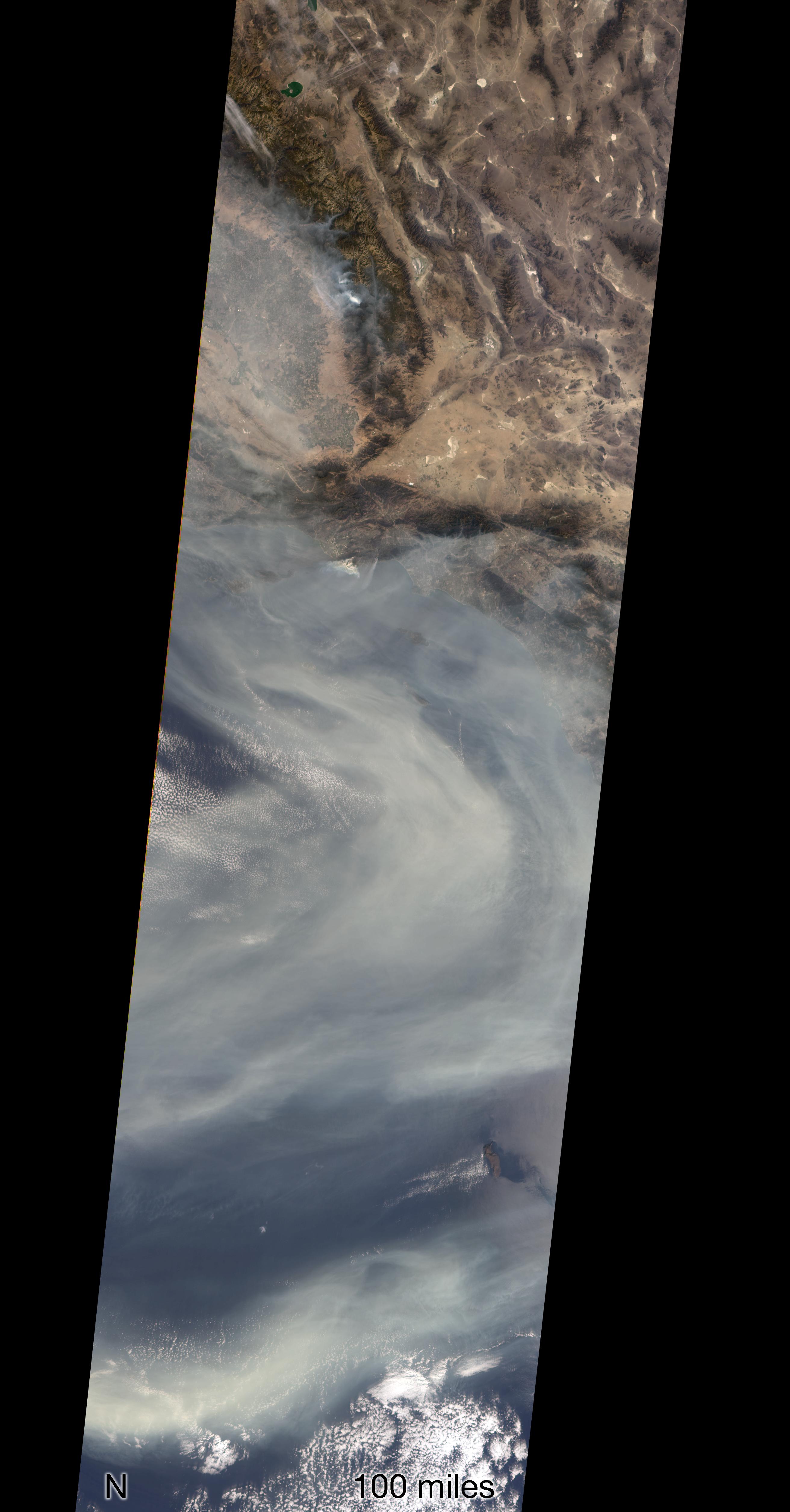
The 2018 Woolsey Fire, from NASA's MISR instrument. The entire Malibu Creek watershed burned; winter ash flowed down to the surf zone.· NASA/GSFC/LaRC/JPL-Caltech, MISR Team
The Surfrider Foundation's logo. A Malibu fight, a global nonprofit, a creek mouth that is still one of California's most polluted.· Amandine Lermigeaux
Humaliwo
The Chumash word means “where the surf sounds loudly,” and the village it named sat at the mouth of Malibu Creek for at least two thousand years. “Malibu” is a Spanish corruption of Humaliwo. The archaeological site, CA-LAN-264, is registered immediately adjacent to the lagoon and the First Point parking lot — which is to say, beneath and around and under the asphalt where every surfer in this essay parked. Frederick Rindge’s 1892 purchase is the ownership lineage every modern deed in the zip code traces back to, and it erased a continuous occupation older than most things Europeans like to call old. The Humaliwo spoke → treats the village on its own terms.
The water
For decades, Malibu Creek has carried Tapia wastewater plant discharge and hillside septic leachate directly across First Point. Heal the Bay has repeatedly listed Surfrider Beach among California’s most polluted, and the listings are not historical footnotes — they are recent. The lagoon restoration of 2013, fought bitterly on both sides, was an attempt to re-engineer the hydrology; whether it worked depends on whom you ask and what the last storm did. The Surfrider Foundation was incorporated in 1984 specifically because of the water at First Point. The Surfrider spoke → traces the full lineage from breakwater fight to Louisiana-Pacific to the present.
The Colony
Surfrider Beach is a public California state beach. The Malibu Colony, founded 1926 on leased Rindge land and home since to Gloria Swanson, Gary Cooper, Barbra Streisand, and the rotating roster of whoever Hollywood is currently buying beach houses for — abuts Third Point. Colony owners have spent the better part of a century testing the California Coastal Act: signage, fence placements, guards, the whole repertoire of soft-access denial. The state has won more of these fights than it has lost, but the fights do not stop. You can walk the wet sand. You should.
Localism
From roughly 1975 into the late 1980s, First Point was a territorially enforced wave. Allen Sarlois the bridge figure between Dora’s Malibu and the modern lineup, and he personified the enforcement era. The unresolved question — which the point has not resolved and is not going to in this paragraph — is who belongs in the water at a wave that was marketed to the entire planet seventy years ago and now has an international lineup every summer morning. And Dora folds into this too: the figure most associated with Malibu was, by any accounting that takes the evidence seriously, a con artist and a man whose recorded views on race do not survive clean inspection in 2026.
Four paragraphs. You cannot love this wave honestly without reckoning with them. The rest of the page proceeds on that basis.
· Nearby
The mile around the mile
Malibu is twenty miles of coast between Las Flores Canyon and Leo Carrillo. First Point is one point on it. These are the places you can walk or short-drive from the Lagoon lot.
Malibu Lagoon State Beach. The estuary behind First Point, the hydrological heart of the break, and the most-argued-about hundred yards of wetland in Southern California.· Steven Lek
Adamson House
On the bluff above First Point. 1929, Malibu Potteries tile throughout, California State Historic Monument, docent-led tours most days. The cheapest history lesson on the entire coast.
Malibu Lagoon State Park
Behind First Point. Restored 2013 after a contentious multi-year fight; endangered tidewater goby and steelhead populations; the parking lot here ($12–15) is where most surfers start. Adjacent to CA-LAN-264.
Malibu Pier
1905 originally as Rindge family freight, 1926 public. The southern anchor of the three points. Restaurants, sport-fishing charters, the Malibu Farm operations on the deck.
Point Dume
Eight miles north. Headland, tidepools, better-than-First-Point surf on certain swells, and Zuma Beach just beyond. Where locals go when First is mobbed.
Duke's Malibu
Five minutes up PCH. Oceanfront restaurant named for Duke Kahanamoku. Kathy Kohner Zuckerman has been a hostess here for decades and sometimes still is.
Leo Carrillo State Park
Twenty minutes north. The opposite geology — sand-bottom beach breaks, tide pools, the Malibu Colony's negative image. The northern end of the Rindge grant.
· Sources
What this page is built on
A page about a beach that has been written about as much as any beach on Earth has a responsibility to cite the sources it stands on. This is a short version; the spokes list their own.
Surf history and the longboard canon
Matt Warshaw — Encyclopedia of Surfing (2003) and The History of Surfing (2010). Malibu, Dora, Carson, Munoz, and Fain entries.
William Finnegan — Barbarian Days (2015, Pulitzer Prize). Malibu chapters.
Craig Stecyk & Drew Kampion — Dora Lives: The Authorized Story of Miki Dora (T. Adler Books, 2005).
LA Times / NYT / Surfer obituaries of Miki Dora (Jan 2002), Tubesteak Tracy (2012), and Dewey Weber (1993).
Gidget and the cultural explosion
Frederick Kohner — Gidget: The Little Girl with Big Ideas (Putnam, 1957) and sequels.
Brian Gillogly (dir.) — Accidental Icon: The Real Gidget Story (2010 documentary).
Kathy Kohner Zuckerman interview archive — NPR Fresh Air (2009), LA Times retrospectives, New Yorker.
Bruce Brown production and distribution records for The Endless Summer (1966).
Surfrider Foundation and water quality
Surfrider Foundation organizational history (surfrider.org/about) and annual reports.
Surfrider Foundation v. Louisiana-Pacific Corp. and Simpson Paper Co. (N.D. Cal. 1991) settlement filings.
Heal the Bay annual Beach Report Cards (1991–present).
California State Parks Malibu Lagoon Restoration Project (2005–2013) planning and monitoring documentation.
Las Virgenes Municipal Water District — Tapia Water Reclamation Facility public records.
Humaliwo, the Chumash, and the Rindge grant
Chester D. King — Evolution of Chumash Society (Garland, 1990).
CA-LAN-264 site records and UCLA Fowler Museum archival materials.
Santa Ynez Band of Chumash Indians — official cultural publications.
Wishtoyo Chumash Foundation — cultural village resources and programming.
California State Archives — Rancho Topanga Malibu Sequit grant chain of title and Rindge family litigation.
Written by Erin Rose. First Tier 1 built via the research-brief → image-CLI → prose-subagent pipeline. The brief lives at site/docs/legendary/briefs/malibu.json; prose drafts at site/docs/legendary/drafts/malibu-*.md. Voice register WRY (primary) with REVERENT shifts for the wave mechanics and SEVERE shifts for the honest reckoning and Humaliwo. Images sourced from Wikimedia Commons with license metadata captured at fetch time; see each figure caption for attribution. Version v0.9. Corrections welcome, particularly on Ventureño etymology and contemporary Chumash tribal nomenclature; on 1991 Surfrider v. Louisiana-Pacific settlement specifics; on Malibu Surfing Association institutional history; and on current- decade First Point lineup dynamics.