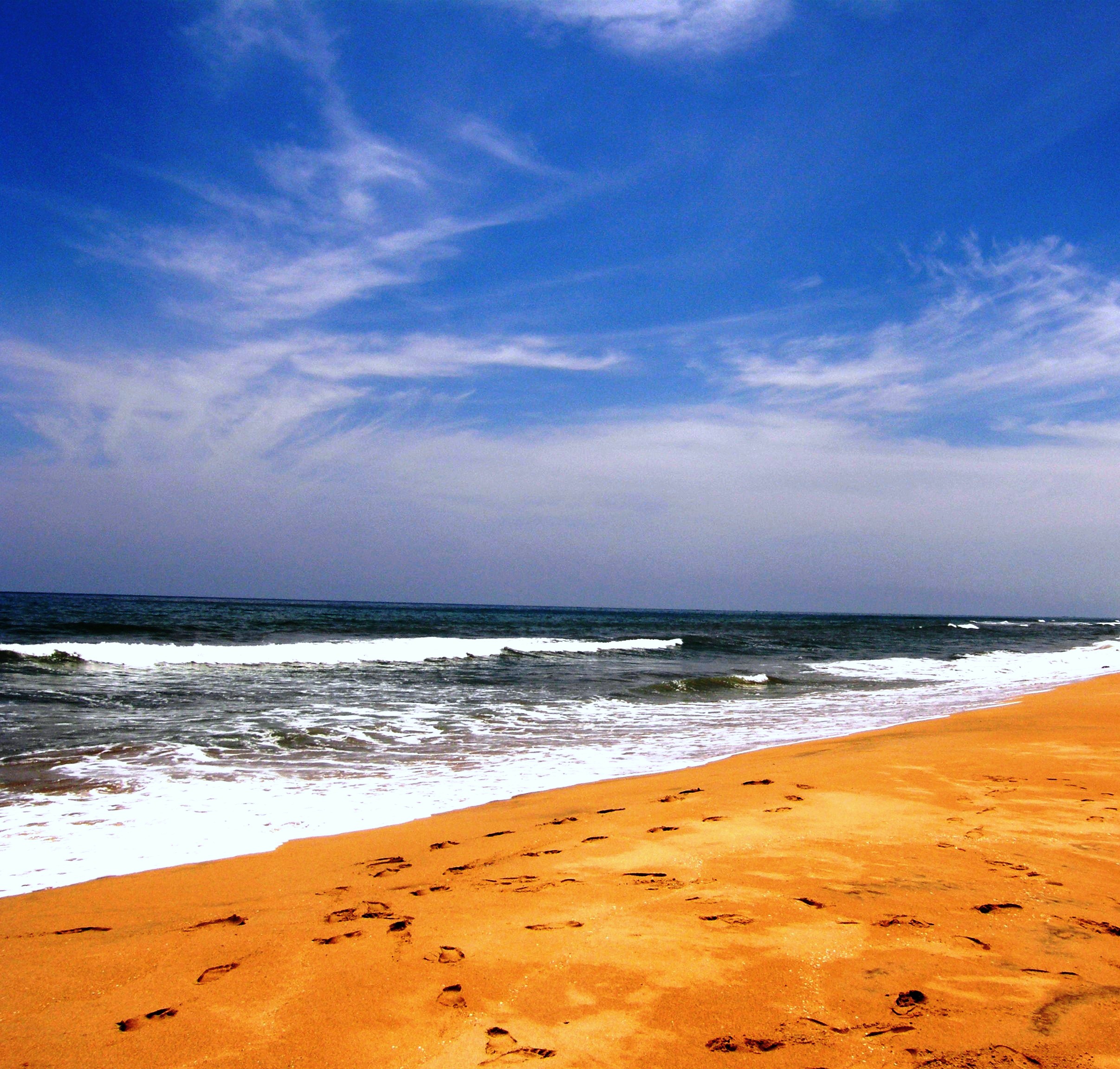
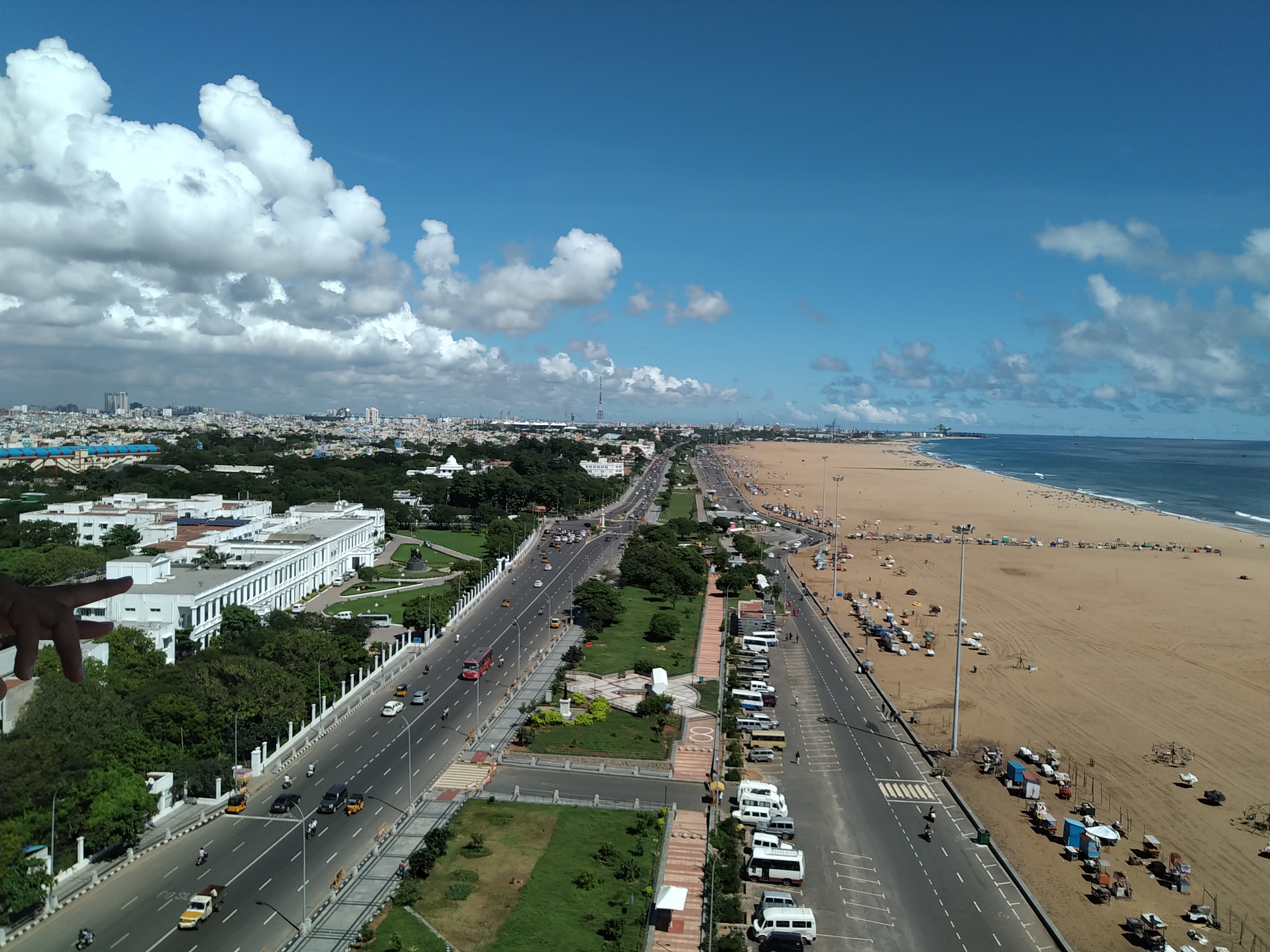
The strange fact about Marina Beach is that the city built it without meaning to. A casual visitor reads the Marina as nature — a vast, flat, open sand beach that happens to sit beside a large city. The truth is closer to the opposite. The wide beach you walk on is, to a large degree, an engineering by-product, and understanding that is the key to understanding everything else about the place: why it is shaped the way it is, why the coast a few kilometers north of it is starving for sand, and why this enormous beach is one you are forbidden to swim at.
Start with the harbour. Madras had no natural harbour; it was an open roadstead where ships anchored offshore and cargo came in through the surf on small boats. Construction of an artificial harbour on the open shore was sanctioned in the 1870s and the breakwater work began in 1881. The crucial physical fact of this coast is its longshore drift — the steady, wave-driven transport of sand that runs predominantly northward along the Coromandel shore. A breakwater built across that current acts like a dam in a sediment river. On the up-drift (southern) side of the harbour, sand that was traveling north piled up against the structure; on the down-drift (northern) side, the coast was suddenly cut off from its sand supply and began to erode. This happened fast and visibly — deposition south of the breakwater was rapid even while the harbour was still under construction, and erosion to the north was severe enough that engineers had to place groins to fight it. The Marina, immediately south of the harbour, is on the depositing side. The north-drifting current, blocked, widened this beach to its present extent. The flat, near-half-kilometer-wide strip is the sand the harbour stopped from leaving.
Then the governor gave it a promenade. Mountstuart Elphinstone Grant Duff, governor of Madras from 1881 to 1886, had been taken with the foreshore on an earlier visit, and in 1884 he had it graded and dressed with soft sand into a carriage promenade, naming it the Madras Marina after the seafront promenades of European cities. So the beach has two authors working at the same moment: the harbour engineers, who unintentionally manufactured the sand, and the colonial governor, who deliberately landscaped a walking front onto it. The promenade road — today Kamaraj Salai, formerly South Beach Road — is the spine of the famous northern stretch, running roughly 6 kilometers of the beach's total ~13 kilometers.
The Marina then became Tamil Nadu's civic stage, and the sand filled with statues. For the 1968 World Tamil Conference, a line of statues went up along the promenade honoring Tamil poets, scholars, and social reformers — figures like Thiruvalluvar, Kannagi, Bharathiyar, and others — turning the seafront into an open-air statement of Tamil identity and the Dravidian movement. Set back from the water are the political memorials that make this the most charged stretch of sand in the state: the Anna Memorial (the samadhi of chief minister C. N. Annadurai, 1970) and the M.G.R. Memorial (1988) for the actor-turned-chief-minister M. G. Ramachandran. The Marina later became the burial ground of more of the state's chief ministers — J. Jayalalithaa in the M.G.R. campus in December 2016, M. Karunanidhi beside Annadurai in August 2018. A beach is not usually where a polity buries its leaders; the Marina is.
The same civic gravity is why the beach became a protest ground. In January 2017, after the Supreme Court upheld a ban on jallikattu — the Tamil bull-taming sport tied to Pongal — the Marina filled for ten consecutive days with one of the largest spontaneous demonstrations the city has seen, a leaderless, mostly young crowd that reporting put at more than a million people at its peak, with sympathy gatherings reported in cities abroad. The protest worked: the state passed an ordinance to allow jallikattu to resume. The Marina's openness — the very flatness and width the harbour created — is what lets it hold a crowd that size.
And then there is the water, which is the honest center of the place. This is a beach you are legally not allowed to swim at. The prohibition is not bureaucratic caution; the nearshore undertow here is strong, and people drown regularly — local reporting has for years cited on the order of five sea-bathing deaths a month, with the Marina recording the most drownings of any beach in Tamil Nadu. The danger is compounded by hazards in the water, including the wreck of the SS Damatis, which sank off the Marina in 1966 and whose remains have been blamed for snagging and drowning bathers. The deadliest single event was the 2004 Indian Ocean tsunami: on the morning of 26 December 2004, the waves struck the beach and killed about 206 people on the Marina itself — morning walkers, shore-side fishing families, and children playing cricket — part of the far larger toll along the Tamil Nadu coast.
Put the pieces together and the singular thing about the Marina comes clear. It is a beach manufactured as a side effect of a harbour, landscaped by a colonial governor, lined with the statues and graves of a region's political and literary leaders, capable of holding a million-person protest, and so dangerous in the water that swimming is banned and a handful of people still drown there every month. It is less a beach in the holiday sense than a civic ground that happens to face the sea — and the sea it faces is the part it keeps people out of.