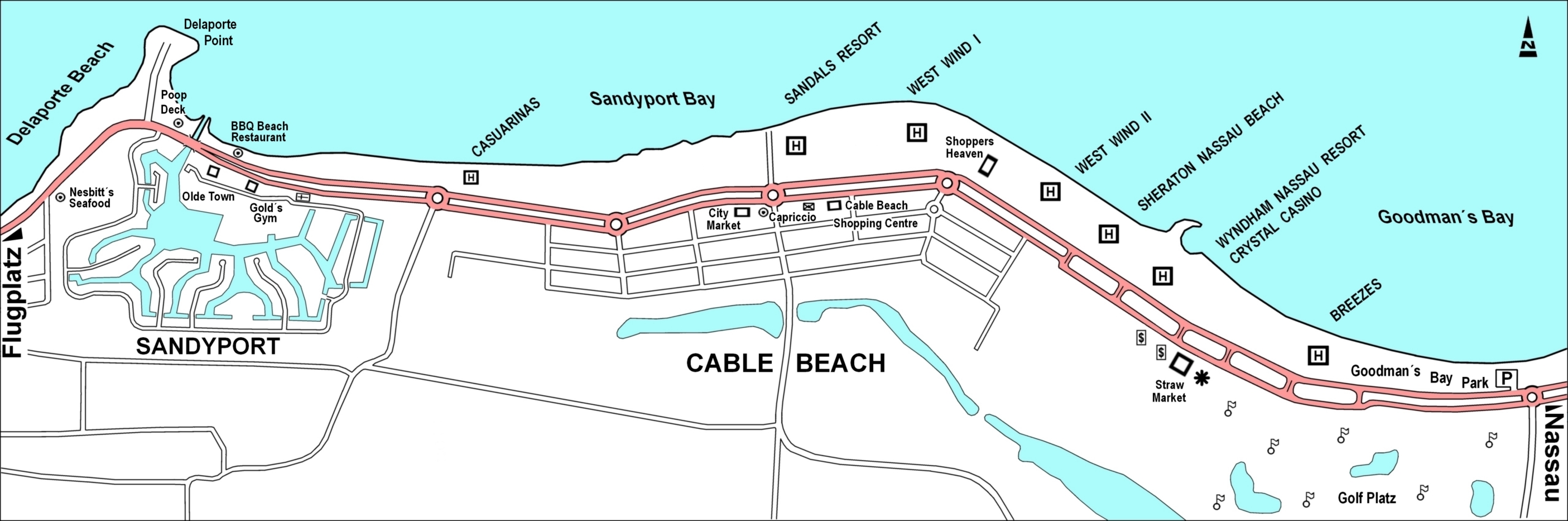
Cable Beach runs about four kilometers along Nassau's north shore on New Providence Island, named for a submarine telegraph cable that came ashore at Goodman's Bay, near its eastern end, in 1892 — the first cable linking the Bahamas to the United States, from Jupiter, Florida. The sand's brightness comes from oolitic aragonite, near-spherical grains of calcium carbonate that precipitate out of the warm, carbonate-saturated Bahama Banks water, not from crushed quartz.
Tourism took off in the 1950s, when the strip earned the nickname the Bahamian Riviera. The Emerald Beach Hotel opened in 1954 as the Bahamas' first air-conditioned hotel and its largest casino at the time; the site was later redeveloped as the Crystal Palace Resort, whose casino closed in February 2015, and the Wyndham/Crystal Palace towers were demolished in October 2018. Howard Johnson opened his first hotel outside the continental United States here in 1958. After independence in 1973, several hotels failed; the Pindling government bought them, and the Free National Movement re-privatized a number in the 1990s.
The complex dominating Cable Beach today is Baha Mar: 1,000 acres, roughly $4 billion, three brands — Grand Hyatt, SLS, Rosewood — 2,200 rooms, a 100,000-square-foot casino, a Jack Nicklaus golf course. Developer Sarkis Izmirlian began assembling the parcels in 2005 and broke ground on 21 February 2011, financed by a $2.45 billion China Exim Bank loan and built by state contractor China Construction America. Completion, targeted for late 2014, slipped to 27 March 2015.
That date was missed. BML Properties hit a liquidity crisis and filed Chapter 11 in June 2015 with the resort 97 percent finished; construction stopped for nearly a year. A China Exim Bank subsidiary took control in October 2016, and Hong Kong's Chow Tai Fook Enterprises bought the property outright that December. Baha Mar reopened in stages — Grand Hyatt in April 2017, SLS that November, Rosewood in June 2018 — six years after groundbreaking.
In October 2024, a New York judge ruled on what happened during the delay. Justice Andrew Borrok found China Construction America had committed fraud at least four times, describing "outright sabotage" of the project — including diverting a $54 million subcontractor payment to buy an unrelated hotel — and ordered it to pay BML Properties $1.6 billion. Cable Beach's skyline exists because a fight over who broke the project took nine years to settle, in a Manhattan courtroom rather than Nassau.