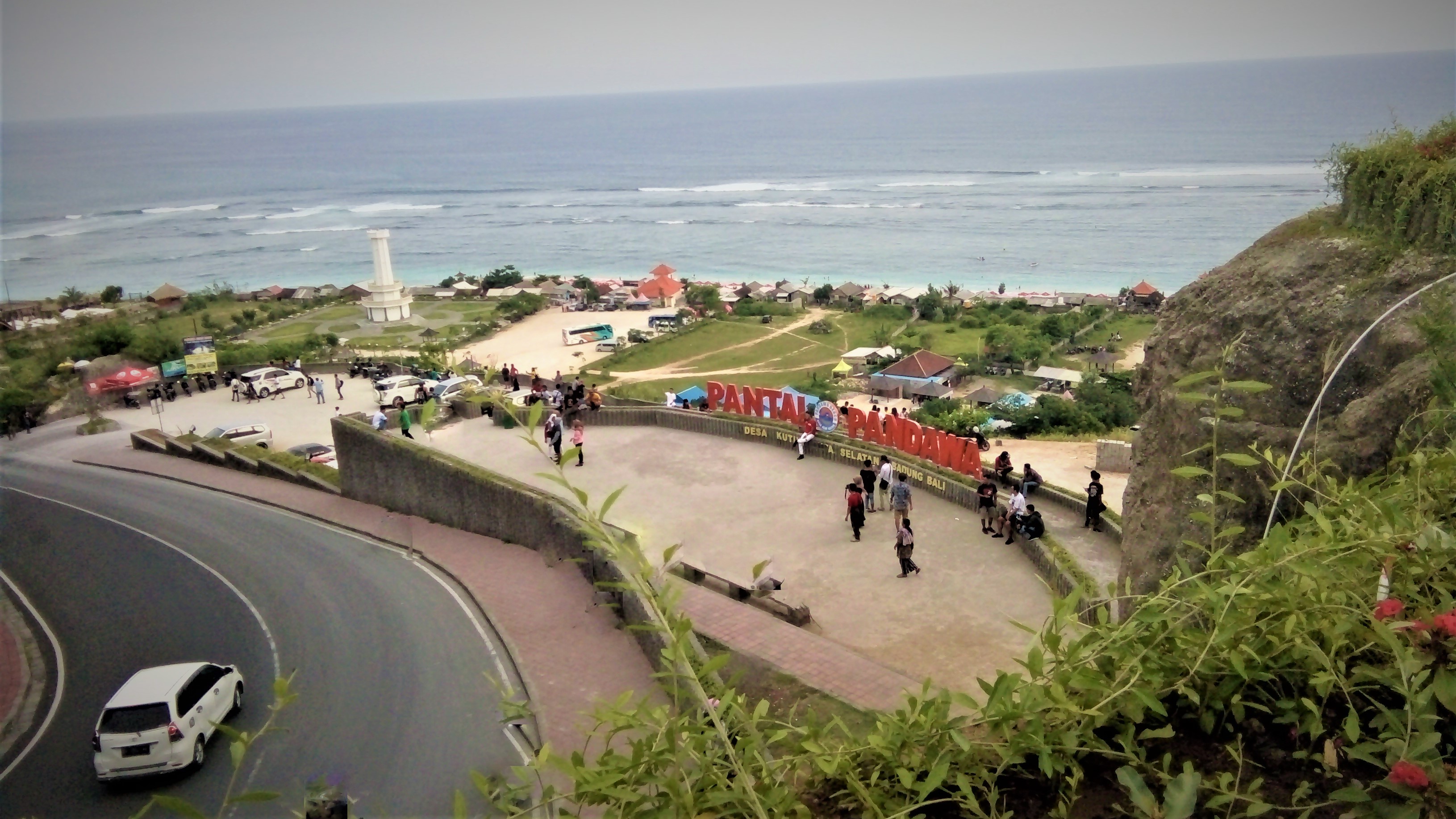
Pandawa Beach is what happens when a quarry road turns into a tourism pipeline in five years. The core fact is simple and checkable: until 2012, this cove on Bali's Bukit Peninsula had no public road. A limestone ridge sealed it off, and the few outsiders who found a way in by boat or footpath called it Secret Beach. Then a road was cut — following, by most English-language accounts, the path of an existing rock quarry through the hillside — and by 2017 Bali's provincial tourism office was counting 1,356,321 visits a year to a beach almost nobody outside Kutuh village had heard of a decade earlier.
The geology set the terms. The Bukit Peninsula is Tertiary-era seafloor limestone, pushed above the waterline by tectonic uplift, the same dry, karst-riddled plateau that gives Uluwatu its cliffs and reef breaks 15 kilometers west. That limestone is soft enough to quarry and carve, and hard enough to wall off a cove from casual access. Both properties mattered here. The rock that made Pandawa hard to reach for decades is the same rock that, once cut through, made it a controlled, single-entrance tourist product: one road in, one road out, an entrance gate, a parking lot, and a fee.
The statues are not incidental decoration. Six figures are carved into the northern headland — Kunti and her five sons, Yudhishthira, Bhima, Arjuna, Nakula, and Sahadewa, the Pandava brothers of the Mahabharata. This is not a beach that borrowed a mythological name for marketing; the statues are a literal carving of the epic into the cliff that defines the cove, and the beach's official name, Pandawa, is the epic's name transliterated into Balinese place-naming convention. Whether the carving predates or postdates the road's opening is not clearly documented in available sources, but the statues and the access road are both products of the same limestone-cutting era.
The economics run in two layers that rarely appear together. Underneath the tourist infrastructure, the cove's shallow, current-sheltered water has supported seaweed algaculture for longer than it has supported paragliding concessions — locals still work rows of cultivation line across the tidal flats, an activity that depends on exactly the same sheltering headlands that make the beach marketable as calm and swimmable. Tourism did not replace this economy; it grew alongside it, on the same stretch of sand, sometimes visibly in the same frame as the tour buses.
The "secret" framing was manufactured, and the sources say so plainly. A Bali tourism outlet profiled the beach as a newly rising attraction in May 2013, one year after the road opened. Indonesian media separately reported that location shoots for FTV — televised drama serials — helped make Pandawa a recognizable name that same year. Wikipedia's own citation list for the beach includes an article literally titled, translated, "Because of FTV, Pandawa Beach Became Famous." A beach discovered by outsiders and then made famous by a state road and a soap opera is a different kind of place than a beach that word-of-mouth quietly found; the marketing language of "secret" and "hidden" persisted well past the point where it stopped being true.
The visitor numbers tell the rest of the story with unusual precision, because Bali's provincial tourism office tracks beach-level visitor counts that get folded into Wikidata: 906,001 in 2016, a peak of 1,356,321 in 2017, 1,286,536 in 2018, 1,040,705 in 2019, then a collapse to 585,531 in 2020 as COVID-19 travel restrictions cut off the island. That trajectory — steep rise, plateau above a million, sudden 44% crash — is the shape of a manufactured attraction meeting a global shock, not the shape of organic, slow-building popularity.
There is also a quieter tension in the data that's worth naming honestly. Open-ocean wave models covering this stretch of coastline classify it as exposed, with an annual mean wave height near 1.9 meters and a warning about rip current. That reading describes the open swell hitting the Bukit Peninsula's coastline generally; it does not describe the sheltered pocket behind Pandawa's two headlands, which is precisely calm enough to have supported seaweed farming and is marketed, accurately, as swimmable. The tension is real and worth flagging for anyone cross-referencing regional wave data against a specific, headland-protected cove: the model is right about the coast and can be misleading about this one enclosed stretch of it.
What makes Pandawa worth an honest page, rather than a brochure one, is that every layer of it is a byproduct of infrastructure. The statues exist because the cliff could be carved. The beach is accessible because a quarry became a road. The fame is dated to a specific year and a specific TV genre. The seaweed economy survives underneath the tourist one because the geology that makes the cove marketable also makes it good for algaculture. None of that is a complaint — it's simply what the record shows, and it is more interesting than "hidden gem."