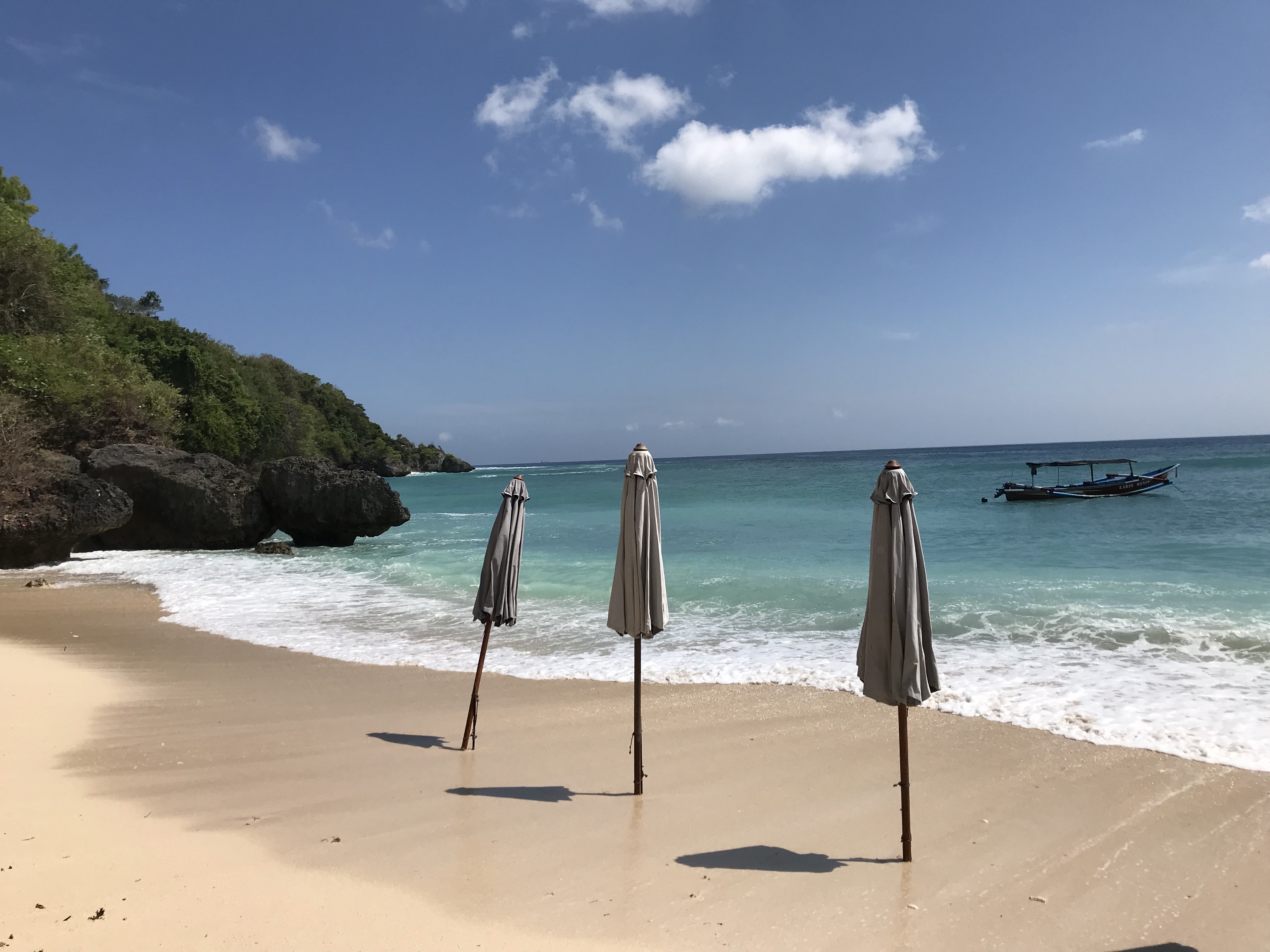
Padang Padang is small in a way that matters. The sand runs about 110 metres between two limestone headlands on the west side of Bali's Bukit Peninsula, in Pecatu village, South Kuta. There is no walking onto it from the road. You park on the cliff-top, pay an entrance fee, and go down through the rock: roughly 120 steps that thread a narrow cleft between a fallen boulder and the cliff face, a passage so tight in places that two people cannot pass abreast. You come out into the cove almost without warning, the sea suddenly in front of you. The Balinese name is Labuan Sait; Padang Padang is the name the surfers and the tourists use.
The wave is why surfers know it. Just off the sand, over a shallow coral reef, breaks Padang Padang Left, a fast, hollow, left-hand barrel often called the Balinese Pipeline. It is an expert's wave and an unforgiving one. It only stands up properly on a handful of the biggest dry-season swells, and when it does it draws the best surfers in Indonesia and beyond. The Rip Curl Cup Padang Padang, an invitational held here, does not run on a fixed date; it waits, sometimes for weeks, for the barrels to arrive, and is called off if they don't.
Most people who come down the stairs are not surfers. They came because of a film. In 2010 Padang Padang appeared in Eat Pray Love, the adaptation of Elizabeth Gilbert's memoir, in the stretch where Felipe (Javier Bardem) confesses his love to Liz Gilbert (Julia Roberts). The beach-bar set built for that scene was temporary and is long gone, but visitor numbers climbed after the film. The cove that a film made famous is the same cove a 110-metre strip of sand has to hold.
The wider Bukit is temple country. Pura Luhur Uluwatu, one of Bali's six principal sea temples, sits on a 70-metre cliff a short drive south, dedicated to Sang Hyang Widhi Wasa in the form of Rudra and associated by inscription with the 11th-century Javanese sage Empu Kuturan. The same limestone that holds the temple aloft is the rock you climb down through to the beach.
And it is shared with monkeys. Long-tailed macaques live in the cliffs around the entrance and work the staircase and the sand, practised at snatching sunglasses, phones, snacks, and hats from anyone careless with them. They are not a curiosity bolted onto the visit; they are residents, and the loose-belongings warning posted at the top is earned.


