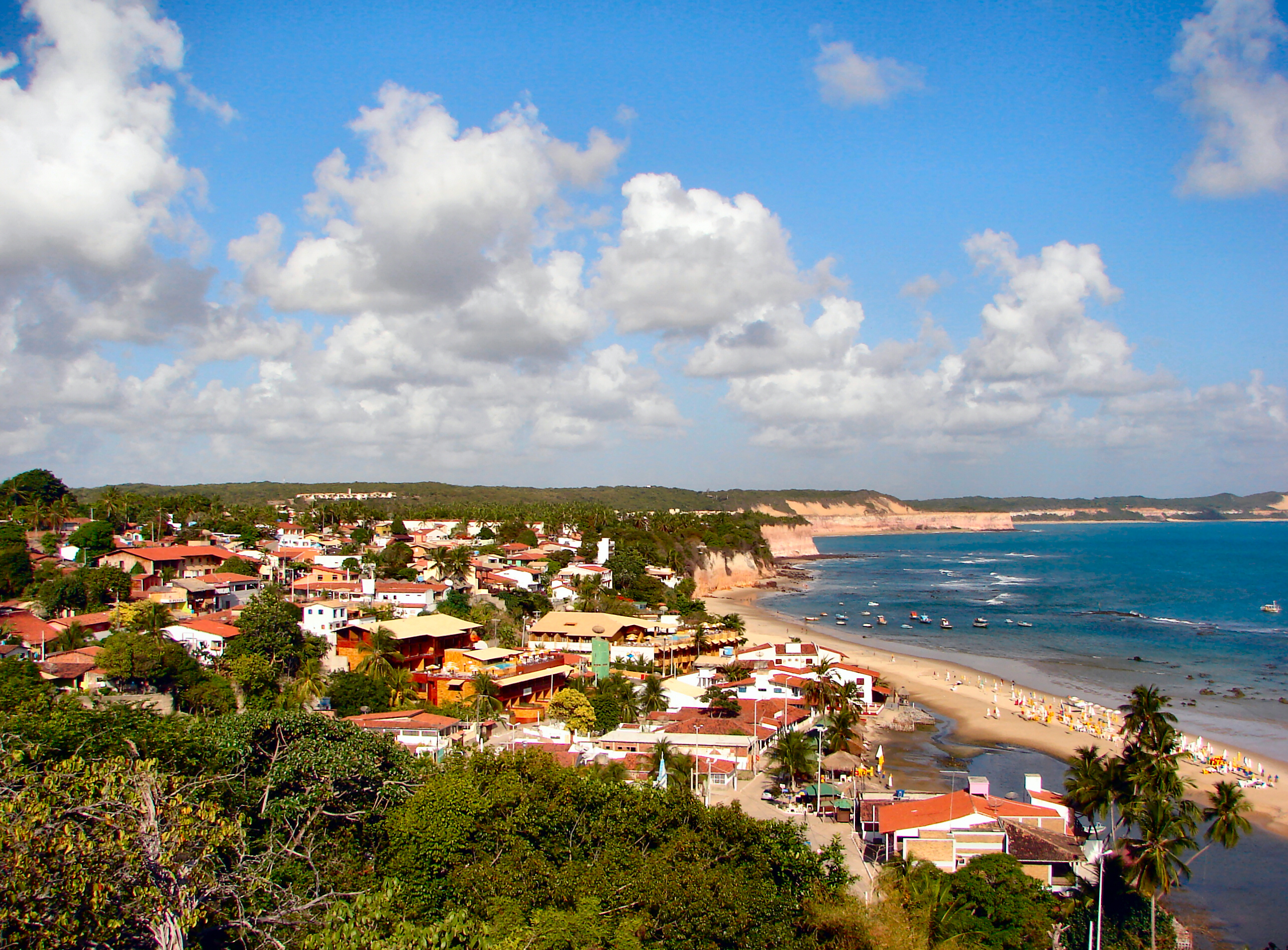
Rio Grande do Norte, BR

Pipa Beach

Pôr do Sol da Praia do Centro.jpg

Rio Grande do Norte, BR

Pipa Beach

Pipa's red sandstone cliffs are its top tourist draw and a documented killer: a 2020 collapse killed a family of three; a 2025 decree fenced them off.

Pôr do Sol da Praia do Centro.jpg · <a href="//commons.wikimedia.org/w/index.php?title=User:Lessa.danilo&amp;action=edit&amp;redlink=1" class="new" title="User:Lessa.danilo (page does not exist)">Lessa.danilo</a> · CC BY-SA 4.0
Nearest airport
NAT · 62 km
I’m here for
Story

Pipa Beach sits in the municipality of Tibau do Sul, Rio Grande do Norte, a village that was still a fishing settlement when surfers and backpackers began arriving in the 1970s. The name comes from a barrel-shaped rock ('pipa' is European Portuguese for barrel) that Portuguese sailors used as a landmark. What drew the surfers is what draws the crowds now: fine white sand, clear water, and a run of red-ochre sandstone cliffs, some reaching 40 meters, walling the beach off from the forest above.

Those cliffs are cut from the Barreiras Formation, a partially cemented sedimentary sequence common along Brazil's northeast coast, and they fail for two compounding reasons: wave action notches the base at high tide, removing support from the rock above, while rain leaches cement from strata-bound fracture sets higher in the face. A 2022 geomorphology study by Federal University of Ceará and Federal University of Rio Grande do Norte researchers concluded the cliffs are structurally unstable by nature, independent of who is standing beneath them.

Someone almost always is. The cliffs are Pipa's main attraction, drawing hundreds to thousands of visitors a day along the sand beneath them, and on 17 November 2020 a section collapsed on a family resting in its shade. Hugo Pereira, 32, his wife Stella Souza, and their seven-month-old son died, along with the family dog. No single trigger was ever publicly established; slow fracture failure rarely has one.

The clifftop carries a second hazard: guided quadbike tours along the plateau known as the Chapadão. A tourist fell from one in September 2020. On 17 January 2024, Ana Carla Silva de Oliveira, 31, died falling roughly 30 meters when her quadbike went over the unmarked edge. In January 2025, two more quadbike accidents there injured four additional people in a single week.

The response finally arrived in 2025. After a State Civil Defense report warned of imminent collapse, Tibau do Sul issued Decree No. 008/2025, declaring emergency and stringing 900 meters of eucalyptus-and-rope fencing across the four most dangerous points. It has not closed the file: a 7 September 2025 landslide at neighboring Praia do Madeiro injured two people and buried four beach bars, and federal prosecutors gave the municipality 15 days to produce a management plan and demolition schedule for structures built too close to the edge.

The spike

Pipa's red sandstone cliffs are its top tourist draw and a documented killer: a 2020 collapse killed a family of three; a 2025 decree fenced them off.

Pipa Beach sells itself on a paradox it rarely states out loud: the cliffs that make the postcard are the same cliffs that keep killing people, and the village has spent five decades building its economy on the part of the paradox that photographs well.

What the rock actually is. The bluffs that wall off Pipa's beaches are cut into the Barreiras Formation, a sequence of partially consolidated Cenozoic sediments that runs along much of Brazil's northeast coast. A 2022 study published in the Revista Brasileira de Geomorfologia, by Rubson Pinheiro Maia (Federal University of Ceará) and Rodrigo de Freitas Amorim (Federal University of Rio Grande do Norte), mapped the failure mechanism in detail: strata-bound vertical fracture sets, confined to specific layers, raise the rock's permeability and let rainwater leach the material cementing the sand grains together, while direct wave impact at the base during high tide carves an erosive notch that removes structural support from the blocks above. The cliffs reach roughly 40 meters in places. They were never geologically stable; the study's point is that they are not becoming unstable because of tourism, they simply are unstable, and tourism puts people directly underneath the part that is failing.

The afternoon it became unignorable. On 17 November 2020, around midday, a section of cliff collapsed onto a family sheltering in its shade on the sand below. Hugo Pereira, 32, a hotel reception manager at the Sunbay hotel whose family had recently moved to Pipa from Jundiaí, São Paulo, his wife Stella Souza, and their seven-month-old son were killed; the family dog died with them. Three rescue teams and forensic investigators from Rio Grande do Norte's Technical-Scientific Institute responded. No single trigger was identified, which is normal for this kind of failure: the wave notch and the leached fracture planes had likely been doing their work for months or years before that particular afternoon.

A second hazard riding on the first one. The cliff face is not the only danger; the clifftop plateau above it, the Chapadão, is a working tour route for guided quadbikes, and the edge has claimed lives independently of the rock below. A tourist went over the edge on a quadbike in September 2020, weeks before the fatal collapse. On 17 January 2024, Ana Carla Silva de Oliveira, 31, fell roughly 30 meters to her death when the quadbike she was in went over an unmarked edge; her sister-in-law survived. There was no warning signage at the site. In a single week in January 2025, two more quadbike accidents on the Chapadão injured four additional people. The pattern repeats because the same feature that makes the clifftop a tour product, an uninterrupted drop to the beach, is the feature that kills when a vehicle or a person crosses the edge.

The state finally moved, in 2025. Rio Grande do Norte's State Civil Defense issued a technical report flagging imminent collapse risk in specific Chapadão sections. Tibau do Sul's municipality responded with Municipal Decree No. 008/2025, a declared state of emergency invoked under Article 8 of Brazil's federal Civil Protection Law (12.608/2012), and began emergency containment work: 900 meters of fencing, built from eucalyptus wood and nautical rope, installed across the four most dangerous points, paired with new warning signage. The material choice was deliberate: fencing that reads as rustic and low-impact rather than industrial, so the barrier does not itself wreck the view it is meant to protect people from.

The fencing did not close the file. On 7 September 2025, a landslide at Praia do Madeiro, roughly 4-5 km northwest of the main Chapadão on the opposite side of the village, injured two people and buried four beach bars operating at the cliff base. It followed an earlier collapse at the same beach in June 2024 that had already destroyed beach-bar structures there. Brazil's federal public prosecutors (the MPF) responded by giving Tibau do Sul fifteen days to produce three things: a management plan defining what activities are actually permitted near the cliffs, an environmental carrying-capacity study quantifying how much foot and vehicle traffic the formation can sustain, and a demolition schedule for structures built illegally close to the edge. Separately, Justiça Federal had already ordered, in August 2024, the demolition of restaurante Barravento's irregular constructions between Cacimbinhas and Ponta do Madeiro, and federal prosecutors (MPF) separately obtained a conviction against Madeiro Beach Hotel Bar e Restaurantes, which had operated without a license for more than 20 years; removal of its structures has begun, and the owners must present a PRAD (environmental recovery plan).

The legal backdrop nobody built a beach bar around. Brazil's federal environmental council, Conama, designated a 100-meter buffer from cliff edges as a Permanent Preservation Area under Resolution 303/2002, meaning construction within that zone has been federally restricted for over two decades. A 2020 attempt to weaken that protection was overturned by Brazil's Supreme Court in December 2021, which restored the cliff-edge buffer nationwide. The rule existed through the 2020 deaths, the 2024 death, and the 2025 landslides; the recurring problem in Pipa has not been an absence of law but the gap between the law on paper and what got built, and permitted foot traffic, at the actual edge.

What this means if you are standing on the sand. Pipa's cliffs are not a hazard that was manufactured by overtourism layered onto an otherwise safe formation; the geology paper is explicit that the fracture sets and wave notching would erode this coastline with or without a single visitor. What tourism did was put hundreds to thousands of people a day directly beneath and on top of a formation that was already failing on its own schedule, and it took a family's death, a tourist's death, two more injured in a single week, and a second beach's bars getting buried before the fencing went up. The 900 meters of rope-and-eucalyptus barrier and the September 2025 prosecutorial deadline are the current state of a five-year-old, unresolved argument about how much of this landscape a coastal village can sell before the landscape starts sending back a bill.

Cruzeiro de Pipa 02.jpg
Culture

Where it shows up

Television
  • Flor do Caribe · 2013
    TV Globo

    The Globo telenovela, broadcast March-September 2013, filmed location scenes at Pipa alongside other Rio Grande do Norte beaches (Baia Formosa, Genipabu); the production spent more than 40 days on location in the state.

Other
  • Baia dos Golfinhos (Dolphin Bay)

    The bay bordering Praia do Madeiro where Guiana dolphins (boto-cinza) gather most mornings, reachable on foot at low tide from Praia do Centro and visited by boat tours from Pipa; the bay lends its name to Pipa's main commercial street, Avenida Baia dos Golfinhos.

History
  • The barrel-rock naming and earlier place names

    Portuguese sailors named the point for a barrel-shaped rock ('pipa'); the area carried the earlier names Orotapiry and Itacoatiara ('the painted cliff') under prior Indigenous and colonial use, both references to the same cliff formation now at the center of the safety story.

Praia de Pipa.jpg
History

What happened here

  1. 1963founding

    Tibau do Sul is established as a municipality

    The municipality that contains Pipa is formally established on 3 April 1963, elevated to municipality status by Rio Grande do Norte state law and separated from Goianinha, beginning as a fishing settlement on the state's southern coast.

    Wikipedia →
  2. 1970cultural

    Surfers and backpackers discover the fishing village

    Pipa remains a small fishing village until surfers and backpackers begin arriving in the 1970s, drawn by clear water, white sand, and the cliffs, starting the shift from fishing economy to tourism economy.

    Wikipedia →
  3. 1980founding

    Santuario Ecologico de Pipa takes root

    Engineer Charles Capelle leases land recovering from decades of logging and cattle pasture and establishes a self-sufficient retreat; the site develops into the private Santuario Ecologico de Pipa, later stewarded by David Hassett, conserving roughly 90 hectares of Atlantic Forest including part of Praia do Madeiro and Baia dos Golfinhos.

  4. 2020safety

    Cliff collapse kills a family of three

    A section of cliff collapses onto a family sheltering in its shade around midday on 17 November. Hugo Pereira, 32, his wife Stella Souza, and their 7-month-old son die, along with the family dog. Rio Grande do Norte's Technical-Scientific Institute investigates; no single trigger is publicly established.

  5. 2021policy

    Supreme Court restores the cliff-edge protection buffer

    Brazil's Supreme Court overturns a 2020 attempt to weaken Conama's 100-meter cliff-edge Permanent Preservation Area rule, restoring the protection nationwide, including at Pipa.

  6. 2024safety

    Tourist dies falling from a quadbike on the Chapadão

    Ana Carla Silva de Oliveira, 31, a Legislative Assembly employee from Roraima, dies on 17 January after the quadbike she was riding in goes over the cliff edge; she falls roughly 30 meters. Her sister-in-law survives and is airlifted to Natal. No warning signage marked the site.

  7. 2024natural

    Cliff collapse destroys beach bars at Praia do Madeiro

    A section of cliff at Praia do Madeiro, near the main Chapadão, collapses and destroys beach-bar structures built at its base, a precursor to the larger September 2025 landslide at the same beach.

  8. 2025policy

    Emergency decree and clifftop fencing

    Following a State Civil Defense report warning of imminent collapse, Tibau do Sul issues Municipal Decree No. 008/2025 declaring a state of emergency and begins installing 900 meters of eucalyptus-and-rope fencing across the four most dangerous points on the Chapadão.

  9. 2025policy

    Landslide at Madeiro, federal prosecutors intervene

    A landslide at Praia do Madeiro on 7 September injures two people and buries four beach bars. Brazil's federal public prosecutors (MPF) give Tibau do Sul 15 days to produce a management plan, a carrying-capacity study, and a demolition schedule for illegal cliff-edge structures.

The honest part
“The village's single best photograph is also its documented cause of death.”

The honest problem with Pipa is that its single best photograph, the red cliff face dropping straight to white sand, is also its documented cause of death. This is not a resort myth or an exaggerated warning sign; it is a five-year run of dated, named, sourced incidents: a family of three killed by a cliff collapse in November 2020, a tourist killed falling from a quadbike off the same plateau in January 2024, four more people injured in two separate quadbike accidents in a single week of January 2025, and two people injured with four beach bars buried in a landslide at neighboring Praia do Madeiro in September 2025.

The village's economy runs on people standing under and on top of a rock formation that a 2022 geomorphology study describes as structurally unstable by nature, not because of tourism, but tourism is what put the bodies in the path of it. The 100-meter construction buffer around cliff edges has been federal law since 2002, survived a 2020 repeal attempt, and did not stop beach bars from operating close enough to the edge to be fined, demolished, or buried. The 2025 fencing and the pending federal prosecutorial deadline are real, current responses, not a closed case; whether a carrying-capacity study and a demolition schedule change what happens on the sand is still an open question as of this writing.

Santuário Ecológico de Pipa.jpg
Anatomy

The shape of the place

Praia do Madeiro / Baia dos Golfinhos overlook

15%

The beach farthest from Centro, roughly 4 km northwest, toward Tibau do Sul, bordering the Santuario Ecologico's protected forest and the Baia dos Golfinhos (which sits between Centro and Madeiro), where Guiana dolphins (boto-cinza) gather most mornings, visible from a low-tide walk along the beach from Praia do Centro, from boat tours out of Pipa, and from the clifftop miradouro.

Best for Dolphin viewing, surf lessons

Site of cliff collapses in June 2024 and September 2025 that destroyed and buried beach-bar structures built at the base.

Praia do Amor

30%

A cove roughly 1.5 km south of Centro, named for the heart shape its sandbar forms at low tide when viewed from the clifftop miradouros above it; reached on foot along the clifftop path or by beach at low tide.

Best for Photography, quieter swimming at low tide

Same Barreiras Formation cliffs wall the cove; base-of-cliff shade carries the same collapse risk as Centro.

Chapadão clifftop plateau

45%

The elevated red-sandstone plateau overlooking the main beach, Pipa's signature view and its documented hazard zone: site of the January 2024 and January 2025 quadbike incidents, now crossed by 900 meters of emergency fencing installed under a 2025 state-of-emergency decree.

Best for Sunset views (from behind the fencing)

Guided quadbike tours operate here; the edge itself is the danger, not the plateau surface.

Centro / Praia da Pipa

50%

The main village beach and the built-up core of Pipa, fronted by Avenida Baia dos Golfinhos, the commercial spine lined with restaurants, pousadas, and shops that grew out of the 1970s surfer settlement.

Best for Food, lodging, the main swimming beach

Starting point for the clifftop walk to Praia do Amor and the Chapadão.

Landmarks

Chapadão de Pipa

natural formation

The red-sandstone clifftop plateau that gives Pipa its skyline, cut from the partially consolidated Barreiras Formation and reaching roughly 40 meters in places. Its instability is documented by a 2022 UFC/UFRN geomorphology study and by a string of fatal and near-fatal incidents from 2020 to 2025, which led to a 2025 municipal state-of-emergency decree and clifftop fencing.

Wikipedia →

Santuario Ecologico de Pipa · 1980

private nature reserve · Charles Capelle (founder)

A roughly 90-hectare private Atlantic Forest reserve established from 1980 by engineer Charles Capelle on land that had been logged and grazed since the 19th century; it now borders and helps shelter part of Praia do Madeiro and Baia dos Golfinhos from development.

A day here

From first light to dark

Dawn

Projeto TAMAR technicians walk the sand before the crowds arrive during turtle season (roughly December to May), reading overnight tracks to locate and protect hawksbill turtle nests. Around the same hours, Guiana dolphins (boto-cinza) move into Baia dos Golfinhos, a few kilometers down the coast, visible from the beach at low tide, from boat tours, and from the clifftop miradouro.

Midday

This is when the risk is highest: hundreds to thousands of visitors occupy the sand directly beneath the cliff faces during the hottest, most crowded hours, the same base zone where the November 2020 collapse and other slides have occurred. The 900 meters of eucalyptus-and-rope fencing now marks the four sections judged most dangerous.

Golden hour

The Chapadão plateau fills with people for sunset, the ochre-red rock catching low light above the water; this is also the route guided quadbike tours use, the same activity responsible for the January 2024 and January 2025 injuries and deaths.

Night

The beach empties and, in turtle season, goes dark by design in the areas TAMAR monitors, since hatchlings navigate by light and artificial glow can misdirect them toward the village instead of the water. The fenced cliff sections sit unlit and closed to the tour traffic that crosses them by day.

Chapadão Pipa RN.jpg
Sea & surf

What the water does

JFMAMJJASONDmetres (significant wave height)

Solid = typical monthly wave height; pale = the bigger days (90th pct). Offshore/regional swell from Open-Meteo Marine (ERA5 Ocean reanalysis, 2023–2024); a sheltered cove may sit calmer than this.

Mixed — usually swimmable, with a livelier season
Typical wave height
0.85 m
Biggest swell
Sep · 1.05 m
Calmest
Apr · 0.67 m
Typical period
6.7 s (wind chop)
Before you go

Things to know

The cliffs are the hazard

Both the base of the cliffs (collapse risk, fatal in November 2020) and the clifftop plateau edge (quadbike falls, fatal in January 2024) have killed visitors; stay behind the 2025 fencing and off unmarked edges.

Time the dolphin bay to low tide

Baia dos Golfinhos is reachable on foot at low tide (best entry from Praia do Centro); Guiana dolphins often come within meters of the sand, and boat tours from Pipa also stop in the bay.

Turtle season changes the rules

Roughly December to May, TAMAR monitors nesting hawksbill turtles on Pipa's beaches; some stretches restrict nighttime lighting and activity to protect hatchlings.

Infrastructure lags the crowds

Rapid, unplanned tourism growth since the 1980s has outpaced sewage and transit infrastructure investment, a gap documented in coverage of the village's development.

Sharks

No incidents on record in the global shark-attack file.

Plan

If you go

Getting there
Nearest airport
Rio Grande do Norte/São Gonçalo do Amarante–Governador Aluízio Alves International Airport (NAT) · 62 km
Nearest town
Ares · 13 km

Pipa sits in Tibau do Sul municipality on Rio Grande do Norte's southern coast. The nearest airport is Governador Aluizio Alves International (NAT) in Sao Goncalo do Amarante, about 62 km away by road; the nearest town is Ares, about 13 km away. Most visitors arrive by car or shuttle from Natal, roughly 80-90 km north along the coastal highway. There is no direct public transit onto the Chapadão or into the fenced cliff zones; those are accessed on foot from the village.

When to go
  • Flipipa (Festival Literario da Pipa) · Late October to early November, annually

    A free literary festival held at Praca do Pescador in Tibau do Sul; the 2025 edition was its 9th, running 30 October to 1 November with a program of author panels, a book fair, and secondhand booksellers.

  • TAMAR sea turtle nesting season opening · Mid-December, opening a season that runs into May

    Fundacao Projeto TAMAR marks the start of the hawksbill turtle (Eretmochelys imbricata) nesting season on Pipa's beaches with a public opening event; daily-morning nest monitoring by TAMAR technicians has run since the early 2000s.

  • Pipa Music Fest · Varies by year

    An independent-artist music festival held at Pipa, part of a broader cluster of arts programming (including the Ceu videoclip festival) that has grown alongside the village's tourism economy.

What to eat & drink
Tapioca com ginga

A Rio Grande do Norte specialty rarely found outside the state: ginga (a small saltwater fish, similar to anchovy) is coated in cornmeal, fried, and skewered on a coconut-leaf rib, served alongside tapioca and grated coconut. Attributed to a cook known as Dona Dalila, the dish spread along the Potiguar coast from there.

Street stalls along Avenida Baia dos Golfinhos, Pipa's main commercial street

Carne de sol com queijo coalho

Salt-cured beef paired with squeaky coalho cheese, a staple of northeastern Brazilian coastal cooking, served here in versions ranging from empanadas to burgers to the traditional plate with fried cassava (macaxeira).

Restaurants along Avenida Baia dos Golfinhos

Cruzeiro do Pescador

Pipa's first fine-dining restaurant, opened in 1996 by transplanted São Paulo restaurateur Daniel Felipe Rios; the house dish is fish a Micaela, smoked to order and served with sauteed vegetables, alongside a shrimp- and mollusk-heavy seafood menu.

Near the entrance to the Chapadão, where the restaurant relocated in 2005

The cliffs themselves have no food service

The clifftop plateau and the sand directly beneath the cliff faces are the fenced, monitored hazard zone; there are no vendors on the Chapadão itself. Eating happens back on Avenida Baia dos Golfinhos or at the beach-access kiosks below the safer stretches of sand.

N/A — by design, not oversight

Sources & references
  1. Wikipedia: Pipa Beach · cited 2×
  2. Agora RN, May 2025 · cited 2×
  3. Municipal history; Wikipedia: Tibau do Sul
  4. Santuario Ecologico de Pipa; Vive Pipa
  5. Agencia Brasil; Pragmatismo Politico, Nov 2020
  6. Mar Sem Fim, cliff coverage
  7. Diario do Nordeste; Radio Itatiaia; SBT News
  8. Ponta Negra News, Sept 2025 (retrospective)
  9. Agora RN; SaibaMais, May 2025
  10. Ponta Negra News; Tribuna do Norte; Agora RN, Sept 2025
  11. Agencia Brasil, Nov 2020 coverage
  12. Revista Brasileira de Geomorfologia, 2022 (Maia & Amorim)
  13. Agencia Brasil; Pragmatismo Politico
  14. Diario do Nordeste; Radio Itatiaia
  15. Ponta Negra News, Sept 2025
Colophon · Provenance

Where this page comes from

Geography, facilities
OpenStreetMap (ODbL) for geometry and facility tags within 500 m of the beach centroid. GeoNames for city/airport distances.
Climate & ocean
Open-Meteo ERA5 + Marine archive, 2014–2023 monthly normals.
Photography
Archival, original tone (Tier B — Wikimedia Commons). Each image licensed per its own terms; attribution visible inline.
History & culture
Every factual claim is linked to its source in the prose above. Wikipedia citations inline. Non-wiki sources named where relevant.
Editorial voice
Register: severe. Written to pass a local's nod test; corrections welcome.
Written by Erin Rose
Last reviewed 2026-04-19
v0.9 — in editorial development toward v1.0