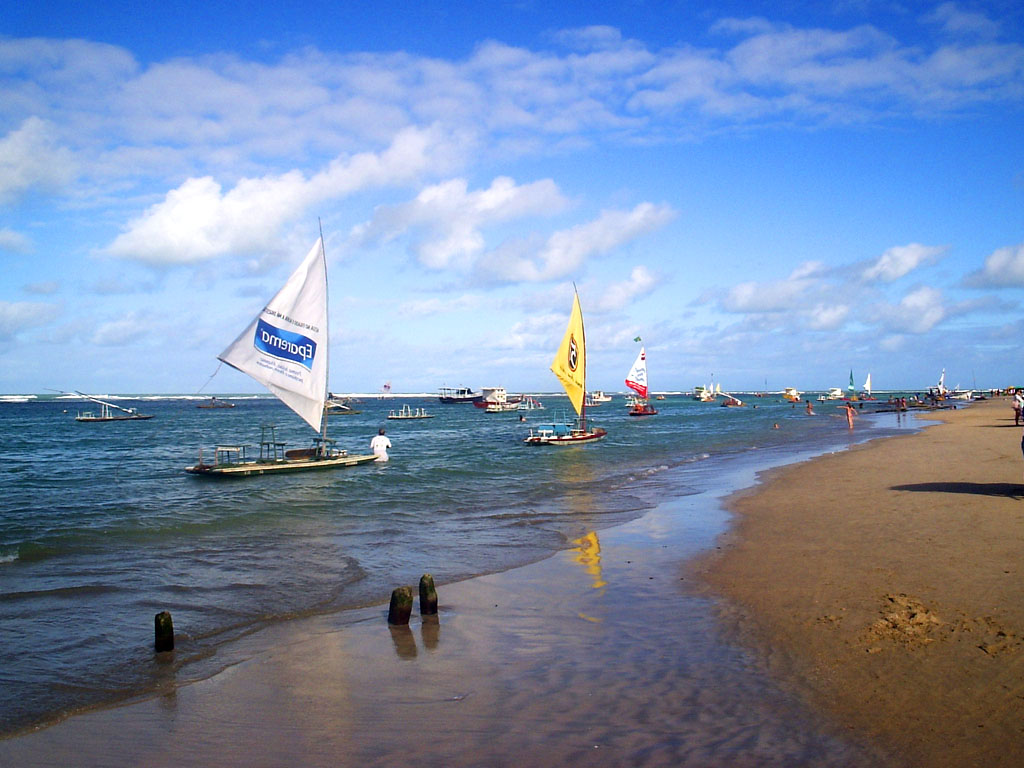
The singular thing about Porto de Galinhas is that its two defining facts pull in opposite directions, and the place is named after the darker one. The beach is famous for a reef that turns the sea into clear, still pools you sail out to on a raft. The town is named for that same coast being chosen, two centuries ago, precisely because it was quiet enough to land smuggled human beings without being seen. The pools and the name come from the same geography: a sheltered, reef-screened stretch of shore away from the watched harbor at Recife.
Start with the reef, because it is the physical engine of everything here. A line of sandstone and coral runs parallel to the beach a short distance offshore. At high tide it is mostly submerged and the sea looks ordinary. At low tide it surfaces as a barrier, and the water it holds back on the landward side settles into shallow basins — the piscinas naturais. Wikipedia's entry calls them the natural pools closest to the coast of anywhere in Brazil, and that closeness is the draw: you do not need a boat to deep water, only a short ride to a reef a few hundred meters out. The standard way to make that ride is the jangada, the flat, single-sailed raft that fishermen of the northeast have used for generations. Jangadeiros now sail tourists rather than nets, ferrying them out at low tide and back before the returning water clouds the pools.
The timing is not a detail; it is the whole experience. The pools exist only in the window around low water. The semidiurnal tide here swings about two meters on a spring, so the reef is exposed and the basins are clear and calm twice a day, then drowned and ordinary twice a day. A trip that ignores the tide table sees a reef under choppy water and wonders what the fuss was about. This is why the beach's reputation rests on a schedule the sun has nothing to do with — the magic hour at Porto de Galinhas is whenever the moon has pulled the tide out.
Now the name, told plainly, because it is the part a brochure leaves out. The town was Porto Rico — Rich Port — until the mid-1800s. Brazil signed a treaty and passed a law in 1831 abolishing the transatlantic slave trade, but the law was so nakedly unenforced that the country produced an idiom for it that survives today: "para inglês ver" — for the English to see — a law passed only to satisfy British pressure, with no intention of being obeyed. The trade continued, illegally and in enormous volume, for another two decades, until the Eusébio de Queirós Law of 4 September 1850 finally shut it down in earnest.
Because the trade was now illegal, it went where it would not be watched. The port of Recife, the provincial capital, had supervision. This stretch of the Ipojuca coast did not. So smugglers brought enslaved Africans — Angolans prominent among them — ashore here, and the cover story was livestock. Crates of helmeted guinea-fowl, the bird Brazilians call galinha d'Angola, the Angolan chicken, a favored dish of the local sugar-plantation aristocracy, were landed alongside, or stacked over, the people. The coded announcement that a contraband ship had arrived was "tem galinha nova no porto" — there are new chickens in the port. The euphemism stuck so hard it replaced the town's real name. Porto Rico became Porto de Galinhas: the port of the chickens, where the chickens were people. Several Brazilian sources describe this beach as the principal point of the illegal slave landings in the northeast during the contraband decades; the etymology and the code phrase are attested directly in the Wikipedia entry.
That is the spike. Most legendary beaches carry a comfortable origin story — a saint, a shipwreck, a turtle, a painter. Porto de Galinhas carries a confession. The reef that makes the pools also made the cove a smuggler's berth; the name is a slaver's password that nobody ever bothered to retire; the guinea-fowl on the town's logos and souvenir stalls is the literal animal the human cargo was disguised as. You can stand waist-deep in turquoise water that genuinely was voted the best in the country, on a beach whose name is a sentence men once used to report the arrival of people in chains.
The modern chapter completes the irony. The same reef that built the reputation is now being worn down by the reputation. Researchers measuring the reef flats found that in high tourist season the water carries markedly more ammonium, nitrate, and phosphate — nutrient pollution that tracks with the crowds — and documented visitors walking on the coral, packing the pools, and leaving trash. The reef has bleached in the heat, badly: a major event in 2020, and during the 2023–24 global bleaching the incidence at Porto de Galinhas was reported around 84 percent. The jangadeiros who once only ferried tourists have, in part, become reef caretakers, helping plant 3D-printed coral cribs to rebuild what the visitors damage. So the place is singular twice over: a beach whose beauty is inseparable from a reef, whose name is inseparable from slavery, and whose future depends on whether the people drawn by the first can stop destroying the thing that made it.