Lisbon, PT

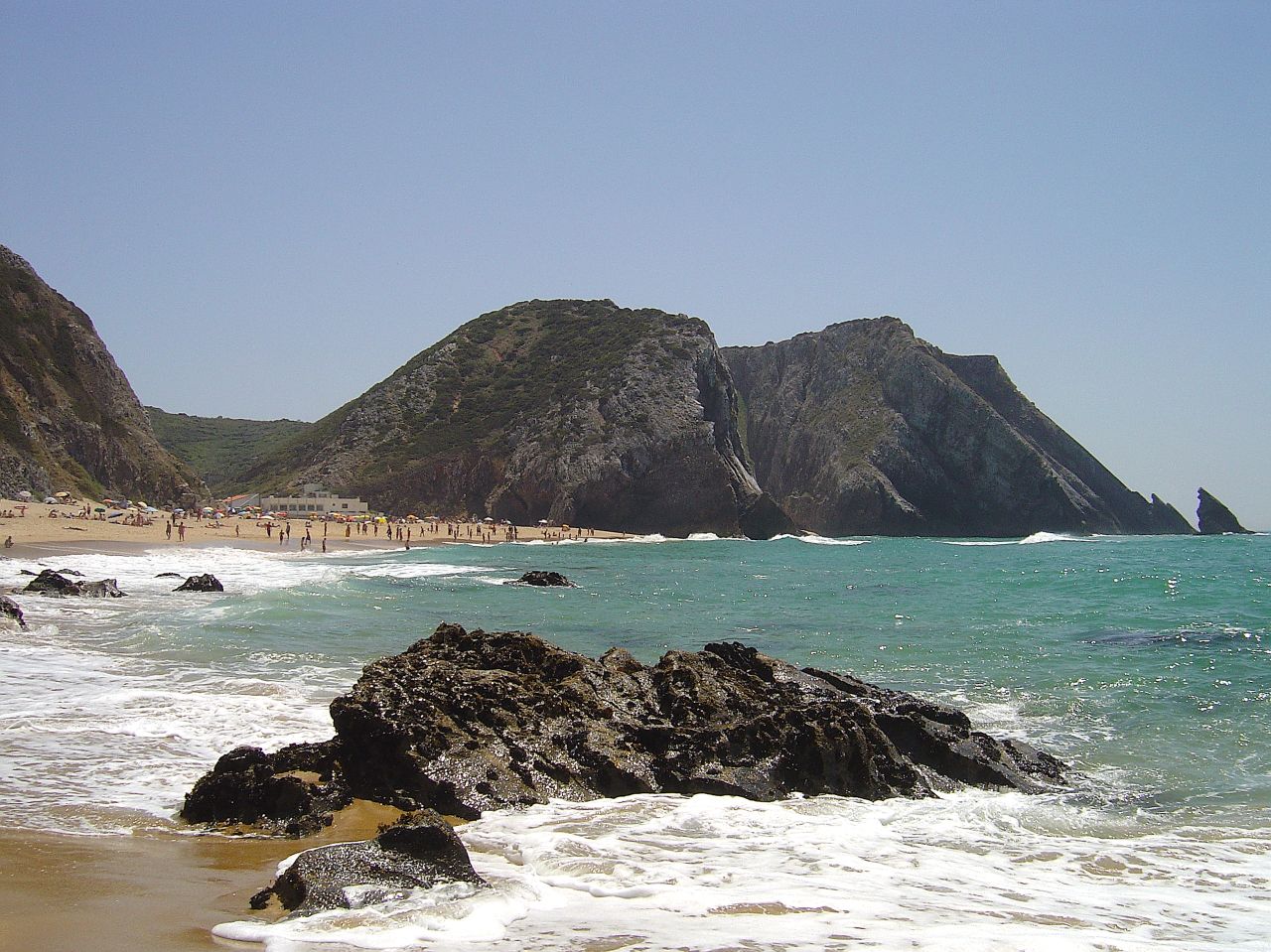
Praia da Adraga

Adraga 03.jpg

Lisbon, PT

Praia da Adraga

Sintra paid a bankrupt developer €500,000 for 54.6ha next to Adraga in 2021, and won't finish rebuilding the land into a park until 2027.

Adraga 03.jpg · <a href="//commons.wikimedia.org/w/index.php?title=User:Ppinhol&amp;action=edit&amp;redlink=1" class="new" title="User:Ppinhol (page does not exist)">Ppinhol</a> · CC BY-SA 4.0
Nearest airport
CAT · 14 km
I’m here for
Story

Praia da Adraga is a wild, cliff-backed North Atlantic beach on the Sintra coast of Portugal, near the small village of Almoçageme in the parish of Colares, Sintra municipality — about 3.3 kilometers from Colares itself. Wikipedia notes an excellent restaurant and a very good emergency-service system on site, but says the beach is hard to reach by public transportation.

On the southern escarpment stands the Pedra de Alvidrar, a rock formation that plunges almost vertically into the ocean; local tradition held that young men proved their courage climbing it. About fifty meters from the cliff is the Fojo da Adraga, a natural well roughly 90 meters deep, carved by rainwater and wave action into a labyrinth of caves. Roman-era legend held a Triton's conch sounded from its bottom, prompting an embassy to Emperor Tiberius between 14 and 34 AD.

The land behind the beach is now the Adraga-Praia Grande ecological park, a restoration project run by Sintra's municipal council with the Aga Khan Trust for Culture and Portugal's environmental agencies. Before the work began, invasive plants covered about 63% of the site. Making the beach's backdrop look untouched again took buying out a bankrupt developer and years of active rebuilding — the fuller story, and the numbers behind it, are in the deep dive below.

In the water, Adraga is a point break with a sandy-and-rock bottom, producing hollow, fast, powerful, ledgey lefts and rights; Surf-Forecast rates it an exposed beach-and-reef break with fairly consistent surf year-round, and December is statistically the best month, clean about 41% of the time. Both Wannasurf and Surf-Forecast flag rocks as a hazard, and Wannasurf adds localism. At low tide the sand connects to neighboring Praia do Cavalo.

Adraga carries the Quercus "Golden Quality Beach" award and held Blue Flag status on Portugal's 2025 national list, with its 2026 season running 30 May to 13 September. In 2003, Sunday Times readers and journalists ranked it third-best beach in Europe — the only Portuguese beach on the list. The one confirmed business here, Restaurante Adraga, has served fish since 1905 and once hosted Queen D. Amélia, who came for the simplicity of a fisherman's cabin.

The spike

Sintra paid a bankrupt developer €500,000 for 54.6ha next to Adraga in 2021, and won't finish rebuilding the land into a park until 2027.

Praia da Adraga is marketed, correctly, as one of the wildest beaches on the Sintra coast: a cove of vertical cliffs, sea caves, a reef point break, and almost no built environment beyond one restaurant. What that description leaves out is that the land behind the beach is wild today because Sintra's municipal council bought it from a bankrupt company and is now spending years physically rebuilding it.

What was actually bought. In 2021 the council paid €500,000 for 54.6 hectares between Praia da Adraga and Praia Grande, land that had belonged to a now-bankrupt developer, Cintra – Urbanizações Turismo e Construções. A January 2025 press report confirmed the purchase and named the project it would become: the Parque Ecológico da Adraga e Praia Grande, a partnership between the municipal council, the Aga Khan Trust for Culture, and Portugal's environmental agencies — ICNF, APA, and CCDR Lisboa e Vale do Tejo. A municipal technician said the park could eventually grow to 67 hectares with further land acquisitions.

Why the land needed rebuilding at all. Before any restoration work began, invasive exotic plants covered about 63 percent of the site, and only three of its habitats were rated in good conservation condition. The council's own figures put real ecological stakes on the land: 14 natural habitat types, roughly 16 percent of every habitat type identified anywhere in Portugal, six of them under EU protection; 199 recorded plant species; more than 200 recorded animal species. That is not marginal scrubland. It is one of the richer habitat inventories on this stretch of coast, and it had been left to decay under absentee, bankrupt ownership until the council stepped in.

The timeline is long, and public. Phase one of the project, due by 31 July 2025, covered clearing 35 percent of the northern area and laying three kilometers of marked trails. Phase two, running from August 2025 to 31 December 2027, is meant to clear the rest, finish the trail network, add observation points and rest areas, and build an environmental interpretation center. A 13 January 2026 update from Público confirmed the project was still under way and still on track for the end of 2027. Officials have said the park can be visited before then, but that full ecological recovery — the habitats actually returning to health, not just being cleared of invasive cover — will only be complete after ten years. That is a decade-long project sitting directly behind a beach most visitors experience as simply, permanently wild.

The honest tension. None of this is concealed. It is on the municipality's own website and in regional press coverage. But it complicates the postcard version of Adraga in a specific way: the beach's reputation rests partly on looking untouched, and "untouched" here is the product of an active, funded, multi-year public works project with a partnership of five institutions and a ten-year completion horizon — not the absence of human intervention, but its careful, ongoing application. The land was not preserved. It was purchased out of bankruptcy, cleared, and is being rebuilt habitat by habitat.

What this means for a visitor today. Walk the cliffs above Adraga now and you are walking through an active restoration site, not a finished nature reserve. Some of what you see — cleared trails, marked observation points — is intentional and recent. Some of what you don't see — habitats still recovering after crews directly intervened on only 17 of the site's hectares so far, out of the 54.6 the council bought — is also part of the story, just further from finished. The whole area sits inside the UNESCO-listed Sintra Cultural Landscape's protection zone, which raises the stakes on getting the restoration right, but does not speed it up. None of that shows up in a photograph of the point break.

The wild beach is real. The waves are real, the cliffs are real, the caves are real. What is not quite real is the idea that nobody had to do anything to keep it that way. Someone had to buy failed land off a bankrupt company for half a million euros, and then commit to a restoration measured in years, not seasons, to make the "wild" version of Adraga the one visitors actually get to stand in front of.

Roque Gameiro - Praia de Adraga.jpg
Culture

Where it shows up

Other
  • Sunday Times European beach ranking · 2003
    The Sunday Times

    Readers and journalists ranked Praia da Adraga third-best beach in Europe, the only Portuguese beach on the list.

  • "Pure Shores: 10 top Portuguese beaches" · 2004
    The Independent

    Adraga is featured in the Independent's June 2004 roundup of Portugal's best beaches.

History
  • The Fojo's Roman legend

    Legend held the Romans believed a Triton blew a conch at the bottom of the Fojo, prompting an embassy to Emperor Tiberius between 14 and 34 AD.

  • Queen D. Amélia's visits

    In the early 20th century, Queen D. Amélia was won over by the simplicity of the beachfront cabin that became Restaurante Adraga and spent long afternoons there away from her entourage.

Praia da adraga 1.jpg
History

What happened here

  1. 14legend

    The Fojo's Triton legend reaches Tiberius

    Legend held a Triton's conch, heard from the ~90m-deep Fojo, prompted an embassy to Emperor Tiberius between 14 and 34 AD.

  2. 1905culture

    Restaurante Adraga opens as a fishermen's cabin

    Maria Libânia begins cooking for local fishermen in a beachfront cabin that becomes Restaurante Adraga.

  3. 2003recognition

    Sunday Times readers rank Adraga 3rd in Europe

    Readers and journalists of the Sunday Times name it the only Portuguese beach on their European best-beaches list.

  4. 2004culture

    The Independent lists Adraga among Portugal's top ten beaches

    "Pure Shores: 10 top Portuguese beaches" runs in The Independent.

    Wikipedia →
  5. 2015recent

    Unexplained cliffside works reported

    A local blog observes cliff intervention work at Adraga that the municipality would not explain.

  6. 2021governance

    Sintra buys 54.6ha from a bankrupt developer

    The municipality pays €500,000 for land between Adraga and Praia Grande, later the ecological park site.

  7. 2022nature

    Marine survey counts ~300 species off the coast

    A monitoring campaign records algae, invertebrates, fish, birds and marine mammals fed by coastal upwelling.

  8. 2025governance

    Ecological park project gets the green light

    Phase one (35% of the north cleared, 3km of trails) is due by 31 July; phase two runs to Dec 2027.

The honest part
“The same sea caves that make Adraga one of Portugal's most photographed beaches turn into a trap the moment nobody is watching the tide.”

The same rock arches and sea grottoes that make Praia da Adraga one of Portugal's most photographed beaches turn into a trap the moment nobody is watching the tide. In 2026 a tourist couple entered the caves on the beach's left side around 7pm without noticing the tide coming in, and spent the whole night trapped inside. They were found the next morning by a lifeguard and local surf instructors who happened to be teaching nearby; the rescuers organized the rescue with the help of surfboards, and firefighters from Almoçageme assisted on site. The couple showed signs of hypothermia and emotional shock, but the incident ended safely.

Sintra's own municipal council already warns that the ground around the Fojo — a different but nearby cave system on the same cliff — carries added risk in slippery conditions, strong wind, fog, rough sea or high tide. The sea caves that trapped the couple are not the Fojo, but the hazard is the same: a landscape rewarded with a Quercus Golden Quality Beach award and a full Blue Flag season is still a place where the tide, not the weather, decides whether a scramble into a cave ends as a photograph or a rescue.

Praia da Adraga - Portugal (231189762).jpg
Anatomy

The shape of the place

The sea caves (left side)

20%

Sea grottoes reachable only around low tide; a tourist couple was trapped here overnight by the rising tide in 2026 (see Honest Reckoning).

Tide-dependent access; do not enter without checking tide times.

The point break

50%

A sandy-and-rock-bottom point break producing hollow, fast, powerful, ledgey lefts and rights; Surf-Forecast rates it an exposed beach-and-reef break with fairly consistent surf year-round.

Best for Experienced surfers

Hazards: rocks and localism.

Fojo da Adraga

70%

A natural well about fifty meters from the cliff edge, roughly 90 meters deep, connecting to the sea at its base through a labyrinth of caves the sea and rain carved out together.

Council warns of slippery ground, strong wind, fog, rough sea and high tide.

Pedra de Alvidrar

75%

An enormous rock formation on the southern escarpment that plunges almost vertically into the ocean; local tradition held young men proved their courage by climbing it.

Best for Photographers

Landmarks

Pedra de Alvidrar

rock formation

An enormous rock formation on Adraga's southern cliff that drops almost vertically into the Atlantic; local tradition held that young men proved their courage by climbing down and back up it at risk of their lives.

Fojo da Adraga

natural well / sea cave

A natural well about fifty meters from the cliff, roughly 90 meters deep, formed by rainwater erosion combined with wave action into a labyrinth of caves and fissures; Roman legend held a Triton's conch was heard from its depths.

Igreja de Nossa Senhora da Graça, Almoçageme

church

The parish church of neighboring Almoçageme, whose patron-saint festival has run since the 18th century.

A day here

From first light to dark

Dawn

At first light the point break is often at its most rideable, before onshore wind picks up; Surf-Forecast rates Adraga's surf as fairly consistent year-round, so an early swell is never a surprise.

Midday

Whether the cliff route to the Fojo and the walk across to Praia do Cavalo are open depends entirely on the tide — at low tide both are reachable, at high tide neither is, and the council itself warns the ground turns dangerous in rough seas or fog.

Golden hour

Late light picks out the Pedra de Alvidrar's near-vertical drop into the ocean and throws the sea caves into deep shadow — the same caves that look scenic in a photograph and disorienting in person once the sun is behind the cliff.

Night

After dark the tide keeps rising whether or not anyone is watching it, and caves that were dry ground at low tide can seal shut at high tide with the ocean between them and the exit — which is exactly what stranded a tourist couple overnight in 2026.

Portugal 2, Praia da Adraga at Almoçageme (Sintra municipality).JPG
Sea & surf

What the water does

JFMAMJJASONDmetres (significant wave height)

Solid = typical monthly wave height; pale = the bigger days (90th pct). Offshore/regional swell from Open-Meteo Marine (ERA5 Ocean reanalysis, 2023–2024); a sheltered cove may sit calmer than this.

Heavy — a powerful, surf-driven coast
Typical wave height
2.32 m
Biggest swell
Mar · 3.39 m
Calmest
Jul · 1.59 m
Typical period
10.2 s (groundswell)
Before you go

Things to know

Getting there

Praia da Adraga is hard to reach by public transportation, per Wikipedia; the nearest airport is Cascais Airport (CAT), 14.2 km away in a straight line, and Lisbon Airport (LIS) is about 30 km (19 miles) away, also straight-line.

Tides govern access

The Fojo and the cliff paths around it carry added risk from slippery ground, strong wind, fog, rough sea or high tide, per Sintra's municipal council — plan any cliff scramble around the tide, not just the weather.

Surf hazards

Rocks and localism are the two hazards both Wannasurf and Surf-Forecast flag at Adraga's point break; December is statistically the best surf month, clean about 41% of the time.

Season

Adraga's 2026 bathing and Blue Flag season runs 30 May to 13 September; Restaurante Adraga keeps shorter winter hours (Wed–Sun, 12:30–21:30, closed Mon–Tue) from October to May, and in summer it is closed Tuesdays, open shorter hours Monday (12:30–16:00), and 12:30–21:30 Wednesday–Sunday; it also closes for the full month of December.

Surf & rip

Powerful water — strongest around Mar, gentlest in Jul. Mind rip currents; this isn't a wade-in-anywhere beach.

Sharks

No incidents on record in the global shark-attack file.

Plan

If you go

Getting there
Nearest airport
Cascais Airport (CAT) · 14 km
Nearest town
Colares · 3 km

Praia da Adraga sits near the village of Almoçageme, in the parish of Colares, Sintra municipality, Lisbon district — about 3.3 km from Colares itself. The nearest airport is Cascais Airport (CAT), 14.2 km away in a straight line; Lisbon Airport (LIS), the country's main hub, is about 30 km (19 miles) away, also measured straight-line. Road distance and drive time from Lisbon were not confirmed in any source used for this page. Wikipedia describes the beach as hard to reach by public transportation despite having an on-site restaurant and a very good emergency-service system.

When to go
  • Festa da Padroeira (Almoçageme parish festival) · Annual, held since the 18th century

    Almoçageme's Igreja de Nossa Senhora da Graça hosts a patron-saint festival that has run since the 18th century.

What to eat & drink
Restaurante Adraga — fish, cliff-top

The beach's one confirmed restaurant traces to 1905, when it was a beachfront cabin where Maria Libânia cooked for local fishermen; Queen D. Amélia was won over by its simplicity and spent long afternoons here away from her entourage. It is run by the same family today — five generations on by its own account, four generations per a 2016 profile.

Cliff-top above Praia da Adraga

No other confirmed food on the beach

No kiosks, snack bars or other named vendors turned up in any harvested source — Restaurante Adraga is the only verified food option at Adraga itself.

Praia da Adraga

Sources & references
  1. cm-sintra.pt · cited 4×
  2. BeachCam, Jan 2025 · cited 3×
  3. Restaurante Adraga · cited 2×
  4. Câmara Municipal de Sintra
  5. Rio das Maçãs blog, 2015
  6. Wikipedia: Praia da Adraga
  7. Rio das Maçãs blog
  8. BeachCam / câmara Municipal de Sintra, Jan 2025
  9. Surf-Forecast.com
  10. Sunday Times readers' poll, via Rio das Maçãs blog
Colophon · Provenance

Where this page comes from

Geography, facilities
OpenStreetMap (ODbL) for geometry and facility tags within 500 m of the beach centroid. GeoNames for city/airport distances.
Climate & ocean
Open-Meteo ERA5 + Marine archive, 2014–2023 monthly normals.
Photography
Archival, original tone (Tier B — Wikimedia Commons). Each image licensed per its own terms; attribution visible inline.
History & culture
Every factual claim is linked to its source in the prose above. Wikipedia citations inline. Non-wiki sources named where relevant.
Editorial voice
Register: severe. Written to pass a local's nod test; corrections welcome.
Written by Erin Rose
Last reviewed 2026-04-19
v0.9 — in editorial development toward v1.0