Faro, PT

Praia de Benagil

02-05-2017 Praia de Benagil (2).JPG

Faro, PT

Praia de Benagil

A domed sea cave with a hole in its roof and its own beach, reachable only from the water; since August 2024 entry is by guided tour only.

02-05-2017 Praia de Benagil (2).JPG · <table style="margin: 1.5em auto; width:60%; background-color:#CCCCCC; border:2px solid #aaaaaa; padding:1px;" cellspacing="10"> <tbody><tr> <td align="center"><span typeof="mw:File"><a href="//commo · CC BY-SA 4.0
Substrate
sand
Spring tide
2.72 m
Nearest airport
PRM · 16 km
Tier
Featured
I’m here for
Story

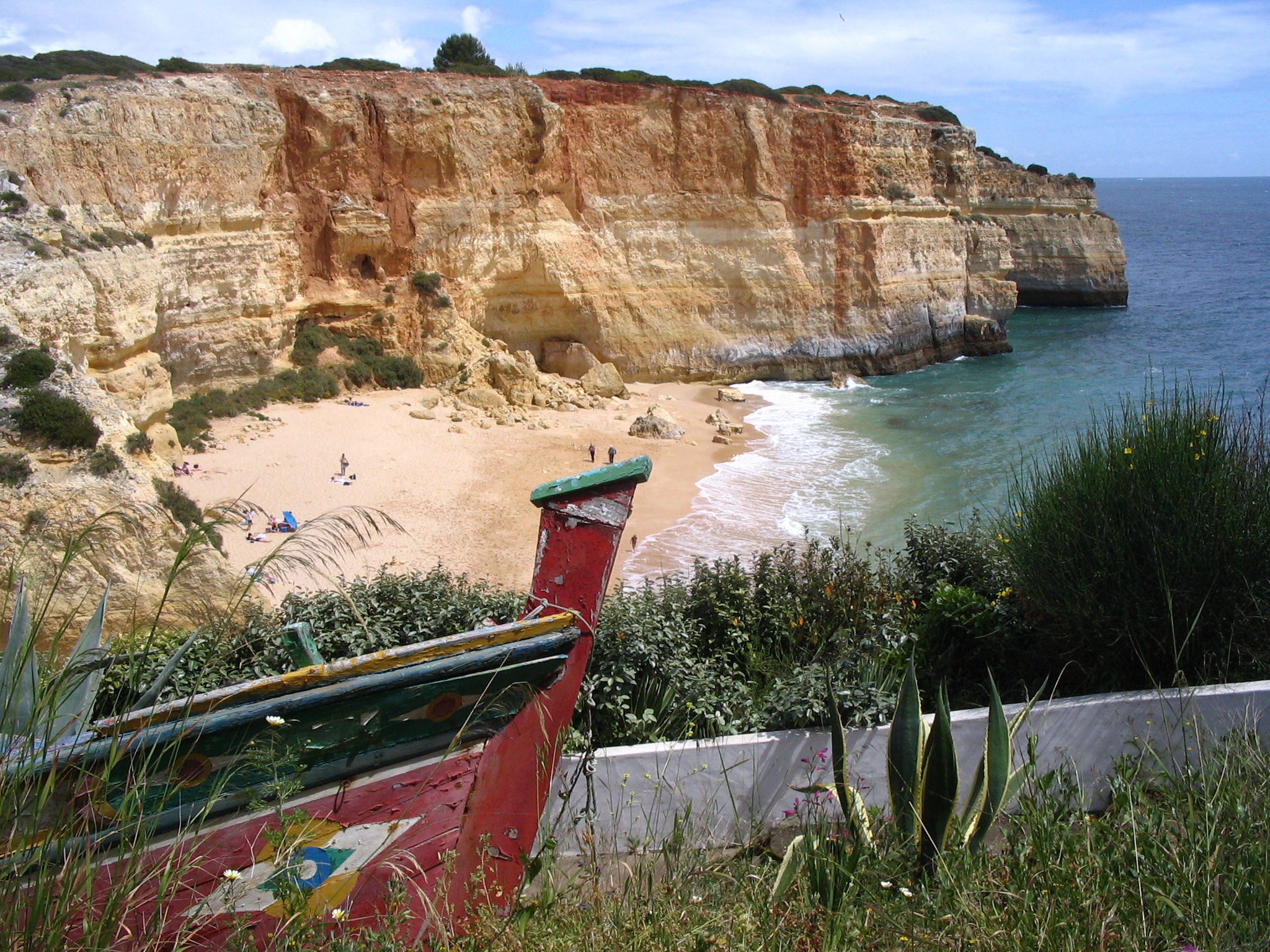
Praia de Benagil is a small beach in a former fishing village of the same name, in the municipality of Lagoa, on the central Algarve coast of Portugal, between Carvoeiro and Armacao de Pera. The beach is modest: a band of sand backed by gold-colored cliffs, with fishing boats still drawn up on it and a single restaurant-snack bar, A Lota, at the waterline. Until the second half of the 20th century the local economy here was built on fishing, not visitors. Almost nobody comes for the beach itself.

They come for what is around the corner. About 150 meters along the cliff, reachable only from the sea, is the Algar de Benagil: a sea cave carved into the Miocene limestone, with a domed chamber, a small sandy beach inside it, two arched mouths opening to the Atlantic, and a circular hole in the top of the dome that locals call o olho, the eye. Light falls through that opening onto the cave's internal beach. There is no path in. You arrive by kayak, paddleboard, boat, or, until recently, by swimming, entering through one of the two arches because the cave does not connect to the land.

The cave became one of the most photographed places in Portugal, carried by Instagram and a long life as desktop wallpaper. That fame collided with the physical reality of the place. The chamber is small, the two mouths are narrow, and on a busy summer day kayaks, paddleboards, tour boats, and swimmers all funnel through the same gaps into the same dome at once. Boats throw wakes, swimmers get pushed onto rock, and people are pulled out of the water every season.

Portugal regulated the cave rather than closing it. After incident-heavy summers, the maritime authority published new rules in an edital dated 30 July 2024 that took force on 13 August 2024. Swimming in is banned, disembarking on the internal beach is prohibited for everyone, renting a kayak without a guide is forbidden, and the only legal way in is a licensed guided tour, a few minutes per group. Operator fines run from 300 to 216,000 euros; swimmers can be fined upward of 2,000 euros. The rules have not ended the rescues: in 2025 a tourist boat overturned near the cave and twelve people had to be pulled out, and on 5 July 2025 two swimmers were found in a banned stretch near Benagil and brought ashore.

So Praia de Benagil is really two places stacked together: a quiet working cove with one restaurant and free parking up the hill, and 150 meters offshore a roofed cathedral of stone so popular it had to be rationed. The honest version of this beach is the gap between those two facts.
The spike

A domed sea cave with a hole in its roof and its own beach, reachable only from the water; since August 2024 entry is by guided tour only.

Praia de Benagil is famous for something that is not on the beach. The beach is small and was, for most of its history, the working front of a fishing village in the Lagoa municipality of the central Algarve. The thing the world recognizes is 150 meters offshore and cannot be reached on foot at all: the Algar de Benagil, a sea cave that erosion carved into the soft Miocene limestone of this coast. What makes it singular is not that it is a cave, the Algarve cliffs are full of caves, but the specific geometry of this one. It has a domed chamber roughly 30 meters across and about 20 meters high. It has its own small sandy beach inside, dry land surrounded by stone. It has two arched mouths cut through the cliff to the Atlantic. And it has a circular hole punched clean through the top of the dome, open to the sky, that local people call o olho, the eye.

That eye is the whole event. It formed the way a karst doline forms: water dissolved and undercut the limestone from beneath until the roof of the dome weakened and partly collapsed, leaving a near-circular opening at the apex. Sources disagree on its exact size, with diameters cited from about 8 meters up to around 20 meters, and that disagreement is itself honest, because no one is standing inside measuring it for tourists. What the eye does is unambiguous. On a clear day it drops a shaft of sunlight straight down through the roof onto the internal beach, so that the inside of a sea cave is lit from above like a cathedral with the roof open. That single image, a roofed room of gold stone with a column of light falling onto sand, is why this place is one of the most photographed natural sites in Portugal.

The access is the second half of the spike, and it is what separates Benagil from an ordinary scenic cove. There is no walking into the Algar de Benagil. The two openings face the ocean and the cave does not connect to the land behind it, so the only way in has always been from the water: kayak, stand-up paddleboard, tour boat, or swimming across the roughly 150-meter channel from the village beach. You enter through one of the two sea arches, with the green of the Atlantic reflecting off the rock above your head, and then you are inside the dome with the eye overhead. A famous beach you can stand on. Benagil's famous feature you can only float into.

That combination, a small enclosed chamber, a single iconic light effect, and water-only access, is exactly the recipe for the crowding problem that now defines the place. The cave went global through the 2010s, carried by Instagram and by years of life as a desktop wallpaper, and the visitor numbers followed the image. But the dome did not get any bigger. On a peak summer day the same small chamber takes a continuous churn of tour boats from several harbors, guided kayaks, paddleboards, and, for years, swimmers, all squeezing through the same two narrow arches into the same room. Boats throw wakes that bounce around an enclosed space. Swimmers tire in the channel, get caught by a wake or a current, and are pushed against rock. People are pulled out of the water near Benagil every season.

So Portugal regulated the cave rather than closing it, and the dates matter. After incident-heavy summers, a working group set up in August 2023 produced new rules; the maritime authority published them in an edital dated 30 July 2024, and they came into force on 13 August 2024. Swimming into the cave is banned. Disembarking or standing on the internal beach is prohibited for everyone, individuals and operators alike. Renting a kayak without a guide in the cave area is forbidden. Guided kayak tours run at a ratio of one guide per six visitor kayaks, time inside the cave is limited to a few minutes per group, and operator fines run from 300 euros to 216,000 euros, with individual swimmers facing fines upward of 2,000 euros. The legal way into the Algar de Benagil is now, simply, a licensed guided tour.

The rules have not made the place safe so much as made it managed, and the difference shows. In 2025 a tourist boat overturned near the cave and twelve people had to be rescued by the Ferragudo lifeboat station and nearby boats; two were injured. On 5 July 2025 two swimmers were found in a banned, unmonitored stretch of water near Benagil and brought ashore by the Ferragudo lifeboat crew and the SeaWatch Project. The cave is genuinely extraordinary, a lit dome with a beach inside it and a hole in the roof, and that is exactly why it is hard to protect: the thing people most want to do, swim into it and stand under the eye, is the thing that has been banned because it kept nearly killing them. Benagil's spike is a single perfect natural room that you are now, for your own safety, only allowed to visit on a leash.

Praia de Benagil.JPG
Culture

Where it shows up

Other
  • Instagram and the photography of o olho

    The cave's circular roof opening and light shaft made it one of the most-shared natural images in Portugal through the 2010s, and that social-media fame is a direct cause of the crowding the 2024 rules now try to manage.

Brand & advertising
  • Desktop wallpaper / screensaver fame

    The Algar de Benagil circulated widely as a desktop wallpaper, which helped push it from a regional landmark to a globally recognized image well before most visitors knew where it was.

History
  • Benagil as a fishing village

    Until the second half of the 20th century Benagil's economy was based on fishing, and fishing boats are still drawn up on the beach. The cave was a feature of working fishermen's water long before it became a tourist destination.

Praia de Benagil - Portugal 🇵🇹 (53650893917).jpg
History

What happened here

  1. natural

    The cave is carved from Miocene limestone

    The Algar de Benagil forms by marine erosion of Miocene limestone, the soft sedimentary rock of this coast laid down roughly 5 to 23 million years ago. Waves cut two arched openings into the cliff and hollow out a domed chamber behind them.

  2. natural

    The roof collapses to form the eye

    Water erodes the limestone from beneath until the dome's roof weakens and partly collapses, opening the circular skylight at the top of the chamber that locals call o olho, the eye, in effect a karst doline open to the sky.

  3. 2023policy

    First access restrictions imposed

    After an extremely busy and incident-heavy summer, Portuguese authorities introduce restrictions on access to the Benagil cave, the first formal limits on the traffic of boats, kayaks and swimmers in and around the chamber.

  4. 2023policy

    Benagil Caves Working Group established

    A working group is set up to regulate the traffic of maritime-tourist vessels, private individuals and beachgoers in the water and around the Benagil cave, the body whose work leads to the 2024 rules.

  5. 2024policy

    New rules published (edital, 30 July 2024)

    The maritime authority publishes Edital 019/2024 setting out the new access regime: a ban on swimming in, a ban on disembarking on the internal beach, a ban on kayak rental without a guide, a guide-to-kayak ratio of one guide per six visitor kayaks, time limits inside the cave, and operator fines from 300 to 216,000 euros.

  6. 2024policy

    Rules come into force (13 August 2024)

    The new Benagil rules take effect ten working days after publication, on 13 August 2024. From this date the only legal way into the cave is on a licensed guided tour; swimming in and standing on the internal beach are prohibited.

  7. 2025disaster

    Tourist boat overturns; twelve rescued

    A tourist boat overturns near the Benagil cave and twelve people have to be rescued. The Ferragudo lifeboat station leads the operation with help from local kayakers and other tour boats; two passengers suffer minor injuries and are taken to Portimao for checks.

  8. 2025rescue

    Two swimmers rescued from banned zone

    On 5 July 2025 two swimmers are found in an unmonitored, swimming-banned stretch of water near the Benagil caves and brought safely ashore by the Ferragudo Lifeboat Station and the SeaWatch Project during a routine patrol, prompting renewed appeals to obey the rules.

The honest part
Swimming in is banned, no one may stand on the internal beach, and legal entry is now by guided tour only; the rescues continue anyway.

The uncomfortable truth about Benagil is that its single most famous feature is small, fragile, and dangerous to reach, and for years it was treated as if it were none of those things. The cave chamber is roughly 30 meters across and about 20 meters high, with two narrow sea arches as its only openings and a circular hole in the roof. On a peak summer day that one small dome absorbs a continuous churn of tour boats, kayaks, paddleboards, and swimmers, all squeezing through the same two gaps. Boats throw wakes inside an enclosed space; swimmers who tire or panic get pushed against rock; currents in the channel between the beach and the cave are stronger than the calm photos suggest. People underestimated all of it for years because the images make it look like a private lagoon.

The authorities did not close the cave; they rationed it. Since the rules took force on 13 August 2024, swimming in is banned, no one may disembark on the internal beach, kayak rental without a guide is forbidden, and legal entry is by licensed guided tour only, with a few minutes allowed per group. Fines reach 216,000 euros for operators and upward of 2,000 euros for individual swimmers. And still the rescues continue: a boat overturned near the cave in 2025 with twelve people pulled out, and two swimmers were rescued from a banned zone near Benagil in July 2025. The cave is genuinely worth seeing. It is also a place that earns headlines every summer for the people it nearly takes.

Praia de Benagil - Portugal 🇵🇹 (53651979938).jpg
Anatomy

The shape of the place

Praia de Benagil (the beach)

30%

The small village beach: a sand cove under gold limestone cliffs with fishing boats on it and the A Lota snack bar at the waterline. The launch point for everything that goes to the cave, and the only part of this place you reach by land.

Best for Launching, swimming near shore, and eating

Free parking is up the hill with a short, steep walk down. Showers and toilets; bring your own shade.

The channel to the cave

60%

The roughly 150-meter stretch of open water between the beach and the cave's sea arches. Calm in photos, but crossed by tour-boat wakes and capable of unexpected current; this is where swimmers got into trouble before the ban.

Best for Guided kayak and SUP crossings

Swimming this stretch to the cave is now banned and fineable.

Algar de Benagil (the cave)

85%

The domed sea cave itself: a chamber about 30 meters across and 20 meters high, with two arched mouths to the Atlantic, a small internal beach, and the circular eye open to the sky overhead. Reachable only from the water.

Best for Seeing the oculus and the light shaft

Guided tour only since 13 Aug 2024; no disembarking on the internal beach; a few minutes per group.

Landmarks

Algar de Benagil

natural

The domed sea cave 150 meters off Praia de Benagil, carved from Miocene limestone, with a chamber roughly 30 meters wide and 20 meters high, two sea arches as its only openings, an internal sandy beach, and a circular roof oculus known as o olho (the eye). One of the most photographed natural sites in Portugal.

The eye (o olho) oculus

natural

The circular hole in the top of the cave's dome, formed by partial collapse of the limestone roof (a karst doline). Sources give its diameter variously from about 8 meters up to about 20 meters; it admits a near-vertical shaft of light onto the cave's internal beach.

A day here

From first light to dark

Dawn

Before the tour fleet launches, the channel between Praia de Benagil and the cave is at its calmest and the light is low. The first guided kayaks slip out from the beach toward the two sea arches; inside the dome the roof oculus has not yet caught the sun, and the internal beach sits in shadow with no one standing on it.

Midday

This is the crush. Tour boats from Portimao, Lagos, Armacao de Pera and Albufeira converge on the two arches while guided kayaks and paddleboards wait their turn, and the eye in the roof drops a near-vertical shaft of light onto the internal sand. Groups get only a few minutes inside before the next boat needs the space. Wakes slap around the enclosed chamber.

Golden hour

Late afternoon thins the boat traffic as day tours head back to harbor. The low sun reaches deeper through the western arch and warms the gold limestone of the dome, and the shaft through the oculus moves and softens. It is the photographers' window, and the calmer water in the channel makes the short crossing easier.

Night

After the last tour the cave is empty, unlit, and silent except for water moving against rock and through the two arches. No one stays; there is no landing and no facilities inside. Up the hill the village of Benagil goes quiet with its one restaurant and its boats pulled onto the beach.

Compare

How it ranks

Peak warmth
Warmer than 82% of beaches in its country
Peak-month high ≈ 28°C

Ranked against every beach in our database — 228,000+ worldwide.

Grotto pano at Algar de Benagil.jpg
Sea & surf

What the water does

JFMAMJJASONDmetres (significant wave height)

Solid = typical monthly wave height; pale = the bigger days (90th pct). Offshore/regional swell from Open-Meteo Marine (ERA5 Ocean reanalysis, 2023–2024); a sheltered cove may sit calmer than this.

Mixed — usually swimmable, with a livelier season
Typical wave height
0.74 m
Biggest swell
Feb · 1.05 m
Calmest
Jul · 0.5 m
Typical period
7 s (wind chop)
Before you go

Things to know

Guided tour only

Since 13 August 2024 the only legal way into the cave is on a licensed guided boat, kayak or SUP tour. You may not swim in, and you may not disembark or stand on the internal beach. Time inside is limited to a few minutes per group.

Do not swim to the cave

Swimming the roughly 150 meters from the beach to the cave is banned and fineable (upward of 2,000 euros). The channel carries tour-boat wakes and unexpected current; swimmers have been pushed onto rock and pulled out by lifeboats, including in July 2025.

Own kayak vs rental

Renting a kayak without a guide in the cave area is prohibited. Bringing your own kayak with a life jacket is generally allowed around the cave, but you still may not disembark inside; guided kayak tours run at a ratio of one guide per six visitor kayaks.

Weather decides

Tours only run when the sea is calm enough to pass the two arches safely. Rough Atlantic days, common in winter, can make the cave unreachable. Check that your tour is actually going before you travel.

Sharks

No incidents on record in the global shark-attack file.

Plan

If you go

Getting there
Nearest airport
Portimão Airport (PRM) · 16 km
Nearest town
Carvoeiro · 3 km

Praia de Benagil sits in Benagil village in the municipality of Lagoa, about 6 km from Lagoa town and roughly 10 to 15 minutes by car. Park free in the cliff-top lot above the beach and walk down the steep road, or use limited roadside spaces. The beach is the only part you reach on foot. The cave, the Algar de Benagil, is about 150 meters offshore and connects only to the sea, so you reach it from the water: since 13 August 2024 that means a licensed guided boat, kayak or SUP tour. Swimming in is banned, and no one may disembark on the cave's internal beach. Many tours also depart from Portimao, Lagos, Armacao de Pera and Albufeira.

When to go
  • Cave tour season · Roughly April through October, busiest June to September

    Licensed guided boat, kayak and SUP tours run from Benagil and nearby harbors (Portimao, Lagos, Armacao de Pera, Albufeira) through the warm season. Summer brings the heaviest boat-and-kayak traffic into the cave and the calmest, busiest water.

  • Winter and rough-sea closures · Winter and any rough-sea days

    Tours stop when the Atlantic is too rough to enter the arches safely, which is common in winter and possible at any time of year. On those days the cave is effectively unreachable and the beach is quiet.

What to eat & drink
A Lota

The single restaurant and snack bar at the waterline on Praia de Benagil itself, serving drinks and basic food to people who have come for the cave. It is essentially the only place to eat on the beach; nothing is sold inside the cave, where disembarking is now banned.

On the sand at Praia de Benagil

Grilled sardines and fresh fish

Benagil was a fishing village into the late 20th century, and grilled sardines and the day's catch are the honest regional staple along this stretch of the Algarve, eaten in the village and neighboring Carvoeiro rather than on the beach.

Restaurants in Benagil village and nearby Carvoeiro

Cataplana de marisco

The Algarve's signature seafood stew, cooked and served in the hinged copper cataplana pan it is named for, is the regional dish to eat after a morning on the water, in Lagoa-municipality restaurants near the coast.

Restaurants in Lagoa, Carvoeiro and Armacao de Pera

Dom Rodrigo and fig-and-almond sweets

The Algarve's egg-yolk-and-almond convent sweet Dom Rodrigo, and the region's traditional fig and almond confections, are the local dessert tradition, sold in pastry shops across Lagoa and the central Algarve.

Pastelarias in Lagoa and the central Algarve

Sources & references
  1. geologyscience.com; benagil-cave.pt · cited 2×
  2. Lusa via aman-alliance.org; theportugalnews.com · cited 2×
  3. portugalresident.com · cited 2×
  4. benagil-cave.pt; geologyscience.com
  5. earthtrekkers.com
  6. benagil.pt; Lusa via aman-alliance.org
  7. theportugalnews.com; portugalresident.com
  8. portugalresident.com; theportugalnews.com
  9. geologyscience.com; mybestplace.com
  10. journee-mondiale.com; barcelo.com
  11. mybestplace.com; journee-mondiale.com
  12. algarvetips.com; boundlessroads.com
  13. theportugalnews.com; benagil.pt
Colophon · Provenance

Where this page comes from

Geography, facilities
OpenStreetMap (ODbL) for geometry and facility tags within 500 m of the beach centroid. GeoNames for city/airport distances.
Climate & ocean
worldclim_v2.1_2.5m
Tides
eot20
Photography
Archival, original tone (Tier B — Wikimedia Commons). Each image licensed per its own terms; attribution visible inline.
History & culture
Every factual claim is linked to its source in the prose above. Wikipedia citations inline. Non-wiki sources named where relevant.
Editorial voice
Register: reverent. Written to pass a local's nod test; corrections welcome.
Written by Erin Rose
Last reviewed 2026-04-19
v0.9in editorial development toward v1.0