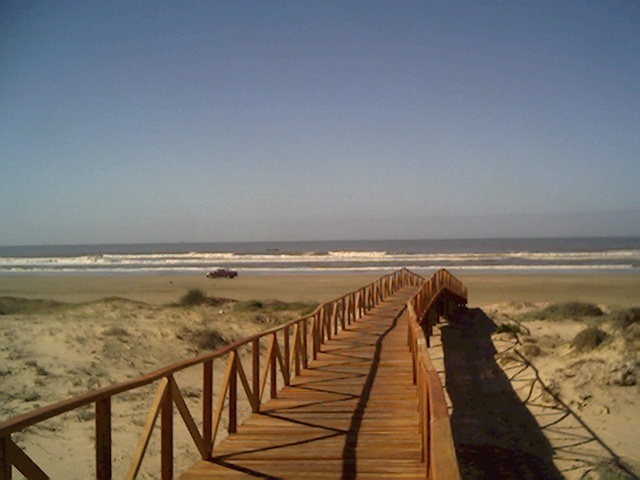
Praia do Cassino runs along the southernmost stretch of the Brazilian coast, in Rio Grande do Sul, and it is most often introduced with a superlative: the longest beach in the world. The sand is unbroken from the Molhes, the great stone jetties at the entrance to the Rio Grande seaport in the north, all the way south to the mouth of the Chuí Stream on the border with Uruguay, a distance sources put at anywhere from 212 to 254 kilometers. Guinness World Records recognized it as the world's longest beach in 1994.
The claim deserves an asterisk, and the honest version is more interesting than the slogan. Beach length runs straight into the coastline paradox: the more finely you measure a shoreline's every curve, the longer it gets, so 'longest beach' is partly an artifact of how you measure. By some readings the 80-Mile Beach in Western Australia is longer. What is not in dispute is that Cassino is one of the longest uninterrupted sandy beaches on Earth, long enough that the usual idea of a beach, a place you walk from end to end, simply does not apply.
It is also not a tropical postcard, and never pretended to be. This is cold water: the Falklands (Malvinas) Current runs north up this coast, and the South Atlantic here is grey and bracing, not Caribbean turquoise. The wind is relentless. And the beach is a working surface, not just a leisure one. The firm sand doubles as a road; people drive cars and motorbikes straight onto it and along it, with the standing advice to use four-wheel drive and check the tide before setting out, because the same flat hardness that makes it drivable will strand and then drown a vehicle caught by the rising sea.
At the northern end, the Molhes da Barra define the place. These breakwaters of piled stone reach far out to protect the entrance of the Rio Grande port, and a wind-powered sail-cart runs about 4.3 kilometers out along the jetty to the lighthouse in roughly 20 minutes, a genuinely strange and lovely piece of local engineering. Sixteen kilometers south of town, the rusting hull of the Altair has sat stranded on the sand since a storm drove it ashore in June 1976. Sea lions haul out along the coast and are visited by boat. And every so often the whole impossible length of the beach becomes a racecourse: the Cassino Ultra Race runs 230 kilometers down it.
What Cassino offers is not prettiness but scale and honesty. It is a vast, cold, windswept, working immensity of sand, one of Brazil's oldest beach resorts at its developed northern end and effectively empty wilderness for most of its length, where the headline is a contested record and the reality is something better: a beach so long it stops being a beach and becomes a coastline you could lose a day driving down.