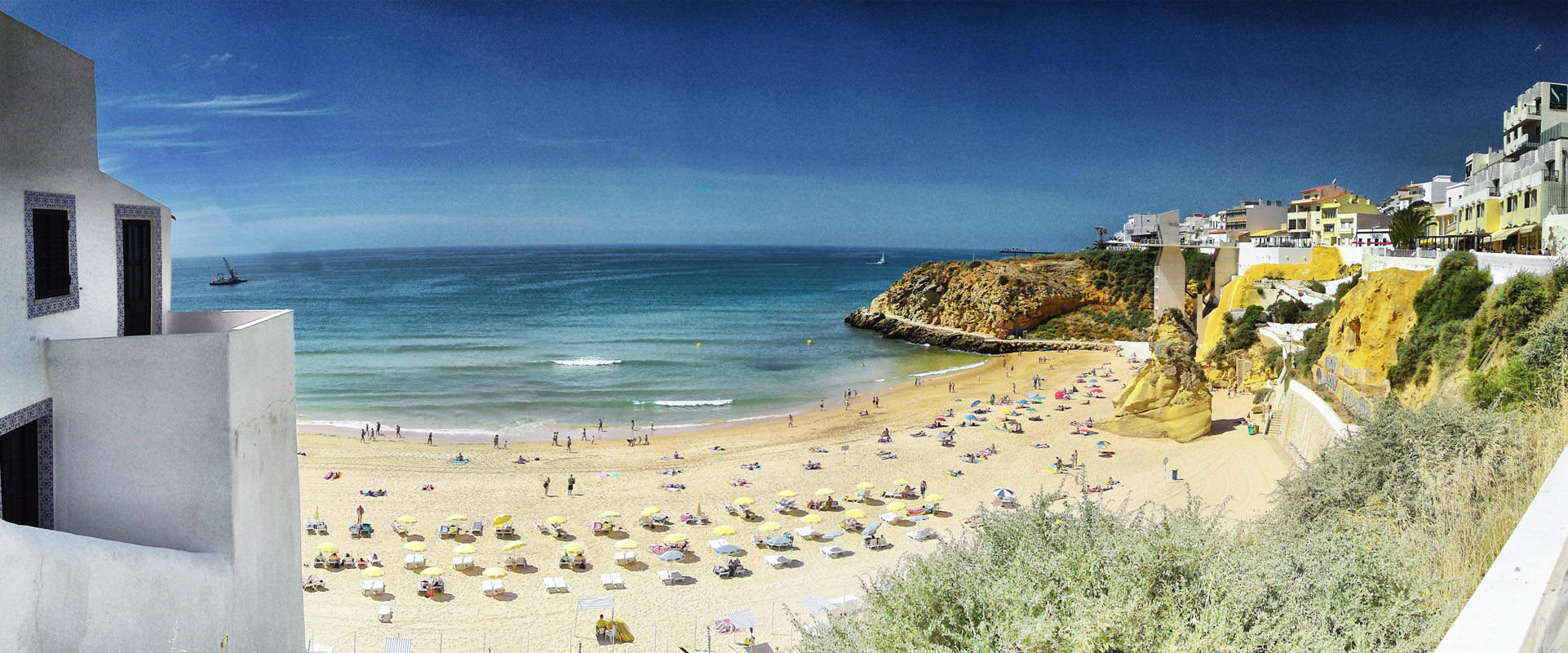
Praia do Peneco sits at the center of Albufeira's seafront, the western half of the town's town-beach pairing with Praia dos Pescadores to the east. It takes its name from a large detached sandstone boulder, a leixão, sitting on the sand and resisting the general retreat of the cliff behind it — the municipality's own beach page explains that such formations are called "penecos" locally. English Wikipedia lists the beach under a different official title, "Praia do Túnel (Peneco)," after the roughly 20-meter pedestrian tunnel cut through the cliff beside the old town's tourist office. Both names are in wide use; this is one beach, not two.
Three routes bring people down from the old town to the sand: the cliff tunnel itself, a stairway to the west, and a free public elevator, the Elevador do Peneco, in the Rossio area. The elevator is 28 meters tall, carries up to 13 people, and normally runs daily from 08:00 to 21:00. Portuguese Wikipedia dates it to "in operation since June 2008"; municipal and press sources instead date its formal inauguration to 20 May 2009 — a discrepancy the town's own record has never resolved.
At the western end of the beach a promenade leads to the Xorino Grotto, where 13th-century legend holds that Moors sheltered after the Christian conquest of Albufeira. That legend is repeated by both English Wikipedia and Portugal's national tourism board. The beach itself carries a EU Blue Flag for the 2026 season, running 1 July to 30 September inside a bathing season of 15 May to 15 October, with lifeguards on duty, loungers and parasols for hire, and good access for disabled visitors.
The beach's namesake rock is now the subject of an unresolved public argument. A drone inspection found the boulder split by a fissure, and on 20 February 2026 Albufeira mayor Rui Cristina said it may, "in principle," be demolished — while conceding the technical call belongs to specialists. A safety perimeter now keeps bathers away from it. This is not the beach's first structural scare: in 1989 a section of the cliff above the sand collapsed, killing one man and injuring his girlfriend, and in 2022 the town spent roughly €1.5 million rebuilding the stairway and cliff face at Esplanada Dr. Frutuoso da Silva.
The rock's fate is tangled up with a wider erosion problem. A March 2026 survey by Portugal's environment agency, APA, measured a 24-meter maximum beach-berm recession here — the worst recorded anywhere in southern Portugal that season — after a run of named Atlantic storms battered the coast since October. As of the Alentejo Sul Informação report of 14 March 2026, repairs to access and the risk perimeter are planned before summer, but the rock formation that gives the beach its name still has no decided fate.