Andhra Pradesh, IN

Rushikonda Beach

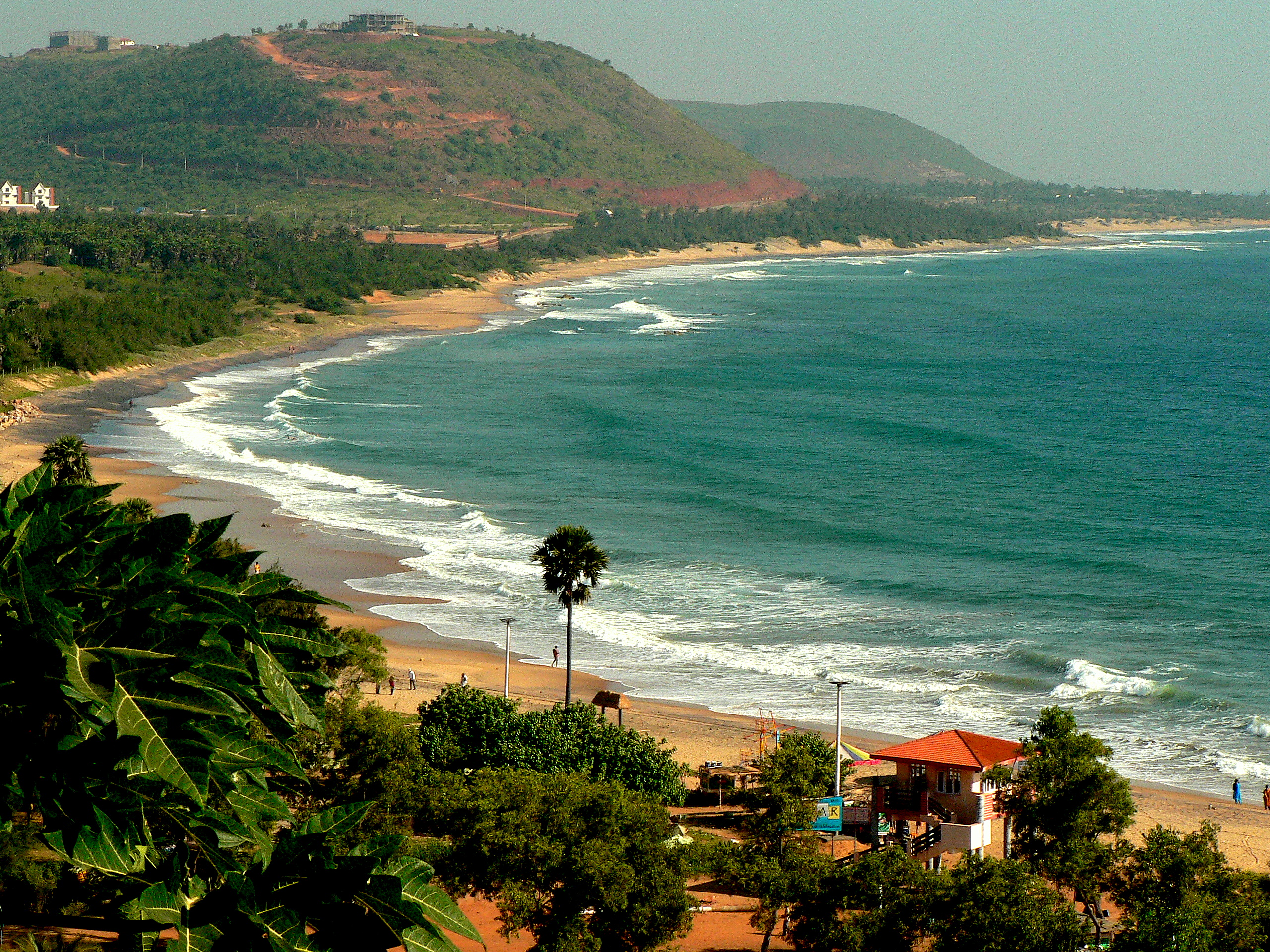
Aerial view of Rushikonda beach.jpg

Andhra Pradesh, IN

Rushikonda Beach

Andhra Pradesh's only Blue Flag beach, below a hill half-cut for a ₹450-crore complex a state panel identified as the chief minister's residence.

Aerial view of Rushikonda beach.jpg · <a href="//commons.wikimedia.org/wiki/User:IM3847" class="mw-redirect" title="User:IM3847">iMahesh</a> · CC BY-SA 4.0
Nearest airport
VTZ · 18 km
Tier
Featured
I’m here for
Story

Rushikonda Beach is a golden crescent of sand on the Bay of Bengal, on the northern coastal road out of Visakhapatnam in Andhra Pradesh, India. Its name is Telugu for "hill of the sages" (rushi, sage; konda, hill), after the wooded hill that rises directly behind the shore, tied in local tradition to sages who came here to meditate. The sand is quartz-dominant, which is why it reads gold rather than the darker grey of much of India's east coast. The Andhra Pradesh Tourism Development Corporation (APTDC) manages it, and in October 2020 it became one of the first eight beaches in India to win the Blue Flag, the international eco-label for water quality, safety, and coastal management. It remains the only Blue Flag beach in Andhra Pradesh.

Because this is India's east coast, the sun rises out of the sea here rather than setting into it, and dawn over the Bay of Bengal is the beach's quiet spectacle. By mid-morning it is the busiest water-sports strip in Visakhapatnam, with jet skis, speedboats, and paramotoring runs off the sand. The waves are moderate, averaging just over a metre and biggest around July, so the beach is usually swimmable rather than a surf destination.

The hill the beach is named for is also the reason Rushikonda became a national story. In 2021 the state government demolished the APTDC's old Haritha resort and began a ₹450-crore complex of blocks named after regional kingdoms, marketed as a tourism resort; roughly 20 acres of the hill were cut and reshaped. In November 2023 a government panel identified the complex not as a resort but as a camp office and residence for the chief minister. It was inaugurated in February 2024, still described officially as a resort.

That is the paradox stamped into one beach. The Blue Flag certifies that Rushikonda's shoreline meets a strict standard for coastal-zone management. The hill immediately above it was excavated in what petitioners told the National Green Tribunal and the High Court was a violation of the Coastal Regulation Zone rules, with construction spilling beyond the permitted footprint and building waste dumped on sea-sand dunes inside a no-development zone. The certified shore and the contested hill are the same place, seen from two directions.

Rushikonda also carries the ordinary hazards of a popular open coast. It sits in one of the world's most active cyclone belts; Cyclone Hudhud made landfall here in October 2014 and devastated the Visakhapatnam coast. Drownings recur despite posted warnings and municipal guards. In February 2025 the beach lost its Blue Flag over lapses in upkeep, then regained it weeks later, a reminder that the certification is a maintenance obligation, not a permanent trophy.

The spike

Andhra Pradesh's only Blue Flag beach, below a hill half-cut for a ₹450-crore complex a state panel identified as the chief minister's residence.

Rushikonda is the rare beach whose two most important facts contradict each other. It is Andhra Pradesh's only Blue Flag beach, and it sits directly beneath a hill the state government half-cut for a ₹450-crore complex that petitioners argued violated the coastal rules the Blue Flag is supposed to certify. To stand on the sand is to look up at both stories at once.

What the Blue Flag actually means. The Blue Flag is an eco-label run by the Foundation for Environmental Education, awarded to beaches that meet a set of criteria for bathing-water quality, safety and services, environmental education, and coastal-zone management. In October 2020 Rushikonda was named one of the first eight Blue Flag beaches in India, and it is still the only one in Andhra Pradesh. That is a genuine distinction: it means the shoreline is monitored, guarded, kept clean, and managed to an international standard. It is also a maintenance obligation, not a trophy, which is why the certification was withdrawn in February 2025 over lapses in upkeep and hygiene, and restored only weeks later once the authorities fixed them.

What was built on the hill. In 2021, after the state announced plans to move Andhra Pradesh's executive seat to Visakhapatnam, the APTDC demolished its old Haritha resort at Rushikonda and began a ₹450-crore complex on the hill: seven blocks with a built-up area near 20,000 square metres, named after regional dynasties including Vijayanagara, Vengi, Kalinga, and Gajapathi. It was marketed throughout as a tourism resort. In November 2023 a government panel identified it instead as a camp office and residence for the chief minister. It was inaugurated in February 2024, still called a resort, and after the change of government in June 2024 it was closed to the public pending an inquiry and the courts.

Where the rules come in. Building on a coastal hill in India means working inside the Coastal Regulation Zone framework, which grades the shore into zones and forbids most development in the most sensitive of them. Petitioners, including sitting politicians, took the project to the National Green Tribunal and the High Court, alleging breaches of the CRZ notification, the Visakhapatnam master plan, and prior court orders. The NGT issued an interim order in 2022 barring further construction, and the Supreme Court subsequently allowed work only on the footprint of the demolished resort and on flat land. A March 2023 survey by the Ministry of Environment, Forest and Climate Change found roughly 18 acres of the hill affected by cutting, slope disturbance, and soil dumping, against about 9.88 acres permitted, and reported that APTDC had altered the number and location of blocks without prior approval.

The cost to the ground itself. The environmental case is not only about acreage. Petitioners reported that APTDC dumped building waste and gravel over naturally formed sea-sand dunes between the low and high tide lines, a band classified as CRZ-I, the no-development zone. Those dunes are a nesting environment, and burying them in construction spoil is precisely the kind of harm the CRZ-I designation exists to prevent. So the hill above a Blue Flag beach, the award that certifies coastal-zone management, became a case study in coastal-zone rules being tested and, by the petitioners' account, exceeded.

The case for the project, stated fairly. The state framed the complex as legitimate tourism infrastructure with CRZ clearance obtained in May 2021 and municipal approvals behind it, an upgrade of a decades-old government resort on land the APTDC already held. Supporters argued the hill had long carried a resort and that the new build sat largely on the old footprint. Whether that defence survives the ministry's excavation findings and the resort-versus-residence dispute is exactly what the courts were left to decide.

What Rushikonda actually is. It is a real, popular, genuinely golden beach that, when maintained, earns its Blue Flag, and it is the clearest place in India to see how differently coastal rules can be applied to a shoreline and to the hill immediately above it. Visitors come for the sunrise, the jet skis, and the water-sports scene; the cut terraces and pale blocks on the slope behind them are visible the whole time, closed and waiting on a court verdict. The flag flies over the sand; the slope behind it was cut for a palace sold as a resort. Both are true, and they are the same beach.

Reflection of Rushikonda hill at Beach in Vizag.jpg
Culture

Where it shows up

History
  • The sages of Rushikonda

    The name Rushikonda, Telugu for 'hill of the sages,' reflects a local tradition that ancient sages meditated on the hill behind the beach. The tradition, not the tourism, is the oldest layer of the place.

Brand & advertising
  • Blue Flag certification · 2020
    Foundation for Environmental Education

    The international Blue Flag eco-label, awarded to Rushikonda in October 2020 as one of India's first eight and Andhra Pradesh's only Blue Flag beach, is now part of the beach's public identity and its marketing.

Other
  • The Rushikonda hill controversy · 2023

    The dispute over the ₹450-crore hill complex, resort or residence, and its alleged CRZ violations became a sustained political and environmental flashpoint in Andhra Pradesh, argued before the National Green Tribunal and the High Court.

  • 'Jewel of the east coast'

    Rushikonda is commonly promoted as a jewel of Visakhapatnam and India's east coast in tourism material, a booster label that sits uneasily beside the cut hill above the shore.

Paragliding in Visakhapatnam (2).jpg
History

What happened here

  1. 2014natural

    Cyclone Hudhud strikes Visakhapatnam

    Very Severe Cyclonic Storm Hudhud makes landfall near Visakhapatnam on 12 October 2014 with winds around 200 km/h, devastating the city's coast and airport. It caused 46 deaths in Andhra Pradesh and ranked among the costliest cyclones in India's history, a reminder of the exposure of this stretch of the Bay of Bengal.

    Wikipedia →
  2. 2020policy

    Rushikonda awarded the Blue Flag

    Rushikonda is named one of the first eight beaches in India to receive the Blue Flag eco-label, and the only one in Andhra Pradesh. The award certifies water quality, safety, facilities, and environmental management to an international standard set by the Foundation for Environmental Education.

    Wikipedia →
  3. 2021founding

    Old resort demolished; hill project begins

    After the state announced plans to shift Andhra Pradesh's executive seat to Visakhapatnam, the APTDC's existing Haritha resort at Rushikonda is demolished and construction begins on a ₹450-crore complex, with Coastal Regulation Zone clearance obtained in May 2021. Roughly 20 acres of the hill are eventually cut and reshaped.

  4. 2022policy

    National Green Tribunal bars further construction

    Following petitions alleging CRZ and master-plan violations, the National Green Tribunal issues an interim order restraining further construction on the hill. The Supreme Court later permits work only on the footprint of the demolished resort and on flat land.

  5. 2023policy

    Environment ministry survey finds excess excavation

    A Ministry of Environment, Forest and Climate Change team surveys the site and finds roughly 18 acres affected by hill-cutting, slope disturbance, and soil dumping, against about 9.88 acres permitted, and reports that APTDC altered block numbers and locations without prior approval.

  6. 2023policy

    Panel calls the 'resort' the CM's residence

    A government panel identifies the complex, publicly marketed as a tourism resort, as a camp office and residence for the chief minister, sharpening the dispute over what the ₹450-crore project on the hill was actually for.

  7. 2024cultural

    Complex inaugurated as a resort

    The Rushikonda complex is inaugurated by the state tourism minister in February 2024, still described officially as a resort, its seven blocks named after regional dynasties including Vijayanagara, Vengi, Kalinga, and Gajapathi.

  8. 2024policy

    New government orders an inquiry

    After the TDP-led coalition under N. Chandrababu Naidu is sworn in on 12 June 2024, the incoming government announces an inquiry into the Rushikonda project and its cost, and the complex remains closed to the public pending the court proceedings.

  9. 2025policy

    Blue Flag lost, then regained

    In February 2025 Rushikonda loses its Blue Flag certification over lapses in maintenance and hygiene, then regains it weeks later after the authorities carry out corrective work, underlining that the certification is a continuing obligation rather than a permanent award.

The honest part
The flag flies over the sand; the slope behind it was cut for a palace sold as a resort.

The uncomfortable truth about Rushikonda is that its two headline facts point in opposite directions. It is Andhra Pradesh's only Blue Flag beach, an award that certifies coastal-zone compliance and environmental management, and it sits directly below a hill that the state government half-excavated for a ₹450-crore complex that petitioners argued in the National Green Tribunal and the High Court breached the very Coastal Regulation Zone rules the Blue Flag rewards. A Ministry of Environment survey in March 2023 found roughly 18 acres of the hill affected against about 9.88 acres permitted; APTDC was reported to have dumped construction waste and gravel onto sea-sand dunes within CRZ-I, the no-development zone where sea turtles nest. The complex was sold to the public as a resort and identified by a government panel as the chief minister's residence.

The beach itself is real, popular, and, when maintained, genuinely clean. But the certification and the excavation are not two separate stories with the beach caught between them; they are one story about how coastal rules get applied to a shoreline and waived for the hill above it. Add the recurring drownings on an open, current-prone coast and the 2014 Hudhud landfall, and Rushikonda is best understood not as a spoiled paradise but as a working record of what "protected coast" means in practice on India's fast-developing east shore.

Rushikonda hill during sunset from beach.jpg
Anatomy

The shape of the place

The sea-sand dunes

25%

The naturally formed sand dunes at the beach's margin, part of the CRZ-I no-development zone and a nesting environment. Petitioners reported that construction waste and gravel from the hill project were dumped over dunes in this protected band.

CRZ-I is classified as a no-development zone; the dune-dumping allegation is central to the environmental case.

The main crescent

45%

The central golden-sand curve where most visitors gather, backed by the hill and watched by APTDC lifeguards and municipal community guards. The guarded swimming zone is here; the sand is quartz-dominant and reads gold in the light.

Best for Swimming inside the guarded zone, sunrise, sitting on the sand

Swim only inside the flagged zone; currents on the open coast have caused repeated drownings.

Rushikonda hill and the APTDC complex

50%

The wooded hill that gives the beach its name and its story, rising directly behind the shore. Its seaward slope carries the cut terraces and pale blocks of the disputed ₹450-crore APTDC complex, the object of the CRZ litigation.

Best for Understanding the beach's central controversy from the sand

The complex has been closed to the public pending court proceedings; the hill-cutting is visible from the beach.

Water-sports strip

60%

The operating area for Visakhapatnam's busiest water-sports scene, jet skis, speedboats, and paramotoring launches working off the sand from mid-morning. Rushikonda is the main place the city goes for motorised water recreation.

Best for Jet skiing, speedboat rides, paramotoring

Operators are seasonal and weather-dependent; confirm safety gear and conditions before booking.

Landmarks

Rushikonda Hill

hill

The wooded hill behind the beach that gives Rushikonda its name, 'hill of the sages.' Its seaward slope was cut over roughly 20 acres for the APTDC complex, and the excavation is the visible core of the beach's controversy.

Wikipedia →

APTDC Rushikonda complex · 2024

building

The ₹450-crore government complex of seven blocks named after regional dynasties, built on the demolished footprint of the old Haritha resort and marketed as a tourism resort, which a government panel identified as a camp office and residence for the chief minister.

Visakhapatnam International Airport (VTZ)

airport

The nearest airport, about 17.9 km south of the beach, serving domestic routes across India and limited international flights, and heavily damaged by Cyclone Hudhud in 2014.

Wikipedia →
A day here

From first light to dark

Dawn

On the east coast the sun comes up out of the Bay of Bengal, and dawn is Rushikonda at its calmest: fishermen, joggers, and a few photographers on cool gold sand before the heat, the water flattest of the day and the hill behind still in shadow.

Midday

By late morning it is the busiest water-sports strip in Visakhapatnam. Jet skis and speedboats run off the sand, paramotoring launches work the breeze, and the sun is hard overhead with little shade; swimmers stay inside the guarded zone as the sea firms up toward its afternoon chop.

Golden hour

Late afternoon light rakes across the beach from inland and lands on the hill behind it, throwing the wooded slope and the pale blocks of the APTDC complex into relief above the shore. The sun sets behind the land here, not the sea, so evening is about the hill, not the horizon.

Night

After dark the beach empties and the water turns genuinely dangerous; swimming is discouraged and the currents that catch inattentive visitors run strongest unseen. The APTDC complex above sits lit and fenced on its cut terraces while the sand below goes quiet.

Visakhapatnam City Area Map.png
Sea & surf

What the water does

JFMAMJJASONDmetres (significant wave height)

Solid = typical monthly wave height; pale = the bigger days (90th pct). Offshore/regional swell from Open-Meteo Marine (ERA5 Ocean reanalysis, 2023–2024); a sheltered cove may sit calmer than this.

Mixed — usually swimmable, with a livelier season
Typical wave height
1.12 m
Biggest swell
Jul · 1.66 m
Calmest
Feb · 0.68 m
Typical period
9.4 s (groundswell)
Before you go

Things to know

Swim only in the guarded zone

Rushikonda is an open-coast beach with currents that have caused repeated drownings despite posted warnings and municipal guards; stay inside the flagged swimming zone and out of the water after dark.

Best season is winter

October to February is the comfortable window. Summer (March to June) is hot and humid, and the October to December months carry the highest cyclone risk on this stretch of the Bay of Bengal.

It rises, it doesn't set, over the sea

On India's east coast the sun rises out of the Bay of Bengal; sunrise is the sea spectacle here, while the evening light falls on the hill behind the beach.

Blue Flag status can change

The certification was withdrawn in February 2025 for upkeep lapses and restored weeks later; amenities and cleanliness are maintained to a standard but are not guaranteed static.

Sharks

No incidents on record in the global shark-attack file.

Plan

If you go

Getting there
Nearest airport
Visakhapatnam International Airport (VTZ) · 18 km
Nearest town
Bhimunipatnam · 14 km

Rushikonda is on the coastal road (the Beach Road) between Visakhapatnam and Bhimili, about 17.9 km north of Visakhapatnam International Airport (VTZ) and roughly 8 to 10 km from Visakhapatnam Junction railway station. APSRTC city buses (routes including 900K and 900T) run from the railway station past Rushikonda; taxis and auto-rickshaws cover the trip from the city in 20 to 45 minutes depending on traffic.

When to go
  • Visakhapatnam Beach Festival · Typically around the year-end tourist season

    Visakhapatnam hosts an annual beach festival along its coast, with music, food, and water-sports events that draw crowds to Rushikonda and the city's other beaches. Dates and scale vary year to year with the organisers.

What to eat & drink
Andhra-style seafood

Visakhapatnam is a working fishing and port city, and fresh Bay of Bengal seafood, prawns, pomfret, and local fish cooked in fiery Andhra spice, is the regional signature. It is eaten at the city's restaurants rather than on the sand.

Restaurants across Visakhapatnam, a short drive from the beach

Bongu chicken (bamboo chicken)

A specialty of the Araku Valley in the hills inland from Visakhapatnam, chicken marinated in tribal spices and cooked inside a green bamboo stem. It is a regional day-trip dish rather than a beach one, but it defines the wider Vizag food map.

Araku Valley and Vizag restaurants featuring Araku cuisine

Andhra thali / spicy meals

The full Andhra vegetarian and non-vegetarian meal, rice with a spread of pickles, gongura, dals, and curries, is the everyday food of the region and among the spiciest in India.

Meal restaurants in Visakhapatnam

Beach vendors and the APTDC canteen

On the sand itself, food is limited to informal vendors selling roasted corn, chaat, and ice cream, plus the APTDC's own refreshment facilities. Rushikonda is not a beach lined with restaurants.

The beach and the APTDC-run facilities

Sources & references
  1. The Print · cited 3×
  2. The Print; Deccan Chronicle · cited 2×
  3. Wikipedia: Cyclone Hudhud; India Meteorological Department
  4. Foundation for Environmental Education; Ministry of Environment, Forest and Climate Change
  5. Deccan Chronicle; The Print
  6. Insights on India; Club Mahindra; YoVizag
  7. Wikipedia: Rushikonda Beach
  8. Foundation for Environmental Education; MoEFCC
  9. Wikipedia: Rushikonda
  10. The Print; MoEFCC survey
  11. MoEFCC survey, March 2023 (via The Print)
  12. GloPrSM v1.0.0 sand model
  13. Open-Meteo Marine (ERA5 reanalysis)
  14. World Beach Tour dataset
Colophon · Provenance

Where this page comes from

Geography, facilities
OpenStreetMap (ODbL) for geometry and facility tags within 500 m of the beach centroid. GeoNames for city/airport distances.
Climate & ocean
Open-Meteo ERA5 + Marine archive, 2014–2023 monthly normals.
Photography
Archival, original tone (Tier B — Wikimedia Commons). Each image licensed per its own terms; attribution visible inline.
History & culture
Every factual claim is linked to its source in the prose above. Wikipedia citations inline. Non-wiki sources named where relevant.
Editorial voice
Register: wry. Written to pass a local's nod test; corrections welcome.
Written by Erin Rose
Last reviewed 2026-04-19
v0.9in editorial development toward v1.0