Kerala, IN

Shankhumugham Beach

Remains of the Shanghumugham airport road after sea erosion.jpg

Kerala, IN

Shankhumugham Beach

Erosion has already swallowed the easiest road to Trivandrum airport's domestic terminal, forcing passengers to walk in with their luggage.

Remains of the Shanghumugham airport road after sea erosion.jpg · <a href="//commons.wikimedia.org/wiki/User:Shantham11" title="User:Shantham11">Shantham11</a> · CC BY-SA 4.0
Nearest airport
TRV · 1 km
Story

Shankhumugham Beach is an urban beach on the western edge of Thiruvananthapuram, Kerala's capital, sitting close enough to Thiruvananthapuram International Airport that part of the Indian Air Force's Southern Air Command and a section of the main airport occupy the ground beside it. Coastal erosion has visibly reduced the beach's area, and a 2022 study measured the surrounding coastline eroding at 4.73 meters a year. Wikipedia's own account of the beach cites a 2023 headline warning that Thiruvananthapuram's beaches, this one included, could vanish within five years. The sea took the benches and walkways first, in high tides, before it reached the road.

That erosion is not abstract. As of September 2021, police had closed a 500-metre stretch of the Shankumugham-airport road roughly five months earlier — the easiest route from most of the city to the airport's domestic terminal — after the sea destroyed it. Passengers were left to walk the gap on foot, hauling their own luggage. An auto driver named Jesudas began charging around Rs 100 a bag to carry it for them. A fisherwoman named Alphonsa, whose stall the erosion had destroyed, took to selling fish sitting on the road instead. A Public Works Department official said rebuilding the road without a scientific fix would only see it erode again within months.

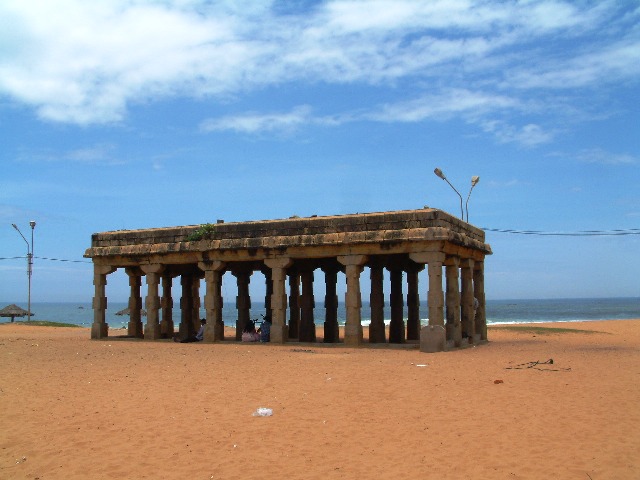
The same beach carries real ceremonial weight. It is regarded as the arattukadavu, the ritual bathing ghat, of Sri Ananthapadmanabhan, the deity of the city, and thousands of Hindus perform the ancestor-offering rite bali tharpanam here on occasions like Karkidaka Vavu. Twice a year, for the Painkuni and Alpashi festivals, Thiruvananthapuram airport closes so that the titular Maharaja of Travancore can lead the Arattu procession in person, royal sword in hand, escorted by armed guards, temple authorities, and mounted police, to bathe the temple's idols — Padmanabhaswamy, Narasimha, Krishna — in the sea. In November 2018 that procession reached the beach's old stone Aarattu Mandapam, as documented.

Public investment here has a mixed record. A Kerala State Planning Board–linked masterplan proposed developing the beachfront in three steps for an estimated Rs 14.6 crore, with officials saying in 2019 that all work would be finished by March 31, 2020. At the time that promise was made, the neighboring Chacha Nehru Traffic Training Park — last properly renovated in 2010 — had already sat closed through another summer vacation, a year into a lease the District Tourism Promotion Council had signed for its renovation. No later source in this record confirms whether the masterplan was ever completed.

Shankhumugham is still a working, visited beach rather than a ruin. Kerala Police patrol it and lifeguards are stationed on the sand. The Sagarakanyaka mermaid sculpture, more than 35 metres long and carved by Kanayi Kunhiraman, remains the beach's best-known landmark, and the Shankhumugham Devi Temple, one of 108 important Durga temples of old Kerala, draws crowds on Tuesdays, Fridays, full-moon days, and the first day of each Malayalam month. What is unresolved is simpler and harder: whether the ground under all of it keeps eroding at the same rate it was measured eroding in 2022.
The spike

Erosion has already swallowed the easiest road to Trivandrum airport's domestic terminal, forcing passengers to walk in with their luggage.

Shankhumugham Beach is a beach with a measured expiration date sitting next to the busiest transit point in the city that surrounds it. In 2022, a study found the coastline in this stretch of Thiruvananthapuram eroding at 4.73 meters a year — a year after erosion had already closed the easiest road to the airport's domestic terminal. Wikipedia's own entry on the beach cites a 2023 headline warning that the city's famed beaches — Shankhumugham among them — could vanish within five years. This is not a hypothetical for future planners. It has already happened once, to the road.

What the sea already took. By September 2021, according to a report in The News Minute, severe coastal erosion had made a major part of the beach nearly disappear. The benches and walkways went first, washed away in high tides, before the erosion reached the road itself. Police had closed a 500-metre stretch of the Shankumugham-airport road roughly five months before that report — the easiest route from most of the city to the airport's domestic terminal. Passengers landing at one of Kerala's busiest gateways were reduced to walking the gap on foot, carrying their own luggage past rubble where a road used to be.

The economy that filled the gap. Where infrastructure failed, an informal one appeared. An auto driver named Jesudas began charging stranded travelers around Rs 100 a bag to carry their luggage across the broken stretch. A fisherwoman named Alphonsa, whose stall the sea had already destroyed, took to selling her catch sitting on the road instead of from a stand. Neither of them chose this; the beach's erosion chose it for them. A Public Works Department official quoted in the same report said as much: rebuild the road without a scientific fix, and it will erode again within months. As of this research, no later source confirms whether that fix, or any rebuild at all, ever happened.

Why the location makes this sharper than an ordinary erosion story. Plenty of coastlines erode. Few of them erode directly across the access route to an international airport, in the capital of a state, at a beach that also hosts a titular monarch's royal procession twice a year and a public masterplan promising Rs 14.6 crore of new development. Shankhumugham sits at the collision of four things that don't usually share one 500-metre stretch of sand: a functioning international airport with a military air command base beside it, a still-living royal ceremony, an ambitious and apparently stalled public investment plan, and a coastline that a 2022 study clocked eroding at nearly five meters a year. Each of those four stories is legible on its own. Together, they describe a place whose ceremonial and civic importance keeps growing even as the ground under it keeps shrinking.

The unresolved plan next door. In May 2019, officials described a Kerala State Planning Board–linked masterplan to develop the beachfront in three steps, for an estimated Rs 14.6 crore, with everything due to be finished by March 31, 2020. That announcement came alongside a much smaller, much older failure sitting on the same stretch of coast: the Chacha Nehru Traffic Training Park, a children's road-safety park last properly renovated in 2010, still closed a full year into a renovation lease the District Tourism Promotion Council had signed for it. If a small park renovation could stall for a year with no reopening in sight, a Rs 14.6 crore beachfront plan on a coastline that would go on to lose a section of its own access road to erosion within two years is not a safe bet to have landed on schedule. This research found no later source confirming either way.

What holds, for now. The beach still functions as a place people go. Kerala Police patrol it and lifeguards are stationed on the sand. The Sagarakanyaka mermaid sculpture, more than 35 metres of stone carved by Kanayi Kunhiraman, still draws visitors, and the Shankhumugham Devi Temple, one of 108 important Durga temples of old Kerala, still fills with devotees on its set days. Twice a year the airport itself still closes so a Maharaja who no longer rules anything can lead an armed procession to the water. What has changed, measurably, is how much beach and how much road are still there to receive all of it. The 2022 erosion figure and the 2023 warning are not decoration on a beach profile — they are the reason a visitor today cannot assume the route their sources describe is the route that still exists.

Sh-beach1.jpg
History

What happened here

  1. 2010governance

    Traffic park last renovated

    The Chacha Nehru Traffic Training Park receives its last proper renovation, under tourism minister Kodiyeri Balakrishnan.

  2. 2017ritual

    Karkidaka Vavu bali tharpanam

    Shankumugham is among the Thiruvananthapuram sites offering facilities for the bali tharpanam ancestor-offering ritual.

  3. 2018culture

    Maharaja leads Arattu procession

    The titular Maharaja of Travancore leads the Alpashi-festival Arattu procession, sword in hand, to the beach's Aarattu Mandapam.

  4. 2019governance

    Traffic park still shut, masterplan proposed

    Report finds the traffic park closed a year into its renovation lease; officials propose a Rs 14.6 crore masterplan due by March 2020.

  5. 2019ritual

    Ganeshotsavam idol immersion

    Ganesha idols from 1,008 locations across the district converge for immersion in the sea off the beach.

  6. 2019event

    IAF static aircraft display

    For the Indian Air Force's 87th anniversary, 28 differently-abled children from seven schools view aircraft including an HS 748 at the air force station.

  7. 2021nature

    Erosion closes airport road stretch

    A 500-metre stretch of the Shankumugham-airport road, closed roughly five months earlier by erosion, forces passengers to walk in with luggage.

  8. 2022nature

    Erosion measured at 4.73 m/year

    A study finds the Shankumugham beach region eroding at 4.73 meters a year.

    Wikipedia →
  9. 2023recency

    Headline warns of vanishing beaches

    A Manorama Online headline, cited by Wikipedia, warns Thiruvananthapuram's famed beaches could vanish within five years.

    Wikipedia →
A sculpture at Shankumugham beach.JPG
Anatomy

The shape of the place

Traffic training park frontage

15%

Ground beside the beach occupied by the Chacha Nehru / Jawaharlal Nehru Park of Traffic Signs for Children, a children's road-safety park with a stalled renovation history.

Best for Families with young children, when the park is open

Last properly renovated in 2010; reported still closed as of May 2019.

Sagarakanyaka sculpture ground

30%

The stretch of beach around the more-than-35-metre Sagarakanyaka mermaid sculpture, carved by Kanayi Kunhiraman, the beach's best-known landmark.

Best for Photography and sunset viewing

The sculpture is the most consistently documented single feature of the beach.

Aarattu Mandapam

45%

An old stone structure on the beach where temple idols are placed for their ritual sea bath during the Arattu ceremony.

Best for Witnessing the biannual Arattu procession

Used twice yearly, for the Painkuni and Alpashi festivals.

Shankhumugham Devi Temple ground

55%

Site of the Shankhumugham Devi Temple, one of 108 important Durga temples of ancient Kerala, drawing crowds on set days.

Best for Temple visits on Tuesdays, Fridays, and full-moon days

Largest crowds gather Tuesdays, Fridays, full-moon days, and the first day of each Malayalam month.

Landmarks

Sagarakanyaka mermaid sculpture

sculpture · Kanayi Kunhiraman

A stone sculpture of a reclining mermaid, more than 35 metres long, and the beach's most recognized landmark.

Aarattu Mandapam

ceremonial structure

An old stone structure on the beach where the Sree Padmanabhaswamy Temple's idols are placed for their ritual sea bath during the Arattu ceremony.

Chacha Nehru Traffic Training Park

park

Also recorded as the Jawaharlal Nehru Park of Traffic Signs for Children; teaches road rules through play, last properly renovated in 2010.

A day here

From first light to dark

Dawn

Early risers share the sand with whatever the previous night's tide left behind; the same tides that carried off the beach's benches and walkways over the years arrive here first, before the crowds do.

Midday

On ritual occasions like Karkidaka Vavu, this is when families gather for bali tharpanam, the ancestor-offering rite performed at the water's edge.

Golden hour

Late afternoon draws the biggest crowds to the Sagarakanyaka mermaid sculpture, with departing flights from the adjacent airport visible low overhead.

Night

Twice a year the ordinary evening gives way to a formal one: the Arattu procession reaching the beach's stone Aarattu Mandapam as the temple idols are carried to the sea.

ശംഖുമുഖം കടൽത്തീരത്തെ മത്സ്യകന്യക ശില്പം.jpg
Culture

Where it shows up

Other
  • Sagarakanyaka mermaid sculpture
    Kanayi Kunhiraman

    A more-than-35-metre stone mermaid sculpture by Kanayi Kunhiraman, a former student of the Chennai College of Arts, and the beach's signature image.

  • Shankhumugham Devi Temple

    One of 108 important Durga temples of ancient Kerala, standing on the beach grounds.

  • Ganesh Chaturthi idol immersion (nimarjan)

    The beach is the prime Thiruvananthapuram site for immersing Ganesha idols at the close of Ganesh Chaturthi.

History
  • Arattu procession of Sree Padmanabhaswamy Temple · 2018

    A royal ceremonial procession, led by the titular Maharaja of Travancore, documented reaching the beach in November 2018 for the Alpashi festival.

The honest part
“By September 2021, passengers were walking past a broken road to reach the airport, carrying their own luggage where the sea had taken the road instead.”

Shankhumugham's problem is not that it lacks landmarks or ceremony; it has a 35-metre mermaid sculpture, a 108-temple-old Devi shrine, and a royal procession that closes an international airport twice a year. Its problem is that by September 2021, erosion had already closed a 500-metre stretch of the road to the airport's domestic terminal for months, forcing passengers to walk in with their own luggage while an informal economy of porters and displaced vendors filled the gap — and a 2022 study measured this coastline eroding at 4.73 meters a year. A Rs 14.6 crore masterplan was promised complete by March 2020; a much smaller traffic park next door had already sat closed for a year past its own renovation lease at the time that promise was made. This research found no later source confirming the masterplan's completion, the road's permanent repair, or the current condition of either.

Chacha Nehru Traffic Training Park, Thiruvananthapuram.JPG
Sea & surf

What the water does

JFMAMJJASONDmetres (significant wave height)

Solid = typical monthly wave height; pale = the bigger days (90th pct). Offshore/regional swell from Open-Meteo Marine (ERA5 Ocean reanalysis, 2023–2024); a sheltered cove may sit calmer than this.

Exposed — real surf, and rip current to respect
Typical wave height
1.3 m
Biggest swell
Jul · 2.17 m
Calmest
Jan · 0.77 m
Typical period
10.8 s (groundswell)
Before you go

Things to know

Road access

A stretch of the Shankumugham-airport road was closed by erosion in 2021; travelers should confirm current road status rather than assume the old direct route is open, since no later source in this research confirms a repair.

Safety patrol

The beach is patrolled by Kerala Police, with lifeguards on duty.

Festival closures

Thiruvananthapuram airport closes twice a year, for the Painkuni and Alpashi Arattu processions — plan flights accordingly.

Temple visiting days

The Shankhumugham Devi Temple draws its largest crowds on Tuesdays, Fridays, full-moon days, and the first day of each Malayalam month.

Surf & rip

Powerful water — strongest around Jul, gentlest in Jan. Mind rip currents; this isn't a wade-in-anywhere beach.

Sharks

No incidents on record in the global shark-attack file.

Plan

If you go

Getting there
Nearest airport
Thiruvananthapuram International Airport (TRV) · 1 km
Nearest town
Thiruvananthapuram · 5 km

Shankhumugham Beach is about 8 km from central Thiruvananthapuram and sits beside Thiruvananthapuram International Airport, with part of the Indian Air Force's Southern Air Command also on adjacent ground. A 500-metre stretch of the direct Shankumugham-airport road was closed by erosion as of 2021, and this research found no later source confirming its repair, so travelers should verify current road status rather than assume the old direct route is open.

When to go
  • Arattu procession · Twice yearly, for the Painkuni and Alpashi festivals

    Thiruvananthapuram airport closes for the day as the titular Maharaja of Travancore leads temple idols in procession to the beach for their ritual sea bath.

  • Ganesh Chaturthi idol immersion · Annually, at the close of Ganesh Chaturthi (August/September)

    Idols from across the district are brought to the beach for immersion in the sea.

  • Bali tharpanam ancestor ritual · On Karkidaka Vavu and other special occasions

    Thousands of Hindus perform the ancestor-offering bali tharpanam rite at the beach.

What to eat & drink
Unnamed star-shaped restaurant

Tamil Wikipedia records a star-shaped restaurant on the beach alongside a water-skiing training school; no name, prices, or current operating status were confirmed in this research.

On the beach grounds, near the water-skiing school

Informal roadside fish selling

After coastal erosion destroyed her fish stall, a vendor named Alphonsa began selling her catch sitting on the roadside near the beach instead — the most concretely documented food commerce in this record, and it is informal, not a business.

The road beside the eroded Shankumugham-airport stretch

Go deeper
Sources & references
  1. New Indian Express, May 2019 · cited 3×
  2. The News Minute, September 2021 · cited 3×
  3. Wikipedia: Shankumugham Beach · cited 3×
  4. New Indian Express, November 2018 · cited 2×
  5. Mathrubhumi English, July 2017
  6. Times of India, September 2019
  7. New Indian Express, October 2019
  8. Cited study, via Wikipedia
  9. Manorama Online, 2023, via Wikipedia citation
  10. Malayalam Wikipedia: Shankhumugham
Colophon · Provenance

Where this page comes from

Geography, facilities
OpenStreetMap (ODbL) for geometry and facility tags within 500 m of the beach centroid. GeoNames for city/airport distances.
Climate & ocean
Open-Meteo ERA5 + Marine archive, 2014–2023 monthly normals.
Photography
Archival, original tone (Tier B — Wikimedia Commons). Each image licensed per its own terms; attribution visible inline.
History & culture
Every factual claim is linked to its source in the prose above. Wikipedia citations inline. Non-wiki sources named where relevant.
Editorial voice
Register: severe. Written to pass a local's nod test; corrections welcome.
Written by Erin Rose
Last reviewed 2026-04-19
v0.9 — in editorial development toward v1.0