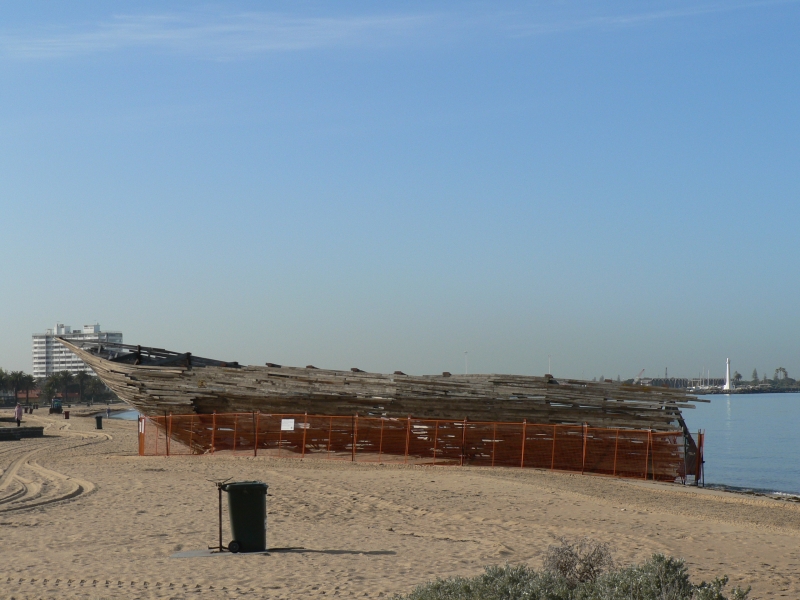
St Kilda Beach is a roughly 700-metre arc of sand on Port Phillip Bay, about 6 kilometres south of central Melbourne in the City of Port Phillip. It is a bay beach, not an open-ocean one: the enclosed water off the foreshore is usually flat, with an annual mean wave height near 0.59 metres and a calm summer character that has made this Melbourne's holiday shore since the railway reached it in 1857. The suburb and the beach take their name from the Lady of St Kilda, a schooner that moored off the sand for much of 1841.
The beach's defining fact is not the sand but the rock at its western end. A bluestone breakwater, built to shelter a harbour for the yachting events of the 1956 Melbourne Olympic Games, now shelters a wild colony of little penguins (Eudyptula minor), the smallest penguin species in the world at about 33 centimetres and roughly one kilogram. Penguins began nesting in the breakwater's rock crevices in the 1970s. When volunteers first counted them in 1986 there were 57; the colony now numbers around 1,400 birds, 6 kilometres from a city of five million.
Behind the sand, the foreshore carries more than a century of Melbourne seaside history. Luna Park opened in December 1912 and still runs its Scenic Railway, a wooden roller coaster operating since that year. The St Kilda Sea Baths date to 1860, the Palais Theatre to the 1920s, and Acland Street one block back became the city's Central and Eastern European cake strip, anchored by shops like Monarch Cakes, which moved to the street in 1934. The St Kilda Pier's Edwardian kiosk, first built in 1904, burned down in 2003 and was rebuilt as a faithful copy.
The penguins are why crowds now gather on the pier at dusk, not only in summer daylight. They are wild animals living at a working city's edge, and the pressures on them are the ordinary hazards of that edge: off-leash dogs, foxes, boat strike, discarded fishing line, marine heat, and rakali, the native water-rat that also lives in the breakwater and takes eggs and chicks. In 1992 the breakwater was declared a Wildlife Management Cooperative Area, with rules against dogs, climbing on the rocks, and white light.
The same foreshore holds a heritage amusement park, one of Australia's largest free music festivals each February, a nightlife strip on Fitzroy Street, and a protected seabird colony within a few hundred metres of each other. The beach is free, patrolled seasonally, and swimmable most of the year in cool water. What makes it worth a page is the arrangement at the end of the pier: a self-sustaining penguin colony that chose, and kept choosing, a rock wall poured for two weeks of Olympic sailing.