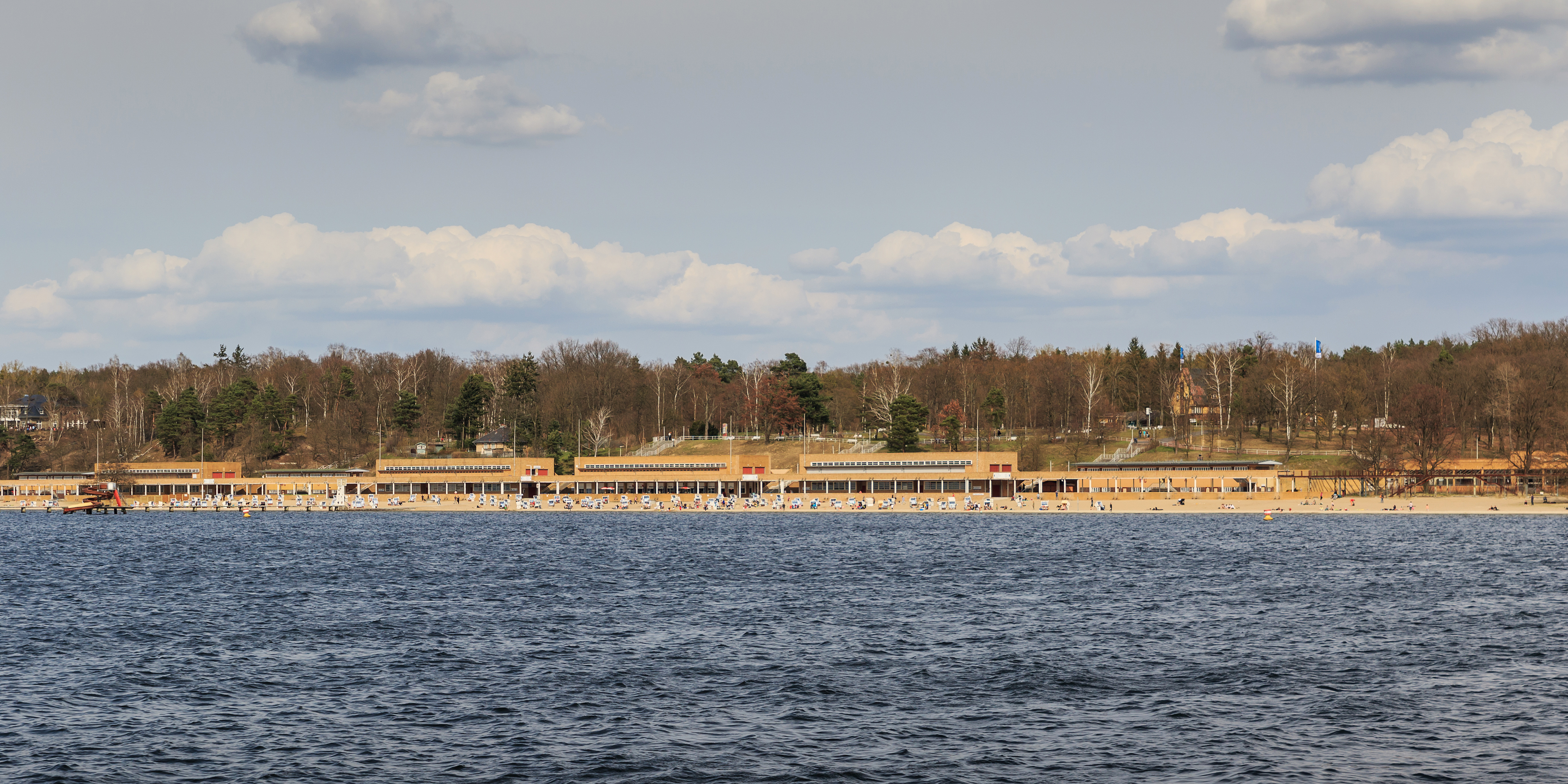
Strandbad Wannsee runs along the east shore of the Großer Wannsee, a wide bay of the Havel river in the Nikolassee locality of southwestern Berlin. It is a lake beach, not a sea one, and one of the largest inland lidos in Europe: a strip of sand 1,275 metres long and about 80 metres wide, on a site of roughly 355,000 square metres, built to hold some 12,000 bathers. The sand is not local. It was hauled in wagonload by wagonload from the Baltic coast at Timmendorfer Strand, several hundred kilometres north, to give landlocked Berliners a seaside floor to lie on.
Bathing here began small. In 1907 the Teltow district authorities gave in to public pressure and permitted swimming on a 200-metre stretch of shore. By 1909 the Freibad Wannsee had a men's beach and a women's beach of 65 metres each, split by a 350-metre family section. It was expanded to 800 metres in 1924, and by 1927 it was drawing around 900,000 visitors a year, fed by the S-Bahn out from central Berlin.
The lido that survives today was built in 1929-1930. Berlin's city building councillor, Martin Wagner, conceived it as a modern mass bathing works and laid out the whole ensemble; the architect Richard Ermisch designed the buildings, long low blocks of yellow clinker brick and steel in the plain New Objectivity style. Then the Great Depression gutted the budget. A planned 5 million Reichsmark, meant to buy a ring of halls, a circular restaurant, a pier café, a marina and an open-air theatre, was roughly halved, and only the northern axis went up: four two-storey buildings instead of the full scheme. Even so, the reopened lido drew about 1.3 million visitors in 1930.
The darker turns came next. Martin Wagner, a committed Social Democrat, was expelled from the Deutscher Werkbund in 1933 and left Germany in 1935, later teaching city planning at Harvard. Under the Nazis, Jews were barred from public baths, a ban formalised in 1938; the "Juden unerwünscht" signs were taken down only to sanitise the beach for the 1936 Olympic Games. Between 1951 and 1955, stray bullets from the neighbouring American Keerans Range struck swimmers, and the beach was closed over the danger in 1952.
In 1951 the beach became a national song. "Pack die Badehose ein," sung by the eight-year-old Cornelia Froboess, turned a day at Wannsee into a pop hit and a permanent German phrase for going swimming; East Germany banned it regionally as advertising for a West Berlin lake. The ensemble was restored in the mid-2000s, is a listed monument, and runs today under the Berliner Bäder-Betriebe for a few euros a day, its Baltic sand raked out each summer beneath Ermisch's yellow brick.


