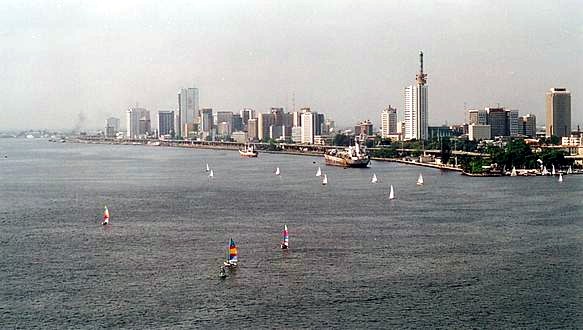
Tarkwa Bay is an artificial sheltered beach at the entrance to Lagos Harbour, opposite Victoria Island across the harbour mouth. It exists because of engineering, not nature: between roughly 1907 and 1913 the colonial harbour works built two stone breakwaters — the East and West Moles — and dredged the bar to let ocean-going ships into Lagos. The moles broke the Atlantic swell that batters the open coast nearby, and behind them a curved bay of dredged sand settled into the calm. That is why it is the swimmable beach in a city whose other beaches face raw surf and rip currents.
There is no road to it. The bay sits on a spit you reach only by boat — a roughly 15-minute water-taxi ride from jetties on Victoria Island, under Falomo Bridge, at CMS or Tarzan Jetty in Maroko, for a fare in the low thousands of naira. It is off-grid, with no mains electricity and no drainage, and it has always been a beach you choose to cross water to reach.
The wave is the surprising part. The moles that calm the bay also bend the swell into a wedge that breaks cleanly enough to surf, and over two decades Tarkwa Bay became the cradle of Nigerian surfing. The Tarkwa Bay Surf Club, co-founded by long-time local John Micheletti and Lagosian surfer Godpower Pekimpuma, taught two generations of kids from the beach's own fishing families; Godpower runs what has been called Nigeria's first surf school. The scene has been filmed by CNN, the BBC and Dylan Graves' Weird Waves, and in May 2023 the beach hosted the Nigerian Surfing Federation's National Surfing Festival.
Before the surfers, and still alongside them, Tarkwa Bay was a working fishing settlement. Families lived in a mix of abandoned concrete villas and corrugated-metal shacks, launched pirogues off the calm sand, and sold fruit, grilled fish and deck-chair hire to weekend day-trippers. The bay is a hinge between two Lagoses: the container ships and oil jetties of Apapa on one side, the beach blankets and surfboards on the other.
The hinge broke on 21 January 2020. The Nigerian Navy moved through the Tarkwa Bay and Okun Ayo communities, gave residents about an hour to leave, and demolished their homes — an operation it justified as a crackdown on oil-pipeline vandalism and fuel theft, and that displaced several thousand people, with totals reported as high as 10,000. A court ordered the demolitions halted; Amnesty International condemned the eviction. The beach you can still ride a boat to is the same one whose community was cleared in a morning.