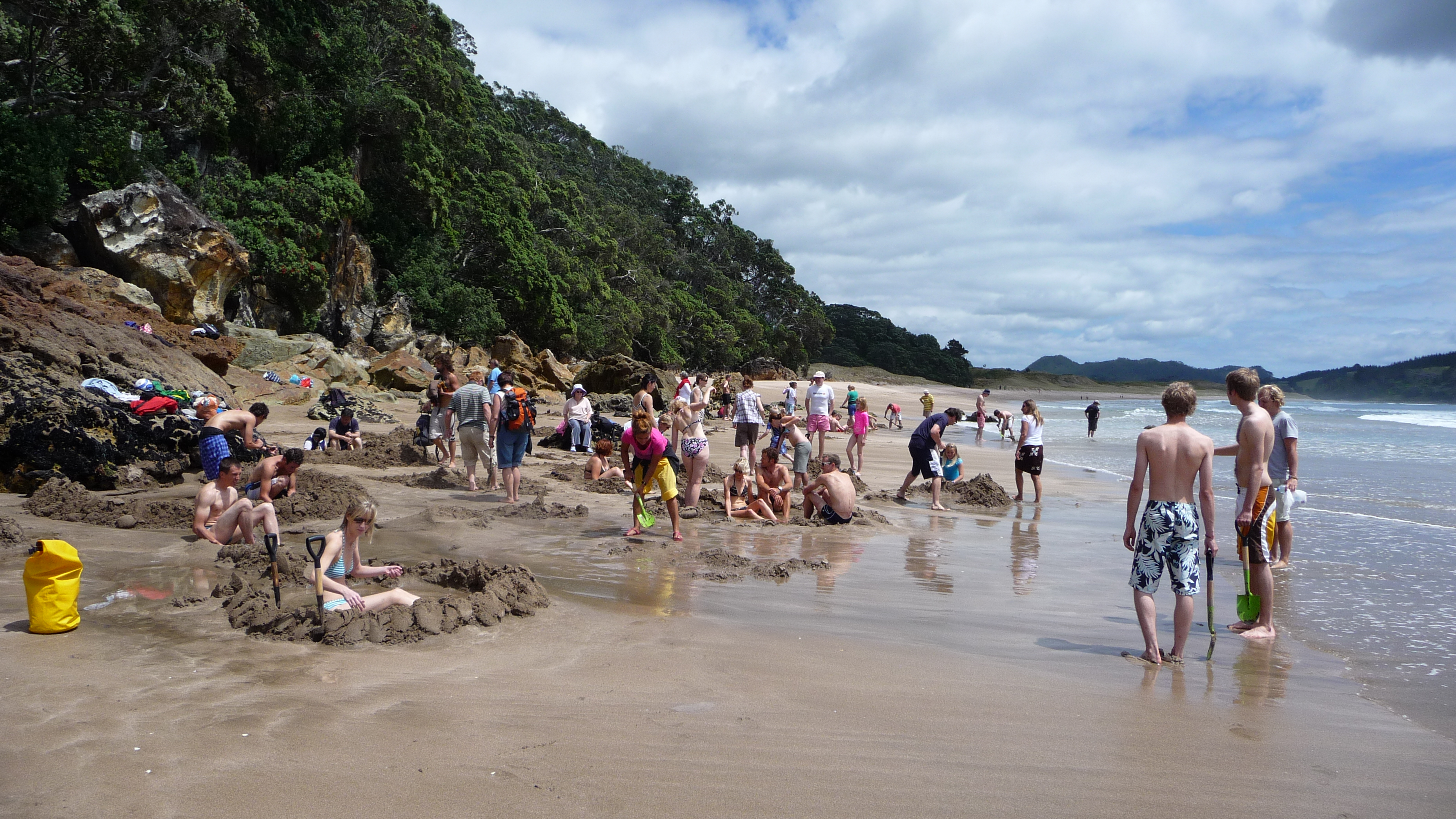
Hot Water Beach is on the east coast of the Coromandel Peninsula, in New Zealand's Waikato region, about 12 kilometres south-east of Whitianga. Local Maori called it Te Puia, the spring, for the mineral hot water that surfaces on the sand at low tide. The phenomenon is narrow and literal: within about two hours either side of low tide, in a patch of beach maybe the size of a tennis court, water as hot as 64°C (147°F) filters up through the sand from two underground fissures sitting close together. People bring spades, dig a hollow, and let it fill into a private hot bath a few metres from the surf.
The heat is real volcanic heat. Hot Water Beach sits inside the Coromandel Volcanic Zone, an extinct Miocene arc on the edge of the Pacific Ring of Fire. Rainwater works down through fractured rock along the peninsula's fault systems, is heated at depth by the cooling remains of old rhyolitic and andesitic volcanism, and rises back to the surface here. By the time it reaches the sand it is hot enough to scald.
The digging is a small choreography dictated by the tide. Too early or too late and the hot patch is underwater or buried; in the window, the sand over the fissures is so hot it is uncomfortable to stand on, and the trick is to mix in cooler seawater to get a pool you can actually sit in. Spades are hired from the cafes and the store by the car park, because almost nobody arrives with one, and on a good low tide the dig zone becomes a crowded grid of strangers' pools, water trenched between them, steam coming off the surface.
The beach does not hand this over gently. The same coast that delivers the hot springs is, by Surf Life Saving New Zealand's own rescue counts, among the most dangerous in the country. The hot water comes up exactly where a persistent rip runs offshore, in the surf zone directly below the dig area, so the crowd that gathers for the novelty is standing next to genuinely lethal water. The hazards stack: scalding sand on land, a strong rip just beyond it, and a low-tide window that funnels everyone into the same hour.
What makes Te Puia singular is that the geology and the danger share an address. Most beaches separate their attraction from their hazard; here the seep you came to soak in and the rip that drowns people are the same fifty metres of sand, governed by the same tide. The soak only works in the exact window when the sea is at its trickiest.


