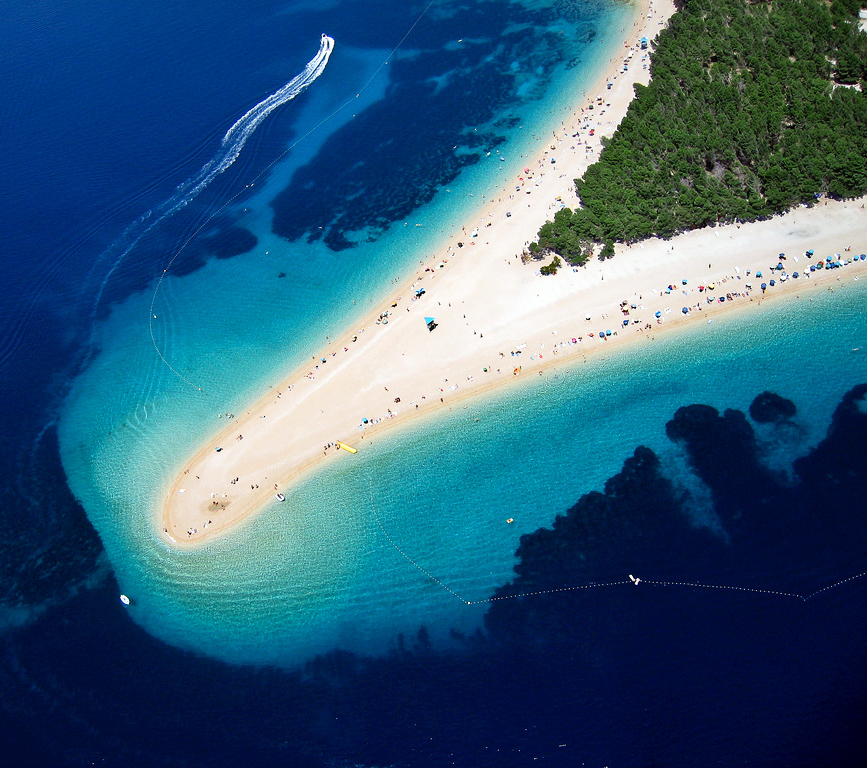
Zlatni Rat is a pebble spit pointing out from the southern shore of Brač, about 2 kilometers west of Bol, into the Hvar Channel between Brač and Hvar. The Croatian name means Golden Cape, rendered in English as the Golden Horn. It is roughly half a kilometer long, fine white pebble, with a spine of Mediterranean pine down its center. What sets it apart from every other famous beach is that it does not hold still: the tip changes shape and direction with the wind and the sea, and after a storm it can point the other way.
The mechanism is two opposing currents meeting at the spit, each pushing sediment a different way, with the wind tilting the balance. In summer the afternoon Maestral, a thermal wind from the northwest, blows down the channel almost daily and pushes the tip east, so the spit runs straight or curls eastward. The Jugo, the warm southeasterly of autumn and winter, drags it back west. A 2015 measurement caught the asymmetry: the west side ran 479 meters, the east side 377 meters — two flanks of one spit over a hundred meters apart because the sea had worked one side harder.
The pebbles come off the mountain behind the beach. Vidova Gora, the high point of Brač and of any Adriatic island at 780 meters, sheds limestone that the currents settle around a submerged reef, and the spit has built outward over decades — roughly 30 centimeters a year, the tip rotating about 20 degrees annually as the seasons trade winds. Croatia protects the promontory by law as a geomorphological monument, an unusual status for a beach, because the landform is a living record of how currents and a mountain together make a coast.
The pine grove is younger than it looks and entirely man-made. Until the 1950s this ground was vineyard planted almost to the waterline, part of a Bol economy built on wine and on the fish caught off the cape. In 1950 the state took the land and the municipality planted the pines that now give the only shade. Hidden among them lie the remnants of a Roman villa rustica with its own bathing pool — proof people have lived off this shore since antiquity, long before it became the postcard of Croatian tourism.
That fame is now the problem. The spit fronts nearly every Croatian travel brochure, and in July and August the crowds and the boats anchored offshore press hard on a landform never built for them. The wind that makes the beach also made it one of Europe's most reliable summer windsurfing venues. Zlatni Rat is, in the same breath, a protected natural monument and a mass-tourism engine, and the tension between the two is the honest story of the place.