Phase 1 · Henry Holland's villa (1787)
In 1787 the Prince of Wales — the future George IV, then 25, already deeply in debt and deeply in love with the actress Mrs Fitzherbert — commissioned Henry Holland to build a modest classical residence at Brighton. Holland (1745–1806) was a competent but not unusual Regency architect; the building he produced was symmetrical, bow-fronted, white stucco, Greek-ionic, and almost entirely unremarkable. A London merchant's seaside-villa. The Prince lived in this version for a decade without much commentary.
Phase 2 · The Chinese interior (1801–1804)
Around 1801 the Prince acquired a substantial collection of Chinese wallpaper — hand-painted silk, purchased through London dealers from the Canton trade. He had no particular place to put it. His response was to order the Brighton villa redecorated to accommodate it. Between 1801 and 1804, the ground-floor interiors were reworked into a theatrical chinoiserie register — gilded dragons, bamboo-patterned plasterwork, red lacquer panelling, lotus chandeliers. The exterior was still Holland's white stucco classical villa at this point. The disjunction between a sober Greek-fronted English seaside house and a Chinese fantasy interior was the Pavilion's condition for fifteen years.
Phase 3 · Humphry Repton and the Indian proposal (1805–1808)
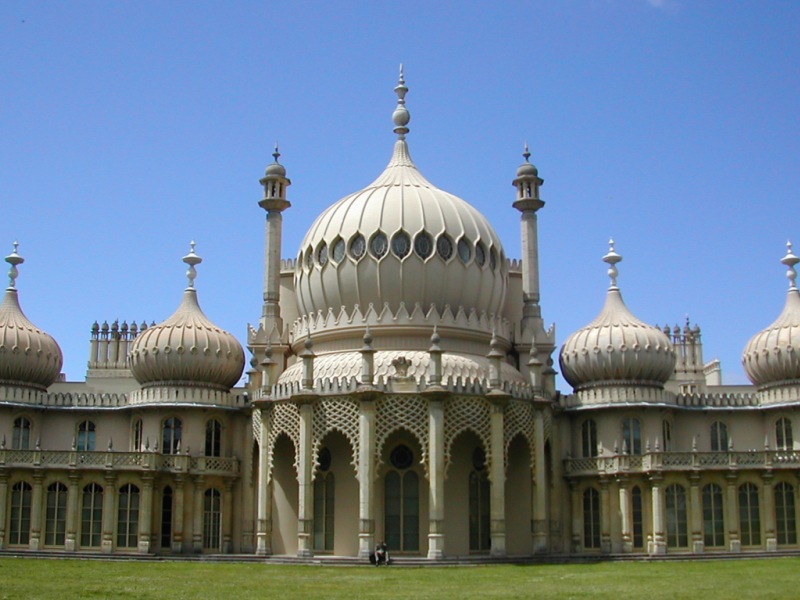
In 1805 the Prince commissioned the landscape designer Humphry Repton to propose a replacement exterior to match the Chinese interior. Repton's brief, in his famous Red Book of watercolor proposals, was to draw architecture inspired by the Mughal palaces of India — specifically the illustrations of William and Thomas Daniell's Oriental Scenery, published 1795–1808, which had become fashionable in London elite collections. Repton's scheme — onion domes, chhatris, minarets, Moorish arches — was approved by the Prince but not executed for nearly a decade; the Napoleonic Wars, the Prince's mounting debts, and the practical difficulties of constructing large domes on the existing Holland-villa structure intervened.
Phase 4 · John Nash's rebuild (1815–1822)
In 1815, with the Napoleonic Wars over and the Regent (as George now was, since 1811) restored to some political relevance, the Pavilion commission passed to John Nash. Nash (1752–1835) was the Regency era's most important architect — the master-planner of Regent Street, the designer of Regent's Park and the John Nash terraces around it, and the single most-influential figure in the look of Regency London. His Brighton Pavilion commission was to execute Repton's Indo-Islamic exterior but more ambitiously — larger domes, more elaborate minarets, a complete reworking of the building's silhouette.
Nash's construction ran 1815–1822. The structural engineering was substantially innovative: the main onion dome is a cast-iron internal frame covered with external plasterwork, a technique Nash was using in parallel at the Brighton's Chain Pier (also cast-iron, opened 1823, destroyed 1896). The minarets are similar: iron armatures, stone-and-plaster skins. The Pavilion's structure is, in this sense, a deeply Georgian-industrial building wearing an Indian-Mughal costume.