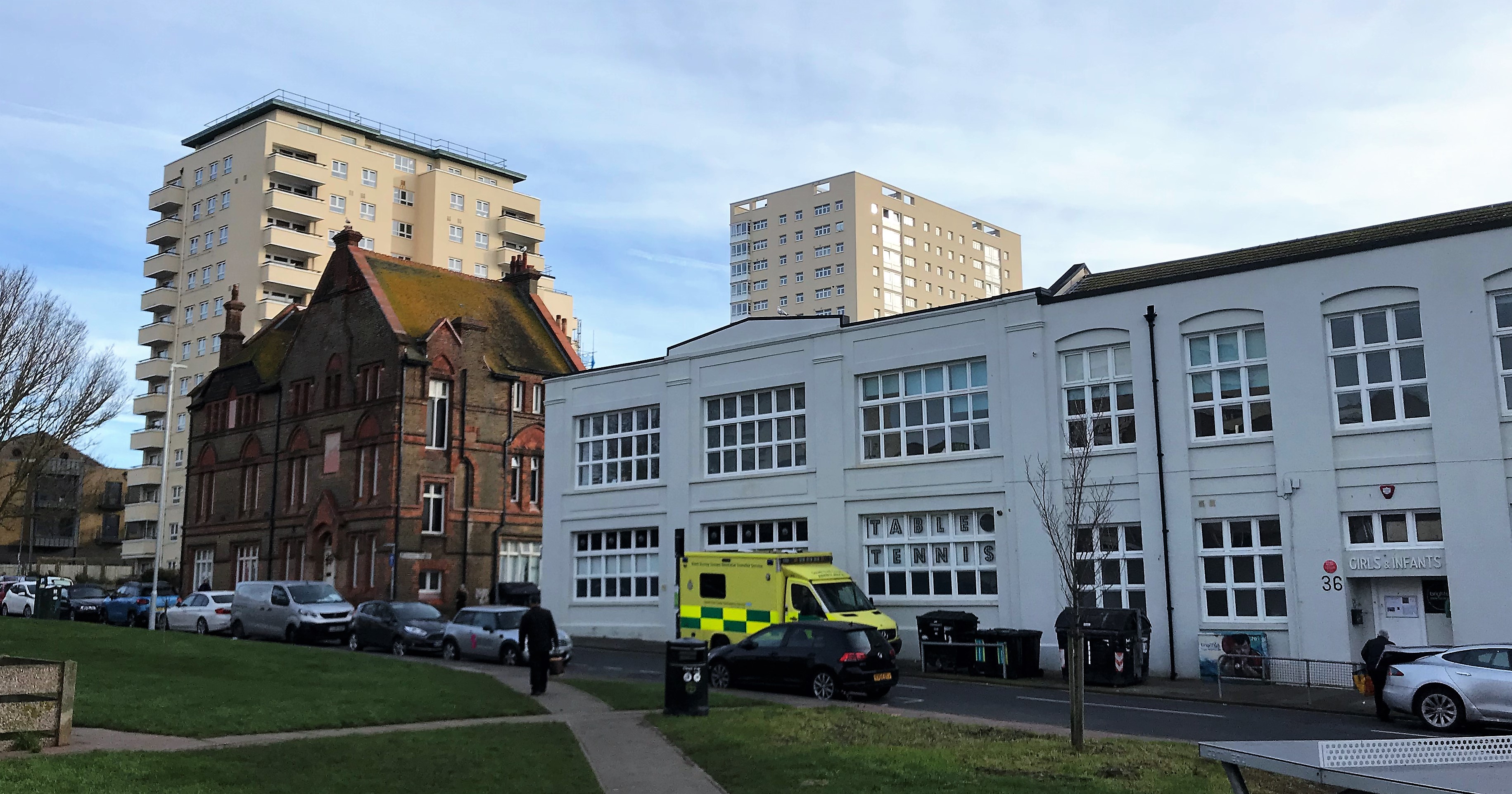
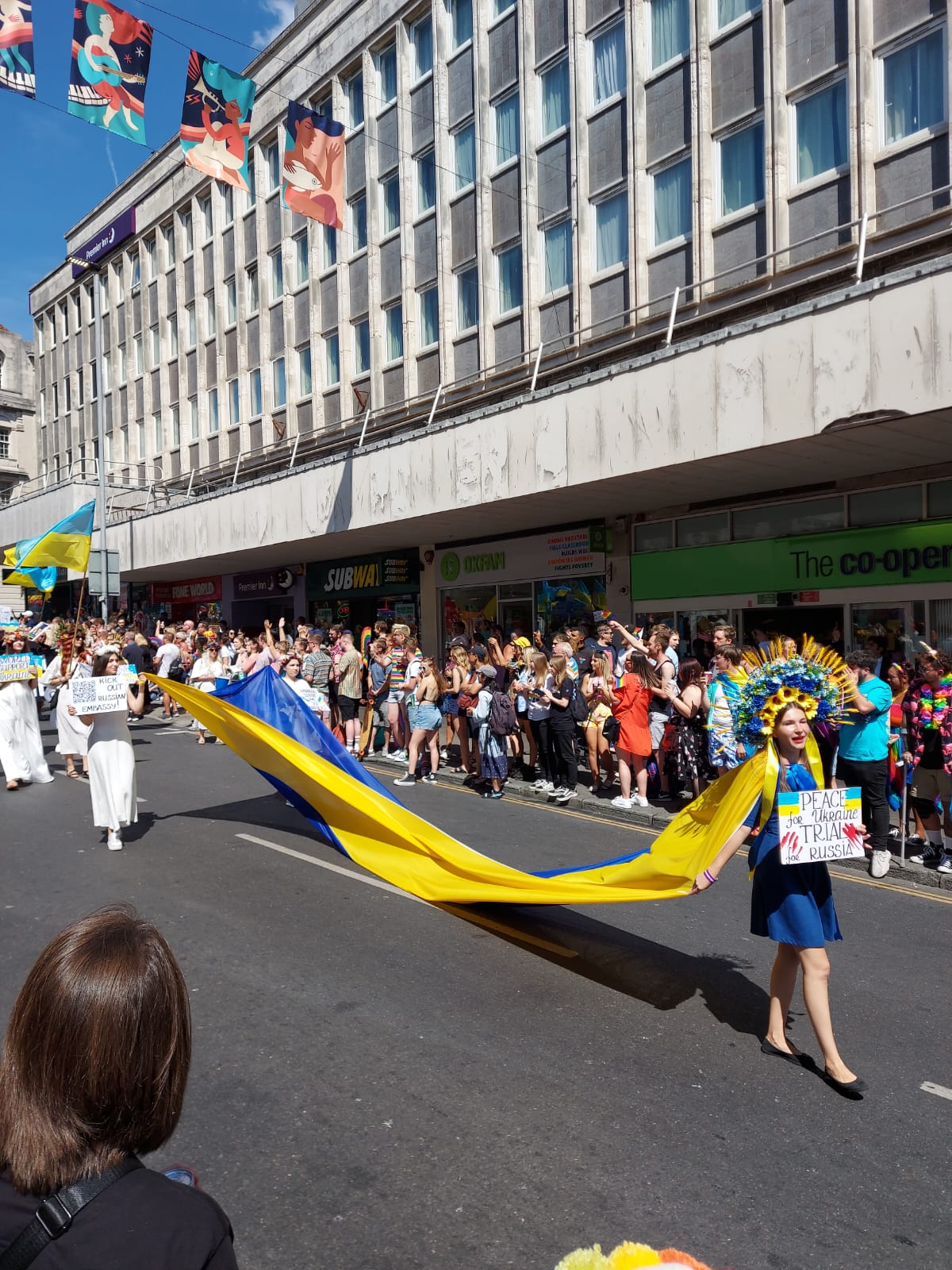
The parade route runs from Hove Lawns through central Brighton to Preston Park, a mile inland. ~100,000 people along the route. Start time is around 11 a.m.; the front of the parade reaches Preston Park by 1 p.m. Best viewing: Old Steine Gardens (central, near the Pavilion) or anywhere along North Street. Arrive by 10 a.m. for a decent spot.

· Queer Brighton
The UK's oldest, largest, longest-running queer capital
Kemptown — a mile east of the Palace Pier — has been the center of British gay life for eighty years. Brighton's Pride is the largest in the UK. The Duke's Mound naturist beach was the country's first, legalized in 1980. This is the spoke that reads the town through the identity that made it.
The neighborhood and how to read it
Kemptown is not a gay neighborhood the way Chelsea or the Castro are gay neighborhoods. It is a Regency-era district of central Brighton that became queer-dominant in the mid-20th century and stayed that way through the 1967 decriminalization and into the modern era. The architecture predates the gay culture by 130 years; the gay culture has shaped the architecture since.
The neighborhood runs roughly from Old Steine in the west (at the eastern edge of the Pavilion Gardens) to Black Rock in the east (where the Brighton Marina now is), and from the seafront north to Queen's Park. The architectural core is a series of Regency terraces built between approximately 1820 and 1840 — the same generation as the seafront's Kings Road squares — on steep hills rising from Marine Parade. Grand in intention, quickly compartmentalized into flats and bedsits as the Victorian middle-class moved on.
By the 1940s Kemptown's cheap rents and discrete street geography had made it a refuge for Brighton's gay community. The UK's criminalization of male homosexual acts, in force from 1885 until the partial decriminalization of 1967, made visible gay life dangerous in most British towns. Brighton — with its Regency tradition of licentiousness, its theatrical and hospitality industries, and its post-war housing availability — was one of the few cities where an informal gay culture could sustain itself at scale. The first documented openly gay pub, The Chequers, opened in Kemptown in the 1940s. The Brighton police's de facto tolerance — they did not run the kind of raids that Soho and Manchester saw — made the town the UK's effective gay capital throughout the 1950s and 60s, before the formal decriminalization of 1967 changed the playing field for other cities.

The Revenge club opened in 1981; the Legends club on Marine Parade opened in the same period. Both were, by the 1990s, Saturday-night landmarks on the European gay circuit — London-Brighton clubbing weekends were a standard format of the UK gay scene. The Marlborough (on Princes Street), The Queen's Arms (on George Street), Charles Street Tap (on St James's Street) were and are the long-running pub scene. Some of these venues have closed and reopened with different names over the decades; most have held their identity.
The UK's first legalized naturist beach, and why it mattered
A mile east of the Palace Pier, where the undercliff walk passes beneath Marine Parade, is a small stretch of pebble beach called Duke's Mound. In 1980, after approximately four decades of informal use and periodic police tension, Brighton & Hove Council formally designated the stretch as the United Kingdom's first legally tolerated naturist beach. This was nominally a clothing-optional-for-everyone designation. In practice, it was — and is — understood as a gay men's beach.
The significance of the 1980 designation for Brighton was twofold. The first-order effect was legal clarification: what had been a de facto usage requiring nightly police forbearance became, after 1980, an explicitly protected public space. The second-order effect was cultural — Brighton's Council had, in 1980, become the first UK local authority to formally legitimize a piece of outdoor gay male space. The precedent mattered. Several other UK councils followed, slowly, through the 1980s and 90s. A substantial piece of the UK's outdoor LGBTQ+ public-space inventory traces to the Brighton decision.
Duke's Mound today is still in operation. It is less heavily used than it was in the 1980s — the broader liberalization of UK society has reduced the function it served as one of few outdoor gay spaces. But it is still there, still protected, still signposted. A visitor who wants to see it should walk east from the Palace Pier along the lower undercliff path; it is a ten-minute walk. The etiquette is the etiquette of any naturist beach: don't photograph people, don't stare, don't approach. The beach is a working piece of Brighton's gay infrastructure, not a tourist curiosity.
AIDS, Section 28, and what Brighton did
The two decades between the first UK AIDS diagnoses in 1982 and the repeal of Section 28 in 2003 were the hardest period in modern British LGBTQ+ history. Brighton was hit disproportionately hard. It also organized disproportionately fast.
The first British AIDS diagnosis was made in late 1981; by the mid-1980s the epidemic had reached the UK's gay community at catastrophic scale. Brighton's disproportionate share of the UK's gay population — by 1985 it had one of the highest per-capita HIV rates in Britain — meant the town also carried a disproportionate share of the deaths. The annual loss during the peak years (1989–1996) was devastating; the Brighton Cemetery at Bear Road holds a substantial section of that generation.
The civic response was unusually fast for a British town. The Sussex AIDS Centre and Helpline was founded in 1985 — one of the UK's earliest — and remains in operation as part of what became the Terrence Higgins Trust national network. Brighton's Claude Nicol Centre (named for the Victorian-era Brighton physician who pioneered community-based public-health work) provided free and anonymous HIV testing when such a service was rare elsewhere. By the late 1980s the town had a network of hospice provision, legal advocacy, and housing support that was by British standards exceptional.
Section 28 — the Thatcher-era statute, active 1988–2003, that prohibited "promotion of homosexuality" by local authorities and in schools — was openly opposed by Brighton & Hove Council. The town's libraries continued to stock LGBTQ+ material; the Pavilion & Museums service ran LGBTQ+ history programming through the Section 28 period that would have generated prosecution-risk elsewhere. The town was not always ahead of national progress, but it was substantially ahead of its local-authority peers.
The first Brighton Pride — in 1992, organized under Section 28 — was in this context an act of some political courage. Its subsequent growth to the UK's largest Pride is, in one reading, the town's continuation of a commitment that predates both the decriminalization and the public-health emergency that shaped it.
What the first weekend of August actually looks like
Brighton & Hove Pride draws roughly 400,000 people across the first weekend of August — the parade, the Preston Park festival, the weekend of club nights. It is the UK's largest Pride. It is also a specific and particular kind of event that benefits from being understood in advance.

The ticketed main event (£35–75 depending on tier). Multiple stages, big-name acts headlining. Historically: Kylie Minogue, Britney Spears, Christina Aguilera, Mariah Carey. The festival runs until roughly 10 p.m.; tickets sell out weeks ahead. Not for everybody — it's a mega-event. Smaller ticketed events in Kemptown clubs follow the evening.
St James's Street in Kemptown is closed to traffic and becomes a street festival; £10–15 entry wristband. The clubs — Revenge, Legends, Charles Street — run at full volume. This is the Pride night most visitors come for; it is also the night Kemptown genuinely fills with people.
Preston Park is cleaner than you'd expect by Sunday morning. The tea dance at the Marlborough or at the Brighton Dome (schedule varies by year) is the Sunday afternoon tradition. Most out-of-town visitors leave Sunday evening; the town takes roughly 72 hours to return to normal.
Book accommodation 4–6 months ahead. Hotel rates triple over Pride weekend. Many Kemptown B&Bs and Lanes hotels are block-booked by Pride operators. Book parade/festival tickets early. Large sections of the Saturday Preston Park festival sell out by June; same-day tickets are rarely available. Pace yourself — Pride weekend is a three-day event and trying to do all of it on day one is the most common mistake. Respect the protest strand: Pride began as a protest, not a party, and the Saturday march still has a banner-bearing front section that is a protest parade. Don't cheer for corporate floats if you wouldn't cheer for corporate anything; applaud the community groups genuinely.
The community beyond the pubs and the parade
Brighton's queer capital status is not just a nightlife economy. It is a resident community, a demographic layer of the city, and a set of institutions.
Brighton has, by several measures, the highest per-capita LGBTQ+ population of any UK city. The 2021 UK census — the first to ask a sexual-orientation question — recorded roughly 10.7% of Brighton & Hove residents as identifying as lesbian, gay, bisexual, or other non-heterosexual orientation. The comparable London figure was 4.3%; the UK average 3.2%. Brighton's trans population is also disproportionately concentrated; the city has one of the UK's few specialist adult gender identity clinics.
This demographic concentration is not only Kemptown. Queer Brighton extends through Hanover (the inland neighborhood just north of Kemptown, traditionally younger and more alternative), through Hove (where many older LGBTQ+ residents live for the quieter setting), and through the central Lanes district (where much of the LGBTQ+ retail, bookshops, and non-pub social infrastructure is located). A visitor who only reads Kemptown is reading ten percent of queer Brighton.
Institutions: Allsorts Youth Project(LGBTQ+ youth support, since 1999), LGBT Switchboard Brighton (helpline and support, since 1974 as Brighton Gay Switchboard), Lunch Positive (for people living with HIV, weekly community lunch since 2009), the Marlborough Productions theatre company (trans- and queer-focused, residency at The Marlborough pub's theatre space), the Brighton Ourstory Project (community LGBTQ+ history archive, since 1989 — one of the UK's oldest community-led queer-history projects).
What all of this means for a visitor: the Kemptown scene you encounter in July 2026 is the top layer of an eighty-year-old community with formal institutions, accumulated knowledge, and real continuity. Leave money in the community. Drink at owner-operated local pubs rather than chain venues, attend a Marlborough Productions show, buy a book at Queer Lit on Gardner Street, donate to Allsorts or Lunch Positive. The Brighton queer economy's sustainability is the mechanism that keeps it being Brighton.
The rest of Brighton
Brighton →
The two piers, the Regency seafront, and what a grey-sky beach built English seaside tourism around.
Visiting →
The London day-trip vs the weekend vs the overnight; where to stay in the Lanes, the seafront, or Kemptown; and how to eat in a town of five hundred restaurants.
The Royal Pavilion →
George IV's Indo-Islamic fantasy palace — how it got built, why it is the way it is, and how to read the most unusual royal building in Britain.
Written by Erin Rose. Historical material follows the Brighton Ourstory Project's published community oral history (since 1989), the LGBT Switchboard Brighton fiftieth-anniversary retrospective (2024), and the Royal Pavilion & Museums Trust's LGBTQ+ history programme catalogues. Kemptown venue status current as of 2026; verify current opening for specific pubs before a visit, as the post-pandemic hospitality churn has affected several long-standing names. Pride logistics reflect the 2026 programme — verify event schedule at brighton-pride.org. Corrections welcome, especially on Portuguese-language framings and on the named practices of Nazaré. Version v0.9.