The beach the world imagines when it imagines a beach. Most of what the world imagines is wrong. The real place is the better story.
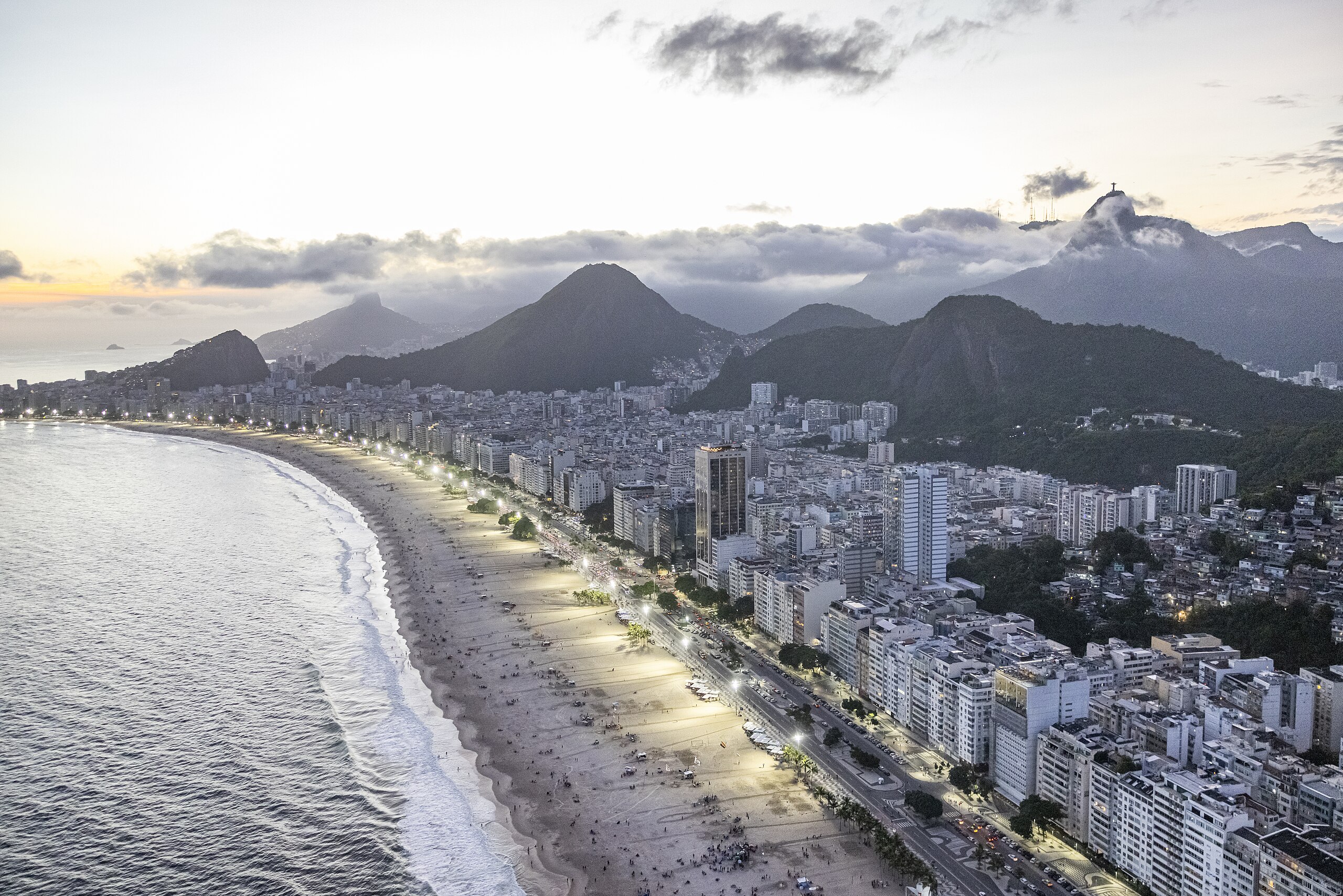
Praia de Copacabana — aerial view of the arc at sunset · Nilton Souza (Wikimedia) · CC BY-SA 3.0 de
· Story
Copacabana is the beach the rest of the world imagines when it imagines a beach, and it deserves that reputation and also undermines it in ways only Cariocas fully understand. Most of what the world imagines was assembled over a hundred years from a 1923 hotel, a 1933 Hollywood film, a 1940 Manhattan nightclub, a 1962 bossa nova recording, a 1970 Portuguese-mosaic redesign, and a 1978 Barry Manilow song that was about the nightclub, not the beach. The real place is the better story.
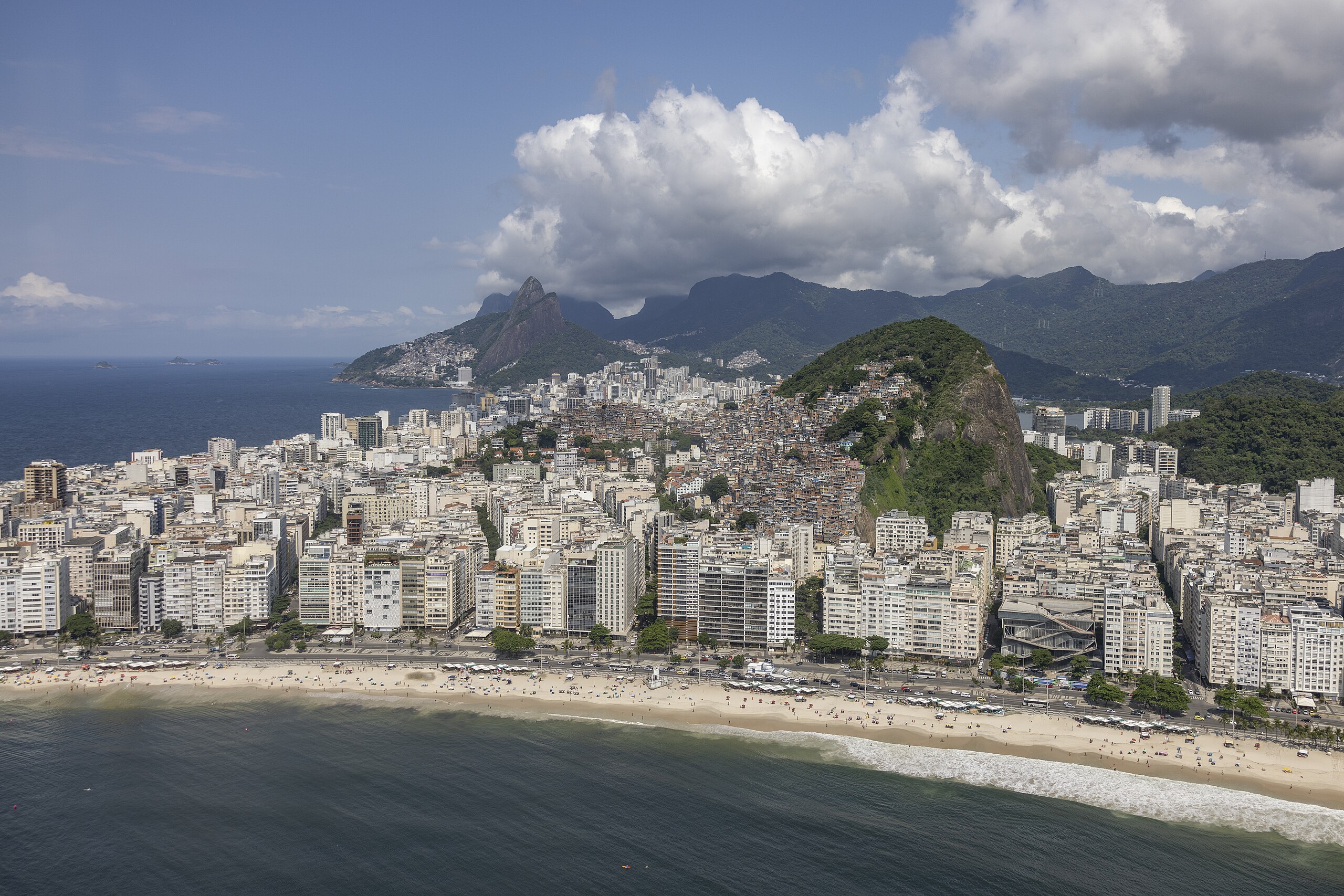
The beach itself is four kilometers of sand arcing between two headlands — Leme at the north, the Forte de Copacabana at the south — with a wall of white buildings behind it, and behind them, the granite peaks that make Rio one of the only cities on Earth where mountain and ocean meet mid-neighborhood. Cristo Redentor is visible from the sand if you know where to look. At midday in February the sand reaches 60°C and children run on it and adults don't.
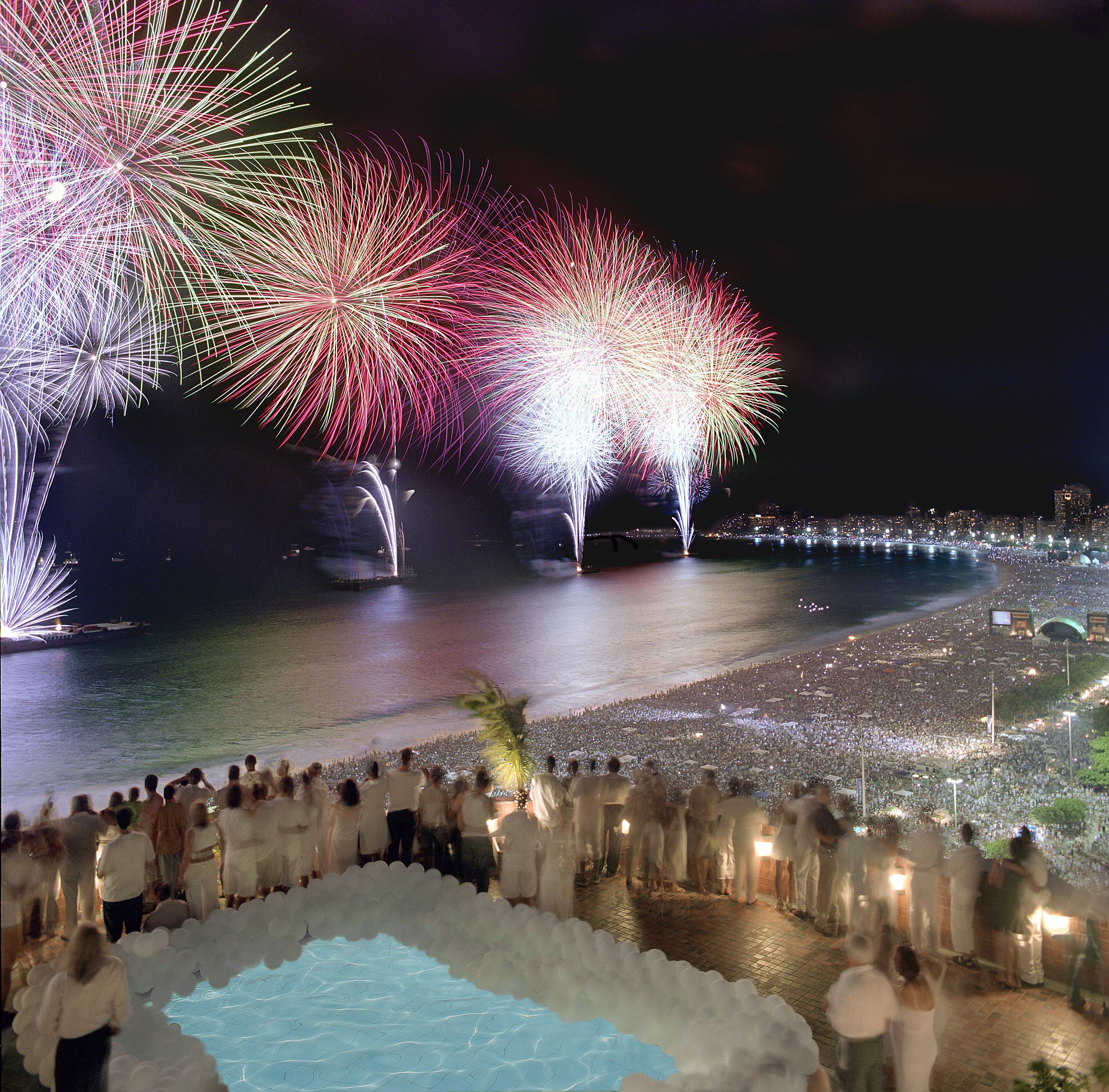
Copa does mass occasions better than any beach on Earth. Two to three million people gather here every New Year's Eve dressed in white — a Yemanjá tradition borrowed from Candombl é. Pope Francis drew 3.7 million at World Youth Day in 2013. Madonna drew 1.6 million in 2024. Lady Gaga drew 2.1 million in 2025. On 30 December 2025, Guinness certified Copacabana's Réveillon as the world's largest New Year's Eve celebration. No other beach on Earth hosts this kind of night at this scale and does so reliably, year after year.
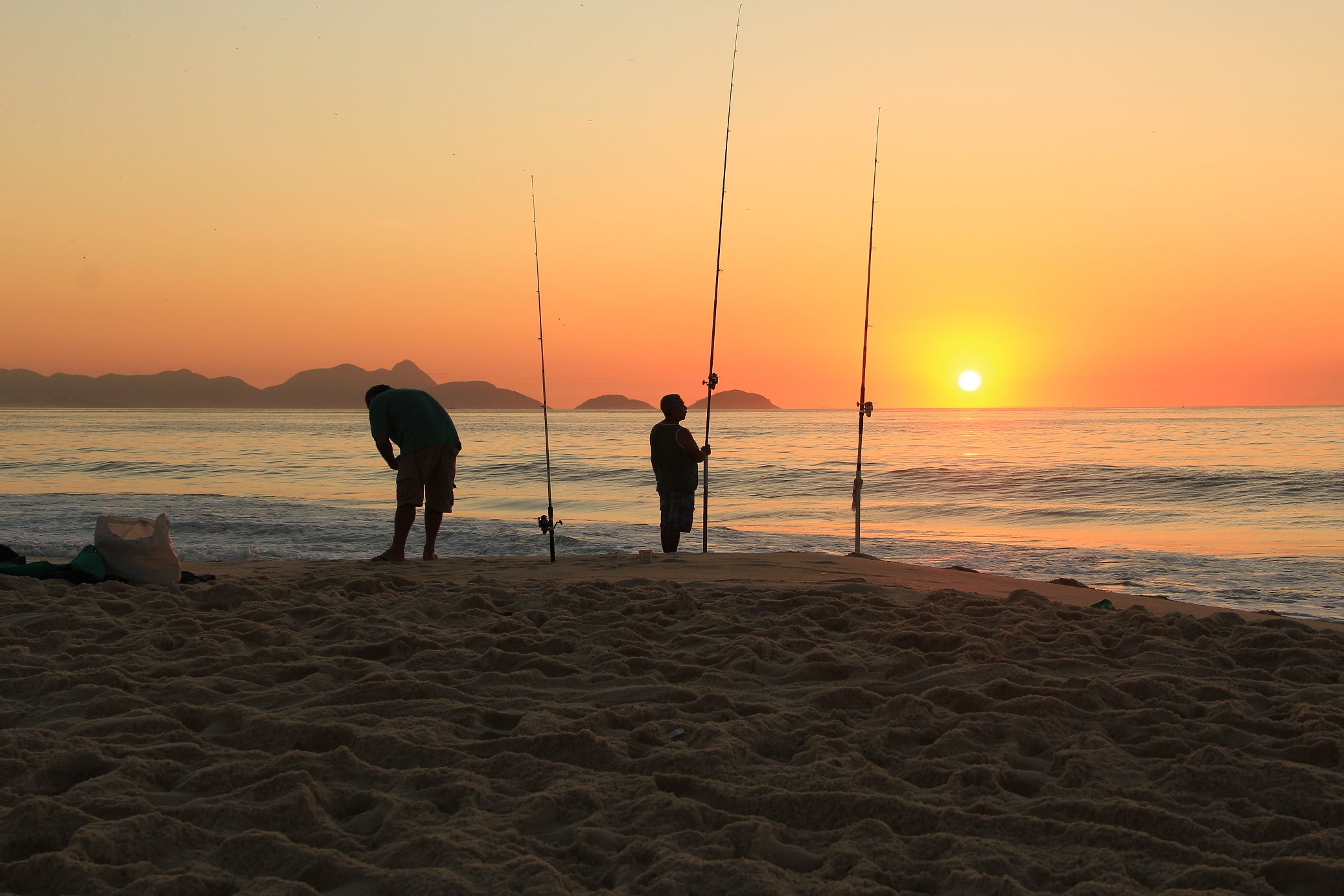
And Copa does ordinary mornings. An old man with a metal detector works the tide line at 5 a.m. The colônia de pescadores at Posto 6 pulls nets in. Runners, swimmers, surfers, kiosk baristas opening the day. A beach this famous does not need to do anything to be itself. It is already happening.
· The Calçadão
Burle Marx's 1970 wave — four kilometers where no stretch repeats
The Portuguese-mosaic pavement that is now the single most recognizable image of Copacabana — the black-and-white wave running the length of the beach — is a specific design by a specific landscape architect commissioned for a specific 1970 land-reclamation project. It is 55 years old as a continuous form, not a centuries-old tradition.
Before 1970 — a narrower beach
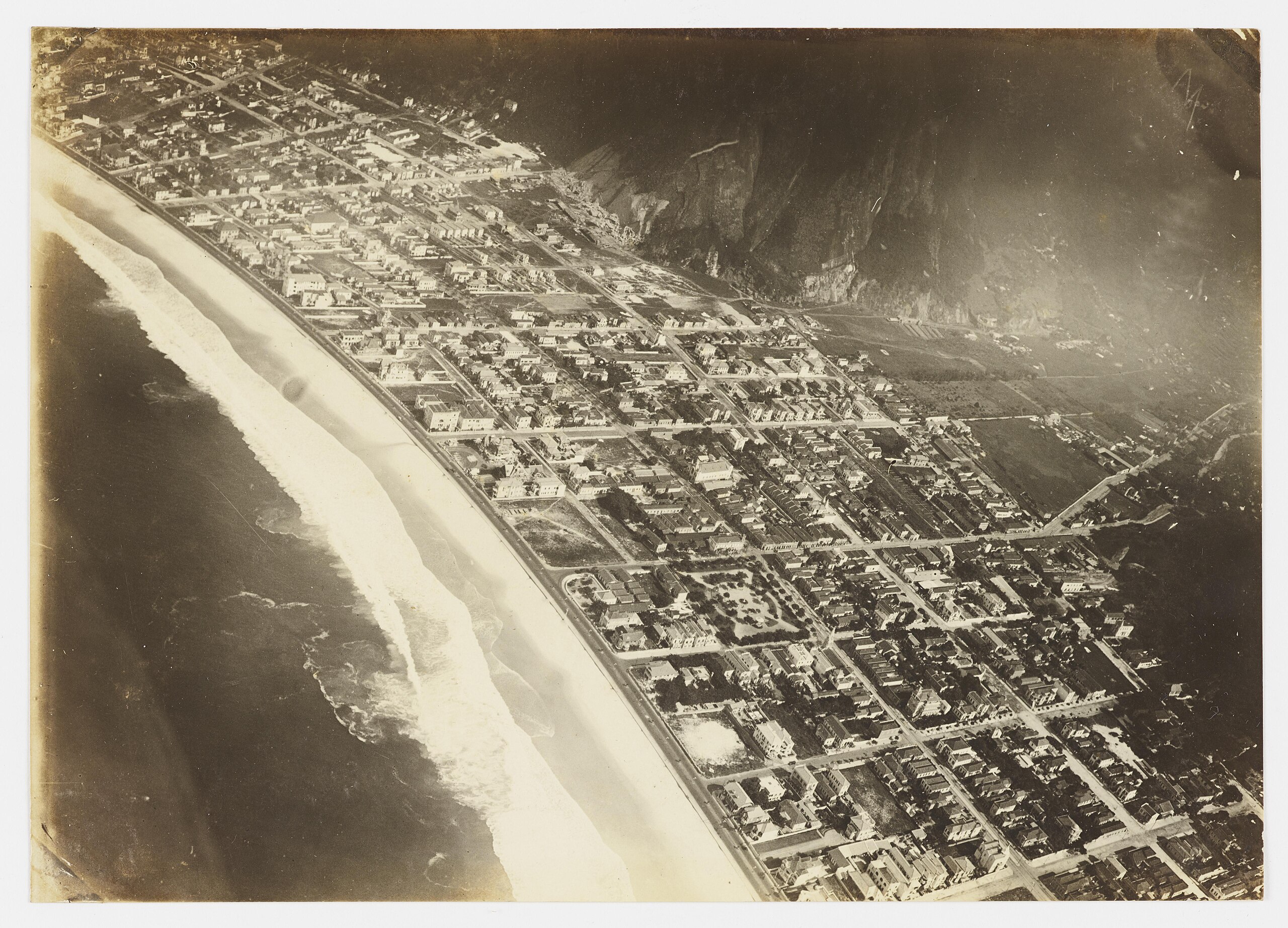
Until 1970 the Copacabana beach was roughly half its current width. Historic photographs from 1916 — preserved at the Instituto Moreira Salles — show waves breaking almost against the foundations of the buildings along what is now Avenida Atlântica. The promenade existed as a narrow sidewalk; it carried Portuguese-style black-and-white mosaic pavement (the calçada portuguesa tradition that arrived with 19th-century Portuguese municipal engineers) but the pattern was a generic diamond-and-diamond scheme not specific to Copacabana.
1916. Copacabana before 1970 — a much narrower beach, the Atlantic reaching almost to the building line. The 1970 land-reclamation project nearly doubled the sand and created the continuous promenade that Burle Marx was commissioned to redesign.· Jorge Kfuri — Instituto Moreira Salles · Public domain
The 1970 reclamation
The 1970 project, under Rio's then-military- government municipal administration, dredged the bay and extended the beach seaward by roughly 50 meters — almost doubling the sand. The reclaimed zone created the conditions for a continuous 4-km promenade with setback, landscaping, and — crucially — a wider paved surface than the pre-1970 sidewalk had allowed. The city commissioned Roberto Burle Marx (1909–1994) — the Brazilian landscape architect best known internationally for the Parque do Flamengo in Rio and for extensive work at Brasília — to design the new paving.
The wave pattern
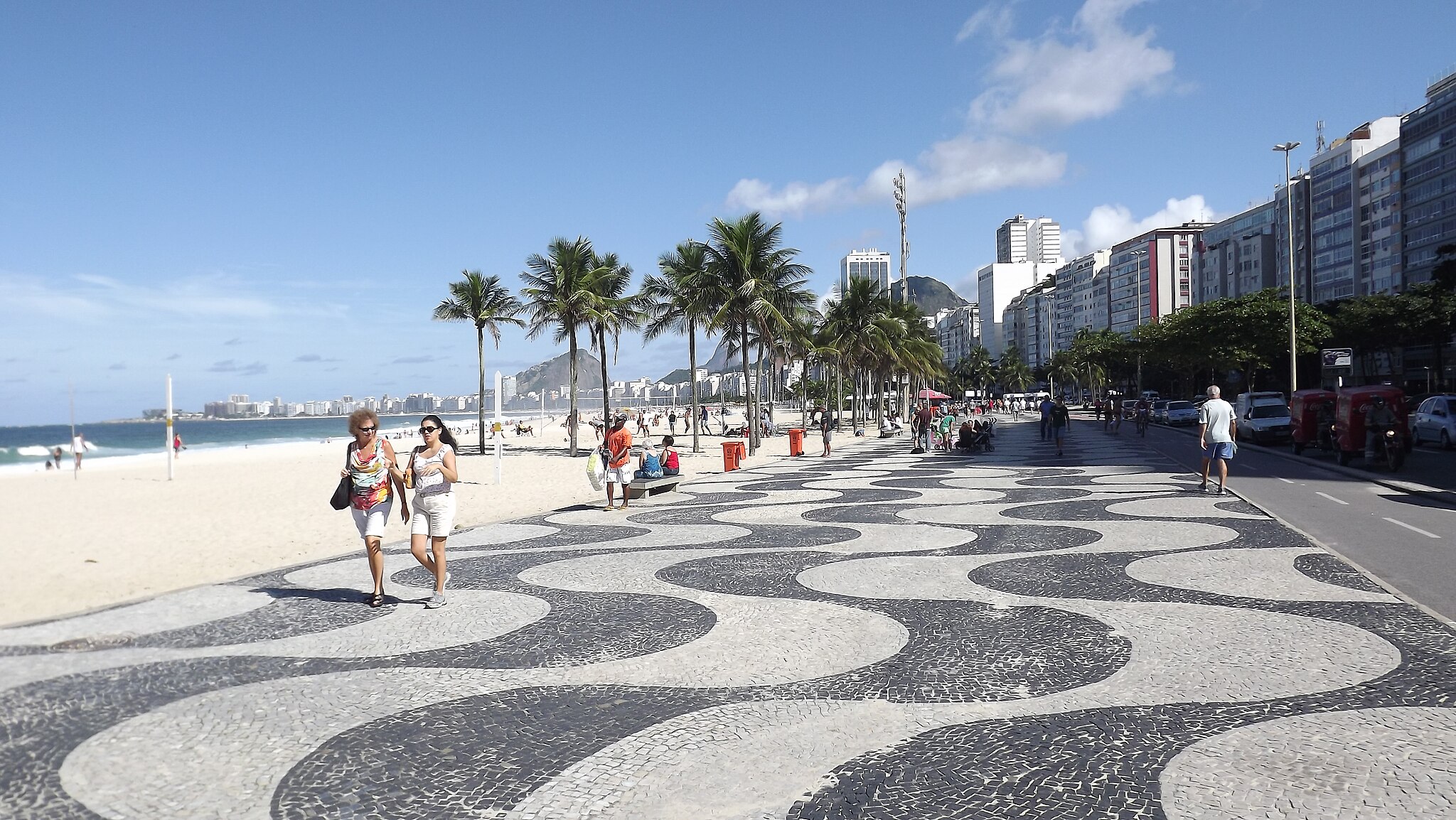
Burle Marx's solution was a scale-shifting wave pattern running the entire four kilometers, executed in the Portuguese black-basalt-and-white-limestone mosaic tradition. The design's formal innovation: the wave's amplitude, wavelength, and orientation shift continuously along the beach, so that no specific 50-meter stretch repeats any other. Some sections have tight dense waves; others have long slow swells; the pattern near the Copacabana Palace runs at a different scale than the pattern at Posto 6 near the Fort. A visitor walking from Leme to the Forte experiences a single continuous design that is nonetheless different under your feet every few steps.
The Calçadão — Burle Marx's 1970 wave design. The pattern shifts in amplitude and scale across the 4 km length; no 50-meter stretch repeats any other exactly.· CC BY-SA 3.0
The paving is hand-laid. Each stone — the individual black-basalt cobbles and white-limestone cobbles are each roughly 5 cm across — is placed by hand by a team of Portuguese-tradition paviours called calceteiros. Rio's Prefeitura maintains a permanent team of approximately 40 calceteiros whose full- time job is Calçadão maintenance: lifted stones are reset, cracked stones replaced, entire sections occasionally rebuilt after heavy storm damage or subsurface work. The craft is disappearing in Portugal itself; Rio is one of the last places in the world where it is still practiced at scale.
Calçadão detail. Each stone is roughly 5 cm across; the black cobbles are basalt, the white are limestone. The pattern is hand-laid and hand-maintained by a permanent municipal team of paviours (calceteiros).· Jorge Láscar · CC BY 2.0
The Calçadão is now the single most-recognizable single image of Copacabana in global visual culture — more so than the hotel, more so than the arc of the beach itself. It appears in every wedding photo, every tourism campaign, every film shot on location at the beach. Its status is unusual among public-works-era designs: most 1970 municipal-landscape commissions of comparable ambition have been partially or fully reconstructed. The Calçadão is exactly as Burle Marx specified it, fifty-five years later.
· Cultural Ubiquity
How a Rio de Janeiro beach became the beach in the world's imagination
The global Copacabana — the one most non-Brazilians carry in their heads — is an assembly of six specific cultural artifacts, produced between 1923 and 1978, most of them outside Rio. The real Copacabana and the imagined Copacabana are different things. Both are interesting.
1 · The Copacabana Palace, 1923
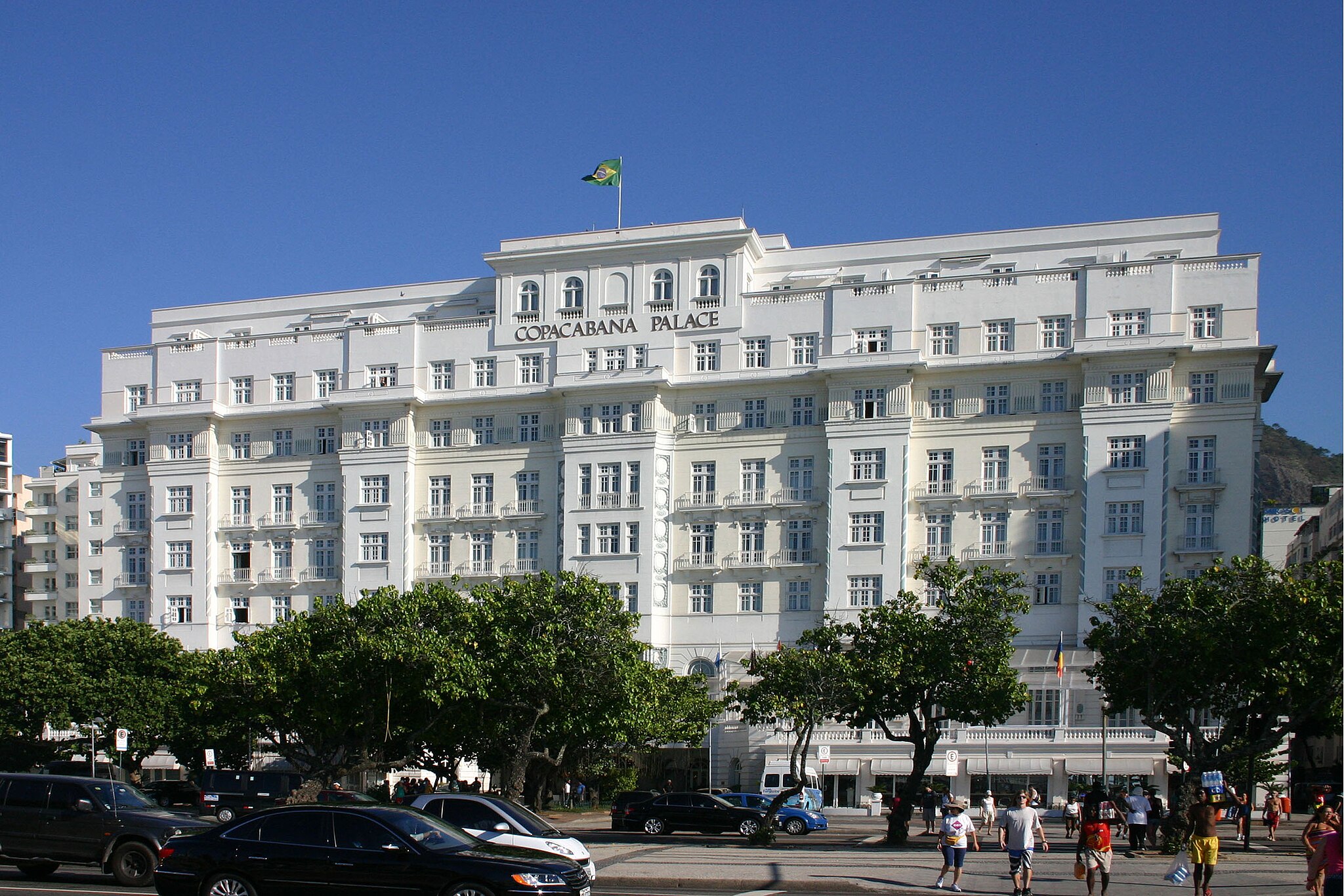
The Copacabana Palace Hotel opened on 13 August 1923 as Rio's first attempt at a European-standard luxury hotel. Architect Joseph Gire(French, also designed the Glória Hotel) produced a Beaux-Arts white-stone building aimed at attracting European royalty and the trans-Atlantic steamship tourist class to Rio. It worked. The hotel's guest list through the 1920s and 30s included Edward and Mrs Simpson, Orson Welles, Errol Flynn, Marlene Dietrich, Ava Gardner, and effectively every interwar Hollywood figure passing through South America. By 1935 the hotel had become synonymous with the beach behind it. The brand "Copacabana" — in any language, in any medium — traces largely to this one hotel.
The Copacabana Palace — opened 1923, still operating as a Belmond luxury hotel. The white Beaux-Arts building that defined the beach's global brand.· CC BY-SA 3.0
2 · Flying Down to Rio, 1933
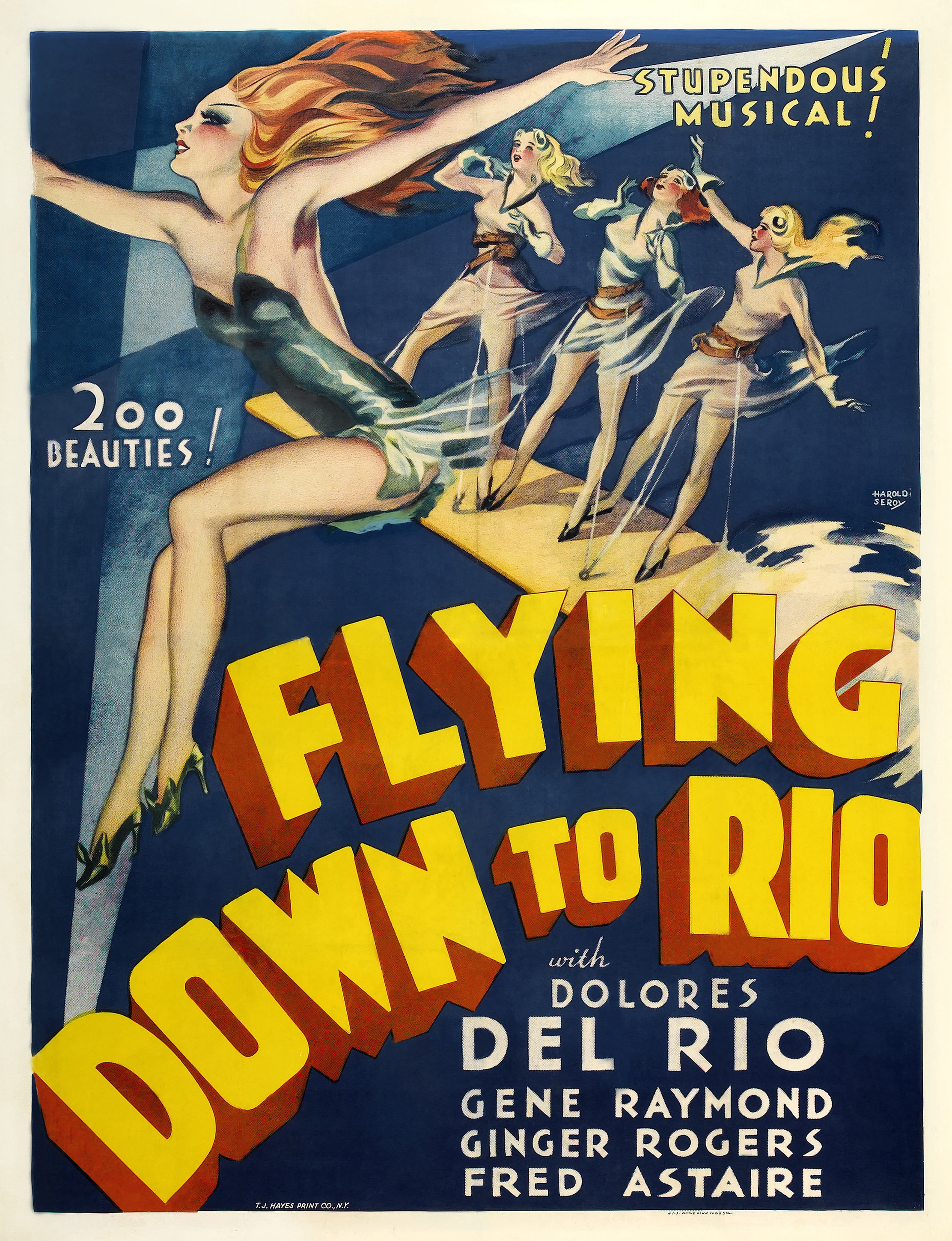
RKO Pictures's 1933 musical Flying Down to Rio — Fred Astaire and Ginger Rogers's first screen pairing — was a major Hollywood hit whose climactic "Carioca" number featured dancers on an airplane wing "flying down to Rio." The film was not shot on location; virtually all of it was filmed at RKO's Hollywood studio with painted backdrops and model airplanes. The film's image of Rio — glamorous, aerial, sun-soaked, faintly absurd — was effectively invented for the American audience. It was the single most-viewed film about Rio for an entire generation. When mid-century Americans said "Rio" or "Copacabana," they often meant what they had seen in Flying Down to Rio; what they were imagining was a Hollywood set.
1933. Flying Down to Rio poster. The film was a Hollywood product end-to-end; the Rio it showed was painted-backdrop Rio. Its influence on the global imagination of Copacabana nonetheless exceeded most actual Rio productions of the era.· Public domain
3 · The Copacabana Nightclub, Manhattan, 1940
In November 1940, a nightclub opened at 10 East 60th Street in Manhattan under the name Copacabana. It had no institutional connection to the Rio beach of the same name; the name was chosen by promoter Monte Proser because it evoked tropical-exotic glamour in the American imagination. The club became one of the key New York nightclubs of the 1940s–60s, hosting Frank Sinatra, Dean Martin, Sammy Davis Jr., and the early American careers of Brazilian performers including Carmen Miranda. Its decor — Brazilian-tropical-pastiche — bore no more resemblance to actual Rio than Flying Down to Rio had; but it was wildly successful, and it exported the word "Copacabana" into American colloquial English as a synonym for "tropical nightclub." This exportation is the root cause of the next artifact's confusion.
4 · "Copacabana (At the Copa)," Barry Manilow, 1978
Barry Manilow's 1978 single Copacabana (At the Copa) — written with Jack Feldman and Bruce Sussman — is, after fifty years, among the most-recognized Copa-associated cultural artifacts globally. The song is specifically about the Manhattan nightclub, not the Rio beach. Its narrative — Lola, the showgirl; Tony, the bartender; Rico, who shot Tony — is set explicitly "at the Copa" on "the hottest spot north of Havana," which is to say: Manhattan at 60th Street. The confusion is nonetheless widespread. Large numbers of non-Brazilian listeners assume the song is about the Rio beach; significant travel-marketing material leans on the ambiguity. Manilow himself has repeatedly clarified — in interviews and in the 1985 TV-film adaptation — that the song is New York, not Rio. The clarifications have not overcome the lyric's memetic momentum. "At the Copa, Copacabana" is, for most of the world, a Rio lyric that is not actually a Rio lyric.
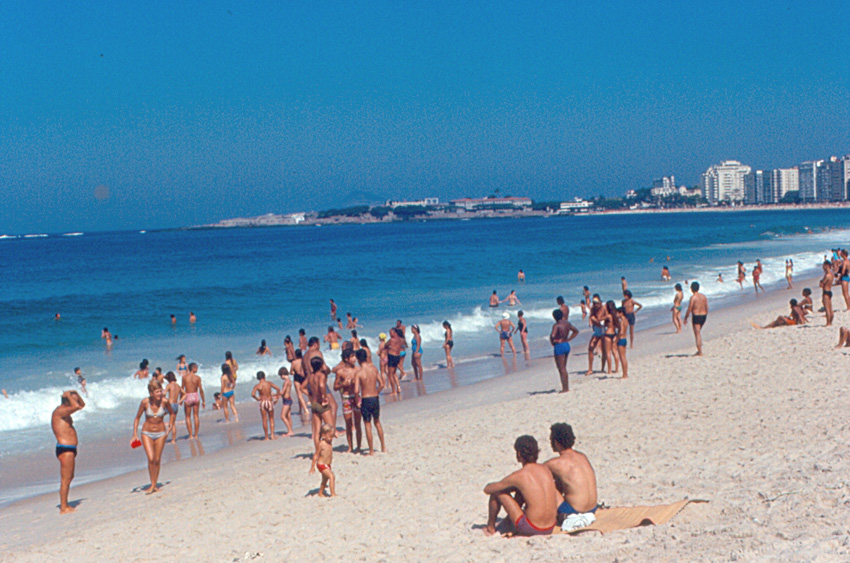
1971. Copacabana in 1971, one year after the Calçadão redesign. The new promenade is visible; the beach is at its modern width. The cultural-ubiquity machinery that built the global Copa brand — the Palace, Flying Down to Rio, the Manhattan nightclub — was by this point already in place.· CC BY-SA 2.0
5 · The 1962 Girl from Ipanema and the bossa nova era
The only cultural artifact on this list that is genuinely Rio, genuinely of the period, and genuinely about the beach-neighborhood culture is the bossa nova movement of 1958–63. The music — Antônio Carlos Jobim, João Gilberto, Vinícius de Moraes, Astrud Gilberto — was composed, rehearsed, and performed in the bars and clubs of Copacabana and Ipanema: the Bottles' Alley (Beco das Garrafas), the Veloso (now the Garota de Ipanema), the Zum-Zum, the Little Club. The 1962 Jobim / de Moraes composition Garota de Ipanema (Girl from Ipanema) was written about a specific teenage girl walking past the Veloso bar on her way to the beach, and the beach in question is genuinely the Rio beach. The 1964 Getz / Gilberto album carried the music globally. Bossa nova is Copa's only genuinely domestic contribution to its own global image.
6 · The modern megaevents — 2013 onward
The final layer of the Copa global image is twenty-first- century: the Rio 2016 Olympic beach volleyball finals at Copacabana, the 2013 Pope Francis World Youth Day Mass drawing 3.7 million, the annual Réveillon NYE now Guinness-certified, Madonna's 2024 concert (1.6 million), Lady Gaga's 2025 concert (2.1 million). The 21st-century Copa identity is as the global mass-event venue — a beach that can reliably host 2–4 million people in a single night, which almost no other beach on Earth can. This modern layer is distinct from the mid-century Hollywood / nightclub / Manilow layer. It is Rio doing Rio at scale, not Rio imported through American pastiche.
· The Postos
Six numbered lifeguard stations, six social zones
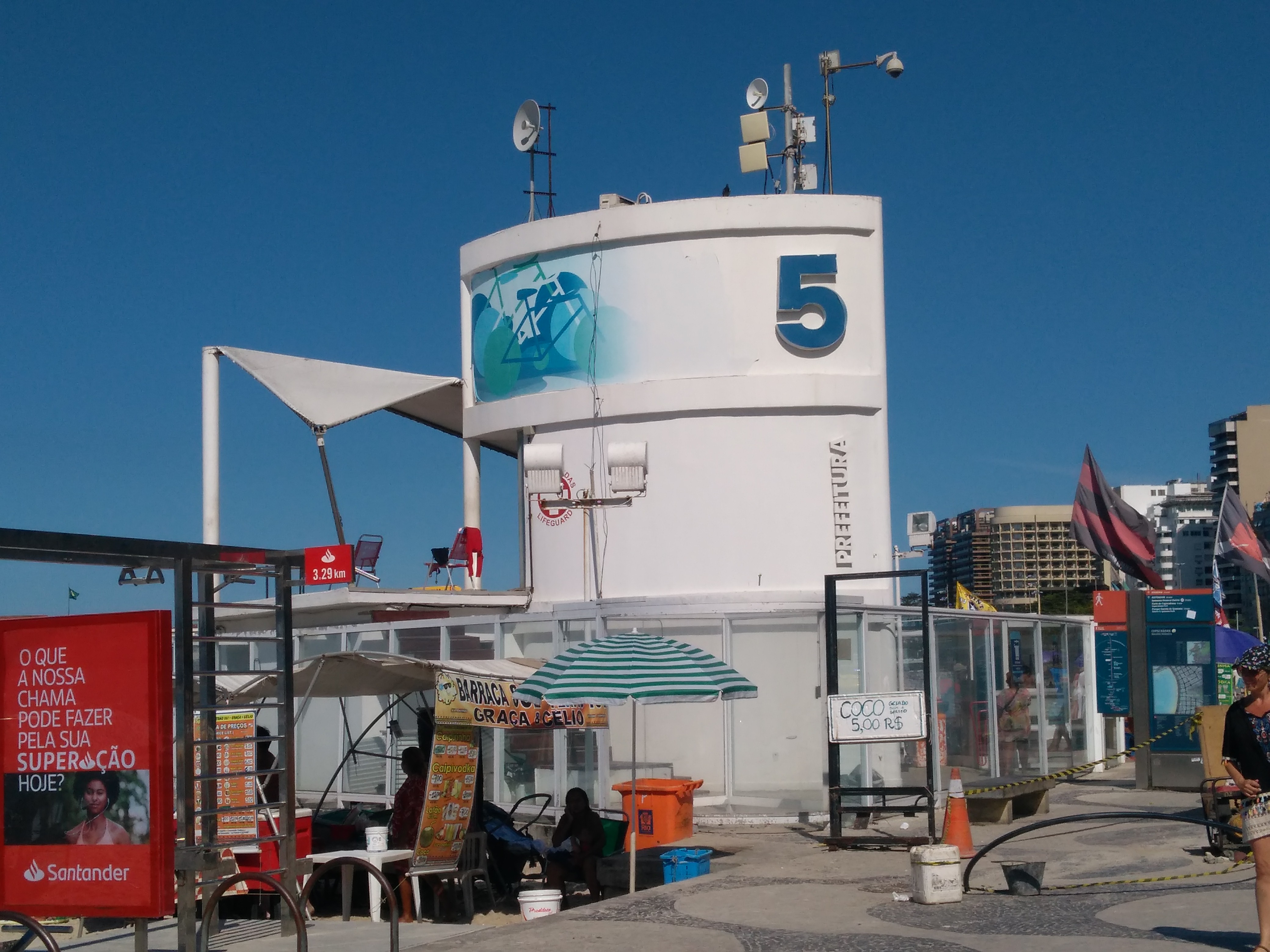
Cariocas navigate Copacabana by its lifeguard-station numbers. 'Meet me at Posto 2' means something specific. So does Posto 6. The numbers are not just geographic — they are demographic.
The Copacabana arc — Leme at the far right (Posto 1), the Forte de Copacabana at the far left (past Posto 6). Four kilometers end-to-end. The postos are numbered along the curve.· Adam Jones · CC BY-SA 3.0
posto-1
Posto 1 — Leme
The quieter end. Closest to the Leme headland and the Morro do Leme forest reserve. Fishermen work the rocks at dawn; families come here to escape the central beach's density.
Best for
swimming with kids, dawn walks, reading
posto-2
Posto 2
The default tourist posto. Wide beach, well-staffed lifeguard station, vendors working the towel-lines with biscoito Globo and mate gelado. If you only read one sentence of a guidebook, you end up here.
Best for
first-time visitors, straightforward beach day
posto-3
Posto 3
Sportier. The beach volleyball and futevolei nets cluster here, and the regulars — some of them playing together for thirty years — claim them by convention. Watching is as much the point as playing.
Best for
beach volleyball, futevolei, watching
Local note
Nets are technically first-come-first-served, but good luck.
posto-4
Posto 4
Mixed, political, progressive in atmosphere. Some Carioca gay culture lives here (though Ipanema's Farme de Amoedo stretch, further south, is the documented hub). Sunday afternoons bring the loudest, most diverse crowd on the arc.
Best for
socializing, Sundays, inclusive crowd
Local note
Local gay scene is split across Copa's Posto 4 and Ipanema's Farme de Amoedo / Posto 8-9.
posto-5
Posto 5
Transition zone. Some of the strongest-mixing kiosks on the arc cluster here — good for late-afternoon drinks as the light falls onto the mountains behind the city.
Best for
sunset drinks, mixed crowd, evening
posto-6
Posto 6 — Fort end
Surfers and fishermen. At dawn, the colônia de pescadores beach wooden boats right here; runners from nearby restaurants buy mackerel and corvina on the sand. The break is Copa's best surf — inconsistent, occasionally excellent. Closest posto to the Fort.
Best for
surfing, sunrise, watching fishermen
Local note
Commercial fishing has coexisted with the urban beach here for a century.
A Posto sign — the concrete lifeguard station numbers are the Cariocas' reference grid for the beach. Every locals' meetup on Copa references a posto number.· Eugenio Hansen, OFS · CC BY-SA 2.0
· A Day Here
Five a.m. fishermen to three a.m. kiosks — how the beach breathes
Posto 6 at dawn — the colônia de pescadores (fishing colony) still pulls nets here, a hundred meters from luxury condominium lobbies. One of Rio's last working urban fishing communities.· Laudelinojunior · CC BY-SA 4.0
Dawn
The fishermen at Posto 6 have already been at work for hours. At first light, small wooden boats come in onto the sand near the Fort and their catch—mackerel, corvina, sometimes a shark's head left on the beach to dry—is sold on the spot to runners from the nearby restaurants. Runners and swimmers show up in that same hour; the surfers paddle out as soon as they can see. The sand is cool. The city is quiet in a way it is at no other time.
Midday
By 11 a.m. the beach is dense. The numbered kiosks are cranking caipirinhas on demand. Vendors move between the towels calling out 'biscoito Globo, mate gelado, acarajé, cerveja estupidamente gelada'—stupidly cold beer. Beach volleyball nets at Posto 3 are claimed by the regulars who have played together for twenty years; foreigners who join get politely destroyed. Sand is 60°C (140°F). Children run; adults don't.
Golden
The 5 p.m. to 7 p.m. golden hour is when Cariocas arrive after work. Capoeira circles form spontaneously near Posto 5—berimbau first, then the roda, then the kicking. The light falls onto the mountains behind the city; the white buildings of Avenida Atlântica turn peach and then gold. Caipirinha kiosks rebalance for evening crowd. At Arpoador, around the corner to the west, tourists applaud the sunset; Cariocas find that funny.
Night
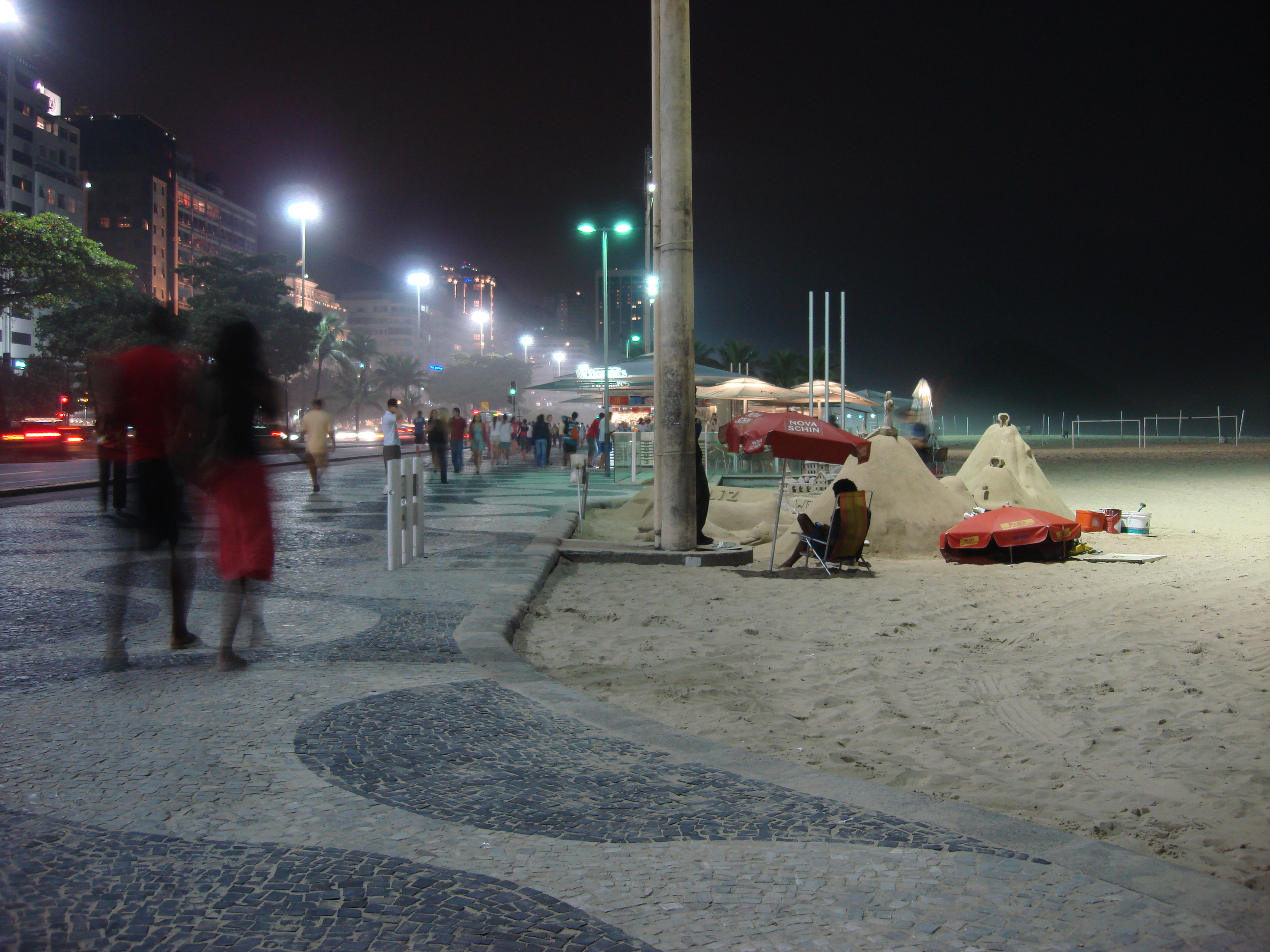
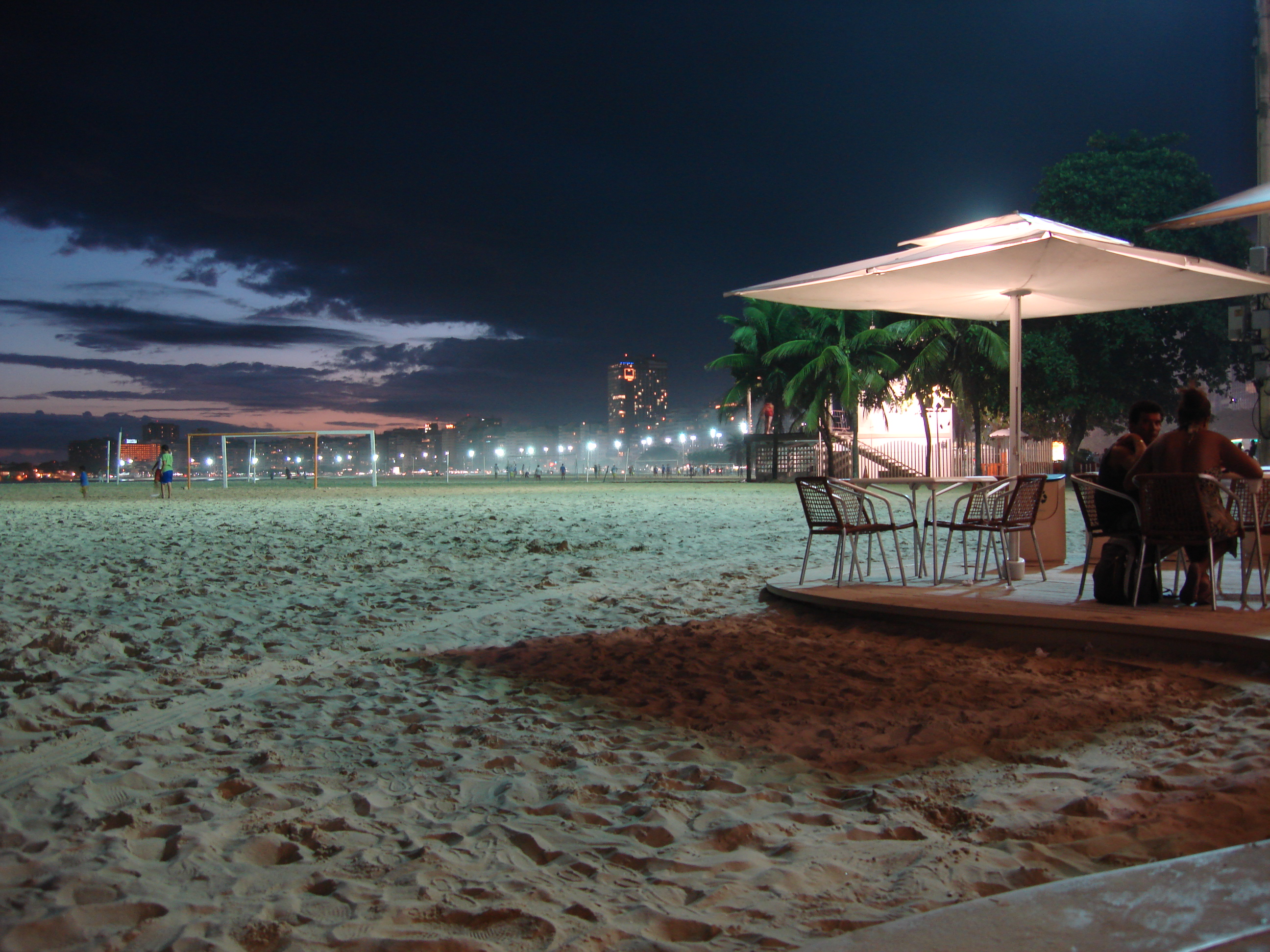
The promenade fills with walkers, runners, dog-walkers, couples, kids on skateboards. Lighted beach soccer matches run at all six postos. The Copacabana Palace glows; Pergula's pool-side tables are full. Inland one block, Cervantes's line is out the door for sandwiches. At the Fort, the café lights are off but the museum is quiet. Walkers in the sand carry their shoes and stay ankle-deep in the warm shore break. The city behind the beach never really stops.
· What the Beach Is For
Kiosks, football, beach volleyball, Olympic sand
Beyond the postcard, Copacabana is a working piece of Rio infrastructure — a free outdoor living room, a sports venue, a food-and-drink strip, a stage. What Cariocas do here on an ordinary Tuesday is different from what the tourist day-trippers do on a Saturday, and both layers are genuine.
The kiosks
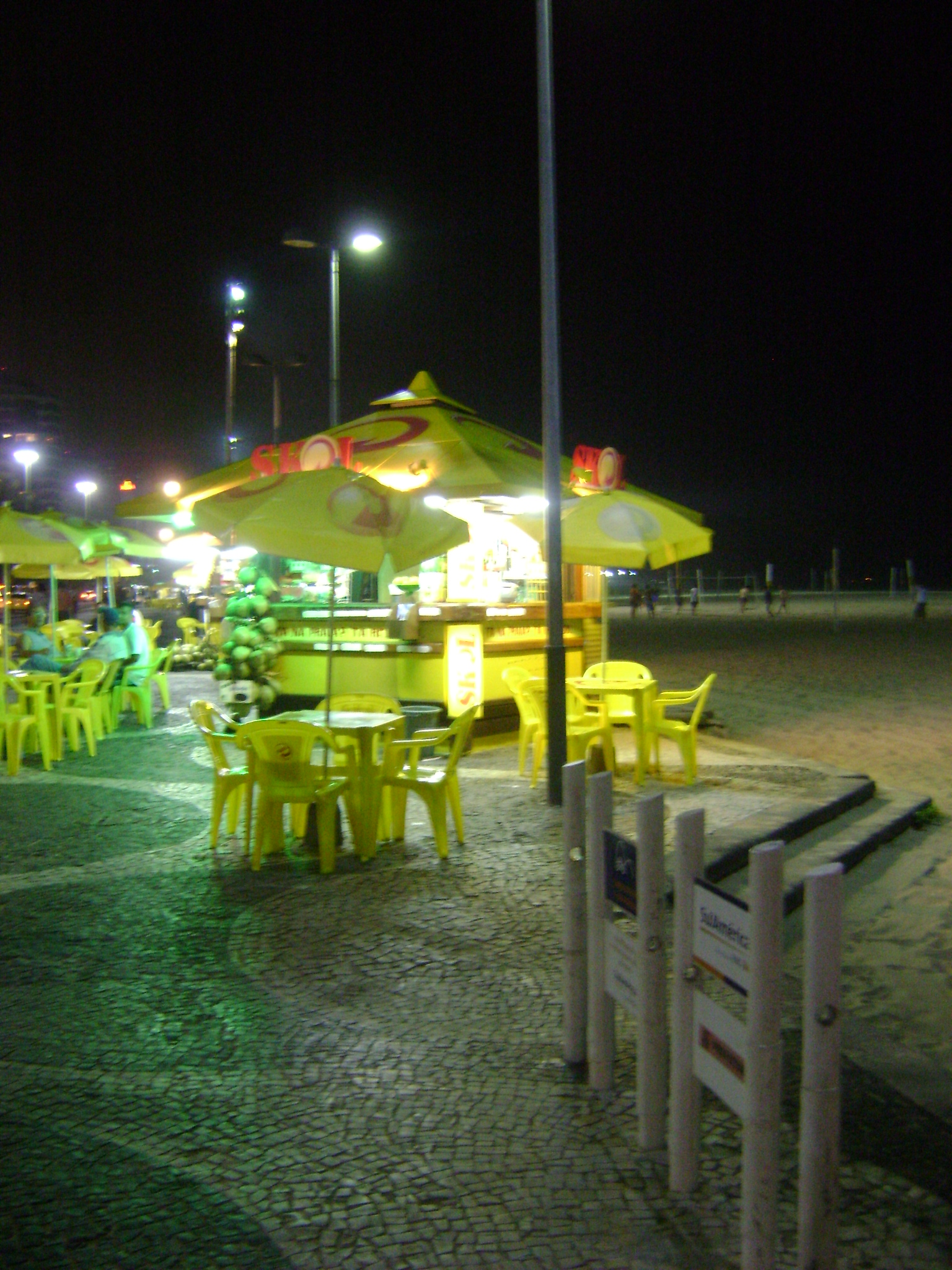
Along the Avenida Atlântica side of the Calçadão, at intervals of roughly 100 meters, are the quiosques — small permanent beach kiosks running fresh coconut water, beer (Brahma or Antarctica, R$8–12 a bottle), caipirinhas (R$15–25), simple grilled food, and a handful of tables and chairs. They have been a feature of the beach since the 1970s and are regulated and licensed by the Prefeitura. In the 2010s the Prefeitura ran a redesign program to replace the old wooden kiosks with modern uniform kiosks; the redesign was controversial — Cariocas preferred the mismatched informal aesthetic — and later modifications have softened the uniformity. Approximately 60 kiosks operate along the 4 km of Copacabana; they are the beach's default social infrastructure.
A Copacabana kiosk. The ~60 quiosques along the 4 km strip are the beach's social infrastructure — beer, caipirinha, coconut water, grilled food, chairs and tables facing the sand.· CC BY-SA 3.0
Beach football and the Brazilian rhythm
Copa has had permanent beach-football facilities since the 1970s. In the evening hours — 5 p.m. through roughly 9 p.m. — the beach's sand-court zone near Posto 2 fills with pickup and organized football. Altinho (the keep-the-ball-in-the-air circle game using all body parts except hands) is the canonical Copa football discipline and is played in informal groups all along the beach on any weekend afternoon. Beach soccer (ordinary football, but on sand, with modified rules) has international-league competition hosted periodically at Copa; the Brazilian national beach-soccer team has won more FIFA Beach Soccer World Cups than any other country and most of its senior players trained at Copa or Ipanema.
Beach soccer at night under the floodlights. The Copa football culture runs evening hours most days of the year, peaking in summer.· Jorge Láscar · CC BY 2.0
Olympic sand
The Rio 2016 Olympics hosted the beach volleyball tournament at Copacabana in a temporary 10,000-seat stadium built on the sand between Posto 2 and Posto 3. The stadium was dismantled after the Games but the beach-volleyball culture it catalyzed has persisted. Permanent beach-volleyball courts are set up year-round on the sand; Brazilian beach-volleyball pairs are traditionally among the world's strongest, and many senior pairs train here in the off-season. A visitor can watch pickup or semi-competitive beach volleyball at Copa most weekend afternoons for free.
Aug 2016. The Olympic beach-volleyball stadium at Copacabana during the 2016 Games. The 10,000-seat temporary structure on the sand between Posto 2 and Posto 3. The stadium came down; the culture of beach volleyball at Copa persisted.· CC BY 3.0
· History
From a tunnel in 1892 to a Guinness certificate in 2025
Seven dates that made Copa Copa, in order. Each is a subdivision, continuation, or inflection of the beach the others built.
1892 · Jul · infrastructure
Túnel Velho opens
The Old Tunnel is drilled through the granite between Botafogo and Copacabana, physically connecting the isolated cove to central Rio for the first time. Tramway follows two years later.
The 239-room Art Deco hotel designed by French architect Joseph Gire opens on 13 August, commissioned by president Epitácio Pessoa to lure European royalty. It becomes the social axis of the beach.
Fred Astaire and Ginger Rogers's first film together sets scenes at the Copacabana Palace. A year later, the New York nightclub Copacabana takes the name, borrowing the beach's glamour for 56th Street.
Jobim and Vinícius write 'The Girl from Ipanema' at the Veloso bar (now Garota de Ipanema), in the neighboring bairro. Copa and Ipanema become twin capitals of a single sound.
A massive land-reclamation project dredges offshore sand and roughly doubles Copacabana's width. Simultaneously Roberto Burle Marx REDESIGNS the existing 1930s-origin wave promenade, running the Portuguese-pavement pattern 4 km continuously along the new Av. Atlântica, no section identical to another.
Pope Francis celebrates a closing Mass at Copacabana; attendance estimates reach 3.7 million — one of the largest single gatherings the beach has ever held.
Lady Gaga's free Copacabana concert in May 2025 draws an estimated 2.1 million — Copacabana's current record for a single paid-free musical act.
· In the Culture
Three layers, sixty years
Bossa nova — 1958–1964
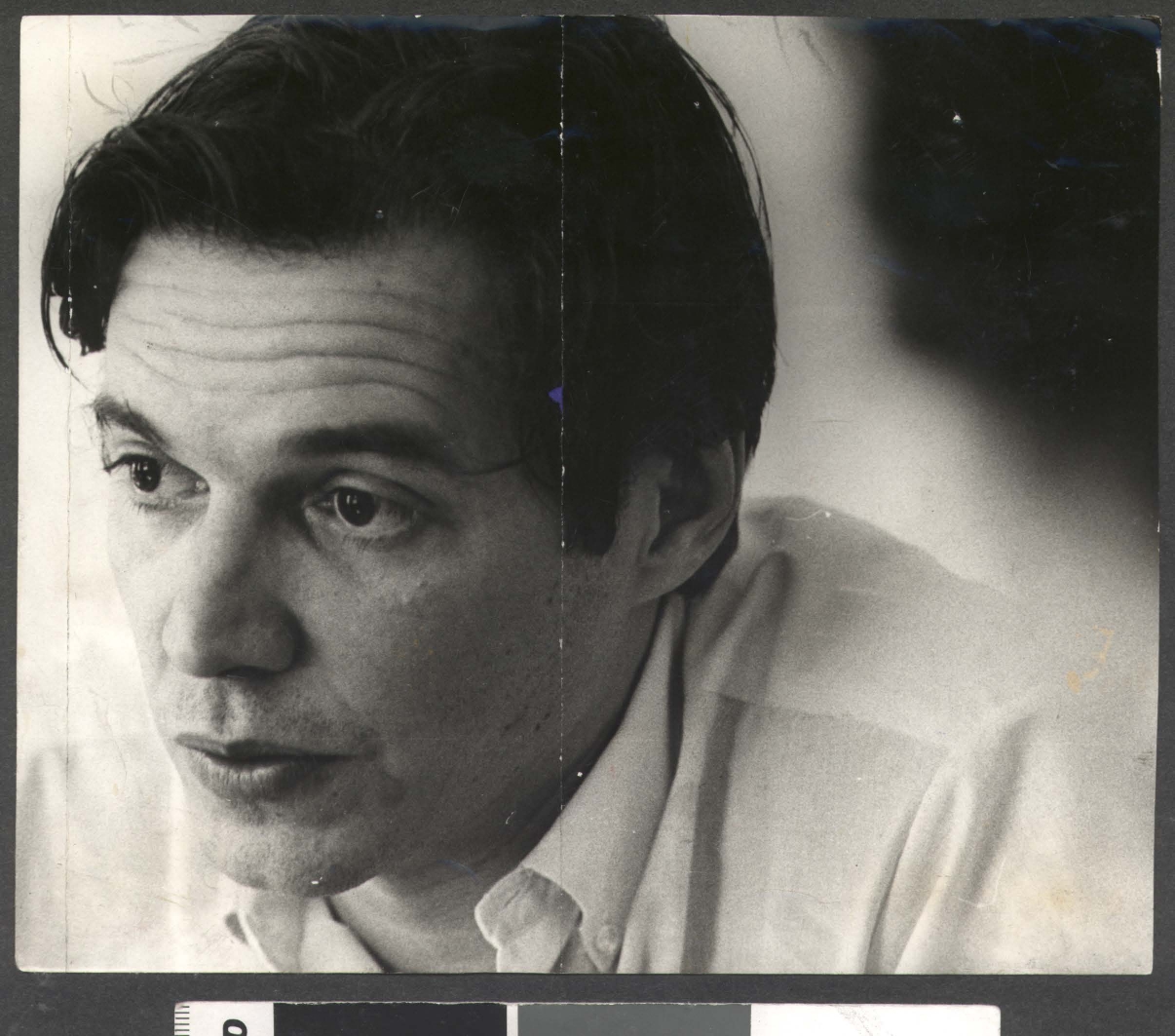
The bossa nova era is Copa's most enduring homegrown cultural export. Between 1958 (the Chega de Saudade album) and 1964 (the Getz/Gilbertoalbum), a small community of Rio musicians invented — in the apartments, bars, and small-capacity clubs of the Copacabana-and-Ipanema neighborhoods — a fundamentally new Brazilian popular-music form. Antônio Carlos Jobim, João Gilberto, Vinícius de Moraes, and Astrud Gilberto are the canonical names; Carlos Lyra, Roberto Menescal, Nara Leão, and Baden Powell were the inner circle. The 1962 Jobim / de Moraes composition Garota de Ipanema (Girl from Ipanema) is now the second most-recorded song in popular-music history after "Yesterday."
Antônio Carlos Jobim. The Copa-Ipanema bossa nova scene is Copacabana's single most durable cultural export — a musical form invented in a specific neighborhood over a specific 6-year window.· Public domain
Stefan Zweig — Brazil: A Land of the Future (1941)
The Austrian writer Stefan Zweig, having fled Nazi Europe, settled in Petrópolis near Rio in 1940 and published Brazil: A Land of the Future in 1941 — a book-length affectionate portrait of the country including a long chapter on Rio and Copacabana. Zweig's portrait is almost uncritically enthusiastic about Brazil's racial mixing, its informal democracy, its future potential — qualities he saw in stark contrast to the Europe he had just escaped. The book was translated widely and shaped a generation of European intellectual opinion about Brazil, and specifically about Rio's beach culture, as an aspirational-cosmopolitan alternative to fascist Europe. Zweig died by suicide in February 1942, seven months after the book's publication; his Petrópolis house is now the Stefan Zweig House Museum. The book and the author's death together became a particular kind of cultural footnote in Rio's mid-century European image.
Réveillon and the twenty-first-century mass events
Copa's modern cultural identity is as the world's premier mass-event venue. The Réveillon — New Year's Eve — is the template. Cariocas have gathered at Copa on 31 December in large numbers since at least the 1940s; the practice of wearing white was borrowed from the Candomblé religion (offerings to Yemanjá, the orixá of the sea) in the mid- 20th century; the fireworks on barges offshore became a municipal feature in the 1980s. Modern Réveillon attendance figures: 2.5 million in 2015, 3 million in 2024. Guinness World Records formally certified the 2025 Réveillon as the world's largest NYE celebration in December 2025.
The Réveillon has proven to be a template for other Copa mega-events: Pope Francis's 2013 World Youth Day Mass drew 3.7 million; the 2016 Olympic beach volleyball finals filled a 10,000-seat stadium every night for two weeks; Madonna's December 2024 free concert drew 1.6 million; Lady Gaga's May 2025 free concert drew 2.1 million. The pattern is consistent: Copa is the beach that can absorb a 1–3 million-person audience, feed them, host them, and return to normal by the next morning. Very few urban spaces on Earth have this logistical capacity; none is a beach.
Réveillon — New Year's Eve at Copacabana. 2 to 3 million people dressed in white. Fireworks on barges offshore. Yemanjá offerings pushed out into the surf at midnight. Guinness-certified in 2025 as the world's largest New Year's Eve celebration.· Porto Bay Hotels · CC BY 2.0
· The Hills Above
The inequality is the view
Luxury apartments facing the beach. Favela stairs climbing the hills behind them. The one contains the other in the same visual frame. This section is Copa's honest self- reckoning; the fuller treatment is in the Favela Above spoke.
The Mirante do Pavão-Pavãozinho — the public viewpoint at the top of the Plano Inclinado, looking down on Ipanema, Copa, Leme, and across to Sugarloaf. Most tourists never make it here.· CC BY-SA 3.0 de
The favelas of Cantagalo and Pavão-Pavãozinho rise directly behind Copacabana and Ipanema. Their houses are visible from the sand whenever you look up. That geographic adjacency — luxury apartments facing the beach, favela stairs rising behind them — is not a problem to be elided from a travel guide. The inequality is the view.
On 23 December 2009, Rio installed a Unidade de Polícia Pacificadora (UPP) covering Pavão-Pavãozinho, Cantagalo, and Vietnã. For several years the program was credited with real economic gains in the community — Pavão-Pavãozinho's unemployment reportedly dropped to 5% by mid-2012. Its decline after 2016, under Rio's fiscal crisis, is documented in Brazilian press. The operational state of the favelas fluctuates; the view from the beach does not.
There is also a specific way up. The Plano Inclinado do Morro Cantagalo — a free municipal inclined elevator, built alongside the Metro Rio expansion and opened in 2010 — runs from the General Osório metro station in Ipanema up into the favela. The ride is two minutes. At the top is the Mirante do Pavão-Pavãozinho, a public viewpoint that looks down on the entire Ipanema-Copacabana-Leme arc and across to Sugarloaf. Most tourists never make it here; the few who do generally say it's the best view in the South Zone, and it is.
The communities have their own long cultural lives — funk carioca's origin sites, working samba schools, restaurants, and a tradition of community tour cooperatives meaningfully different from the 'favela safari' tours residents have asked visitors to avoid. If you walk Copacabana and never look up at Cantagalo, you have seen half the beach.
· In the South Zone
Four places within thirty minutes
adjoining south
Ipanema & Leblon
The two beaches south of Copa — Ipanema's Arpoador rock is 1 km south of Posto 6; Leblon is another 1.5 km past that. Ipanema is the beach bossa nova was written about; Leblon is the residential wealthy Rio's beach. Together the three — Copa, Ipanema, Leblon — are Rio's continuous 8 km South Zone shoreline. Do all three in a day.
3 km east
Pão de Açúcar (Sugarloaf)
The 396-meter granite monolith at the mouth of Guanabara Bay. The cable-car ride (1912 original, still running as the Bondinho do Pão de Açúcar ) to the top is one of Rio's canonical non-beach experiences. Best at golden hour. 45 minutes total from Copa by bus.
8 km west (by road)
Cristo Redentor (Christ the Redeemer)
The 38-meter Art Deco statue atop Corcovado, 710 meters above Copa. Visible from the beach on most days. Reach by the cogwheel train from Cosme Velho (the historic route) or by van from Parque Lage. ~4 hours round-trip including travel. Best visited at sunrise to beat the afternoon clouds.
5 km west
Santa Teresa & Lapa
The two artsy hillside-and-downtown neighborhoods. Santa Teresa has the Bondinho tram, tiled artist studios, and views back toward Guanabara Bay. Lapa at the foot of the hill has the Escadaria Selarón tile staircase and the country's densest concentration of samba clubs — most nights of the week, from roughly 9 p.m. onward.
Written by Erin Rose. Calçadão technical detail follows the Instituto Moreira Salles photographic archive and the Prefeitura do Rio de Janeiro calceteiros program documentation. Bossa nova historical material from Ruy Castro's Chega de Saudade (Companhia das Letras, 1990) — the canonical Brazilian bossa nova history. Réveillon attendance figures from the Riotur / Prefeitura records and Guinness World Records certification (December 2025). UPP pacification material from the Instituto de Segurança Pública do Rio de Janeiro and contemporary Brazilian press coverage since 2009. Version v0.9. Corrections welcome, particularly from Cariocas on specific posto-culture detail and current-year kiosk operator changes.