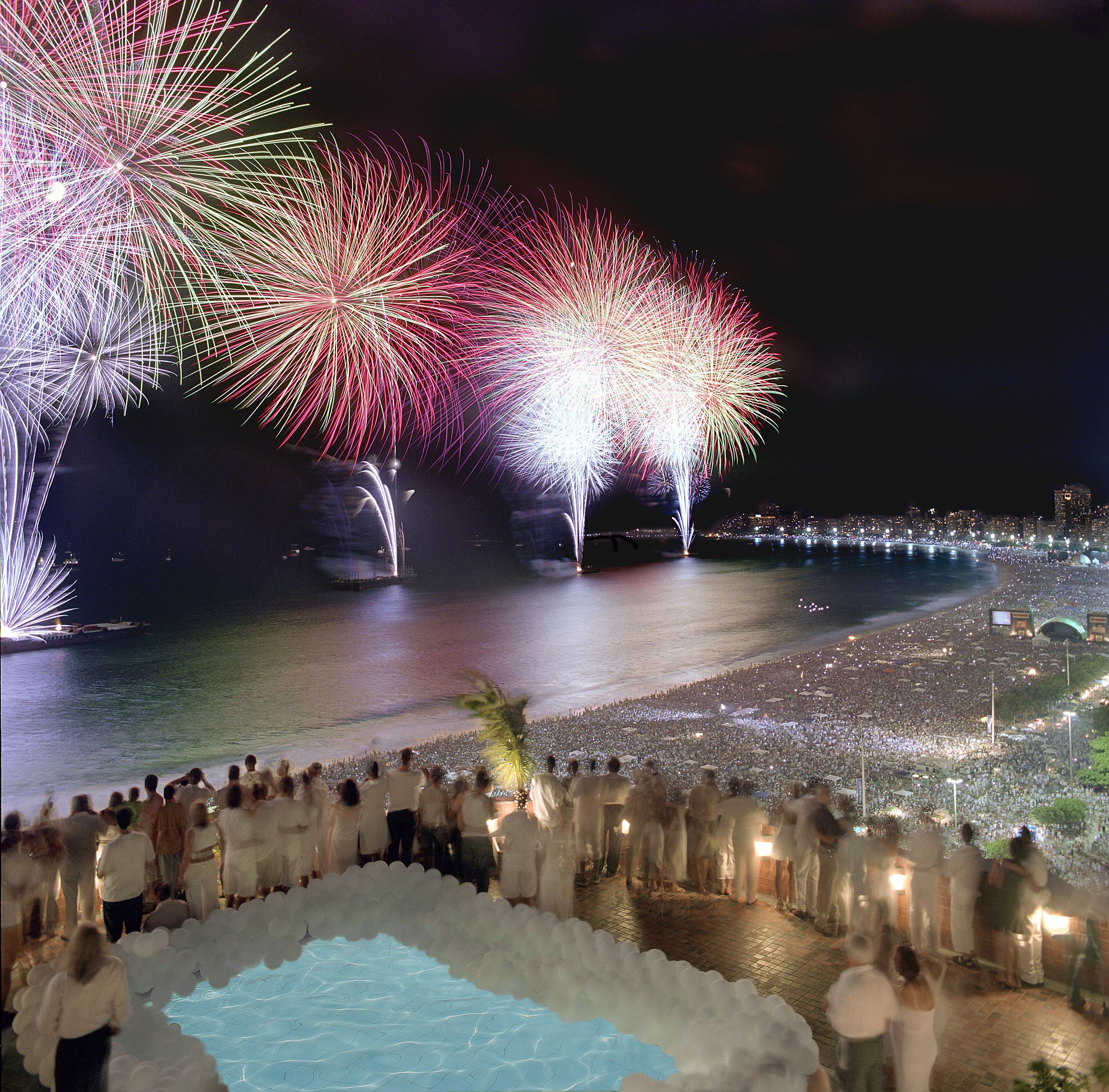
Réveillon — New Year's Eve fireworks on Copacabana

· Réveillon

The world's largest New Year's Eve

Three million people, 4 kilometers of sand, white clothes, fireworks on barges offshore, Candomblé offerings pushed into the surf at midnight, and a city that has organized its Réveillon for a century with genuine operational skill. If you are considering being here for 31 December, this page is the reason to and the how to.

Réveillon — New Year's Eve fireworks on Copacabana · Porto Bay Hotels · CC BY 2.0
· The Event

Guinness-certified, 2025

Attendance at Copa's Réveillon has grown over the last century from tens of thousands in the mid-20th century to 3 million on recent peak years. In December 2025, Guinness World Records formally certified the celebration as the world's largest New Year's Eve event.

The practice of gathering at the beach on 31 December goes back in Rio at least to the 1940s, when Carioca middle-class families would bring picnics to the sand and watch the midnight fireworks that some hotels ran off their rooftops. The scale began growing in the 1960s and 70s; by the 1980s the Prefeitura of Rio formalized the event by adding a municipal fireworks program on offshore barges, infrastructure for public toilets and water stations, and a beach-wide lighting plan that turned the event into a coordinated civic spectacle.

Modern Réveillon attendance figures are tracked by the Prefeitura's tourism agency Riotur: 2.5 million in 2015, 3 million in 2024, similar in the 2025 peak. The attendance spans the full Copa arc from Leme to the Forte plus substantial overflow along Ipanema and Leblon. Guinness World Records certified the 2025 event as the world's largest documented NYE celebration — ahead of Times Square, Sydney Harbor, and the London Embankment. The certification was the culmination of several years of Rio municipal lobbying and a painstaking attendance-methodology audit.

The fireworks

The Copa Réveillon fireworks are launched from 11 barges anchored approximately 400 meters offshore along the length of the beach. The show runs roughly 12 minutes starting at midnight, with 24 tonnes of pyrotechnics discharged in a choreographed program. The municipal investment runs roughly R$15–20 million annually. Scale-wise, it is comparable to the Sydney Harbour NYE fireworks; the immersion of the audience — standing on the beach within 400 meters of the barges, the sky filling the whole field of vision — is distinct.

· White Clothing and Yemanjá

The Candomblé tradition most visitors don't know they're participating in

If you look at any Copa Réveillon photograph, nearly everyone is dressed in white. This is not a tourist gimmick, a fashion choice, or a municipal dress code. It is a Candomblé tradition honoring Yemanjá, the Afro-Brazilian orixá of the sea. The practice enters mainstream Rio NYE through the Candomblé and Umbanda religious traditions, both of which have deep roots in Rio's Afro-Brazilian communities.

The specific ritual observed most visibly on the sand: practitioners bring offerings — white flowers (typically roses or lilies), perfume, small mirrors, rice, and occasionally full candle-lit wooden boats (barquinhos de Iemanjá) with small offerings inside — and at midnight push them out into the Atlantic. The prayer: if the offering returns to shore, Yemanjá has refused it; if the offering goes out to sea, it has been accepted and the prayer is granted. The three waves one is supposed to jump in sequence at midnight, each wave a wish, come from the same tradition.

The white clothing: white is Yemanjá's color. Wearing white on the beach at midnight is a visual invocation of her presence. Cariocas who are not themselves Candomblé practitioners still wear white on NYE because the tradition is fully absorbed into secular Rio practice. A visitor unfamiliar with Afro-Brazilian religion need not pretend to be a practitioner to participate respectfully; the baseline is simply to wear white, to not step on offerings being set out on the sand (they look like small flower arrangements and candles — don't kick them), and to understand that you are in the presence of a living religious tradition, not a municipal aesthetic choice.

Réveillon — New Year's Eve fireworks on Copacabana
Réveillon at Copa — white clothing, barge fireworks, and (not visible in this frame) Yemanjá offerings being pushed out into the surf at midnight. The religious tradition is absorbed into the civic event; both layers are present.· Porto Bay Hotels · CC BY 2.0
· How to Actually Be Here

The practical guide to surviving and enjoying 3 million people on a beach

Réveillon is one of the best mass events anywhere. It requires preparation. Below is the guide Cariocas pass to their first-time Réveillon visitors.

1

Book accommodation 4–6 months ahead

Hotel rates triple for the Réveillon week. Many Copa beachfront hotels require a minimum 4-night stay over 28 December–2 January. By November the inventory is 90%+ booked. Book by August if possible. If you miss that window, look to Ipanema or Botafogo where stock is more available and the walk to the event is still reasonable.

2

Wear white

As above. Any white clothes work — T-shirt and shorts are fine; dress-up is optional. Some Cariocas wear specific colors over the white for specific wishes (yellow for wealth, green for health, pink for love); most wear white only.

3

Arrive by 9 p.m., not 11:30

The beach's access streets close to vehicles at 6 p.m. The Metro runs until past midnight but gets overwhelming by 10:30 p.m. Arrive early, stake out your sand. Most Cariocas set up on the beach by 7–8 p.m. with drinks and food and stay through the fireworks.

4

Don't drive

All major access streets close to private vehicles on 31 December afternoon. Uber works but surge prices are extreme. Metro or walking from Ipanema / Leblon / Botafogo is the standard. Don't plan a post-midnight taxi; it won't work.

5

Hotel-rooftop alternatives

If 3 million people on the sand sounds like too much, most Copa hotel rooftops run ticketed Réveillon parties — the Copacabana Palace's rooftop dinner is the canonical one (R$4,000+ per person), Fairmont's and other hotels run R$800–2,000 parties. The view is identical to the beach's; the crowd density is 0.1% of it.

6

Keep your valuables minimal

A 3-million-person crowd attracts pickpocketing. Leave passport, credit cards, and anything non-essential at the hotel. Bring a phone (keep in a front pocket or zipped bag), a cash amount you can afford to lose, and the clothes you are in. Don't wear expensive jewelry.

7

Post-midnight: pace yourself

After the fireworks end (~12:12 a.m.), the beach doesn't clear — crowds stay through 2–3 a.m., many stay until sunrise. If you are planning to last until 3 a.m., don't drink heavily before midnight. If you are planning to sleep at 1 a.m., start moving toward your hotel at 12:20.

8

Sunrise on New Year's Day is the best-kept secret

Most Réveillon visitors leave the beach by 3 a.m. The sand from 5 to 7 a.m. on 1 January is strangely quiet, littered with the debris of the night before, and catches the first sunrise of the year over the Atlantic. If you can stay up or wake up early, this is the hour that rewards the trip. The first sun of the new year rising over a beach still dressed in white wreckage is a particular kind of Rio image.

· About this spoke

Written by Erin Rose. Attendance figures and municipal logistics from Riotur and Prefeitura do Rio de Janeiro public data. Guinness certification per the Guinness World Records database (December 2025). Candomblé / Yemanjá religious detail follows Reginaldo Prandi's Segredos Guardados (Companhia das Letras, 2005) and the Sala de São Paulo Afro-Brazilian music / culture archive. For current-year Réveillon schedule, verify with Riotur (visit.rio) before travel; specific logistics shift year-to-year. Corrections welcome, especially on Portuguese-language framings and on the named practices of Nazaré. Version v0.9.