CW

Grote Knip

Curacao Dushi (34800928041).jpg

CW

Grote Knip

Grote Knip beach takes its name from the Kenepa plantation, where Tula led Curaçao's largest slave revolt, roughly 2,000 people, on 17 August 1795.

Curacao Dushi (34800928041).jpg · <a rel="nofollow" class="external text" href="https://www.flickr.com/people/132646954@N02">dronepicr</a> · CC BY 2.0
Nearest airport
CUR · 28 km
I’m here for
Story

Grote Knip is a cove on Curaçao's west coast, in the Bandabou district between Westpunt and Lagún, about 35 km by road from Willemstad. The Dutch name is a corruption of the Papiamentu kenepa, the genip tree behind both the beach and the plantation it sits on. Locals also call it Playa Abou, "beach in a valley," for how it sits wedged between limestone rock. A strip of coral rubble separates the sand from open water and marks the start of a reef, making the beach a snorkeling entry point more than a swimming one.

The name comes from the Kenepa plantation that stood about a kilometer inland, and the plantation is why this coastline carries more than scenery. On 17 August 1795, an enslaved man named Tula refused to work and, with 40 to 50 others, walked to owner Caspar Lodewijk van Uytrecht's house to demand the freedom he said they were owed. The group moved on through the plantations of Lagún, Santa Cruz, Porto Marie, San Nicolas, Santa Martha, and San Juan, freeing enslaved people as it went, until it numbered roughly 2,000 — the largest slave revolt in Curaçao's history. Dutch colonial forces took more than a month to put it down. Tula was captured and executed by torture on 3 October 1795.

Landhuis Kenepa, the plantation house, still stands about a kilometer north of the beach. It runs today as a museum on Tula and the revolt; Dutch Wikipedia's most recent update records that it closed in 2021 and reopened in 2024. The story reached a wider audience through Tula: The Revolt, a 2013 Dutch-Curaçaoan film directed by Jeroen Leinders with Obi Abili as Tula, Danny Glover, and Jeroen Krabbé, which won the Grand Jury Prize at the 2013 London Film Awards and Best Film and Best Lead Actor at the 2014 San Diego Black Film Festival.

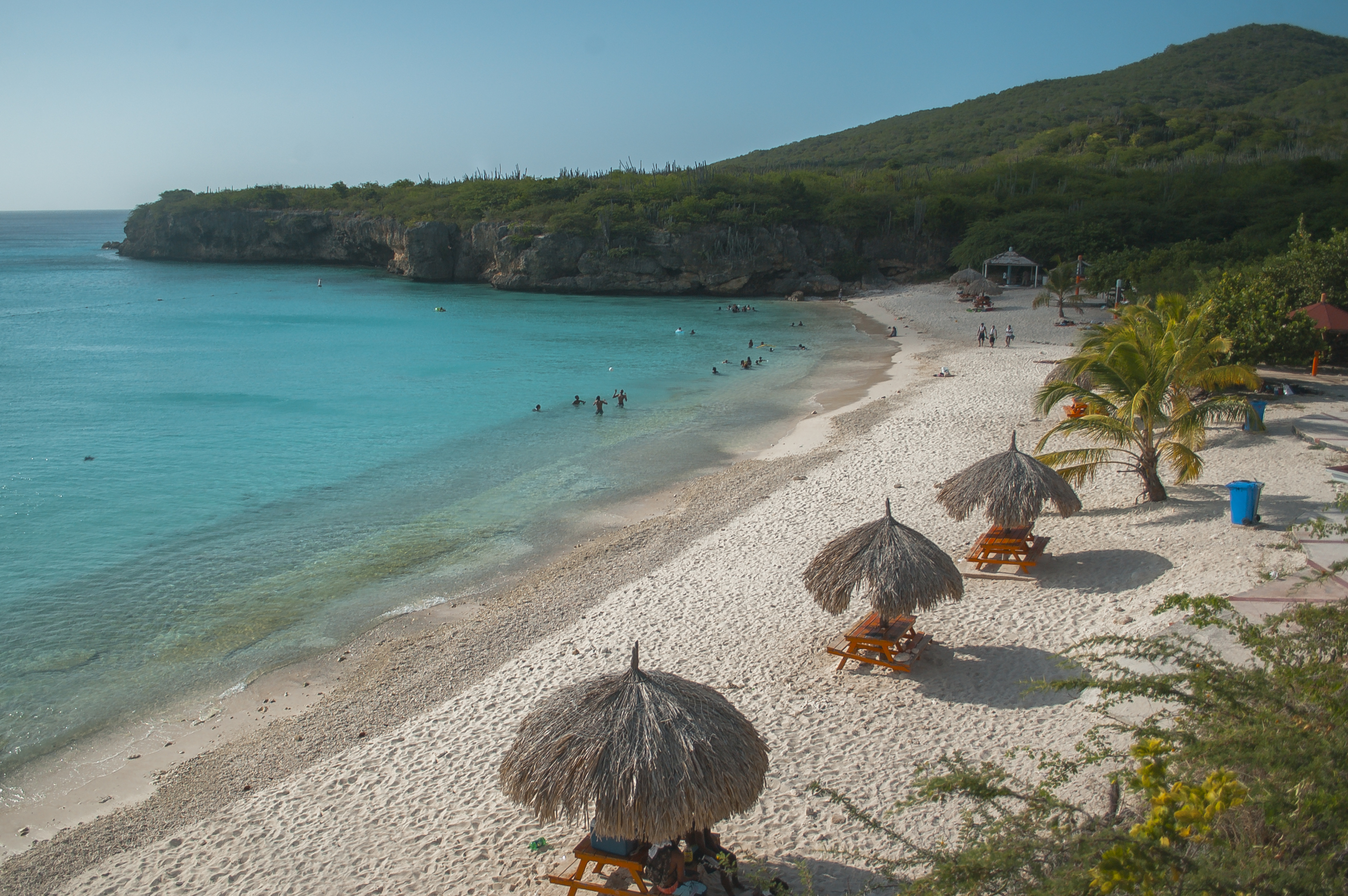
None of that shows on the sand. What's there is a white, coral-rubble beach under limestone bluffs, ringed with thatched palapas over picnic tables, rows of rental sun loungers and umbrellas, and a small red-roofed pavilion where snacks are sold intermittently; for a full meal or a grocery run, Westpunt village, a few kilometers north, is still the nearest real supply point. Open-Meteo's ERA5 marine reanalysis puts the average wave height at 1.21 m across 2023-2024, biggest in February and calmest in October, and the same dataset calls the water plainly: exposed, real surf, and a rip current to respect. Curaçao sits outside the Atlantic's main hurricane development region, and no hurricane has made direct landfall since NHC tracking began, though storms still pass near it.

The spike

Grote Knip beach takes its name from the Kenepa plantation, where Tula led Curaçao's largest slave revolt, roughly 2,000 people, on 17 August 1795.

Grote Knip is named for a tree, and the tree is not really the point. Kenepa is the Papiamentu word for the genip, whose fruit gave its name to the Kenepa plantation, and Kenepa plantation gave its Dutch spelling, Knip, to the beach in front of it. That chain, fruit tree to plantation to beach, is the entire naming history the tourism copy usually tells. What it leaves out is that Kenepa plantation is also where, on 17 August 1795, the largest slave revolt in Curaçao's history began.

What happened at Kenepa. On that date an enslaved man named Tula refused to report for work. He was not alone: 40 to 50 fellow enslaved people joined him, and together they walked to the house of the plantation's owner, Caspar Lodewijk van Uytrecht, to press a demand for the freedom they said they were owed. That confrontation did not stay contained to one plantation. The group moved on through Lagún, Santa Cruz, Porto Marie, San Nicolas, Santa Martha, and San Juan, freeing enslaved people at each stop, until the uprising numbered roughly 2,000 people, a substantial fraction of an island whose entire population, free and enslaved combined, was a fraction of today's 156,000. Dutch colonial forces spent more than a month suppressing it. Tula was eventually captured, and on 3 October 1795 he was executed by torture.

Why the beach carries the name at all. Beaches in Curaçao are conventionally named for the plantation, village, or landmark nearest to them, and Grote Knip is no exception; the word "Grote," Dutch for "big" or "great," distinguishes it from Kleine Knip, the smaller cove just south. That naming convention is what puts a tourist beach and a colonial-era plantation revolt in the same two words. It is not a metaphor or a marketing choice. It is a literal geographic fact that the sand people photograph for its turquoise water sits in front of the estate where roughly 2,000 people rose up against their own enslavement.

What's left of the plantation today. Landhuis Kenepa, the plantation's great house, still stands about a kilometer inland from the beach. It functions today as a museum devoted to Tula and the revolt, though even that thread has not run continuously. The most recent update to the Dutch-language Wikipedia entry for the beach records that the museum closed in 2021 and reopened in 2024, meaning that for roughly three years the one site that actually tells this history in detail was not open to the public at all, while the beach in front of it kept drawing rental-car tourists uninterrupted.

The version that reached wider audiences. The revolt got a bigger platform in 2013, when Dutch director Jeroen Leinders released Tula: The Revolt, a $4 million Dutch-Curaçaoan production with Obi Abili in the title role alongside Danny Glover and Jeroen Krabbé. The film won the Grand Jury Prize at the 2013 London Film Awards and took Best Film and Best Lead Actor honors at the 2014 San Diego Black Film Festival. It is, by a wide margin, the most internationally visible retelling of what happened at Kenepa, more visible, arguably, than the museum on the actual site, which most beach visitors will never see because it sits a kilometer inland and unmarked from the sand.

A monument elsewhere, not here. Curaçao does memorialize Tula, but not at this beach. A Tula monument stands on the island's south coast, geographically separate from Kenepa itself. That separation matters for anyone actually visiting Grote Knip: there is no plaque, no marker, and no signage at the beach connecting the white coral-rubble sand to the plantation revolt whose name it carries. A visitor who parks, swims, and leaves has no reason to learn any of this unless they already knew to look for it.

What the beach is, apart from its name. Set the history aside and Grote Knip is a functioning cove: a narrow strip of coral rubble separates the sand from open water and marks the start of a reef used for snorkeling, the water runs an average 1.21 meters of wave height across 2023-2024 per Open-Meteo's marine reanalysis, and the same dataset's own summary calls the water plainly "exposed, real surf, and rip current to respect." The beach itself carries thatched palapas over picnic tables, rows of rental loungers and umbrellas, and a small pavilion with intermittent snack vending, though a full meal still means the drive to Westpunt. None of that description requires knowing anything about Tula. But the name does, and the name is not incidental. It is the same word, unchanged, that named the plantation where a defining act of resistance in Dutch colonial history took place. Grote Knip's postcard version and its documented history occupy the same coastline; only one of them is usually mentioned.

Grote Knip Curacao (34800917861).jpg
Culture

Where it shows up

Film
  • Tula: The Revolt · 2013
    Jeroen Leinders

    A Dutch-Curaçaoan historical drama on Tula and the 1795 revolt, starring Obi Abili as Tula with Danny Glover and Jeroen Krabbé; won the Grand Jury Prize at the 2013 London Film Awards and Best Film and Best Lead Actor at the 2014 San Diego Black Film Festival.

History
  • The 1795 Curaçao slave revolt · 1795

    The largest slave revolt in Curaçao's history, beginning at the Kenepa plantation behind Grote Knip beach and growing to roughly 2,000 participants before being suppressed after more than a month.

Brand & advertising
  • Curaçao liqueur

    The island's namesake orange liqueur, distilled from the peel of the laraha citrus that adapted to Curaçao's dry climate; Lucas Bols claims a 17th-century origin for the style, while Senior & Co.'s Chobolobo estate makes a separate, competing claim to be the only producer still using native Curaçao laraha fruit.

Other
  • The Knip geological formation

    One of Curaçao's four named geological formations takes its name from this same stretch of coast, alongside the island's lava formation, Mid-Curaçao formation, and limestone formations.

Grote Knip (Curaçao).jpg
History

What happened here

  1. 1795conflict

    Tula's revolt begins at Kenepa

    On 17 August, an enslaved man named Tula and 40 to 50 others refuse to work and confront the Kenepa plantation's owner, Caspar Lodewijk van Uytrecht, launching what becomes Curaçao's largest slave revolt.

    Wikipedia →
  2. 1795conflict

    Revolt grows to roughly 2,000

    The uprising moves through the plantations of Lagún, Santa Cruz, Porto Marie, San Nicolas, Santa Martha, and San Juan, freeing enslaved people at each, until participants number around 2,000.

    Wikipedia →
  3. 1795conflict

    Tula executed

    Dutch colonial authorities capture Tula and execute him by torture on 3 October, more than a month after the revolt began at Kenepa.

    Wikipedia →
  4. 1947economy

    Senior & Co. establishes the Chobolobo distillery

    Senior & Co. buys the landhuis Chobolobo in Willemstad and continues distilling Curaçao liqueur there from native laraha fruit, the only producer still using the island's own citrus.

    Wikipedia →
  5. 2013cultural

    Tula: The Revolt premieres

    Director Jeroen Leinders releases a $4 million Dutch-Curaçaoan film dramatizing the 1795 revolt, with Obi Abili as Tula alongside Danny Glover and Jeroen Krabbé; it wins the Grand Jury Prize at the London Film Awards.

    Wikipedia →
  6. 2021policy

    Landhuis Kenepa museum closes

    The plantation-house museum devoted to Tula and the revolt, about a kilometer inland from the beach, closes.

    Wikipedia →
  7. 2024policy

    Museum reopens

    Landhuis Kenepa reopens as a museum, per the most recent update to the Dutch Wikipedia entry for the beach.

    Wikipedia →
  8. 2025policy

    Caribbean guilder replaces the Antillean guilder

    The Caribbean guilder (XCG) becomes legal tender across Curaçao on 31 March, pegged at 1.79 to the US dollar; the old Netherlands Antillean guilder stops being legal tender on 1 July 2025.

    Wikipedia →
The honest part
“The beach markets a turquoise cove; the plantation a kilometer inland is where roughly 2,000 people rose up to end their own enslavement.”

Grote Knip is sold, and photographed, as a turquoise cove; the coral-rubble sand and limestone walls are the whole pitch on tourism pages and travel photos. What that pitch leaves out is that the cove takes its name from a plantation where, on 17 August 1795, the largest slave revolt in Curaçao's history began, and where the enslaved people who joined it, eventually numbering roughly 2,000, were fighting for exactly the freedom the modern description of the beach never mentions. There is no marker at the beach itself. The museum that tells the story, Landhuis Kenepa, sits a kilometer inland and is easy for a day-tripper headed straight to the sand to skip entirely.

The economics compound the omission. Bandabou, the district that includes Westpunt, Lagún, and Knip, is described by Wikipedia in blunt terms: poor infrastructure and a lack of economic opportunities, even as its beaches, Grote Knip chief among them, draw the rental-car tourism Curaçao's economy increasingly depends on. Tula was executed by torture on 3 October 1795, six weeks after he walked off the Kenepa plantation. The beach that carries his plantation's name asks almost nothing of the people who sunbathe on it.

Grote Knip Kenepa Grandi Curacao (36561697451).jpg
Anatomy

The shape of the place

Landhuis Kenepa (plantation site)

0%

The plantation great house about a kilometer inland where Tula's 1795 revolt began; now a museum, closed 2021, reopened 2024.

Best for History

Not visible from the beach and unmarked from the sand; easy for a day-tripper to skip entirely.

Limestone bluffs

20%

The pale limestone rock walling the cove on its northern side, part of the geological formation that shares the Knip name.

Best for Photography, late-afternoon shade

The bluff itself falls into shadow before the open sand does, but the cove's westward opening keeps the sunset visible over the water.

Coral-rubble reef edge

45%

A narrow strip of broken coral rock separates the sand from open water and marks the start of a reef used for snorkeling.

Best for Snorkeling

Open-Meteo's wave data flags this stretch as exposed, with a rip current to respect.

The main sand cove

50%

The white coral-rubble sand at the center of the cove, wedged between limestone rock on both sides — the stretch shown in almost every photograph of Grote Knip.

Best for Sunbathing, the classic view

Thatched palapas over picnic tables and rows of rental loungers line the tree edge of this stretch; the open sand itself stays largely unshaded.

Landmarks

Landhuis Kenepa (Tula Museum)

plantation house / museum

The plantation great house about a kilometer inland from Grote Knip where Tula's 1795 revolt began; it operates as a museum on Tula and the revolt, closed in 2021 and reopened in 2024.

Wikipedia →

Kleine Knip

beach

A smaller cove immediately south of Grote Knip, also wedged between rocks, with parking directly beside the sand and documented sightings of sea turtles and manta rays.

Wikipedia →

Chobolobo · 1947

distillery

The Willemstad estate where Senior & Co. has distilled Curaçao liqueur from native laraha citrus since buying the property in 1947, about 35 km from the beach.

Wikipedia →
A day here

From first light to dark

Dawn

Early morning at Grote Knip is quiet before the rental-car crowd arrives from Willemstad, the water calmer than the afternoon's wind-driven chop, and the limestone walls on both sides of the cove still in shadow.

Midday

By midday the sun sits directly over the cove; the beach's thatched palapas offer patches of shade near the tree line, but most of the open sand stays exposed, and the onshore breeze that builds through late morning makes the water's exposed, real-surf character most obvious.

Golden hour

Grote Knip's cove opens west, so the sun sets directly over open water instead of dropping behind rock; the limestone bluffs flanking the cove fall into shadow first while the coral-rubble sand and bay keep the last of the light.

Night

After dark the palapas and pavilion sit empty and unlit, with no posted schedule; Westpunt village, a few kilometers north, is the nearest place with power and people once the beach itself goes fully dark.

Grote Knip Kenepa Grandi beach (34933031995).jpg
Sea & surf

What the water does

JFMAMJJASONDmetres (significant wave height)

Solid = typical monthly wave height; pale = the bigger days (90th pct). Offshore/regional swell from Open-Meteo Marine (ERA5 Ocean reanalysis, 2023–2024); a sheltered cove may sit calmer than this.

Exposed — real surf, and rip current to respect
Typical wave height
1.21 m
Biggest swell
Feb · 1.36 m
Calmest
Oct · 0.99 m
Typical period
6.5 s (wind chop)
Before you go

Things to know

Facilities are basic, not absent

Grote Knip has thatched palapas, rental loungers and umbrellas, and a small pavilion with intermittent snack vending, but nothing like a full supply point; the nearest is Westpunt village, several kilometers north.

Water is exposed, not sheltered

This site's beach dataset, derived from Open-Meteo wave statistics (2023-2024), labels this stretch "Exposed — real surf, and rip current to respect," with wave heights averaging 1.21 m and peaking near 1.78 m in February.

The history isn't on-site

Landhuis Kenepa, the plantation where Tula's 1795 revolt began, sits about a kilometer inland and operates as a museum (closed 2021, reopened 2024); nothing at the beach itself marks the connection.

Currency changed in 2025

Curaçao now uses the Caribbean guilder (XCG), pegged at 1.79 to the US dollar, after it replaced the Netherlands Antillean guilder on 31 March 2025; USD is still widely accepted.

Surf & rip

Powerful water — strongest around Feb, gentlest in Oct. Mind rip currents; this isn't a wade-in-anywhere beach.

Sharks

No incidents on record in the global shark-attack file.

Plan

If you go

Getting there
Nearest airport
Hato International Airport (CUR) · 28 km
Nearest town
Dorp Soto · 11 km

Grote Knip sits in the Bandabou district between Westpunt and Lagún, about 35 km by road from Willemstad — roughly 45 minutes to an hour's drive, most of it on the island's one main westbound road. It is 27.6 km in a straight line from Hato / Curaçao International Airport (CUR); the actual driving route through Willemstad runs considerably longer. Public buses from Willemstad (Otrobanda terminal) reach Westpunt but run infrequently — roughly every 1-2 hours — so a rental car is the practical way in.

When to go
  • Rainy-season lull · October through February, showers typically at night

    Wikivoyage describes Curaçao's rainy season as running October to February with showers mostly falling at night, so the beach itself is rarely rained out during daylight hours even in the wet season.

What to eat & drink
Keshi yena

A ball of Gouda or Edam cheese stuffed with spiced meat, believed to have originated among enslaved people in the Dutch West Indies repurposing leftover cheese rinds; it is a national dish of Curaçao and Aruba today.

Restaurants in Westpunt village and Willemstad; nothing is sold at the beach itself

Curaçao liqueur

An orange liqueur distilled from the dried peel of the laraha, a bitter citrus that adapted to the island's dry climate; Senior & Co. has distilled it at the Chobolobo estate since buying the property in 1947, using native laraha fruit.

Chobolobo distillery and bars island-wide, about 35 km from the beach

Westpunt village kiosks

The nearest food access to Grote Knip is a few kilometers north in Westpunt, population 738 as of the 2011 census; the beach itself has a small pavilion with intermittent snack vending plus rental chair and umbrella stands, but nothing like the range of a village kiosk.

Westpunt village, north of the beach

Sources & references
  1. Wikipedia: Tula (Curaçao) · cited 6×
  2. Wikipedia (Dutch): Grote Knip · cited 3×
  3. Wikipedia: Tula: The Revolt · cited 2×
  4. Wikipedia: Caribbean guilder · cited 2×
  5. Wikipedia: Curaçao (liqueur)
  6. Open-Meteo Marine (ERA5 Ocean reanalysis)
  7. Beach dataset (nearest_airport)
Colophon · Provenance

Where this page comes from

Geography, facilities
OpenStreetMap (ODbL) for geometry and facility tags within 500 m of the beach centroid. GeoNames for city/airport distances.
Climate & ocean
Open-Meteo ERA5 + Marine archive, 2014–2023 monthly normals.
Photography
Archival, original tone (Tier B — Wikimedia Commons). Each image licensed per its own terms; attribution visible inline.
History & culture
Every factual claim is linked to its source in the prose above. Wikipedia citations inline. Non-wiki sources named where relevant.
Editorial voice
Register: reverent. Written to pass a local's nod test; corrections welcome.
Written by Erin Rose
Last reviewed 2026-04-19
v0.9 — in editorial development toward v1.0