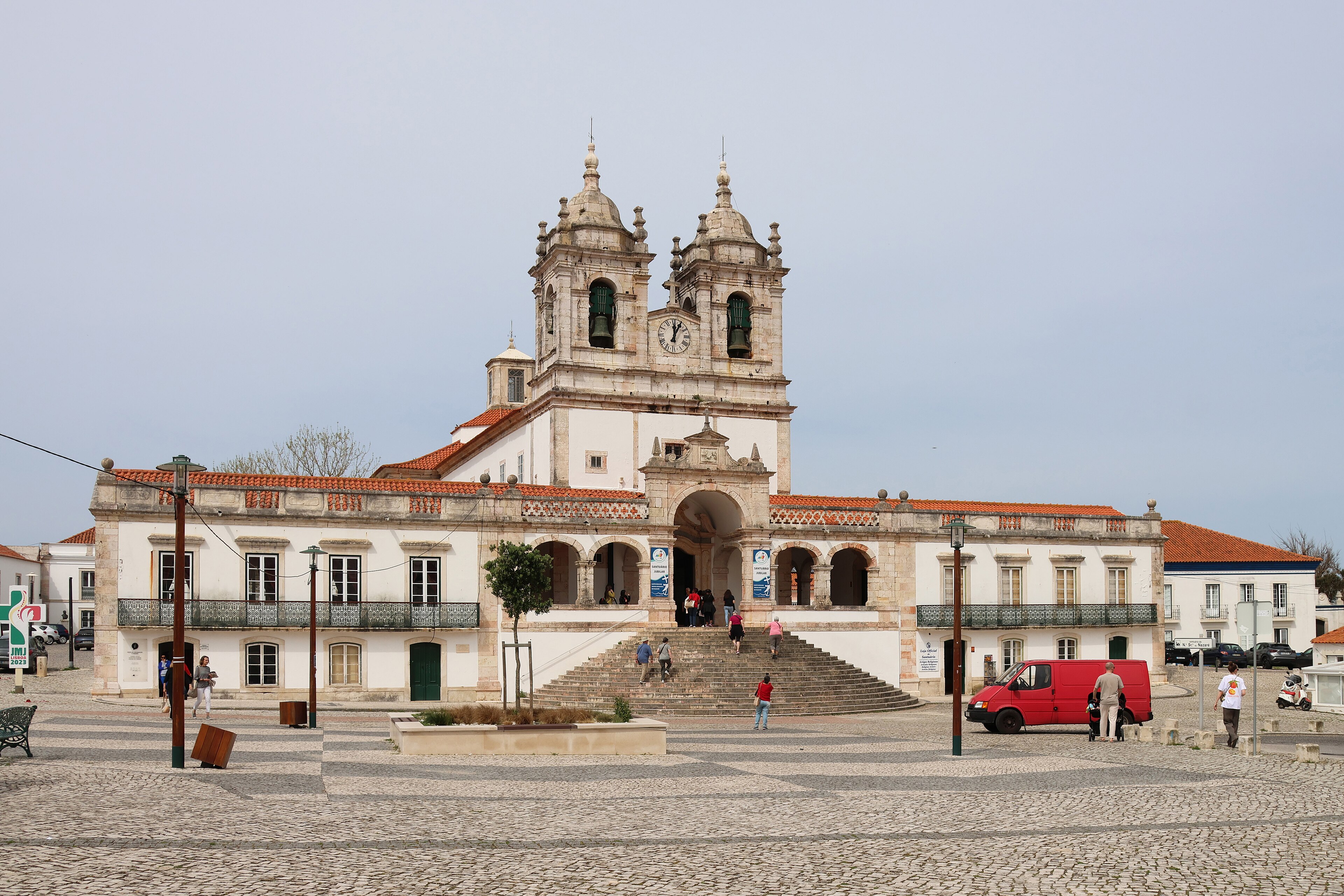
· The Sanctuary
The older story on the same clifftop
Eight hundred and twenty-nine years before Garrett McNamara rode the 2011 wave, a nobleman's horse stopped at the edge of this cliff. The chapel built on the spot is still here. The pilgrimage is still 100,000 people a year.
The horse that stopped at the edge
Every Portuguese schoolchild learns this story. It is the founding event of the town of Nazaré and the reason the clifftop of Sítio is a sacred site.
The Lenda da Nazaré is told in every Portuguese primary-school textbook, in the stained glass of the Santuário, and in the bronze relief carved into the wall of the small memorial chapel that stands on the exact spot where the events took place. In outline:
On a morning in September 1182, Dom Fuas Roupinho — the Portuguese nobleman who served as Alcaide-mor (military governor) of the nearby castle at Porto de Mós, and a member of the Order of the Knights Templar under Afonso Henriques, Portugal's first king — was hunting deer on the heath above the Sítio cliff. A heavy Atlantic fog rolled in. Following a deer into the mist, Dom Fuas's horse galloped at full speed toward what he did not know was the cliff edge.
At the moment when the horse's forelegs should have gone over the drop, it stopped. Dom Fuas, recognising that only divine intervention could have stopped a galloping horse at a cliff edge in fog, dismounted. Near the cliff's edge he found a small grotto containing an ancient wooden statue of the Virgin Mary nursing the infant Jesus — a Marian icon the local fishermen had been venerating quietly for some decades. Dom Fuas gave thanks and ordered the construction of a larger sanctuary on the spot. That sanctuary — rebuilt and expanded over nine centuries — is the Santuário de Nossa Senhora da Nazaré.
The story has the shape of a dozen medieval Iberian Marian legends — a nobleman, a mist, a horse, a miracle. It is also unusual in one respect: it names a specific historically verifiable person (Dom Fuas Roupinho of Porto de Mós, who is in the Portuguese military records of the 1170s), a specific date window, and a specific geographic spot that anyone can still visit. The little memorial chapel — the Ermida da Memória — is built directly over the grotto. The statue described in the legend is reported to be inside the Santuário's main altar, where it is displayed to pilgrims several times a year.
Whether the horse actually stopped at the cliff or the story was shaped later around an older local Marian cult is unprovable at this distance. What is provable is that by the 14th century the shrine was already one of the most-visited pilgrimage sites in Iberia, that the current Santuário building was consecrated in 1377 under King Ferdinand I, and that the pilgrimage every 8 September has been celebrated without interruption for at least seven hundred years.
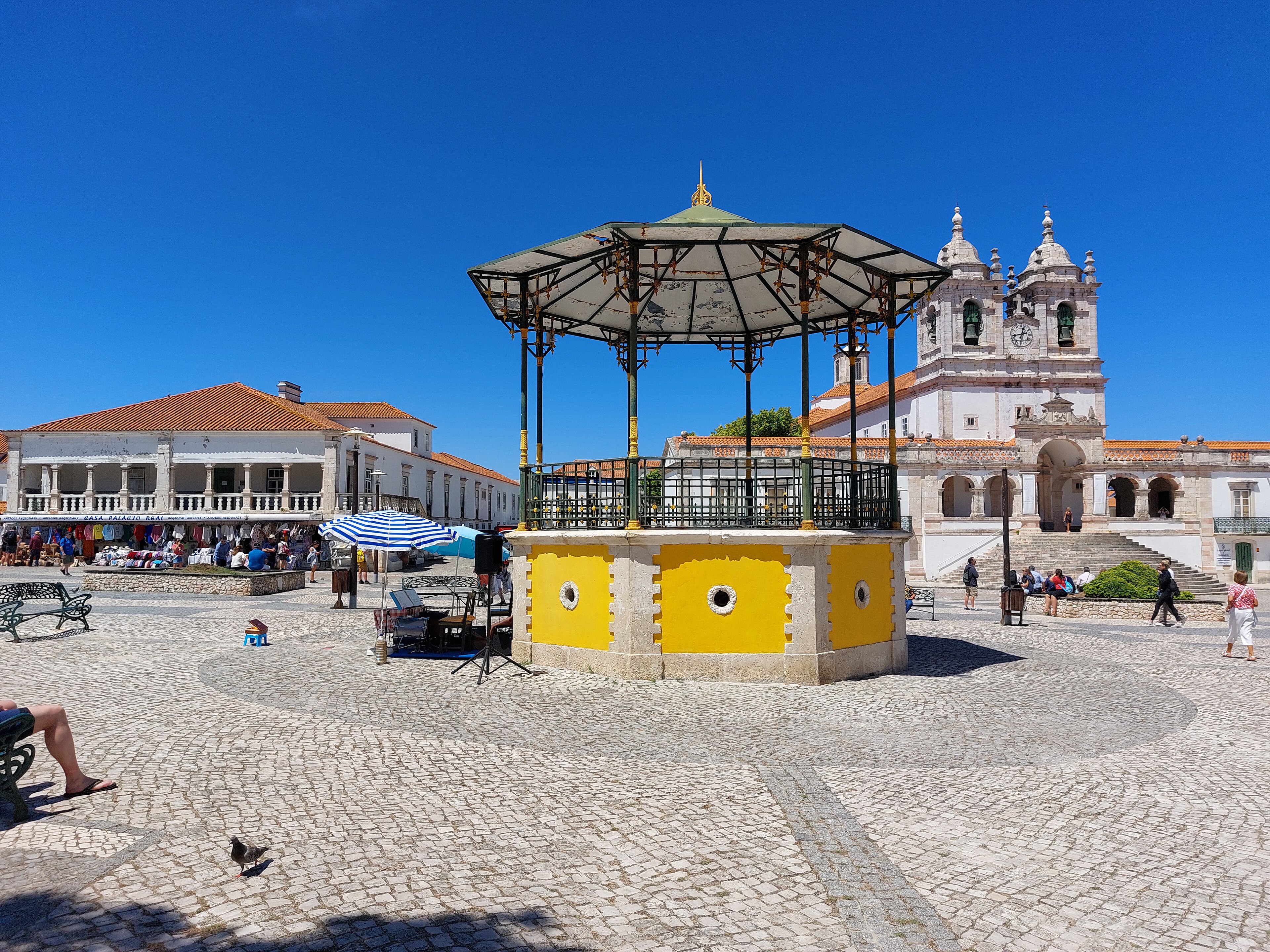
Santuário de Nossa Senhora da Nazaré
The church is the third building to stand on the spot. The statue inside is older than the church, the village, and possibly older than Portugal itself.
The building
The current Santuário was consecrated in 1377 under King Ferdinand I of Portugal, built on the site of an earlier 13th-century chapel that had itself replaced the original 12th-century structure from Dom Fuas Roupinho's time. The 1377 structure is the Gothic core. The building has been expanded and redecorated repeatedly since — the baroque gilt-work of the interior, the blue-and-white azulejos tile panels in the side chapels, the marble altar housing the statue — most of it dating to the 17th and 18th centuries. It is free to enter. A small attached museum, displaying ex-voto offerings from nine centuries of pilgrims — hand-carved wax body parts, silver hearts, photographs, embroidered panels — costs €2.
The statue
The Nossa Senhora da Nazaré is a small wooden carving of the Virgin nursing the infant Jesus, identified by local tradition as a 4th-century Byzantine icon. The tradition holds that the statue was brought to Iberia during the Muslim conquests of the 8th century by a Greek monk fleeing Constantinople. Academic Marian scholarship disagrees with the 4th-century dating — stylistic analysis places the carving more plausibly in the 12th or 13th century, contemporary with the building of the first chapel. But the sanctuary's official tradition is maintained, and the statue's age is not the point of its veneration.
The statue is not displayed continuously. It is kept in a niche above the main altar and is brought out several times a year for processions and on request for pilgrim groups. The two most important appearances are 8 September (the Marian feast day of the Nativity of Mary, which is the feast day the Santuário honors) and Easter Sunday.
Visiting the church
Daily Mass is said at 7 a.m., 10 a.m., and 6 p.m. (5 p.m. in winter); Sunday Mass at 8 a.m., 10 a.m., 11:30 a.m., and 6 p.m. The church is open to visitors outside Mass times. Modest dress is expected — covered shoulders, no shorts above the knee. Photography without flash is permitted in the nave; the altar area is typically restricted during services.
Ermida da Memória — the spot itself
A two-minute walk from the Santuário, along the cliff promenade toward the ocean, stands a small square building with a blue-and-white tile-work dome: the Ermida da Memória, the Memory Chapel. It is built directly over the grotto where, according to the Lenda, Dom Fuas Roupinho's horse stopped. Inside, on the wall opposite the entrance, a carved stone relief depicts the scene: the mist, the horse, the cliff edge, the rider frozen in astonishment.
The current Ermida is small, essentially a pilgrim's chapel rather than a church. It is the third structure on the site — the first was put up immediately after the miracle in 1182; the second, a larger stone chapel, was built by King Manuel I in 1517; the present building dates to 1758 and was redecorated in the 19th century. It is usually unlocked during daylight hours. The floor is covered in small ex-voto tiles left by pilgrims, each inscribed with a name and a year.
Standing in the Ermida and looking through the doorway you can see the cliff edge, the Atlantic beyond it, and — on big-wave days — the surfers in the water below. This is the one spot in Nazaré where the village's two narratives meet spatially: the 12th-century miracle chapel, and the 21st-century big-wave break, visible at the same time from the same doorway.
One hundred thousand pilgrims, one week
The Festas da Senhora da Nazaré is the annual Marian pilgrimage. It is one of the oldest continuously-celebrated Marian feasts in Iberia — older than the country that organizes it.
The feast day itself is 8 September — the Nativity of Mary in the Catholic liturgical calendar. The festival week runs from the Saturday before to the Sunday after. Attendance across the week approaches 100,000 people, which is comparable to the entire annual big-wave-season surf crowd but concentrated in seven days.
The structure of the week
- Saturday (opening): the statue is brought out of its niche above the main altar and placed in a processional float. Evening Mass. Fireworks over the Atlantic from the Forte headland.
- Sunday–Tuesday: daily pilgrim Masses, increasing in attendance. Folkloric performances in the square — traditional ranchos folclóricos from surrounding villages, each in regional dress. The village restaurants run extended hours; pilgrim-rate prices.
- Wednesday night: the procissão das velas — the candle procession. The statue travels from the Santuário down the cliffside path to the lower village at sunset, carried on a float accompanied by thousands of pilgrims holding candles. It is the most visually striking event of the week.
- 8 September (the feast day itself): pontifical Mass in the Santuário at 10 a.m.; the main procession at 4 p.m. traverses the Sítio streets with the Marian float, the village's ranchos, multiple Portuguese dioceses' pilgrim groups, and the diocesan brass bands.
- Closing Sunday: final pilgrim Mass; the statue is returned to the altar niche; the week ends with a final fireworks display after the evening Mass.
If you're coming for the Festas
Book accommodation four to six months ahead for the week of 8 September. Hotel rates triple. Parking in the village is impractical; take the bus from Lisbon or park outside and walk. Dress modestly for any Mass inside the Santuário. Do not photograph the statue during the processions without explicit permission from the diocese. Cover your head inside the church if you are a Catholic woman — locals take this seriously and will notice.
The Festas are a religious event. They are also, for this village, the single most important week of the year — more important than the peak big-wave day, than the WSL Tow Challenge, than the Carnaval. If you want to understand why Nazaré is the village it is, come here in September before you come here in February.
Reading Sítio as a sacred landscape
Most pilgrimage sites are a single building. Sítio is a landscape. Walking it in the right order is the pilgrimage.
A pilgrim arriving in the lower village — Praia — takes the 1889 funicular up to Sítio. The ascent is not incidental; the 120-meter vertical rise from the fishing port to the clifftop is the body's preparation for the liturgical geography that follows. Medieval pilgrims climbed the 175-step Capuchinhos stairway, and many still do.
From the top of the funicular the walk is short and the sequence is fixed:
- Santuário de Nossa Senhora da Nazaré — at the end of the long central square. The pilgrim enters, lights a candle, approaches the main altar, kneels, says the prayer they came to say. The statue is in its niche above the altar.
- The square itself — the Praça Sousa Oliveira — with the ex-voto museum attached to the Santuário. Here the pilgrim reads, in wax body parts and silver hearts and embroidered panels, the pains that brought other pilgrims here across nine centuries. This is not decoration; it is the village's collective medical history rendered as prayer.
- The walk to the Ermida da Memória — 400 meters along the cliff-edge promenade, the Atlantic visible throughout, the Forte de São Miguel Arcanjo visible in the distance. In winter the big-wave sets can be heard from this path.
- The Ermida itself — the pilgrim enters the small square building, faces the carved scene of the miracle, and looks out through the doorway to the cliff edge a few meters away. The view is the point. This is the spot.
- Return via the Miradouro do Sítio — the cliff-top belvedere with the best view along the coastline in either direction. The pilgrim's descent completes the visit.
Walked in reverse, or skipped, or treated as five separate tourist stops, the clifftop reads as a somewhat unusual small Portuguese town with a nice view. Walked in this sequence it reads as what it is: a landscape that has been worked liturgically for 900 years.
The rest of Nazaré
Nazaré (Praia do Norte) →
The canyon, the village, the wave — the full argument that this cluster sits inside.
Visiting Nazaré →
Getting there, where to stay, what to eat, visitor safety, itineraries.
Surfing Nazaré →
Forecasting, wetsuits, tow mechanics, records anthology, Jaws comparison.
Written by Erin Rose. Historical material on the Lenda, the Santuário's 1377 consecration, and the structural history of the Ermida follows the Portuguese ecclesiastical archives published in Rodrigues (2014) Nazaré: Santuário e Lenda. Dating of the Nossa Senhora statue reflects current academic consensus, which diverges from the sanctuary's own 4th-century tradition; both are reported. Mass times and festival program verified with the Santuário office for the 2026 calendar. Corrections welcome, especially on Portuguese-language framings and on the named practices of Nazaré. Version v0.9.