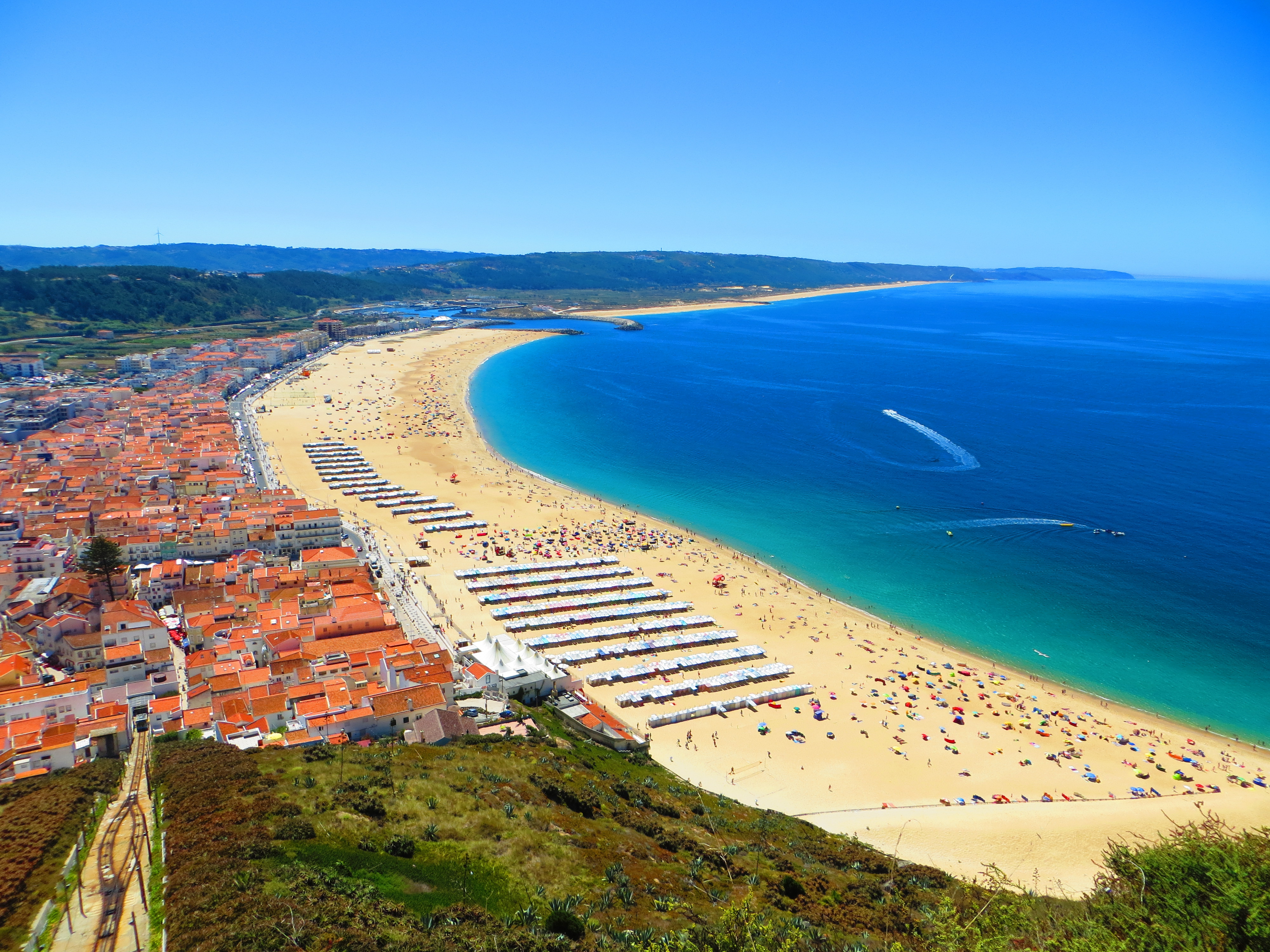
Praia da Nazaré (village beach) from the Sítio headland, with summer striped tents

· Visiting Nazaré

How to actually be here

Two nights in the lower village is the right default. Three if you're chasing a winter swell forecast. Less than one if you don't mind missing the atmosphere.

Praia da Nazaré (village beach) from the Sítio headland, with summer striped tents · panoramio contributor (Wikimedia Commons) · CC BY-SA 3.0
· Two-Minute Answers

When, where, how long

When

October–February for drama. April–September for weather.

October through February is the big-wave window — daily forecasts decide whether any given afternoon is empty or packed to the cliff ramparts. Spring and early summer are the easiest weather on this coast; the village is half-empty and the sea is swimmable at Praia da Nazaré. September 8 is the pilgrimage — book months ahead if you want to be here for the Festas.
Where

Stay in Praia. Walk or funicular up to Sítio.

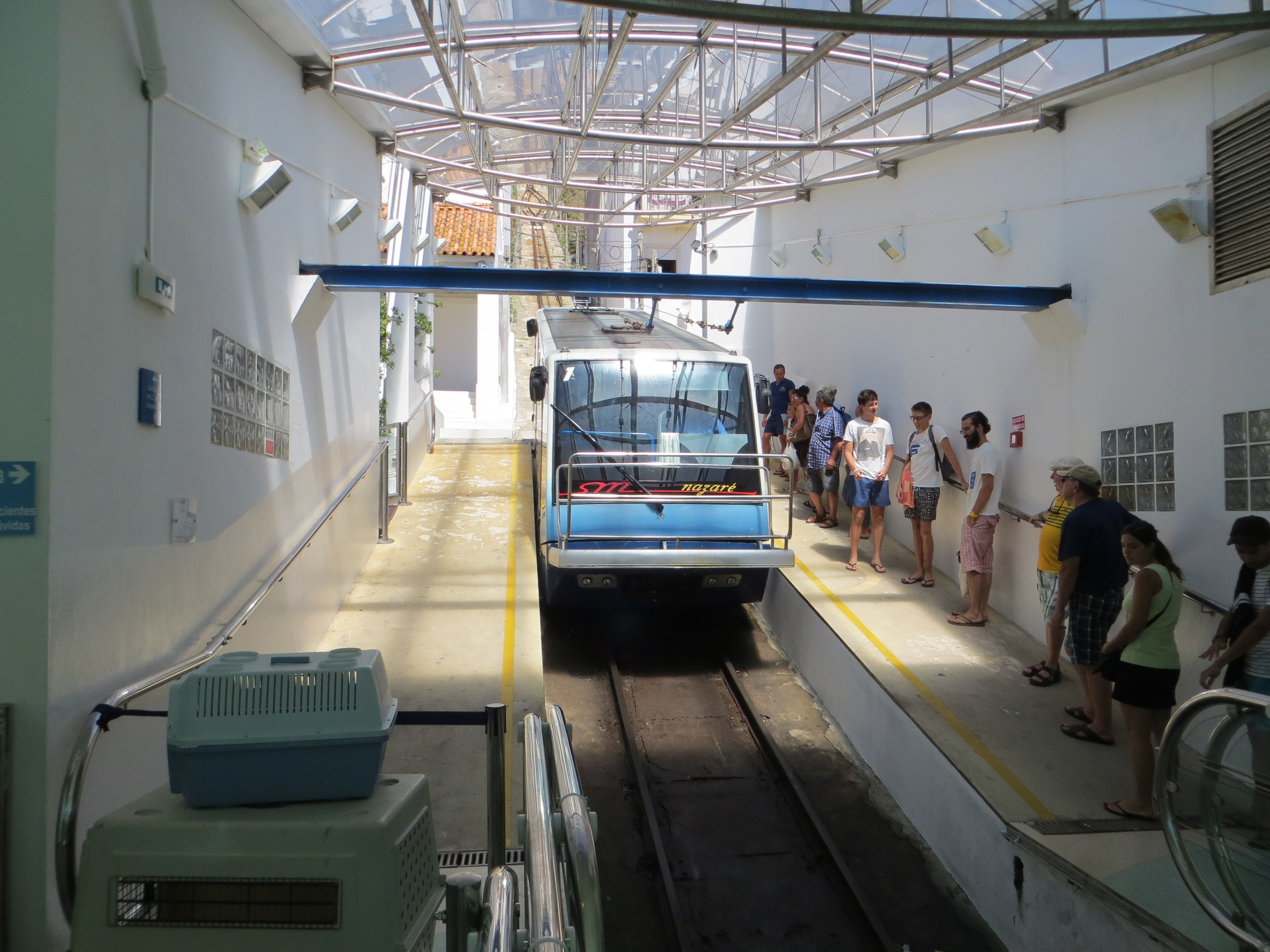
Praia — the lower village — has the restaurants, the fishing port, and the walk to the village beach. Sítio — the upper town, 120 m above — has the Santuário, the Forte de São Miguel (surf museum and the big-wave viewpoint), and a quieter overnight atmosphere. The 1889 funicular connects the two in two minutes for €2.20 round trip.

How long

Two nights. Three if winter swell is forecast.

Two nights is the default — Day 1 lower village and estendal; Day 2 Sítio, Forte, surf museum, afternoon at the Praia do Norte viewpoint. Three nights in winter gives you forecast flexibility for a swell window. One day is a Lisbon day trip and feels rushed but does work.

· Getting Here

92 km from Lisbon, nothing from anywhere else

Nazaré has no train station. Almost every visitor arrives either in a rental car off the A8 motorway or on the Rede Expressos bus from Sete Rios. Budget an hour and fifteen minutes from LIS.

From Lisbon (LIS)

The practical base. 92 km north on the A8 motorway; 60–75 minutes by car in normal traffic. Rede Expressos runs a direct bus from Lisbon Sete Rios to Nazaré — about 1h 50m, €12. No direct train. Uber does not operate between Lisbon and Nazaré.

Taxis from LIS will quote €120–150 one-way. Unless a car isn't an option, rent one.

From Porto (OPO)

200 km south. Most visitors fly Lisbon. Porto plus a rental car adds two hours to the drive but gives you the scenic Atlantic coast via Aveiro and Figueira da Foz, which is a reasonable use of a day if you're building a longer trip.

By car — A8 exit Nazaré

Exit the A8 at Nazaré; follow N242 into the lower town. Parking in the lower village is free on the street and in the large lot at the south end of Avenida Marginal. The clifftop parking at the Forte — for the Praia do Norte viewpoint — is tight on swell days. Arrive before 11 a.m. if you want a spot.

Walking the village

Lower Nazaré is end-to-end walkable in 15 minutes. Up to Sítio: the 1889 funicular (€2.20 round trip, runs every 10 minutes from 7 a.m. to midnight), the 175-step Capuchinhos stair, or the winding road. The funicular is almost always the right answer unless you want the stair views on a clear morning.

The 1889 Funicular da Nazaré — connecting Praia to Sítio
The Funicular da Nazaré — 318 meters of inclined rail, 120 meters of vertical rise in two minutes. Designed by Raoul Mesnier du Ponsard, opened 1889.· Mister No
· Where to Stay

Praia by default, Sítio if you want quiet, Pederneira if you want rural

Praia (lower village)

Where almost everyone stays. Walk to the fishing port, the Praia da Nazaré, the estendal, and most of the restaurants. Noise at 7 a.m. from fishing returns; quiet by 11 p.m.

Luxury (€200+)
Hotel Praia, Hotel Mar Bravo
Mid (€80–150)
Hotel Maré, family-run pensões
Budget (€40–80)
Nazaré Hostel & Guest House, apartment rentals

Sítio (upper town)

Quieter, older, closer to the Santuário and the Forte. Tree-lined squares. Ten-minute funicular down to the lower town for dinner. Excellent for pilgrimage or big-wave-morning stays.

Luxury (€180+)
Miramar Hotel Sítio
Mid (€70–130)
Vila Sítio, small pousadas
Budget (€40–70)
Rooms above the cafés; weekly rentals

Pederneira (inland, 5 km)

The original pre-maritime village on a small hilltop. Medieval fortress ruins. Rural, affordable, requires a car. Good for travellers who want Portuguese countryside over seafront.

Luxury (€150+)
Quintas de turismo rural com piscina
Mid (€60–100)
Casa da Pederneira, holiday rentals
Budget (€20–50)
Camping Inatel Nazaré (year-round)

Hotel names are given as anchors, not endorsements. The village is small; walking between any two of them on the same tier-level takes minutes. The choice that matters is which of the three zones you base in, not which particular hotel.

· What to Eat

Salt cod, dried sardines, and the right etiquette at the estendal

Portugal has, by tradition, a different bacalhau recipe for every day of the year. Nazaré's version — drier, saltier, honest about its 500-year relationship with North Atlantic cod — is one of them. Order it.

Bacalhau à Nazaré

€12–18

Salt cod flaked with shredded potato, eggs, olives, and parsley. The Nazaré variant is drier and saltier than the Lisbon or Porto versions — the village processed salt cod from the Newfoundland fleets for five centuries and the recipe reflects the sourcing. Good at Taberna d'Adélia, Rosa dos Ventos, Casa Marques.

Sardinha seca

€6–10 for three

The iconic Nazaré food. Sardines split along the belly (not gutted), dry-salted, and laid on the wooden racks — the estendal — on the village beach. Grilled whole over charcoal, eaten with broa (corn bread) and fingers. The practice is a 2023 UNESCO Intangible Heritage candidate. Buy from the women working the estendal directly; most traditional restaurants also serve.

Caldeirada de peixe

€15–25

Portuguese fish stew. Four to five species per pot: scorpion fish, hake, monkfish, squid, sometimes conger eel. Tomato, onion, white wine, potato, saffron. Best at family restaurants where the same pot has been running 40 years. A Casa Velha and Tasca do Celso (in Praia) are the names worth trying.

Vinho Verde & Ginjinha

€3–5 glass

Vinho Verde is the young, slightly-fizzy white wine of northern Portugal — the right lunchtime accompaniment to grilled fish on the beach. Ginjinha (ginja) is the afternoon drink: sour cherry liqueur, often served in a small chocolate cup you eat after. Ginjinha Sem Rival is the local brand.

· Estendal Etiquette

The women working the sardine-drying racks on the Praia da Nazaré are working, not performing. Most are over 60; most are in the traditional seven-skirt dress. The practice is in a UNESCO Intangible Heritage file. If you stop to watch: buy sardines if you eat fish, ask before taking photographs, and do not photograph the women's faces without eye contact. This is someone's afternoon, not a museum diorama.

· How to Not Die

Five things that have killed visitors here

Nazaré is a very safe small Portuguese town by normal measures. Violent crime is rare; the risks are specific and mostly marine. Read this section.

1 · Praia do Norte currents · fatal

Do not swim at Praia do Norte, even in summer. The rip currents and the canyon-driven nearshore bathymetry produce rapid underwater current changes that are dangerous even to strong swimmers. The beach is not lifeguarded; warning signs are explicit. People die at this beach every few years, and they are almost always non-surfers. Swim at Praia da Nazaré (the village beach, south of the headland) — lifeguarded in summer, gentle slope, small shore break, safe for families.

2 · The cliff edge at the Forte on big-wave days · fatal

The ramparts at the Forte de São Miguel — the fortress / lighthouse / surf museum at the tip of Sítio — have no continuous railing on the ocean side. On big-wave days the viewpoint fills with hundreds of spectators. Wind gusts are strong. At least one fatal fall has occurred in the last decade. Stay well back from the edge; do not climb onto the low stone walls. The view is as good from two meters inside the line.

3 · Traffic in Praia on big-wave days · serious

The village's streets were laid out for fishing carts. On peak swell days with a WSL event or viral-level conditions, several thousand cars try to fit through Avenida Marginal and up to the Forte. Locals avoid driving on these days and walk or use the funicular. If you arrive in the lower town by car and see crowds, park where you are and walk.

4 · The jet-ski tow operations · serious

During big-wave sessions, you will see jet-skis visible offshore at Praia do Norte — sometimes two hundred meters out, sometimes closer. Do not attempt to paddle out or swim toward them for a closer look. A driver focused on a surfer at speed cannot see a civilian swimmer in time to avoid collision, and the impact zone moves unpredictably.

5 · Cold-water exposure at all seasons · real

Atlantic water at Nazaré runs 14 °C in February, 19 °C in August. Even in peak summer a swim is refreshing, not soothing. Visitors from warmer coasts regularly get into trouble with hypothermia on overcast days in May or October. If you're swimming at Praia da Nazaré outside July–August, expect to be cold faster than you expect to be cold.

· Itineraries

Four ways to use two days

6–8 hours

Day trip from Lisbon

Drive up via A8, arrive by 10 a.m. Morning in Sítio — the Santuário and the Forte / surf museum. Lunch in Praia. Afternoon at the Praia da Nazaré to see the estendal. Leave by 4 p.m. Misses the 4-p.m.-golden-hour at the Praia do Norte viewpoint — which is the thing you came for in winter — so only do this in summer.

Arrive day 1 afternoon, leave day 3 morning

Two nights (the default)

Day 1: lower village, Praia da Nazaré, dinner at Taberna d'Adélia. Day 2: morning funicular to Sítio, Santuário, Forte / surf museum, lunch in Sítio. Afternoon at the Praia do Norte viewpoint. Dinner back in Praia. Day 3: estendal breakfast, walk the coastal path north before leaving.

Arrive day 1 with a 72-hour swell window visible

Three nights (winter, swell-forecast)

Same two days, plus a buffer day for the swell to actually arrive. Watch the forecast from magicseaweed.com / surfline.com. The WSL Tow Challenge is called 72 hours ahead of a swell; if the call happens while you're here, you have the best cliff seat in Europe. Keep day 3 flexible until the morning of.

Arrive day 1, leave day 4

Three nights (non-surf, Silver Coast)

The two-night Nazaré itinerary plus a day exploring the Silver Coast. Alcobaça (12th-century monastery, 15 km inland) in the morning; Óbidos (walled medieval town, 25 km south) in the afternoon; dinner back in Nazaré. Or substitute São Martinho do Porto (shell-shaped bay, 10 km north) for a swim-friendly morning.

· About this spoke

Written by Erin Rose. Logistics and rates current as of April 2026. Restaurant and hotel names are anchors for navigation, not paid placements. Ferry / bus schedules should be re-checked before arrival; Rede Expressos publishes at rede-expressos.pt. Corrections welcome, especially on Portuguese-language framings and on the named practices of Nazaré. Version v0.9.