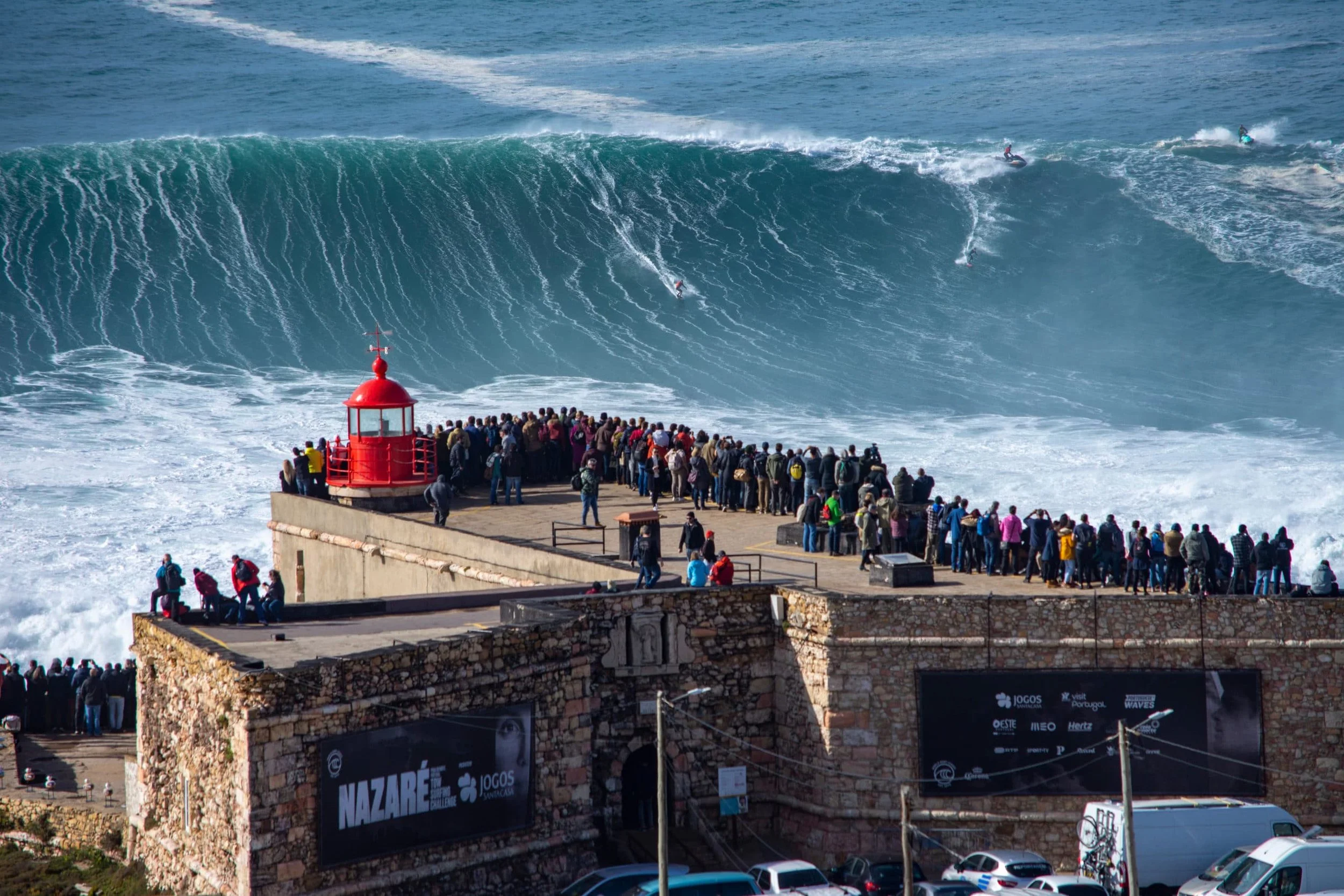
The fortress, the crowd, and the wave — Praia do Norte on a big-wave day

· Surfing Nazaré

What the wave looks like from inside the sport

You do not paddle into Nazaré. You are towed into it by a jet-ski travelling at fifty kilometers an hour, released at the exact moment the swell begins to peak, and then allowed to free-fall down a face the height of a six-story building.

The fortress, the crowd, and the wave — Praia do Norte on a big-wave day · via nazarebroadcasting.com · Editorial use
· Reading the Forecast

What makes a Nazaré day — and what doesn't

The canyon is only productive under a narrow set of conditions. Most winter days do not produce rideable waves. The ones that do, you can see coming three days out on a public forecast.

A Nazaré day requires four things to align:

  1. A deep Atlantic low-pressure system — a winter storm centered northwest of the Azores, generating open-ocean groundswell with a fetch of several thousand kilometers.
  2. The swell direction must arrive from the W to NW (roughly 280°–320°). A northerly swell misses the canyon alignment; a southerly swell refracts against the headland and loses amplitude.
  3. Long period: 16 seconds or more between wave crests at the buoy. Short-period wind swell does not have the deep-water energy to survive the canyon-driven refraction process. The bigger the period, the bigger the wave that ultimately arrives at Praia do Norte.
  4. Light or moderate offshore wind — easterly, roughly 10–25 km/h. The wave face needs to be held up vertically for a tow-in surfer to ride it; strong onshore wind collapses the face early and makes the break unsurfable.

When all four align — usually 15 to 20 times in a full October-to-February season — Nazaré produces the biggest rideable surf anywhere on Earth. When they don't, the break is either flat or messy. Reading a Nazaré forecast is reading for these specific conditions; gross wave-height forecasts are misleading here because the canyon amplifies only a narrow band of incoming swell.

The canonical public forecasts: magicseaweed.com (Nazaré page), surfline.com (Nazaré Premium forecast is better than the free version), and the IPMA Portuguese marine model. Local surfers also consult the Ocean Prediction Center's North Atlantic surface analysis for synoptic context. The WSL's Tow Surfing Challenge call goes out 72 hours before an event — if you're trying to be here for a competition, watch WorldSurfLeague.com from mid-October on.

· What to Wear

Wetsuit guide, month by month

The Atlantic at Nazaré runs 14 °C in February and 19 °C in August. The wetsuit you wore at Ericeira two weeks ago is almost certainly not the right one for here.

MonthWater °CAir °CSuitNotes
Jan15 °C8–145/4 + booties + hoodDeep winter. Big-wave season peak. Serious cold.
Feb14 °C8–155/4 + booties + hoodColdest water of the year.
Mar14 °C9–175/4 or 4/3 + bootiesTransition month. Still cold.
Apr14 °C10–184/3 + bootiesAir warms fast, water doesn't.
May15 °C12–204/3Booties optional. Wave season ending.
Jun17 °C15–223/2Summer shore-break season begins at Praia da Nazaré.
Jul18 °C16–243/2 or shortyWarmest wetsuit layer of the year.
Aug19 °C17–252 mm or shortyFlat or small surf season. Practical wetsuit break.
Sep19 °C16–243/2Festa da Senhora week. Still swimmable at Praia da Nazaré.
Oct18 °C14–214/3Wave season starting. First serious swells mid-month.
Nov16 °C11–174/3 + bootiesWater drops fast. McNamara's 2011 ride was 1 November.
Dec15 °C9–155/4 + bootiesFull winter kit. Short days; surf the morning sessions.

Suit thicknesses are standard big-wave Atlantic specs (5/4 = 5 mm torso / 4 mm limbs). Add a hood any time water is under 15 °C if you're in the water more than an hour. Booties any time rocks are a consideration on launch, which at Praia do Norte is always.

· The Tow Protocol

Two jet-skis, one sled, ninety seconds

Every tow-in surfer at Nazaré is actually three people in the water: the surfer, the tow driver, and the rescue driver. Understanding the protocol is the difference between watching a ride and watching an operation.

At most big-wave breaks — Mavericks, Jaws on a clean day, Waimea Bay — a surfer can paddle into the wave. The wave is steep enough and shaped well enough that arm propulsion matches the takeoff speed. At Nazaré the wave face is moving too fast; human arms cannot catch it. The only way onto a Nazaré wave is to be towed in.

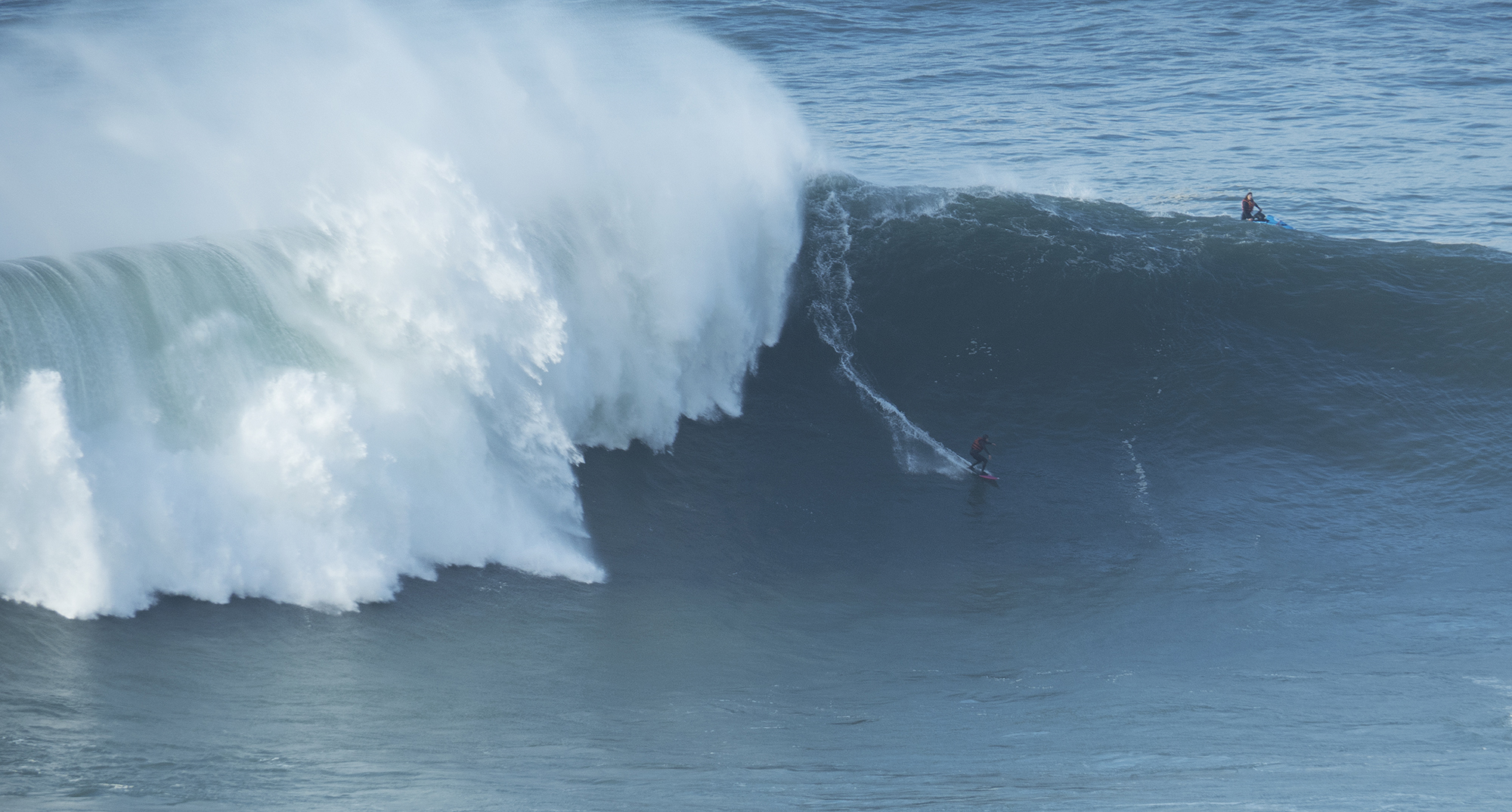
Big-wave surfer at Praia do Norte
A tow-in ride at Praia do Norte. The small white object visible behind and above the surfer is the rescue jet-ski, stationed roughly 100 meters outside the break.· Alohamansurfer

The choreography

  1. Tow driver accelerates the surfer into the wave via a tow rope — a 15–20 meter line attached to the ski's stern. Target entry speed: 50 km/h matching the swell's advance.
  2. Release happens at the precise moment the swell begins to peak — too early and the surfer loses the wave; too late and the ski itself goes over the falls. Release is on the surfer's whistle or the driver's visual call, depending on team protocol.
  3. Rescue driver, stationed 100–200 meters outside the impact zone on a second ski, monitors the ride. A rescue sled — a buoyant platform — is strapped to the back of the rescue ski.
  4. On wipeout, the rescue ski enters the impact zone within seconds; the surfer grabs the sled as the ski exits the wave's breaking face. Target: from wipeout to sled pickup under 90 seconds — the margin between an unconscious surfer who recovers and one who doesn't.
  5. Every serious big-wave surfer at Nazaré wears an inflatable flotation vest with a CO₂ canister triggered by a ripcord. The vest is the last line of defense if the rescue ski cannot reach the surfer in time — it keeps an unconscious body face-up on the surface.

Who drives safety

There is a specific community of water-safety drivers who have built careers around this break. Names that recur on the events:

  • Lucas Chianca ("Chumbo") — Brazilian, competes and drives safety; widely considered the best in the water on both sides of the role.
  • Nic von Rupp — Portuguese; one of the core local big-wave surfers and frequent safety driver.
  • Pedro "Scooby" Vianna — Brazilian, longtime resident safety driver for the McNamara and Gabeira teams.
  • Kai Lenny — Hawaiian; both competes and works safety across the winter season.
  • Garrett McNamara — still active; typically drives safety now rather than surfing.

Most of them live in the village from October through February. They know each other's riding styles, each other's wipeout tendencies, each other's breathing capacity, and each other's wives and children. When a WSL Tow Challenge is called for a specific swell, the surfers don't draw teams; the teams are already teams, built over years in this water.

· Records

The wave-height chronology

Every current big-wave world record — men's and women's, across all certifications — belongs to this beach. The list is short and it is all here.

1 Nov 2011

Garrett McNamara

23.77 m (78 ft)

Towed into the wave during a rising winter swell by Portuguese safety driver Andrew Cotton. Certified by Guinness as the largest wave ever surfed. The photograph of McNamara at the base of the wave, with the Forte lighthouse visible on the cliff, is the single image that created the modern Nazaré big-wave era. Within six months Praia do Norte had a permanent water-taxi service and an international surf community.
28 Jan 2013

Garrett McNamara

~30 m (disputed ~100 ft)

A second, larger ride. Estimated visually at close to 100 feet; never formally certified because the measurement standards at the time required photogrammetric analysis McNamara's team did not provide. Widely considered the largest wave McNamara ever rode, but it is not in the Guinness record.

8 Nov 2017

Rodrigo Koxa

24.38 m (80 ft)

Brazilian surfer; broke McNamara's 2011 standing record. Certified by Guinness in 2018 following photogrammetric review. Koxa's ride was the first confirmation that Nazaré was producing bigger waves than anyone had ridden before — and that the 2011 ride had not been a one-off.

29 Oct 2020

Sebastian Steudtner

26.21 m (86 ft) · ~28.6 m remeasured

German; currently the standing Guinness world record for the largest wave ever surfed. Subsequent photogrammetric re-analysis by a research team at the University of Alcalá in 2022 estimated the true height closer to 28.6 m. Steudtner is now one of the Nazaré-resident core big-wave group.

11 Feb 2020

Maya Gabeira

22.4 m (73.5 ft)

Brazilian; currently the standing record for the largest wave ever ridden by a woman. Gabeira's line at Nazaré is a story in itself: she nearly drowned here in 2013, returned, rebuilt her technique, and set the women's world record first in 2018 (20.7 m) and extended it here in 2020. The 2020 wave was surfed on the same session — same swell window — as Steudtner's men's record.

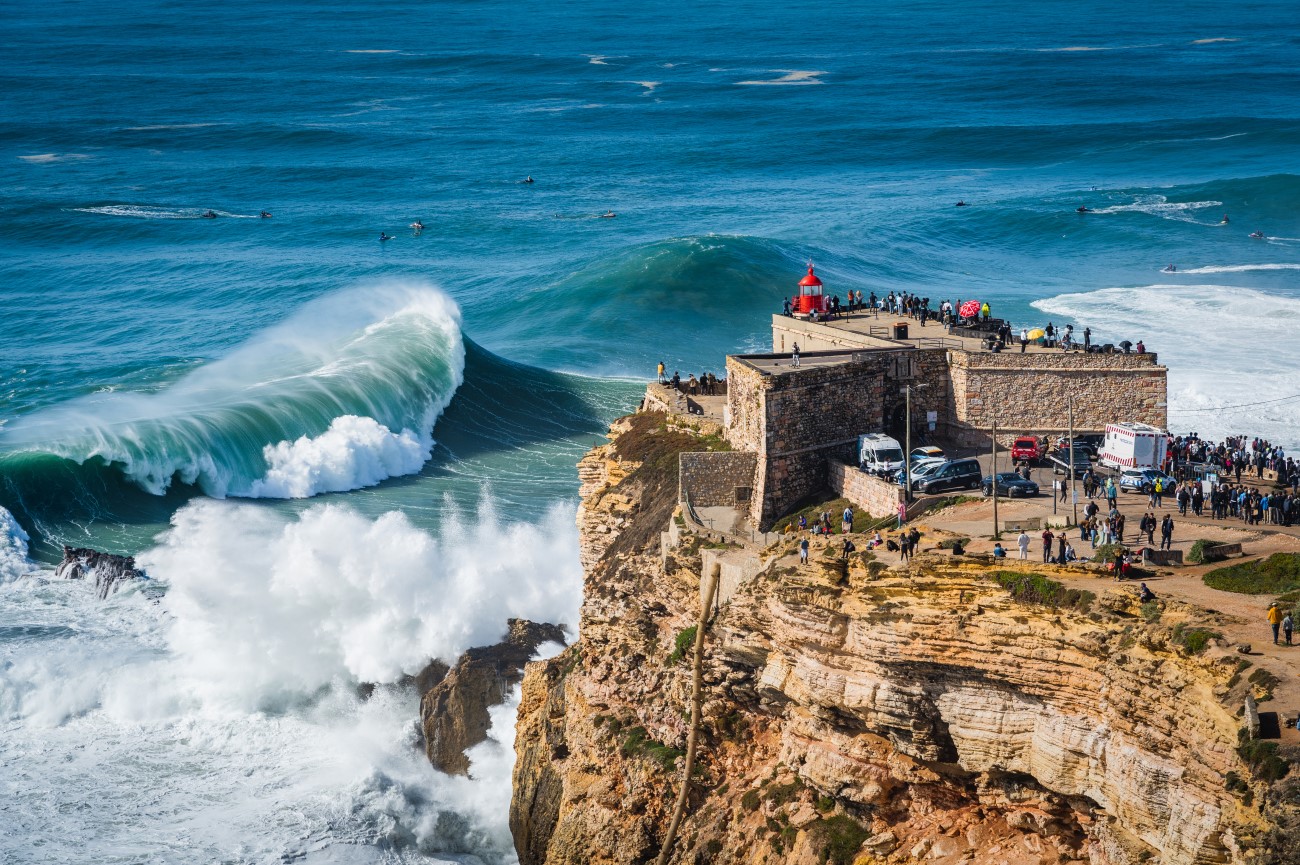
The Forte de São Miguel Arcanjo with a wave breaking to the left and surfers offshore
Praia do Norte on a mid-sized day. The records above were all set on waves substantially larger than this.· Revigorate
· The Wipeout

What a Nazaré hold-down physically is

Two-wave hold-downs of 45 seconds or more are routine here. The inflatable vest is the margin.

A wipeout at Praia do Norte is not a single event. The wave breaks, the surfer is separated from the board, the surfer is driven under the surface and along the seabed for a distance that depends on the wave's energy. The problem is the second wave. Nazaré's sets arrive in trains of three to six, roughly fifteen to twenty seconds apart. A hold-down from the first wave ends as the next wave arrives, which means the surfer surfaces into the next breaking face and goes back down. Two-wave hold-downs of 45 seconds or more are routine here.

Two wipeouts define the sport's understanding of this break.

October 2013 — Maya Gabeira. Towed into a wave estimated at around 25 meters. Separated from the board on take-off. Received two two-wave hold-downs. When Carlos Burle reached her on a jet-ski she was unconscious and floating face-down; he dragged her to the beach and administered CPR on the sand below the fortress. She survived with a broken fibula and nerve damage. Her return and eventual 2020 world record is the sport's most-studied arc of recovery from a near-fatal big-wave incident.

5 January 2023 — Márcio Freire. Brazilian big-wave pioneer, age 47. One of the original Hawaiian paddle-in "Mad Dogs" group that first surfed Jaws without tow assistance in the early 2000s. Died at Praia do Norte during a freesurfing session on a mid-size swell. The immediate cause was drowning following a hold-down. It was the first fatality at Nazaré in big-wave surfing history. The surf community's relationship with this break was not the same afterwards. The Forte flew its flag at half-mast for a week.

Freire's death did two things. It accelerated the adoption of the CO₂-triggered inflation vest as a required, not optional, piece of kit for anyone surfing Praia do Norte on a non-contest day. And it changed the conversation, inside the sport, about what kinds of days are worth surfing at all — a discussion that is still ongoing among the Nazaré-resident group.

· The Comparison

Nazaré vs. Jaws — the only useful one

Pipeline and Mavericks are different categories. The break that actually compares to Nazaré — same canyon-amplification mechanism, same tow-dominant register, same modern big-wave attention — is Pe'ahi, on Maui's north shore.

Portugal · North Atlantic

Nazaré

Mechanism
Canyon-focused swell (Canhão da Nazaré, 230 km / 5,000 m deep)
Season
Oct–Feb
Record ridden
26.21 m (Steudtner, 2020) · ~28.6 m remeasured
Water temp
14–19 °C — Atlantic cold
Entry
Tow-in exclusively
Break character
Thick, heavy, moving water; steep but not barrelling
Hazards
Two-wave hold-downs; canyon currents; onshore rocks
Local community
~30 core resident surfers Oct–Feb
Maui, Hawaii · North Pacific

Jaws / Pe'ahi

Mechanism
Reef + deep-water canyon offshore of Pe'ahi Bay
Season
Dec–Feb
Record ridden
~21 m (Kai Lenny, multiple 2021–2022)
Water temp
23–26 °C — tropical
Entry
Both tow-in and paddle-in (rare big-wave break where both work)
Break character
Hollow, barrelling wave; classic tube shape
Hazards
Reef at low tide; impact zone over shallow coral
Local community
~40 core resident surfers, Hawaiian core older than Nazaré's

The two breaks are most usefully understood as the two ends of the big-wave spectrum. Jaws rewards barrel-riding technique and produces the most photogenic rides in the sport. Nazaré rewards drop-riding commitment and produces the biggest measurable waves. A surfer who can handle both is the short list the sport is currently working with.

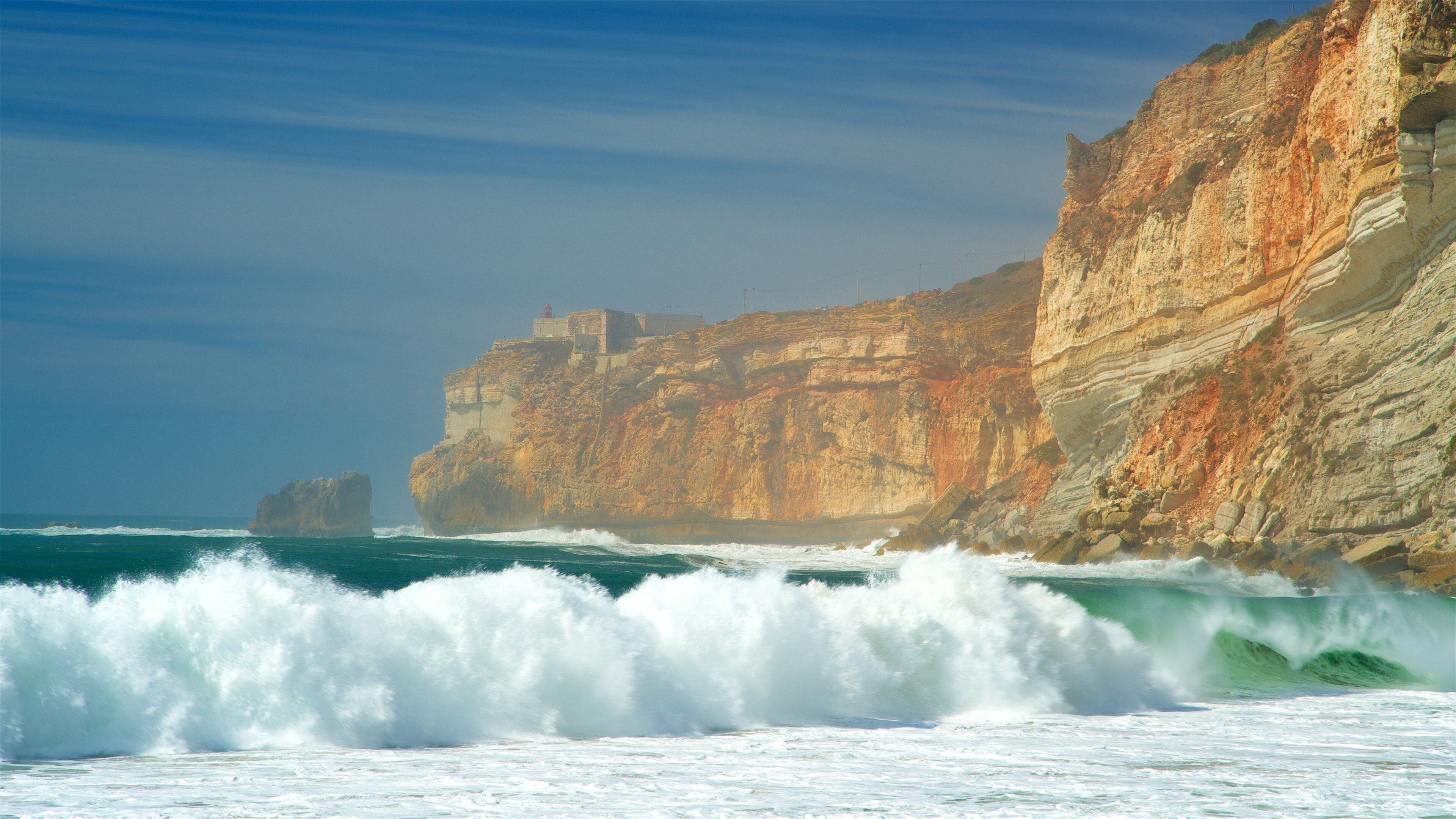
Shore break at the base of the Sítio cliff
Praia do Norte shore break — the 95 m → 0 m bathymetric ramp compressed into a few hundred horizontal meters. Same mechanism that builds the outside wave.· trvl-media / Expedia Group
· About this spoke

Written by Erin Rose. Swell-checklist thresholds reflect consensus among the Nazaré-resident group and published Magicseaweed / Surfline forecasting guides. Record heights are as certified by Guinness and, where applicable, post-ride photogrammetric remeasurement. Freire fatality details from Portuguese and Brazilian press coverage, January 2023. The wetsuit-by-month table is based on IPMA water-temperature normals and Nazaré surf-community practice. Corrections welcome, especially on Portuguese-language framings and on the named practices of Nazaré. Version v0.9.