Campania, IT

Spiaggia di Citara

Giardini termali poseidon - panoramio (3).jpg

Campania, IT

Spiaggia di Citara

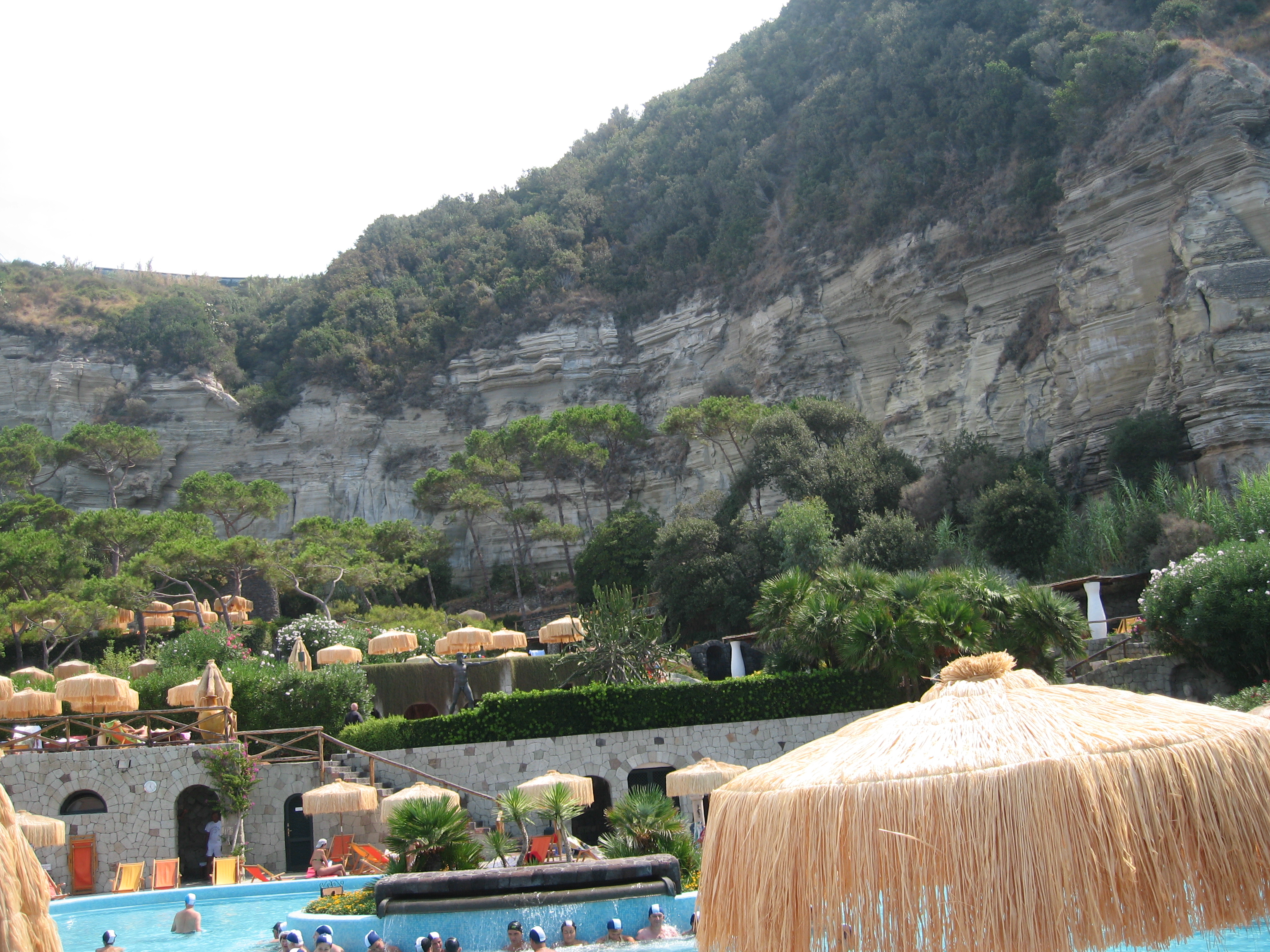
The southwest-facing Citara bay holds the Giardini Poseidon, Ischia's oldest thermal park, opened in 1959 over a beach fed by the island's volcanic springs.

Giardini termali poseidon - panoramio (3).jpg · <a rel="nofollow" class="external text" href="https://web.archive.org/web/20161015061511/http://www.panoramio.com/user/3517988?with_photo_id=37585786">francverde</a> · CC BY 3.0
Substrate
sand
Nearest airport
NAP · 41 km
Tier
Featured
I’m here for
Story

Spiaggia di Citara is a bay on the southwest coast of Ischia, a volcanic island that rises roughly 900 meters off the sea floor in the northwest of the Gulf of Naples. It sits about one kilometer from the center of Forio, the island's western town, and faces open water toward the Tyrrhenian Sea. The sand is dark and lithic, the visible product of Ischia's volcanic terrane rather than the pale calcareous sand of much of the Mediterranean. The water is rated 1 — excellent under the EU bathing-water scheme.

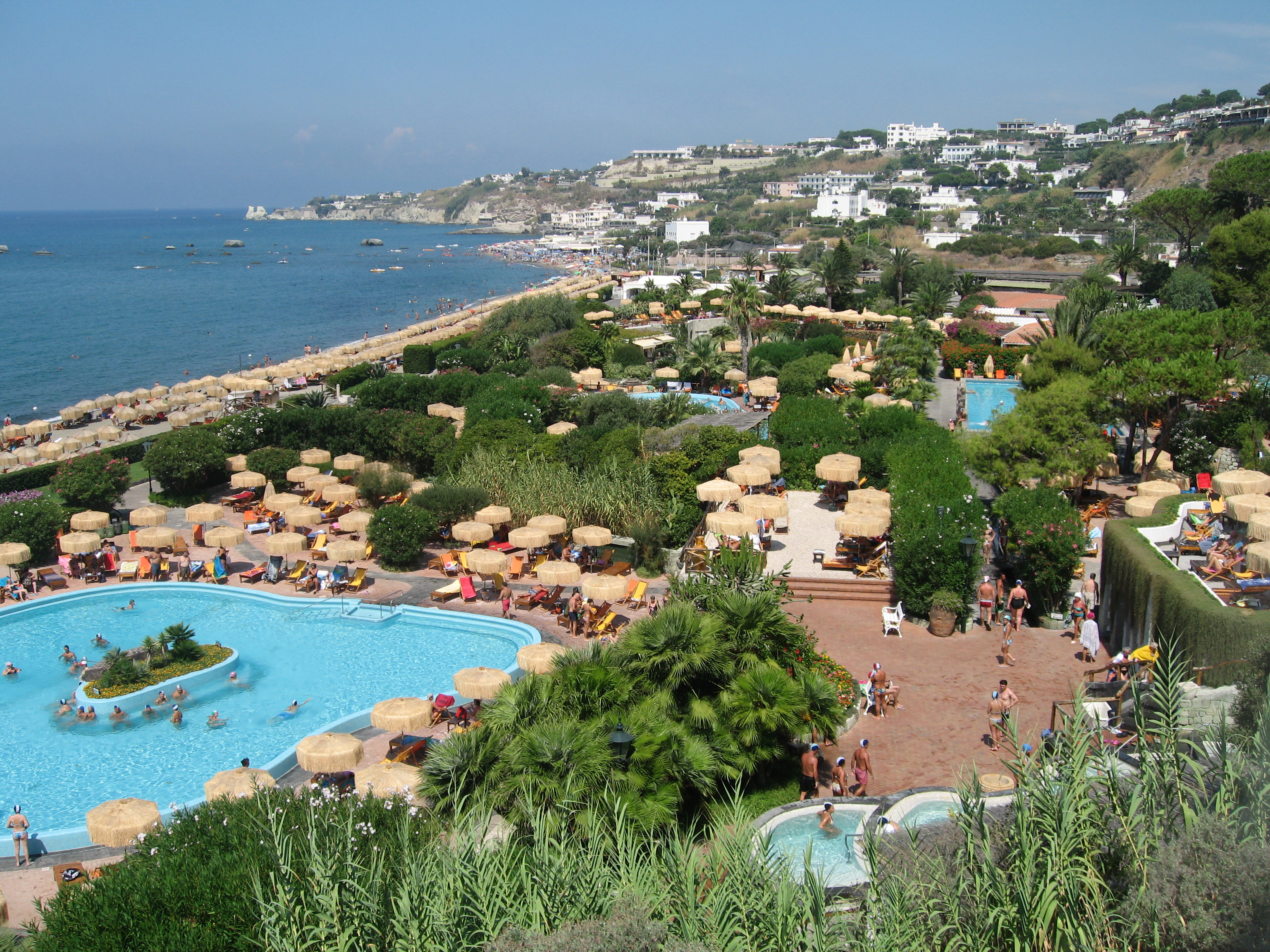
What sets Citara apart is what feeds it. Ischia's last eruption, the Arso lava flow, occurred in 1302 AD, and the island remains volcanically active, with low-energy seismicity, fumaroles, and hot springs across its surface. At Citara, mineral-rich thermal water reaches the shoreline, and the bay became the site of the Giardini Poseidon Terme, the island's oldest and largest thermal park. Poseidon was founded in 1959 by the German physician Gernot Walde, who built a series of pools and connecting paths across what was then farmland running down to the beach and named the complex for the god of the sea. The park now holds more than twenty thermal pools with water from 28 to 40 degrees Celsius, three seawater pools, and a steam cave cut into the tuff in the Greco-Roman manner.

The town above the bay is Forio, and its signature landmark is the Chiesa del Soccorso — Santa Maria del Soccorso — a whitewashed church on a rocky promontory just beyond the town center. The building traces to the 14th century, served as an Augustinian convent until around 1653, then stood abandoned until it was rebuilt in its present form in 1864. Its interior carries votive models of sailing ships left by survivors of shipwrecks.

Citara faces southwest, which orients the bay toward the setting sun and toward Procida and the Phlegrean Fields across the water. The combination is specific: a working thermal beach where volcanic geology, mineral water, and a commercial spa complex are inseparable, below a town whose history runs through earthquakes — most recently the magnitude-4.0 Casamicciola quake of 21 August 2017, which killed two people on the island's north coast.
The spike

The southwest-facing Citara bay holds the Giardini Poseidon, Ischia's oldest thermal park, opened in 1959 over a beach fed by the island's volcanic springs.

Citara's defining fact is that it is a thermal beach on an active volcano, and the clearest expression of that is the Giardini Poseidon Terme, the thermal park that occupies the southern arc of the bay.

The source is the volcano. Ischia is not a sedimentary island with incidental hot springs; it is a volcanic complex that rises roughly 900 meters from the sea floor in the northwest of the Gulf of Naples. Its central peak, Monte Epomeo at 787 meters, was lifted by block resurgence of a caldera formed in the Monte Epomeo Green Tuff eruption about 55,000 years ago — the tuff colored green by chlorite, an iron-bearing phyllosilicate. The island's last eruption, the Arso flow, occurred in 1302 AD and lasted around two months. Ischia is still volcanically active, and that activity surfaces as fumaroles, low-energy seismicity, and hot springs. At Citara, that last expression — thermal water — reaches the shoreline. The dark, lithic sand underfoot is the same story written at grain scale: GloPrSM modeling puts the sand at roughly 69 percent lithic, the signature of a volcanic terrane rather than the calcareous sand common across the Mediterranean.

The park that the water built. In 1959 a German physician, Gernot Walde, looked at the Citara bay — then farmland running down to the beach — and built the first developed thermal garden on Ischia. He cut a series of pools into the slope, linked them with paths, and named the complex for Poseidon. In the 1970s the Bavarian industrialist Ludwig Kuttner took it over and, with the architect Fritz Zollinger, redesigned it into the terraced park that exists now: more than twenty thermal pools running from 28 to 40 degrees Celsius, three seawater pools, and a steam cave cut directly into the volcanic tuff in the Greco-Roman manner. It is the oldest and largest thermal park on the island, and it is the reason most people know the name Citara at all.

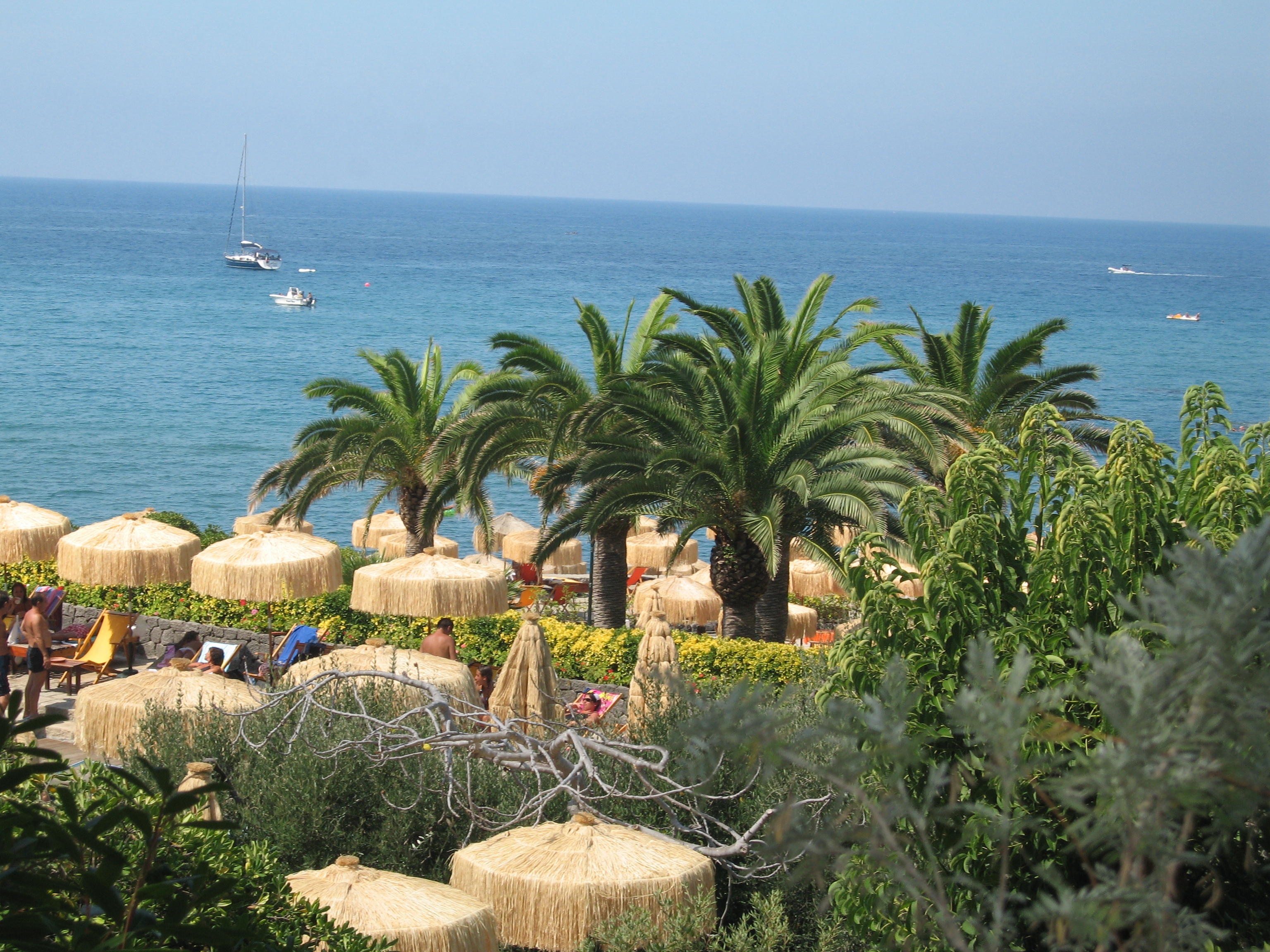
The bay faces the sunset. Citara opens to the southwest, across the Tyrrhenian toward Procida and the Phlegrean Fields. That orientation is not incidental to its reputation — it is why the bay is one of Ischia's established sunset locations, and why the whitewashed Chiesa del Soccorso, on its promontory a short walk into Forio, became the island's signature place to watch the light go down over open water. The church itself, rebuilt in 1864 over a 14th-century convent foundation, holds votive ship models left by shipwreck survivors, a reminder that this is a working seafaring coast and not a resort invention.

The honest tension. The same volcanic system that warms Citara's water is the system that shakes Ischia. The island sits on active faults; the Casamicciola earthquake of 1883 killed roughly 2,300 people, and a magnitude-4.0 quake on 21 August 2017 killed two and left around 2,600 homeless, both on the north coast. Citara is not the epicenter of that danger, but it is fed by the same geology. The beach is a place to sit in mineral water warmed by a living volcano — which is exactly what makes it worth describing precisely rather than loosely.

Giardini termali poseidon - panoramio (1).jpg
Culture

Where it shows up

History
  • Ischia as a thermal-cure destination · 1959

    Ischia's identity as a thermal-treatment island long predates Citara's park, but the Giardini Poseidon's founding in 1959 by physician Gernot Walde turned the bay into a developed wellness destination and made Citara synonymous with thermal bathing on the island.

Other
  • Votive shipwreck models at the Soccorso church

    The Chiesa del Soccorso above Forio holds votive models of sailing ships left by survivors of shipwrecks, a maritime devotional tradition tying the town to the sea that Citara faces.

Giardini termali poseidon - panoramio (4).jpg
History

What happened here

  1. 1302natural

    The Arso eruption, Ischia's last

    Ischia's most recent eruption begins around January 1302 and lasts roughly two months, producing the Arso lava flow on the island's east. It is the last volcanic eruption recorded on Ischia; the island remains active through fumaroles, hot springs, and seismicity to the present.

    Wikipedia →
  2. 1864cultural

    The Chiesa del Soccorso is rebuilt

    After serving as an Augustinian convent until about 1653 and then standing abandoned, the whitewashed Santa Maria del Soccorso church on Forio's promontory is rebuilt in its present form in 1864. It becomes the town's signature landmark above the sea.

  3. 1883disaster

    The Casamicciola earthquake

    A destructive earthquake strikes Casamicciola Terme on Ischia's north coast in July 1883, killing roughly 2,300 people — one of the deadliest in the region's history and a recurring reference point for the island's seismic risk.

    Wikipedia →
  4. 1959founding

    Giardini Poseidon Terme opens

    German physician Gernot Walde founds the Giardini Poseidon Terme on the Citara bay, then farmland running down to the beach. He builds a series of thermal pools with connecting paths and names the complex for Poseidon, god of the sea — the first developed thermal garden on Ischia.

  5. 1970expansion

    Kuttner and Zollinger redesign the gardens

    In the 1970s the Bavarian industrialist Ludwig Kuttner takes over the Giardini Poseidon and, working with the architect Fritz Zollinger, completely redesigns the complex into the terraced pool gardens that exist today.

  6. 2017disaster

    Casamicciola earthquake of 2017

    A magnitude-4.0 earthquake strikes Casamicciola Terme on Ischia's north coast on 21 August 2017, killing two people, injuring around 42, and leaving roughly 2,600 homeless. INGV documents surface faulting from the shallow event.

    Wikipedia →
The honest part
The geology that warms Citara's water is the geology that shakes the island.

Citara is not a wild beach, and reading it as one sets up disappointment. The bay's defining feature — the Giardini Poseidon Terme — is a paid commercial spa, with admission in the range of roughly 25 to 35 euros per day depending on season, and it occupies the southern arc of the shoreline. The public beach is free to enter, but the thermal experience most visitors come for is concentrated inside the park, not freely available on the open sand. The warm zones in the public water are real but modest next to the developed pools behind the gate.

The second honest point is volcanic. Ischia's thermal appeal and its hazard come from the same source. The island is volcanically active, with its last eruption in 1302, and it sits on faults that have produced deadly earthquakes — the Casamicciola quake of 21 August 2017 killed two and left thousands homeless on the north coast, and the historic Casamicciola earthquake of 1883 was far worse. Citara itself was not the epicenter of these events, but the geology that warms its water is the geology that shakes the island. The bay is busy, family-oriented, and best on weekdays; on summer weekends it fills, and the calm it promises is easiest to find outside July and August.

Giardini termali poseidon - panoramio.jpg
Anatomy

The shape of the place

The free public beach

35%

The open, free section of dark volcanic sand with a gently shelving entry, popular with families. Water rated 1 — excellent under EU bathing standards. Warm thermal zones reach the shallows but are modest next to the Poseidon pools.

Best for Free swimming and family beach use

Busiest on summer weekends; facilities close at sunset as on Italian beaches generally.

Southwest sunset exposure

50%

The bay's open southwest face toward the Tyrrhenian, looking across to Procida and the Phlegrean Fields. The orientation that puts the setting sun directly into the bay and gives Citara its evening reputation.

Best for Sunset over open water

The Chiesa del Soccorso, a short walk into Forio, is the classic adjacent sunset viewpoint.

Giardini Poseidon Terme

65%

The thermal park occupying the southern arc of the bay: more than twenty pools fed by mineral water from 28 to 40 degrees Celsius, three seawater pools, and a steam cave cut into the volcanic tuff. Opened 1959, redesigned in the 1970s.

Best for Thermal bathing and full spa immersion

Paid admission, roughly 25 to 35 euros per day depending on season; separate from the free public beach.

Landmarks

Giardini Poseidon Terme · 1959

thermal park · Gernot Walde (founder); Fritz Zollinger (1970s redesign)

Ischia's oldest and largest thermal park, on the Citara bay. Founded in 1959 by German physician Gernot Walde and redesigned in the 1970s under Ludwig Kuttner with architect Fritz Zollinger. Holds more than twenty thermal pools (28–40 °C), three seawater pools, and a tuff steam cave.

Chiesa del Soccorso (Santa Maria del Soccorso) · 1864

church

Whitewashed church on a promontory just beyond Forio's center, overlooking the Tyrrhenian. Traces to the 14th century, served as an Augustinian convent until about 1653, stood abandoned, then was rebuilt in its present form in 1864. Holds votive ship models from shipwreck survivors.

Monte Epomeo

natural

Ischia's central peak at 787 meters, raised by long-lasting block resurgence of the volcanic caldera. The Monte Epomeo Green Tuff, erupted about 55,000 years ago and colored green by chlorite, is the marker deposit of the island's defining eruption.

Wikipedia →
A day here

From first light to dark

Dawn

At first light the bay is quiet and the Giardini Poseidon has not yet opened its gates. The dark volcanic sand is cool before the sun works on it, and the water off the southwest-facing shore is flat. Forio's fishing port, a kilometer north, is the part of the morning already in motion.

Midday

By late morning the Poseidon park is open and its more-than-twenty pools fill, while the free public beach draws families to the gently shelving entry. Summer air runs warm and the dark sand holds heat through the day. Weekends are the crowd peak; the water stays rated excellent under EU standards.

Golden hour

Citara faces southwest, so the late light comes straight into the bay across the Tyrrhenian toward Procida and the Phlegrean Fields. This is the orientation the beach is known for. A short walk into Forio reaches the Chiesa del Soccorso on its promontory, the island's classic sunset viewpoint.

Night

After sunset the beach facilities close, as Italian beaches generally do, and the public sand empties. The evening moves up into Forio — the passeggiata through the town center, the waterfront restaurants, the lit white mass of the Soccorso church above the sea.

La spiaggia de "I Giardini Poseidon" - panoramio.jpg
Sea & surf

What the water does

JFMAMJJASONDmetres (significant wave height)

Solid = typical monthly wave height; pale = the bigger days (90th pct). Offshore/regional swell from Open-Meteo Marine (ERA5 Ocean reanalysis, 2023–2024); a sheltered cove may sit calmer than this.

Mixed — usually swimmable, with a livelier season
Typical wave height
1.03 m
Biggest swell
Nov · 1.57 m
Calmest
Jun · 0.6 m
Typical period
5.5 s (wind chop)
Before you go

Things to know

Two beaches in one

The public sand is free; the thermal experience most visitors want is inside the paid Giardini Poseidon park (roughly 25–35 euros/day).

Getting there

Citara is about 1 km from Forio's center. Ferries reach Forio from Naples (Molo Beverello) and Pozzuoli; island buses and taxis run from the port.

Sunset orientation

The bay faces southwest across the Tyrrhenian toward Procida; the Chiesa del Soccorso a short walk away is the classic sunset viewpoint.

Volcanic ground

The thermal water comes from an active volcanic island whose last eruption was 1302 and whose faults caused deadly quakes in 1883 and 2017.

Sharks

No incidents on record in the global shark-attack file.

Plan

If you go

Getting there
Nearest airport
Naples International Airport (NAP) · 41 km
Nearest town
Forio · 1 km

Citara sits about 1 km from Forio's center on Ischia's southwest coast. Reach Ischia by ferry to Forio from Naples (Molo Beverello, ~50–60 min) or Pozzuoli (~40–45 min); from Forio port the beach is a 5–10 minute bus or taxi ride. Nearest airport is Naples (NAP), about 41 km via the ferry ports.

When to go
  • Summer thermal-park season · Roughly April to October, peaking July and August

    The Giardini Poseidon and the Citara beach run their full season through the warm months, with the heaviest crowds on summer weekends. Ferry frequency from Naples and Pozzuoli peaks in this window, and the public beach reaches capacity by late morning on July and August weekends.

What to eat & drink
Campanian seafood at Forio's waterfront

Forio is a working town with a fishing port, and its waterfront restaurants serve the regional Campanian repertoire — fresh seafood, pasta, local wine, limoncello. This is the dinner end of a Citara day, a kilometer up from the sand.

Forio town center and harbor, about 1 km from the beach

Coniglio all'ischitana (Ischia-style rabbit)

Ischia's signature dish: rabbit braised with tomato, garlic, white wine, and herbs, traditionally raised in pits across the island's interior. A genuine local specialty rather than a tourist invention, found on Forio menus.

Forio and inland Ischia restaurants

Ischian white wine (Biancolella, Forastera)

Ischia DOC whites grown on the island's volcanic, terraced slopes. Biancolella and Forastera are the dominant local grapes; the volcanic soil that warms Citara's water is the same ground these vineyards work.

Forio wine shops and restaurants; island vineyards

Sources & references
  1. Giardini Poseidon Terme: Our Story · cited 3×
  2. ScienceDirect: Arso 1302 lava study; Italian Civil Protection
  3. Ischia Review; Visit Ischia
  4. Italian Civil Protection; INGV
  5. Wikipedia: 2017 Ischia earthquake; INGV
  6. OSM; site beach data
  7. Giardini Poseidon Terme
  8. ScienceDirect; Italian Civil Protection
  9. MDPI Minerals; Italian Civil Protection
  10. GloPrSM v1.0.0 (IJ_QFL)
  11. EU Bathing Water (IT015063031004)
  12. Site beach data
Colophon · Provenance

Where this page comes from

Geography, facilities
OpenStreetMap (ODbL) for geometry and facility tags within 500 m of the beach centroid. GeoNames for city/airport distances.
Climate & ocean
Open-Meteo ERA5 + Marine archive, 2014–2023 monthly normals.
Photography
Archival, original tone (Tier B — Wikimedia Commons). Each image licensed per its own terms; attribution visible inline.
History & culture
Every factual claim is linked to its source in the prose above. Wikipedia citations inline. Non-wiki sources named where relevant.
Editorial voice
Register: reverent. Written to pass a local's nod test; corrections welcome.
Written by Erin Rose
Last reviewed 2026-04-19
v0.9in editorial development toward v1.0