A grey-sky pebble beach where three centuries of English people came to be somebody else for a weekend.
· Story
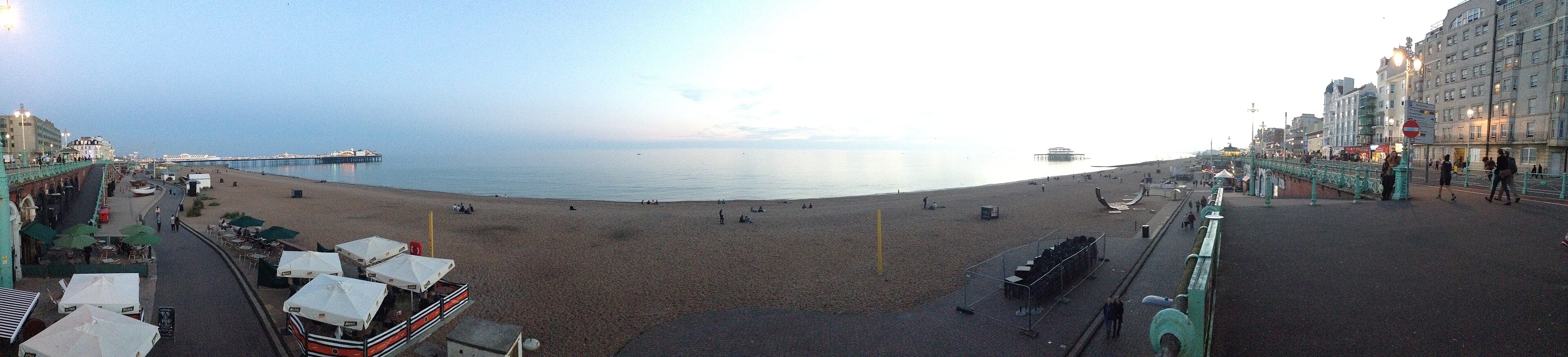
Brighton is a grey-sky beach. That is the first thing to know. The sea is English Channel cold most of the year. The beach is pebble, not sand, and the pebbles hurt your feet. It rains. The pier neon looks best in drizzle. If you arrived here expecting tropical seaside, you misread the postcard — this is specifically British seaside, and specifically British seaside is its own long, weird, wonderful thing.
Brighton began as Brighthelmstone, a fishing village on the Sussex coast. In 1754 a Lewes physician named Richard Russell published a Latin dissertation arguing that drinking and bathing in seawater cured scrofula, and the medical fashion that followed him effectively invented the modern seaside holiday. A few decades later the Prince of Wales — the future George IV — fell in love with the place, built an Indo-Islamic pleasure palace here with onion domes and chinoiserie interiors, and turned a fishing village into the louche English answer to Biarritz.
Two piers were built after the railway arrived from London in 1841. The West Pier opened in 1866, the Palace Pier in 1899 — Victorian iron fairy-tales standing in the Channel. The Palace Pier still runs fairground rides and sells doughnuts. The West Pier burned twice in 2003 and 2004, collapsed progressively over a decade, and its skeleton is still out there in the water. Brighton chose to keep the ruin rather than dismantle it. It is the most-photographed wrecked structure in the south of England.
What makes Brighton Brighton is not the sea. Three centuries of English people came here to write novels, shoot films, be gay, do drugs, start bands, get divorces, hold party conferences, plot against governments, and be somebody else for a weekend. The town is the accumulation of what they built around a beach that, as a beach, is only pebbles.
· The Two Piers
One working, one a burnt skeleton in the sea
Brighton had two Victorian iron piers. One of them you can still walk out onto and eat doughnuts. The other was set alight in 2003 — nobody was ever charged — and its skeleton has been there ever since. The image of the two piers together is the single most photographed thing in the south of England.
The West Pier · 1866–2003
The West Pier opened in 1866, designed by Eugenius Birch — the Victorian pier engineer whose name is attached to half a dozen surviving British seaside structures. It was considered the most elegant iron pier ever built in Britain: 340 meters out into the Channel, with a pavilion, a concert hall, a landing stage for pleasure steamers from Margate and Brighton. The ironwork was filigreed — Moorish arches, cast-iron lamp standards, a bandstand mid- way. It was the architectural masterpiece of British Victorian seaside engineering.
It was also, by the late 20th century, derelict. Maintenance costs had outstripped the Pier's revenue for decades; the 1987 Great Storm tore away significant sections; the pier was closed to the public in 1975. For nearly thirty years it stood in the sea as a fenced-off ruin, visible from the promenade, ignored by most of Brighton except a small preservation trust trying to raise restoration funds.
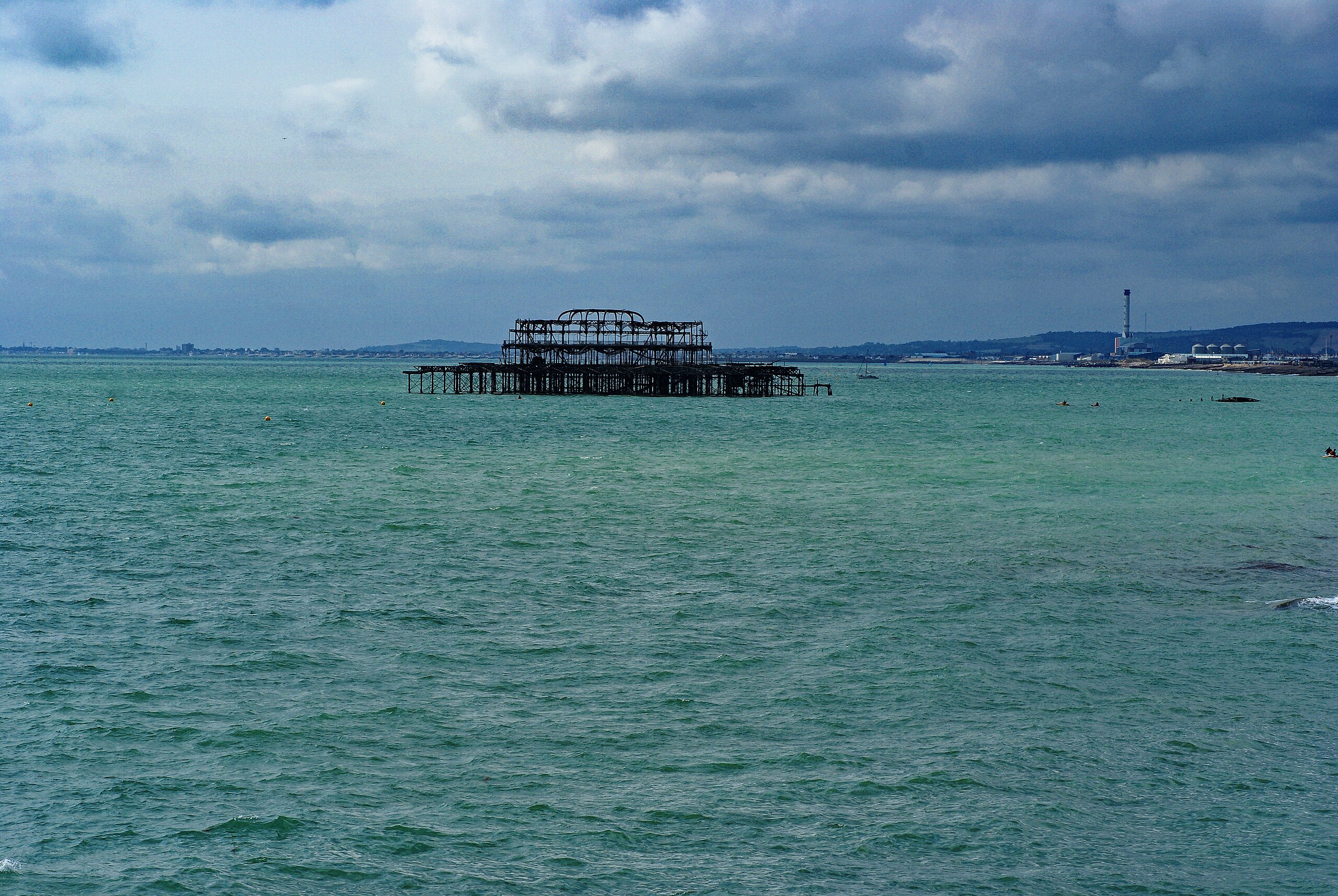
The West Pier skeleton — photographed from the promenade. What remains is roughly the central pavilion frame; the pier-head collapsed in 2002, the main walkway in stages through 2003–2004.· Txllxt TxllxT · CC BY-SA 4.0
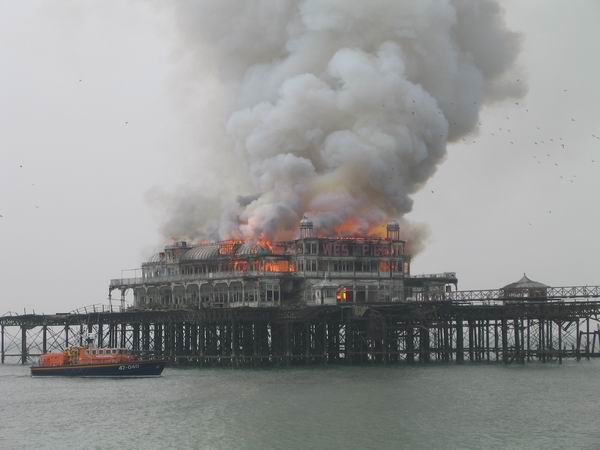
On 28 March 2003, the West Pier caught fire. No cause was ever officially determined. A second fire followed in May 2003, a third in December 2004, and progressive storm-driven collapses through 2010. What's there now is the charred iron frame of the central pavilion — about 15% of the original structure — still standing in the sea roughly 200 meters offshore. Brighton had a decision to make about whether to dismantle or keep it. The town kept it. The ruin is now its most-photographed landmark, and the i360 observation tower was built in 2016 on the exact patch of shoreline where the pier's entrance used to be — a deliberate siting, so that the i360 and the ruin share the same frame.
28 Mar 2003. The West Pier fire. The cause was never officially determined. Brighton's most famous single photograph of the 21st century.· Mark Harris (Meharris) · Public domain
The Palace Pier · 1899–present
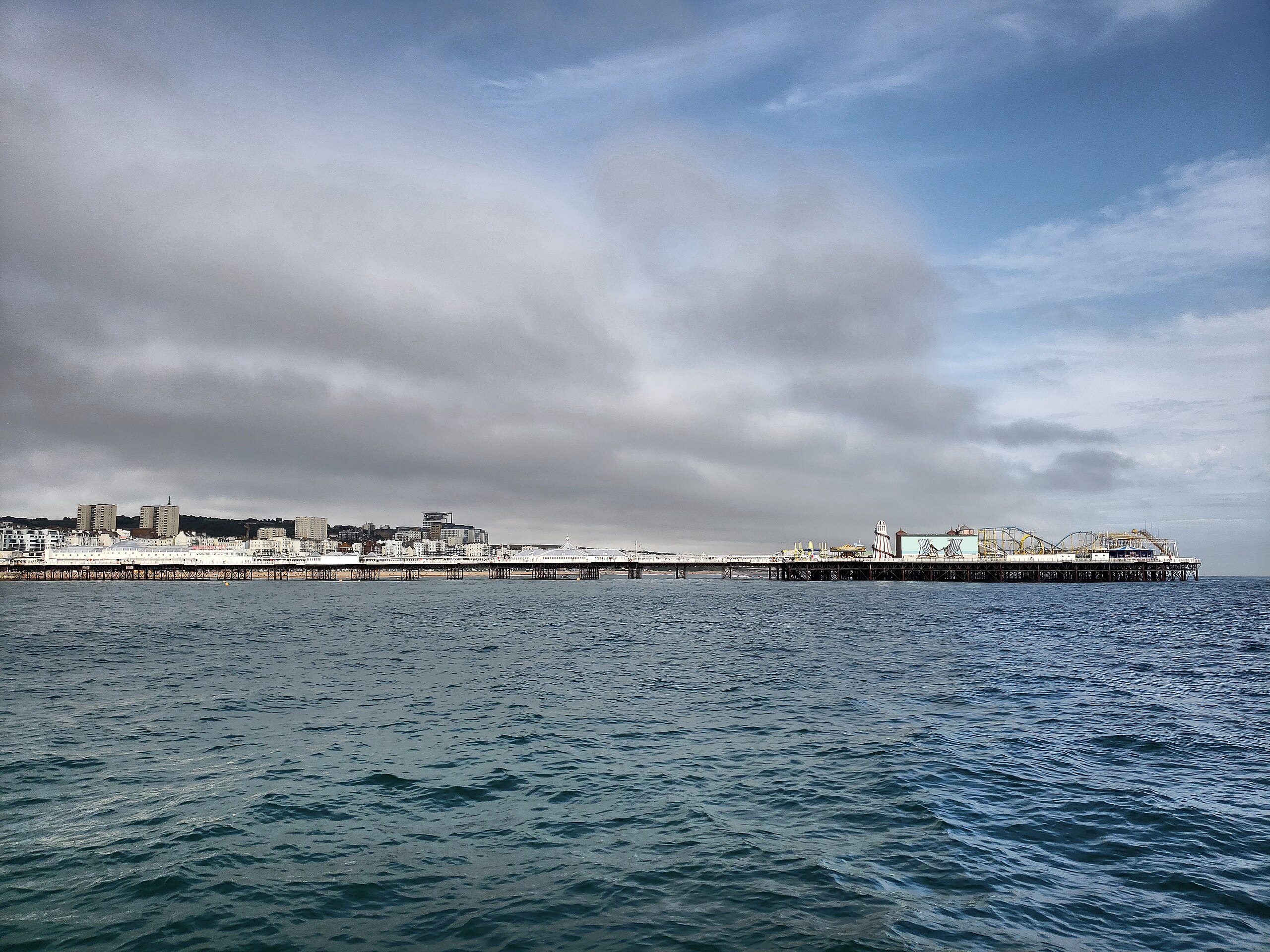
The Palace Pier — formally the Brighton Marine Palace and Pier — opened in 1899, thirty-three years after the West. It was the second of Brighton's Victorian piers and, in several respects, the more commercially pragmatic of the two: wider, structurally simpler, designed for the mass-market railway tourist rather than the steamer-pleasure-cruise clientele of the West Pier's earliest years. Fairground rides and slot machines arrived by the 1930s; they are still there. Candy-floss, doughnuts, fish-and-chips kiosks, the screaming carousel horses, the pier-end concert hall that still does weekend tribute bands. It is working seaside in the straight Victorian sense — loud, profitable, unembarrassed.
The Palace Pier, 2023. The only surviving working pier in Brighton, and one of a handful still operating in Britain.· Onthewings · CC0
The Palace Pier has lost its own pieces to the sea. The 1987 Great Storm took its concert hall entirely — the tail end of the pier that had held the big-name Victorian and interwar variety shows was ripped off in the hurricane-force winds and fell into the Channel. The end of the pier today is the shorter version that was rebuilt through the late 1980s and early 1990s, without the original concert hall's domes and minarets. Old postcards still in circulation, from pre-1987 Brighton, show the pier long enough to look almost Edwardian; the pier you see today is Victorian at the landward end, 1990s at the seaward.
The i360 · 2016–present
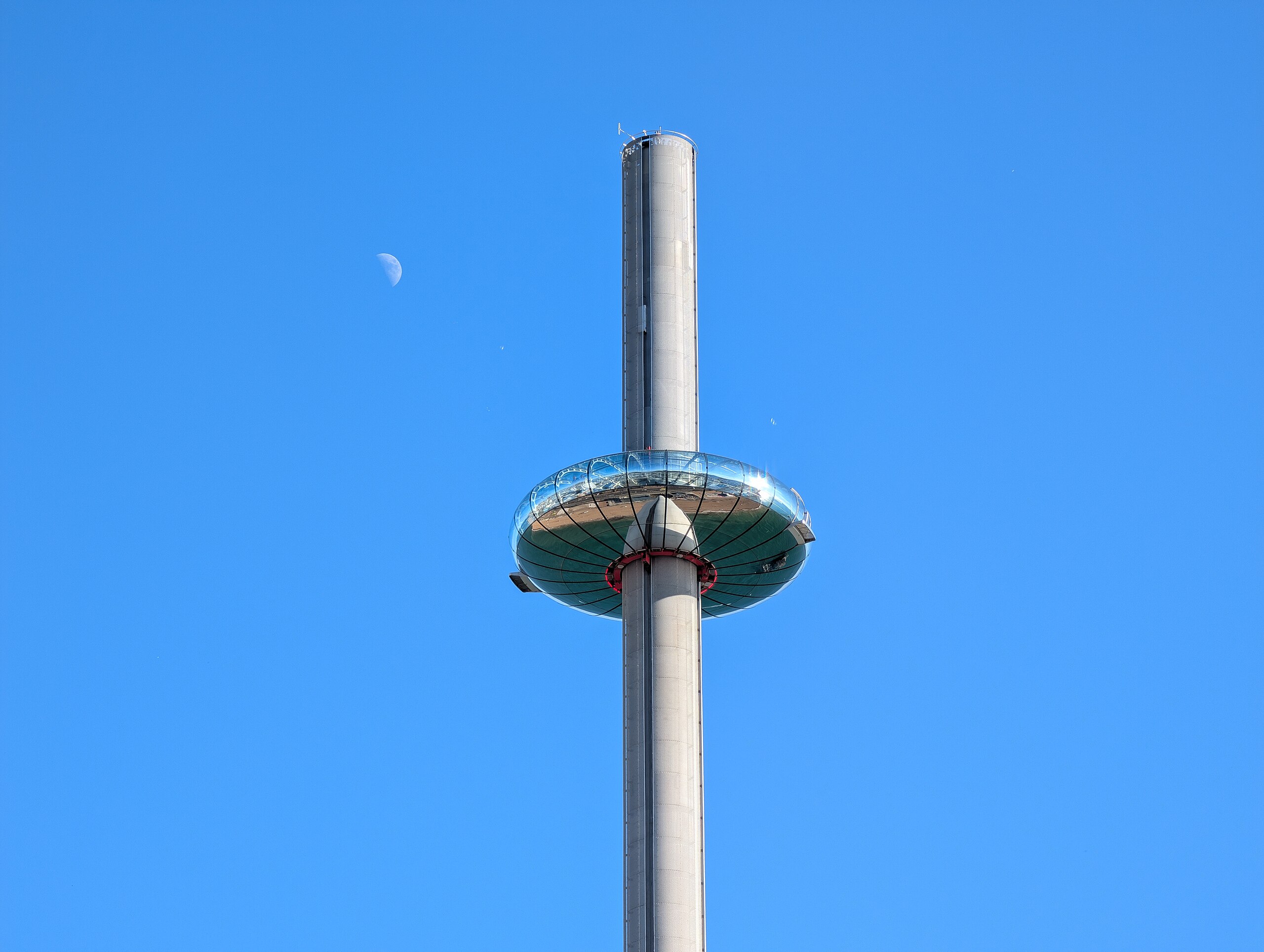
In 2016 the British Airways i360 opened on the seafront directly next to the West Pier ruin. A 162-metre steel pole with a glass observation pod that rises and falls. Designed by Marks Barfield— the team behind the London Eye, with whom it is often compared, though the i360 has proven substantially less loved. It cost £46 million and has been in financial administration at various points since opening. Brighton, with characteristic wry self-awareness, has mostly decided to get on with it — the tower is now visually paired with the West Pier skeleton in essentially every sunset photograph taken on the seafront. The two structures, together, are the image of contemporary Brighton.
The i360 tower — 162 m steel pole, glass observation pod, British Airways branding. Built 2016 on the patch of shoreline where the West Pier's entrance used to stand. Not universally loved; unquestionably now part of the skyline.· Onthewings · CC0
· The Pavilion
George IV's Indo-Islamic fantasy, and why it is here
The Royal Pavilion is not a typical royal building. It was built by a prince who wanted a fishing village, refashioned as a Regency pleasure resort, transformed into an Indo-Islamic pleasure palace. It is possibly the oddest royal building in Britain. That it exists at all is the key to why Brighton became Brighton.
In 1783 the Prince of Wales — the future George IV, then twenty-one, still dissolute, still decades from the throne he would briefly occupy — visited Brighton on a doctor's recommendation. The Russellian seawater cure was at its Regency-era peak; the Prince liked it, or at least liked being away from London. He rented a farmhouse on the Steine, the grassy open space where Brighton's fishermen had once dried nets. He came back. He kept coming back. Within a decade he had commissioned the construction of a substantial classical villa on the site.
The first version of the Pavilion, built 1787 by Henry Holland, was neo-classical and unremarkable. The Prince tired of it. Over the next thirty years he commissioned a sequence of architects to elaborate — first a Chinese interior, then a set of Indian-inspired exterior features. Finally in 1815 he appointed John Nash — later the architect of Regent Street and Regent's Park — to redesign the whole thing. Nash's commission was to produce a building that looked as Indian as possible on the outside and as Chinese as possible on the inside, specifications the Regent personally dictated.
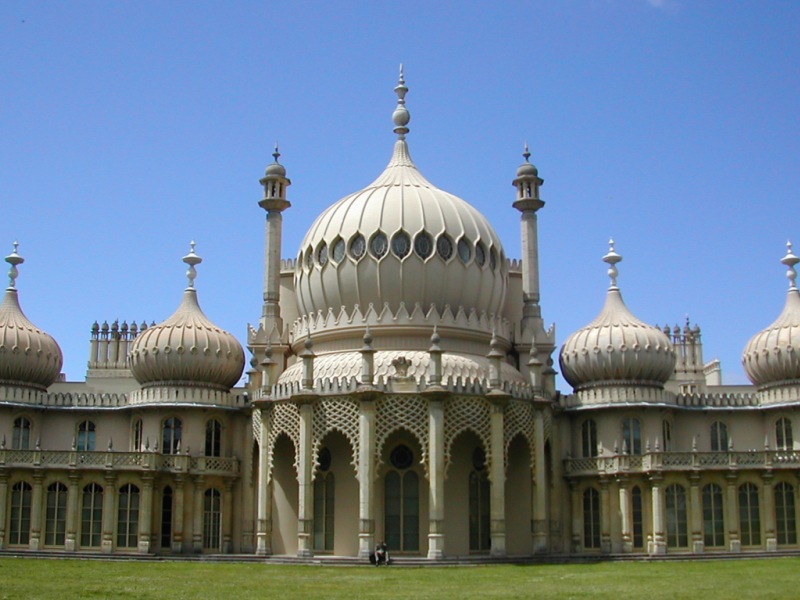
The completed building in 1822 is: an Indo-Islamic Mughal fantasy of onion domes, minarets, and chhatris on the outside; the interior a chinoiserie opera set of gilded dragons, lotus-flower chandeliers, red-and-gold banqueting chambers, and a cast-iron palm-tree Great Kitchen the size of a parish church. It is not subtle. It was not intended to be.
The Royal Pavilion — the Indo-Islamic Mughal exterior Nash designed for George IV. The onion domes, the chhatris, the minarets. It looks like nothing else in England because it is supposed to.· Xgkkp · CC BY-SA 3.0
Why it matters for Brighton
The Pavilion was not incidentally important to Brighton. It was the reason the town became what it became. Where the future George IV spent his money, England's leisured class followed. The first generation of elite visitors — dukes, ambassadors, the fashionable London crowd — came to Brighton in the 1810s and 1820s specifically because the Regent was here. The Brighton Pavilion season drove demand for Regency architecture along the seafront and in the Lanes; most of the white stucco terraces that still face the water were built during this thirty-year royal window. By the time the railway arrived in 1841 and made Brighton accessible to the London middle class, the physical city they arrived at — the seafront terraces, the garden squares of Kemptown and Brunswick, the main promenade — had already been built by Regency aristocrats.
The Pavilion was sold by Queen Victoria in 1850 — she found the building uncongenial and the town insufficiently private — to the Brighton Town Commissioners for £50,000. The building has been municipal property ever since. It is open to the public, admission around £18, and remains one of the most-visited royal buildings in Britain despite no longer being royal.
· Six Stretches, One Seafront
Walk east, walk west — Brighton changes every two hundred meters
The six-kilometer Brighton & Hove seafront is not one beach. It is a sequence of named stretches that serve different crowds and carry different histories. A visitor who only walks between the two piers has seen ten percent of it.
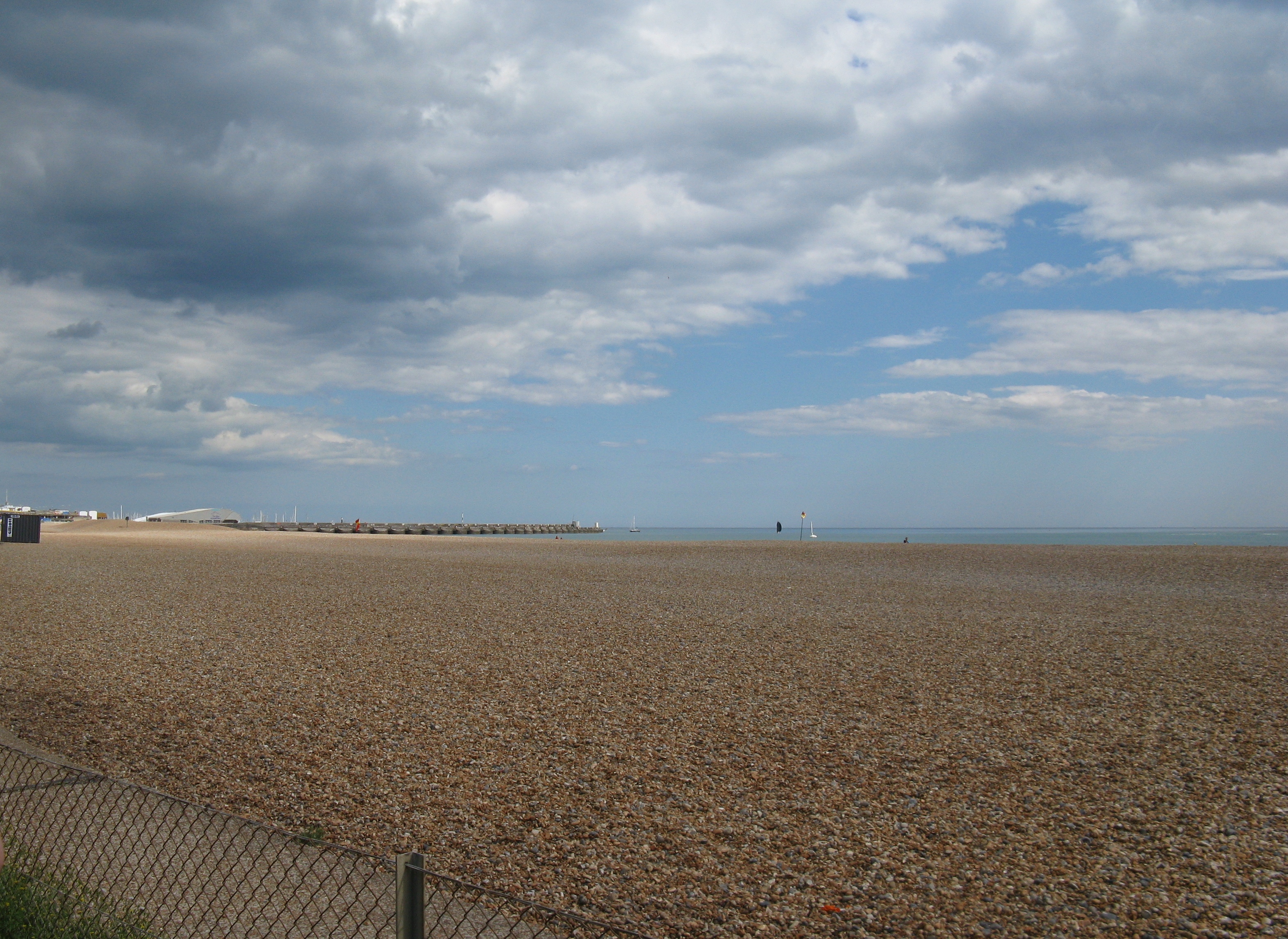
Brighton beach — pebble, not sand. Locals call it 'only pebbles' with a specific shrug. The pebbles hurt your feet; they are also the reason the beach has not eroded in two centuries.· CC BY-SA 2.0
hove
Hove beach
The western stretch, officially in the city of Hove — which Brighton absorbed only in 1997 but which still insists on its own identity. Regency squares, wider pavements, wealthier. The beach is quieter; the Lawns on the seafront are grass not pebble. Birdwatchers work the Hove Lagoon to the west.
Hove insists it is not Brighton. Locals joke about 'Hove, actually.'
west-pier-area
West Pier & i360
The dramatic centre-west of the seafront. The West Pier's burned iron skeleton stands a hundred metres off-shore; the i360 observation tower rises beside it. The Kings Road Arches below the promenade have become the trendy-bar stretch — Jubilee Library to Shoreditch-by-the-sea.
Best for
the best photographs in Brighton, cocktails, the i360
Local note
The West Pier Trust runs a small museum in the base of the i360.
central
Central beach (between piers)
The postcard stretch. Pebbles, deckchairs, beach volleyball nets in summer, the piano-cafe that sometimes appears on the sand. The Grand Hotel and the Hilton Metropole face the water. This is where day-trippers land and where summer weekends look crowded.
Best for
first-time visits, sunbathing, watching the water
Local note
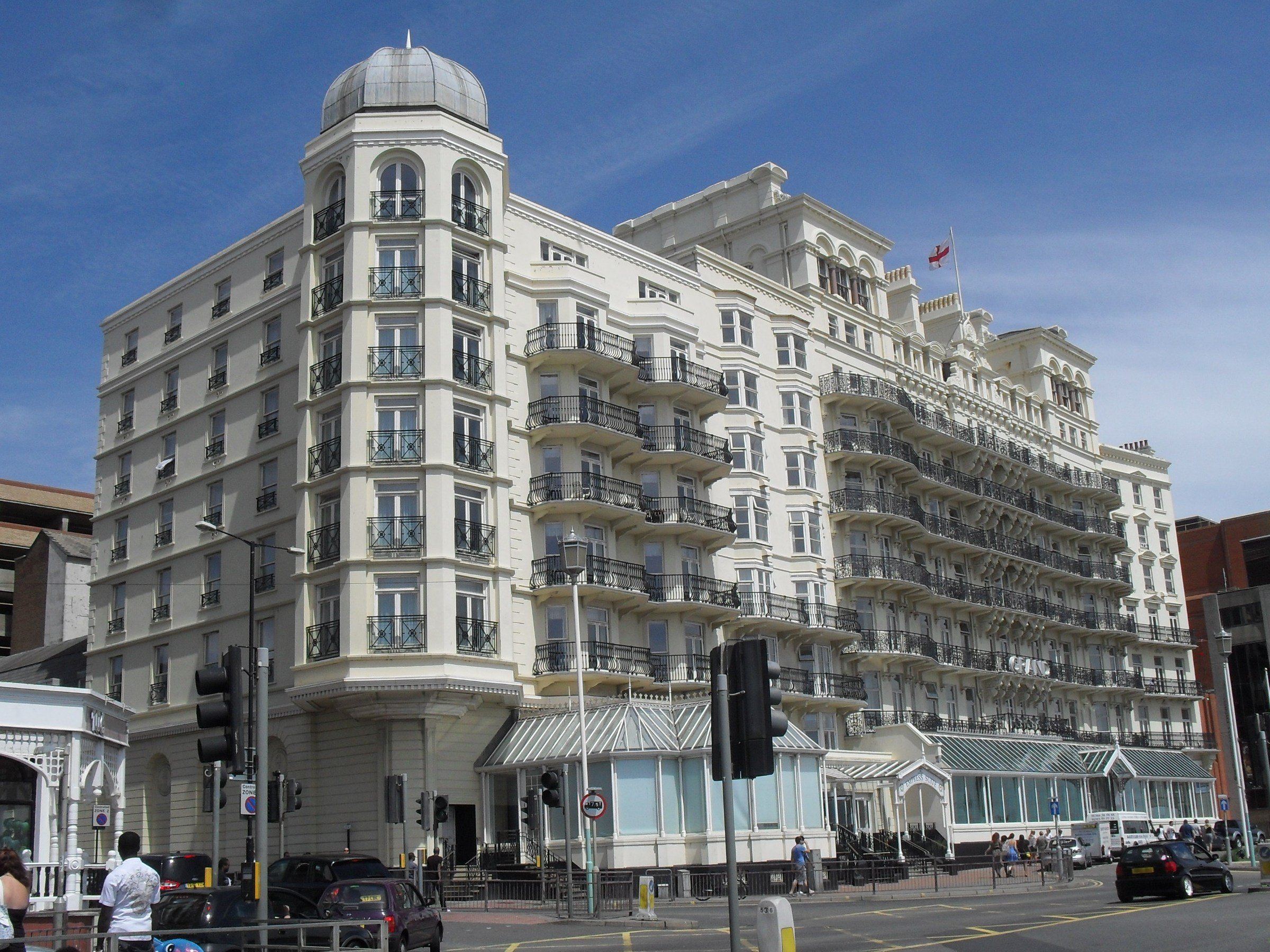
The Grand Hotel facade hides the 1984 IRA bombing's aftermath — rebuilt to original specs.
palace-pier
Palace Pier
The working pier. Rollercoasters, slot machines, candyfloss, doughnuts, fortune tellers, the horse-race machine. Opened 1899 and still running exactly the same business model. The pier itself is 525 metres long; the views back at the city are the best vertical shots of Brighton.
Best for
fairground rides, the pier walk, proper fish and chips
Local note
Free to walk on; you only pay for rides.
madeira-drive
Madeira Drive
The long straight Victorian seafront road east of the Palace Pier, lined with a cast-iron colonnade and the Volks Electric Railway. This is where Mods and Rockers fought in 1964. It is also the start of the London-to-Brighton Veteran Car Run every November.
Best for
architecture walks, Volks Railway, the Whitsun bank-holiday reconstruction
Local note
The Madeira Lift (a Grade II-listed 1890 hydraulic lift to the promenade) is being restored.
kemptown
Kemptown & Duke's Mound
The eastern stretch. Regency terraces, steep streets, and Brighton's gay village — Kemptown has been the UK's longest-running openly queer neighbourhood. Duke's Mound, a small patch of coast here, was designated the UK's first legal naturist beach in 1980.
Best for
queer Brighton, quieter beach, Regency gardens
Local note
Walk east of the Palace Pier or you miss the real Brighton.
· A Day Here
Dawn runners to neon fish-and-chips — hour by hour, in September
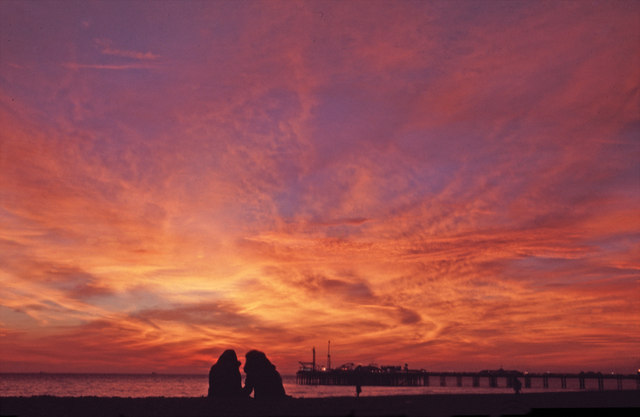
Brighton sunset with the Palace Pier. Brighton's golden hour is short, hard, and catches the Regency stucco at a very specific angle.· CC BY-SA 2.0
Dawn
On a clear morning the Palace Pier's lights are still on as the sky lightens behind it. Fishermen work the shallows off the Hove breakwater. A handful of cold-water swimmers — the Brighton Swimming Club, founded 1860, operates year-round — enter at Banjo Groyne. The promenade is empty except for runners and dog-walkers. The air is usually below 10°C. The West Pier's iron skeleton is at its most dramatic in the first hour of light, silhouetted against the sea haze.
Midday
By mid-morning the beach fills with day-trippers from London — the Brighton Line delivers them in waves. Deckchairs appear on the pebbles. Fish and chips are eaten on the Palace Pier. The Lanes and the North Laine behind the seafront are packed with vintage shoppers. In summer temperatures reach 20-22°C and the pebbles get hot enough to burn bare feet. Kite-surfers work the wind off the Hove shore when the south-westerly is up.
Golden
Brighton's golden hour is specifically short and specifically magical — the light comes in low off the sea at a hard angle, turns the Regency stucco peach, and catches the iron of the West Pier from the west. Crowds gather at the end of the Palace Pier for sunset; the photograph most people come for happens here. The i360 pod rises slowly. From Kemptown hill, you can see the whole arc of the city lit in amber.
Night
The Palace Pier lights up. The Victorian lamps along Madeira Drive come on. Kemptown fills for drinks — Revenge, The Marlborough, The Queen's Arms, the gay capital working at full volume. Under the Palace Pier, teenagers and tourists throw chips to the herring gulls. In summer the music is visible through open doors. In winter the pier is a neon streak in the dark sea and the rest of the seafront is empty by ten.
· History
Seven dates that made Brighton Brighton
A 1754 medical thesis, a Regency prince's taste in onion domes, a railway, two Victorian piers, an IRA bomb, and a 2003 fire.
1754 · cultural
Richard Russell's seawater cure thesis
The Lewes physician Richard Russell publishes a Latin dissertation arguing that drinking and bathing in seawater cures scrofula. The medical fashion that follows effectively invents the modern seaside holiday as a health treatment.
Architect John Nash begins transforming the Prince Regent's Brighton residence into the Royal Pavilion — an Indo-Islamic fantasy with onion domes, chinoiserie interiors, and a cast-iron kitchen. Completed 1822. Still the most unusual royal building in Britain.
The London & Brighton Railway inaugurates service, cutting the journey from a day to three hours. Brighton is now a weekend city for the London middle class. The seaside resort as we know it — three-day-trip, not three-week-cure — is born.
Designed by Eugenius Birch, the West Pier is the most elegant of Britain's Victorian iron piers — a 340-metre promenade with pavilion, concert hall, and landing stage. It closes in 1975 and burns in 2003-2004, but its skeleton is still there.
The Brighton Marine Palace and Pier — universally called the Palace Pier — opens. Ten shillings and sixpence to build. Fairground rides, slot machines, a concert hall at the end. Still working. Still selling doughnuts.
In the early hours of 12 October 1984, an IRA bomb planted by Patrick Magee detonates in the Grand Hotel during the Conservative Party conference. Prime Minister Margaret Thatcher survives. Five others die. The bombing reshapes British security culture for a generation.
On 28 March 2003, a fire — never formally solved — destroys the West Pier's concert hall. A second fire follows in May 2003 and a third in December 2004. The pier collapses progressively over the next decade. The iron skeleton that remains becomes Brighton's most photographed landmark.
Three cultural events Brighton exported to the world
Brighton Rock (1938) — the razor blade under the pier
Graham Greene's 1938 novel is the single most influential literary rendering of Brighton and, by extension, of English seaside noir. The book — which follows the Catholic teenage gangster Pinkie Brown through a murder and its aftermath among the Brighton razor gangs of the 1930s — takes its title from the peppermint stick with 'BRIGHTON' running through its middle, the candy still sold on the seafront. Greene wrote it partly as an argument with himself about Catholic grace and damnation, partly as a portrait of a specific Brighton subculture (the race-track gangs of the 1920s and 30s, the so-called 'boys' with bicycle chains and razors) that actually existed. The 1947 Boulting Brothers film of the novel, with Richard Attenborough as Pinkie, was shot on location. Brighton's reputation as a slightly dangerous, slightly glamorous, specifically English seaside destination is Greene's invention as much as the Regent's. The Royal Albion Hotel on the seafront — where several scenes are set — still trades partly on the novel's recognition.
Mods vs Rockers, 1964 — and Quadrophenia's long tail
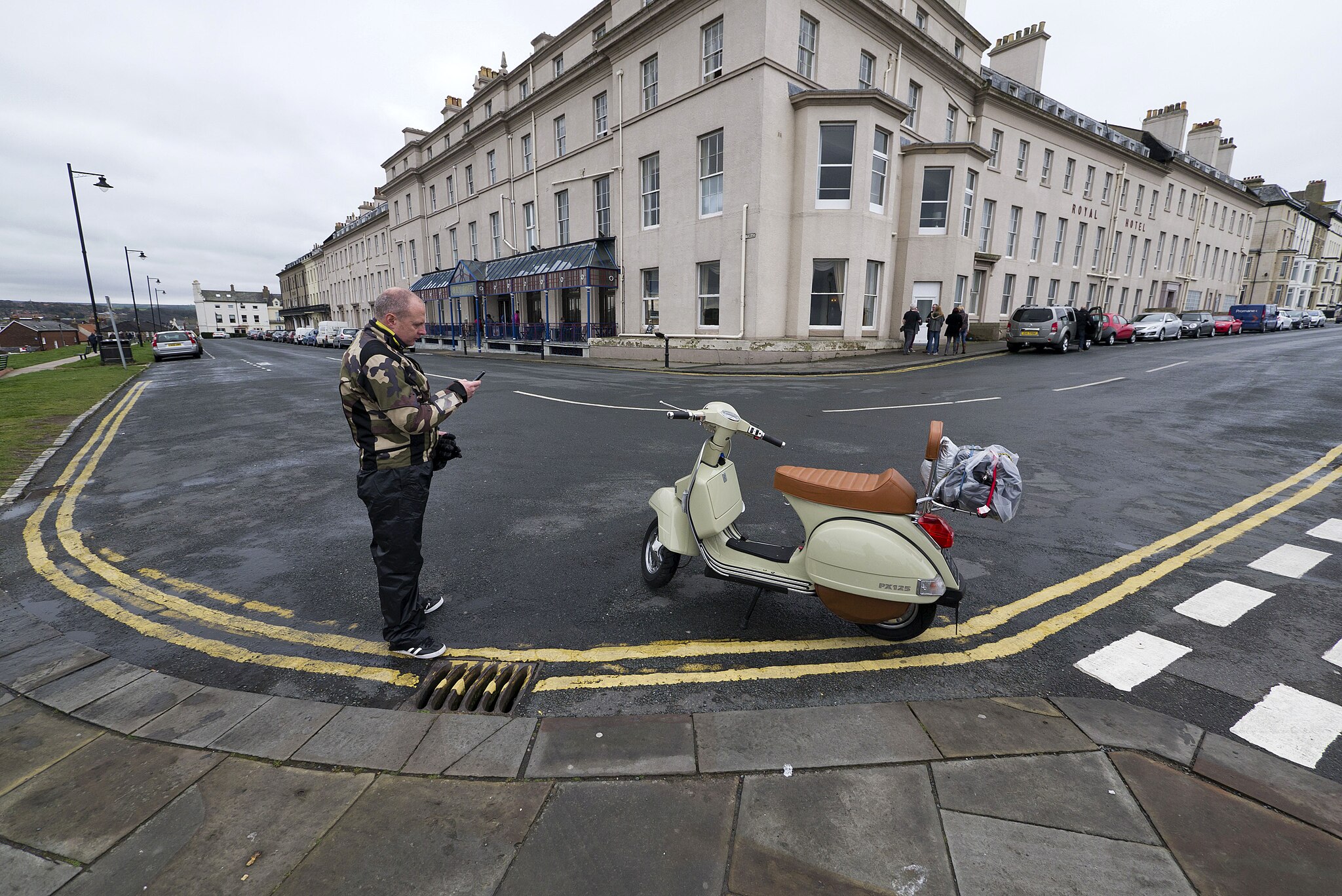
On the Whitsun bank holiday of 1964, Mod scooter gangs and Rocker motorbike gangs converged on Brighton's Madeira Drive and the Aquarium terraces for what the newspapers called, with some exaggeration, a pitched battle. The actual violence was less dramatic than the photographs suggested — most of the damage was to deckchairs — but the images ran in every British paper. The Mods-vs-Rockers moral panic became the defining British youth-culture moment of the decade, and the Brighton seafront became, by association, the canonical British youth-rebellion setting. Pete Townshend of The Who had been at the 1964 clashes; his 1973 rock opera Quadrophenia — about a Mod called Jimmy — ends on Brighton Beach. The 1979 film version, shot on location on Brighton Beach and in Kemptown, hard-wired Brighton into British cinema canon. Every scene of the bike chase along the promenade, every shot of Jimmy on the pebbles, was filmed within walking distance of the Palace Pier.
A Mod scooter rally — not specifically the 1964 Brighton incident, but representative of the visual culture that made Quadrophenia, and Brighton, canonical.· Bryan Ledgard · CC BY 2.0
Brighton as political stage — from the 1984 bomb to the Pride parades
Brighton has been the site of several of post-war British politics's most dramatic moments. In the early hours of 12 October 1984, during the Conservative Party conference, an IRA bomb planted by Patrick Magee detonated in the Grand Hotel on Kings Road. Prime Minister Margaret Thatcher was in her bathroom; she survived. Five others died, including Deputy Chief Whip Sir Anthony Berry and the wife of the Cabinet Secretary. The Grand was rebuilt and reopened two years later; the IRA's statement afterwards — "Today we were unlucky, but remember we only have to be lucky once" — is still studied in British security-service training. A decade later, in 1992, Brighton held its first Pride parade. By the 2010s, Brighton & Hove Pride had become the largest Pride in the United Kingdom, drawing 400,000+ participants across the first August weekend. Brighton's move from Tory conference city to queer-capital city happened in the same two decades. The town holds both histories without obvious contradiction.
The Grand Hotel on Kings Road — rebuilt after the 1984 IRA bombing. The bomb killed five and very nearly killed Margaret Thatcher. Most British Conservative politicians of a certain age still have a view on that night.· The Voice of Hassocks · Public domain
· The Other Brighton
The half of Brighton the Palace Pier doesn't show
Kemptown is a mile east of the Palace Pier. It is not an extension of the tourist seafront — it is a specific neighborhood with a specific history, and it is the reason Brighton became Brighton. The pier-and-fish-and-chips Brighton is ten percent of the town. This is the other ninety.
A Kemptown street scene. Regency terraces, jet-black iron lamp posts, rainbow flags, pre-war pub signage. This is where Brighton gets interesting.· CC BY-SA 2.0
Kemptown is the Brighton neighbourhood just east of the Palace Pier — Regency terraces, steep streets, the Royal Sussex County Hospital, and since the early twentieth century the epicentre of gay Brighton. The first documented Brighton gay pub, The Chequers, opened here in the 1940s. By the 1970s and 80s, Kemptown was one of the few places in the UK where openly gay culture could exist at scale; clubs like Revenge and Legends became Europe's Saturday-night landmarks. The annual Brighton & Hove Pride parade, first held in 1992, is now the UK's largest Pride and draws over 400,000 people across the weekend.
The queer heritage matters for a travel page because it is inseparable from the beach itself. The Kemptown seafront at Duke's Mound — a small patch of coast about a mile east of the Palace Pier — was the UK's first legally tolerated naturist beach, designated 1980 after years of informal use. It was also, for most of the twentieth century, one of the few outdoor gay cruising grounds in the country where police arrests did not happen nightly. That history is not a footnote; it is why Brighton became Brighton.
A visitor walking east from the Palace Pier toward Kemptown can read the city's layers in order: the Victorian stucco of the central seafront, the jet-black iron lamp posts of the Kemptown hill, the rainbow flags, the pubs with their pre-war signage, the garden squares hidden behind the streets. If you never walk east of the Palace Pier, you have seen the tourist Brighton — and missed the actual Brighton.
· On the Sussex Coast
Four places within an hour
20 km east
The Seven Sisters
Seven chalk cliffs rolling into the English Channel east of Eastbourne. The most-photographed coastal cliffs in England, visible at the end of the Sussex Heritage Coast walk. The headland — Cuckmere Haven — is one of the last undeveloped river mouths on the south coast. Ninety minutes by car from Brighton; easier by train to Seaford plus bus.
12 km north-east
Lewes
The Sussex county town where Richard Russell first wrote his seawater-cure thesis in 1754. Norman castle, medieval streets, the Bloomsbury-associated Charleston farmhouse 5 km out, and — every 5 November — the Lewes Bonfire night, by some accounts the largest Guy Fawkes celebration in England. Fifteen minutes by train from Brighton.
10 km north
Devil's Dyke
The deepest dry valley in Britain — a chalk cleft in the South Downs, roughly 100 metres deep, visible from the A23 as you approach Brighton. National Trust land. A half-day walk from the city bus terminus or a 15-minute drive; picnic country, kite-flying, the view south toward the Channel is the opening shot of most English-countryside films.
35 km west
Arundel
The medieval castle town in West Sussex, seat of the Duke of Norfolk. Arundel Castle is one of the longest continuously-inhabited private residences in England (since the 11th century). Half-day trip from Brighton by train; the castle grounds and the Fitzalan Chapel are the core. Pairs well with Chichester and the South Downs.
Written by Erin Rose. Historical material on the Pavilion follows the Royal Pavilion & Museums Trust published documentation. Pier material draws on the West Pier Trust archives and contemporary press coverage of the 2003 fires (cause never officially determined). Graham Greene's Brighton Rock and its film adaptations, Quadrophenia's 1964 Mods-vs-Rockers reconstruction, and the 1984 IRA bombing are treated from the standard published scholarship. Queer-Brighton material from the Brighton Ourstory Project and the Royal Pavilion Museum's dedicated LGBTQ+ history programme. Version v0.9. Corrections welcome, particularly on Pavilion-interior detail and on current-decade Kemptown venue status.