The canyon made the village. 900 years later it made the village famous for something else. It's still the same village.
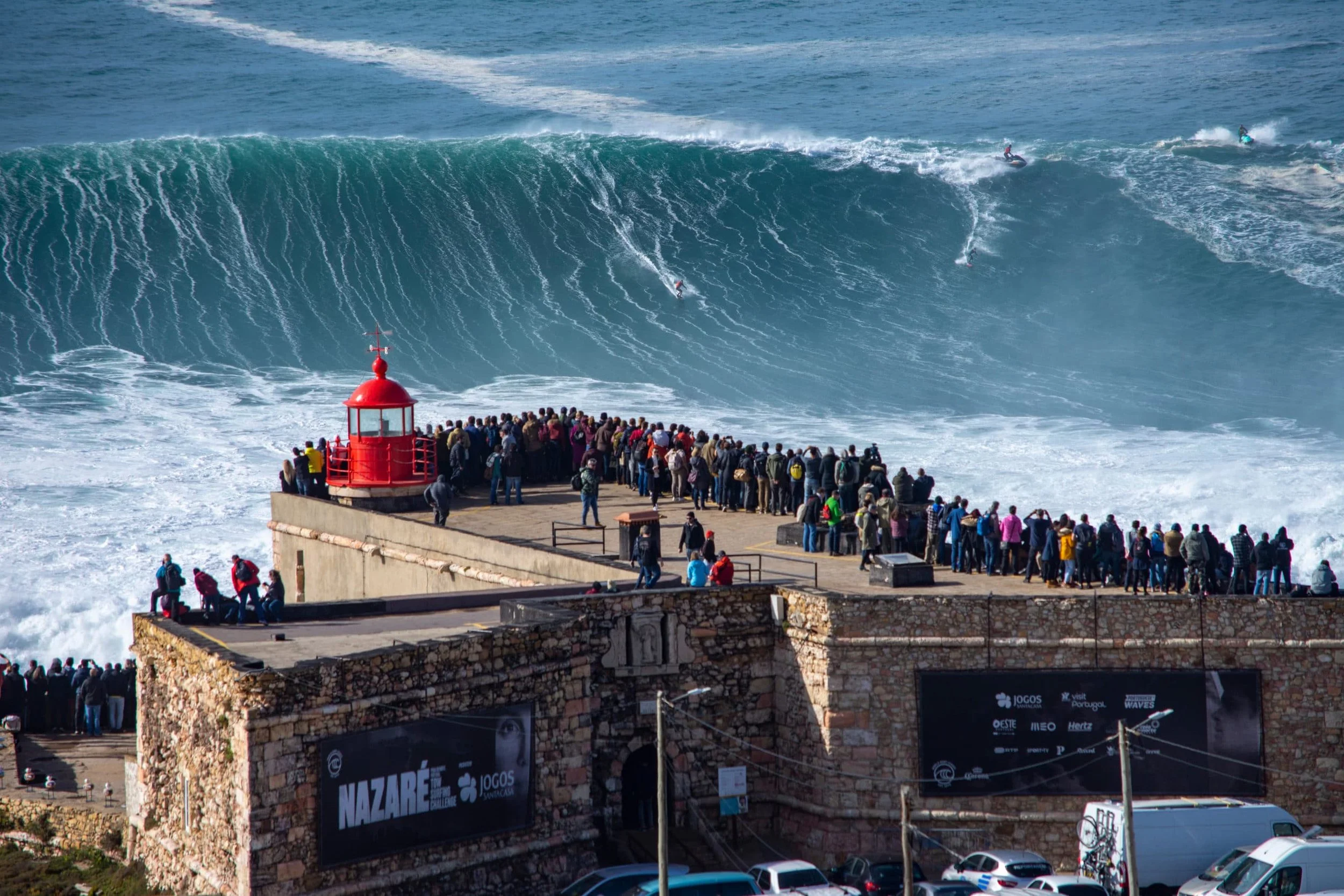
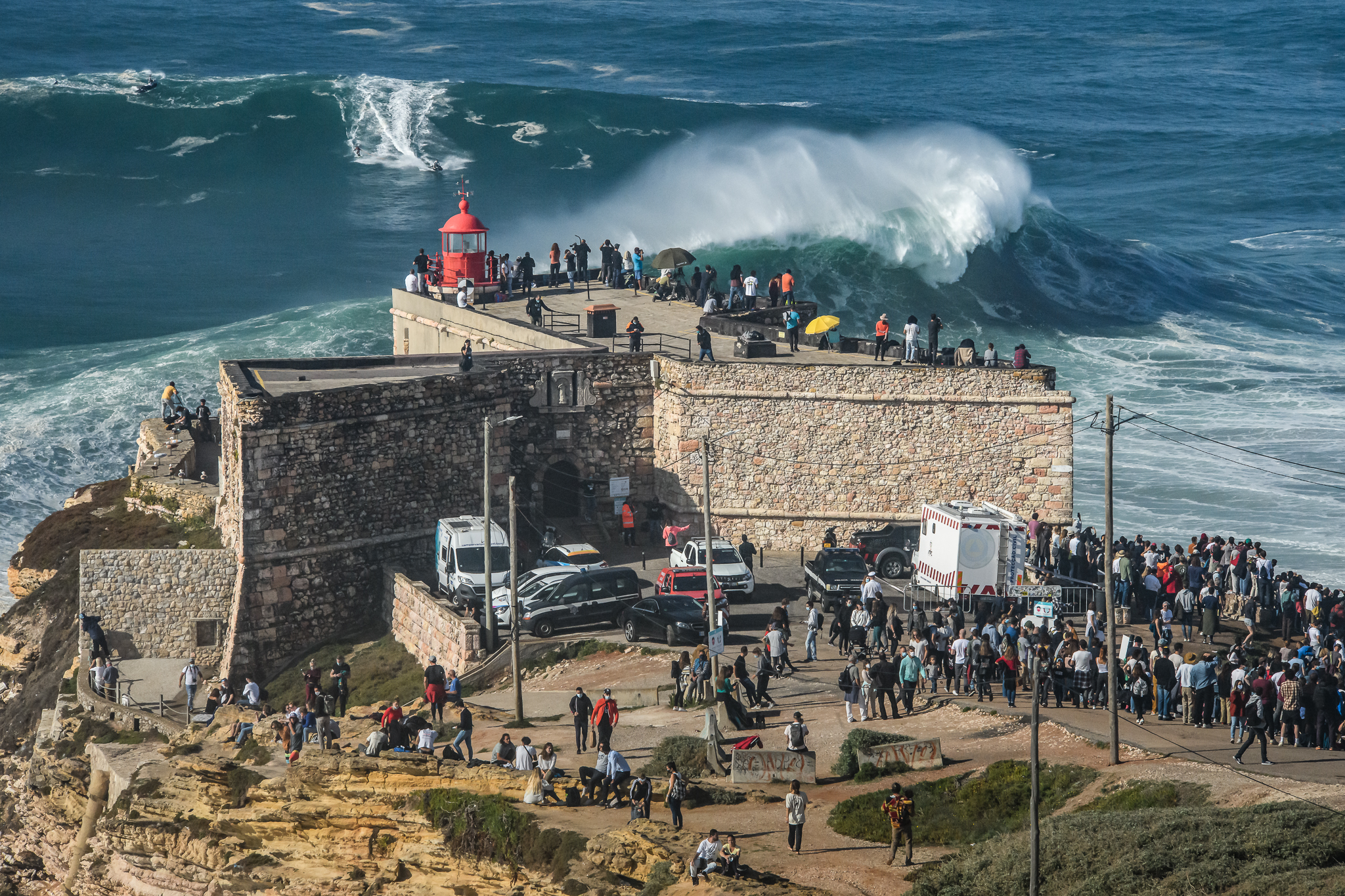
The fortress, the crowd, and the wave — Praia do Norte on a big-wave day · via nazarebroadcasting.com · Editorial use
· Story
Nazaré is a fishing village on the Portuguese Atlantic coast where the seabed drops five thousand meters straight down less than a kilometer from shore. For most of 900 years the village worked the sardine fishery that the canyon's cold upwelling feeds, and nobody outside Portugal had heard the name.
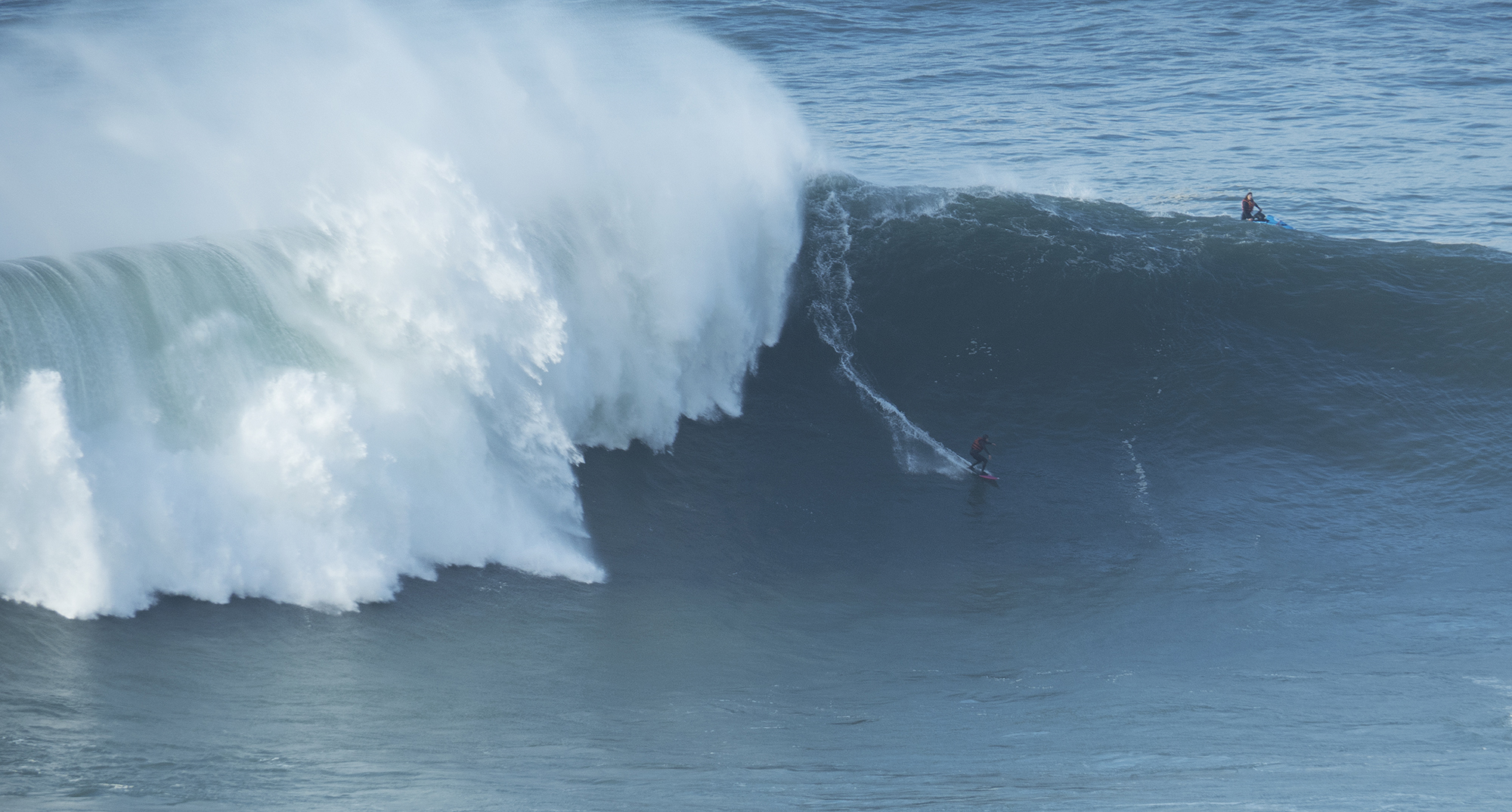
Then in November 2011 a Hawaiian surfer named Garrett McNamara was towed into a wave at Praia do Norte — the beach directly below the Sítio cliff — and the photograph of a speck at the base of a 78-foot wall of water, with a white lighthouse visible at the cliff's edge, became one of the most-reproduced images in surfing history. In the fifteen years since, Nazaré has become the site of every current big-wave world record, the subject of three seasons of HBO documentary, and the centerpiece of Portugal's international tourism campaign.
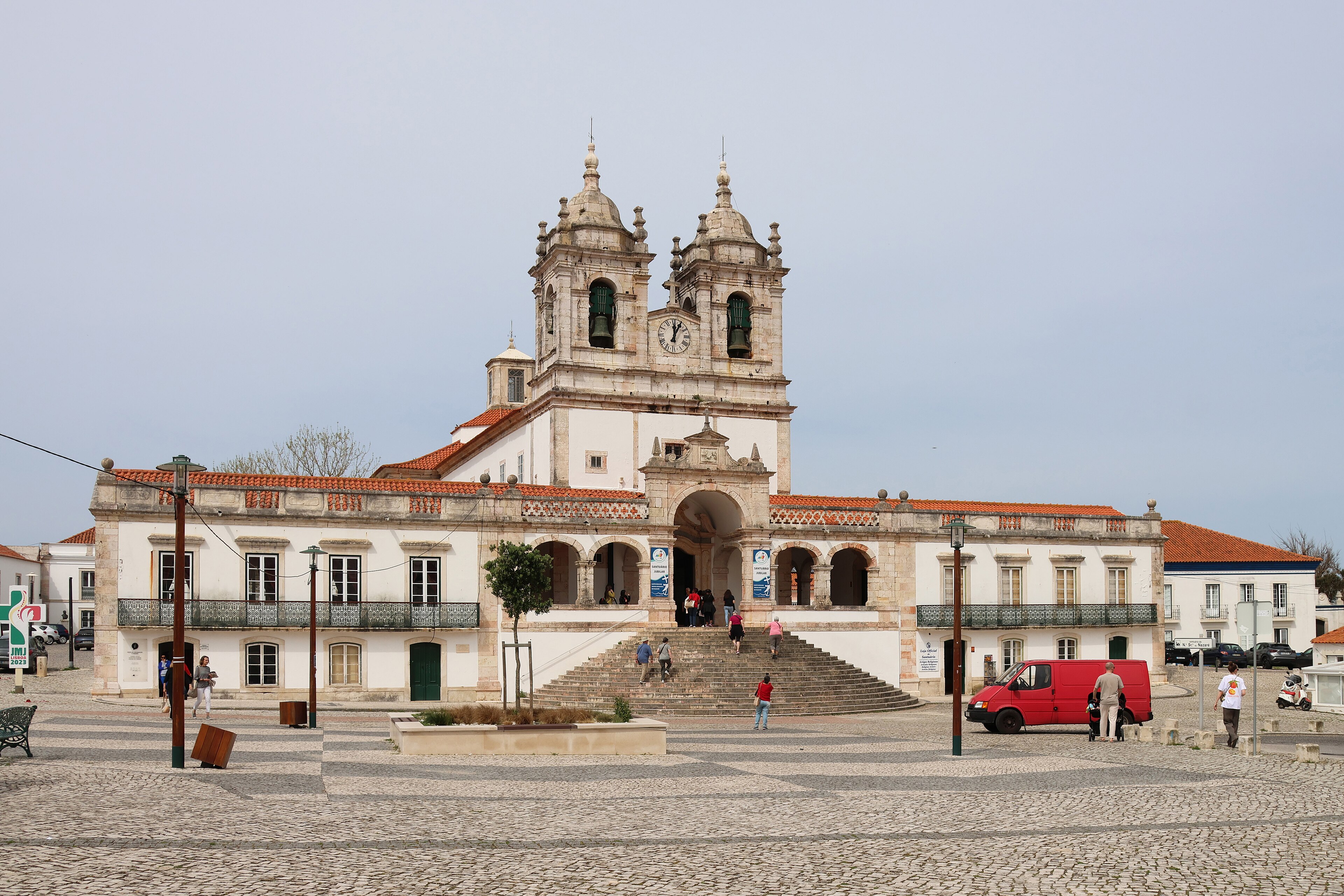
None of the 900 years stopped. The fishermen still sail. The fishermen's widows still dry sardines on wooden racks on the village beach. The sete saias — the seven-skirt dress of Nazarené women — is in a 2023 UNESCO Intangible Cultural Heritage file. The Marian pilgrimage every September 8 still draws close to 100,000 people to the cliff-top sanctuary that was built in 1377 around a statue the legend says stopped a nobleman's horse from plunging into the Atlantic in 1182.
This page is about the canyon that did both things. It is also about the village that is still the village.
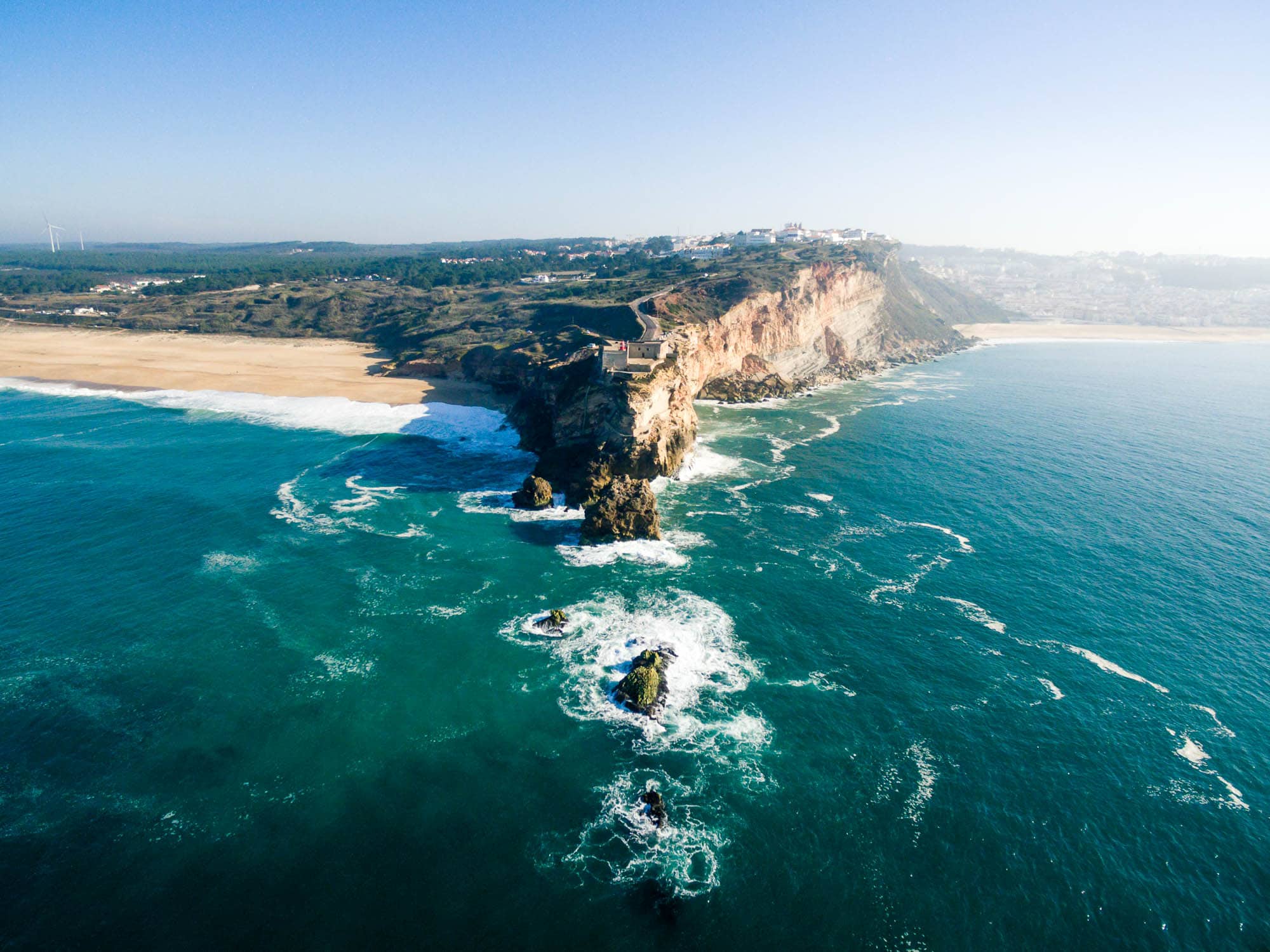
The Sítio headland from offshore. The Nazaré Canyon begins roughly 500 meters off the sand visible at bottom-left and runs five kilometers straight down to the Iberian Abyssal Plain.· Ben Kepka (Cultured Kiwi)
· The Canyon
The same canyon makes the wave and feeds the village
A 230-kilometer submarine trench begins 500 meters off this beach. It produces the world's largest surfable wave. It has also, for nine centuries, fed the fishery the village lived on. One feature, two gifts, one village.
The mechanism that makes the wave
The Nazaré Canyon — Canhão da Nazaré — is one of the largest submarine canyons in Europe. Its shoreward head begins approximately 500 meters off the coast at Praia do Norte and runs west for 230 km, plunging to 5,000 meters at its terminus. Submarine canyons exist off many coastlines. What makes this one produce waves no other does is two features of its geometry.
Swell refraction along the canyon axis. When a winter Atlantic swell arrives from the northwest, part of the wave front crosses the canyon's north rim and continues over the shallow shelf. The other part runs down the canyon axis through much deeper water. Deep water is fast; shallow is slow. The two halves re-converge near the shore in phase. Amplitudes add. A 4-meter open-ocean swell becomes, at the break, an 8-meter wave.
The bathymetric ramp at the canyon head. The seafloor rises from 95 meters to the beach within roughly 500 horizontal meters. Water arriving from the deep canyon has all the speed and mass of deep-ocean water, and when it hits the ramp it has nowhere to go but up. The wave face rears, the crest folds. Researchers at the University of Lisbon and Portugal's IPMA (Instituto Português do Mar e da Atmosfera) published the mechanism in 2013.
Schematic west-east cross-section (not to scale). The canyon head is less than half a kilometer off the beach; the deep terminus sits on the Iberian Abyssal Plain, 230 km offshore.
The mechanism that feeds the village
The canyon is not only a wave factory. It is one of the most biologically productive features on the Iberian coast. Submarine canyons are nutrient pumps — cold, nutrient-rich deep water is driven up the canyon walls by interaction with the continental current, fertilising the photic zone above. The upwelling supports pelagic shoals — sardine, mackerel, horse mackerel — and the predators that follow them. Sperm whales feed on squid in the canyon's mid- depths year-round; they are visible offshore most months. Blue sharks and short-finned pilot whales work the edges.
This productivity is why there has been a fishing port on this headland since the 12th century. The arte xávega — the beach-seine method in which enormous nets were rowed out and then dragged back by teams of oxen (later, tractors) hauling from the sand — was Nazaré's industry for 400 years. The catch was divided by a formal share system: a share to the boat owner, shares to the companha (the crew), and a share set aside as the quinhão dos pobres — the portion of the poor. Portuguese fishing fleets reached Newfoundland for cod in the 1490s, and Nazaré was one of the coastal ports that salted and dried the catch. The estendal — the wooden racks where sardines still dry on the village beach — is the living descendant of that 500-year salt-fishery practice.
The canyon produced the fishery. The fishery produced the village. Eight hundred years later the same canyon produced the wave that made the village globally famous. Two gifts from one feature of the Earth, separated by almost all of recorded Portuguese history, landing in the same kilometer of sand.
What kind of feature this is
Submarine canyons are not rare in the abstract — the Atlantic margin is lined with them. What's unusual about Nazaré is its size combined with its nearshore position. The canyon is comparable to California's Monterey Canyon (which feeds the Mavericks big-wave break) in length, and far exceeds it in depth. Its head is closer to shore than almost any comparable canyon on Earth. Geologically it was cut during sea-level lowstands in the late Miocene and Pliocene, roughly 20–24 million years ago, by a combination of ancient rivers and repeated mass-flow events (undersea landslides and turbidity currents). It is still active; small slumps of the canyon walls occur continuously, and the larger ones generate minor tsunamis recorded on tide gauges up the Portuguese coast. The canyon is part of the plumbing of the 1755 Lisbon earthquake and tsunami — one of Europe's defining natural disasters — which is believed to have been amplified by canyon-related bathymetry along this stretch of coast.
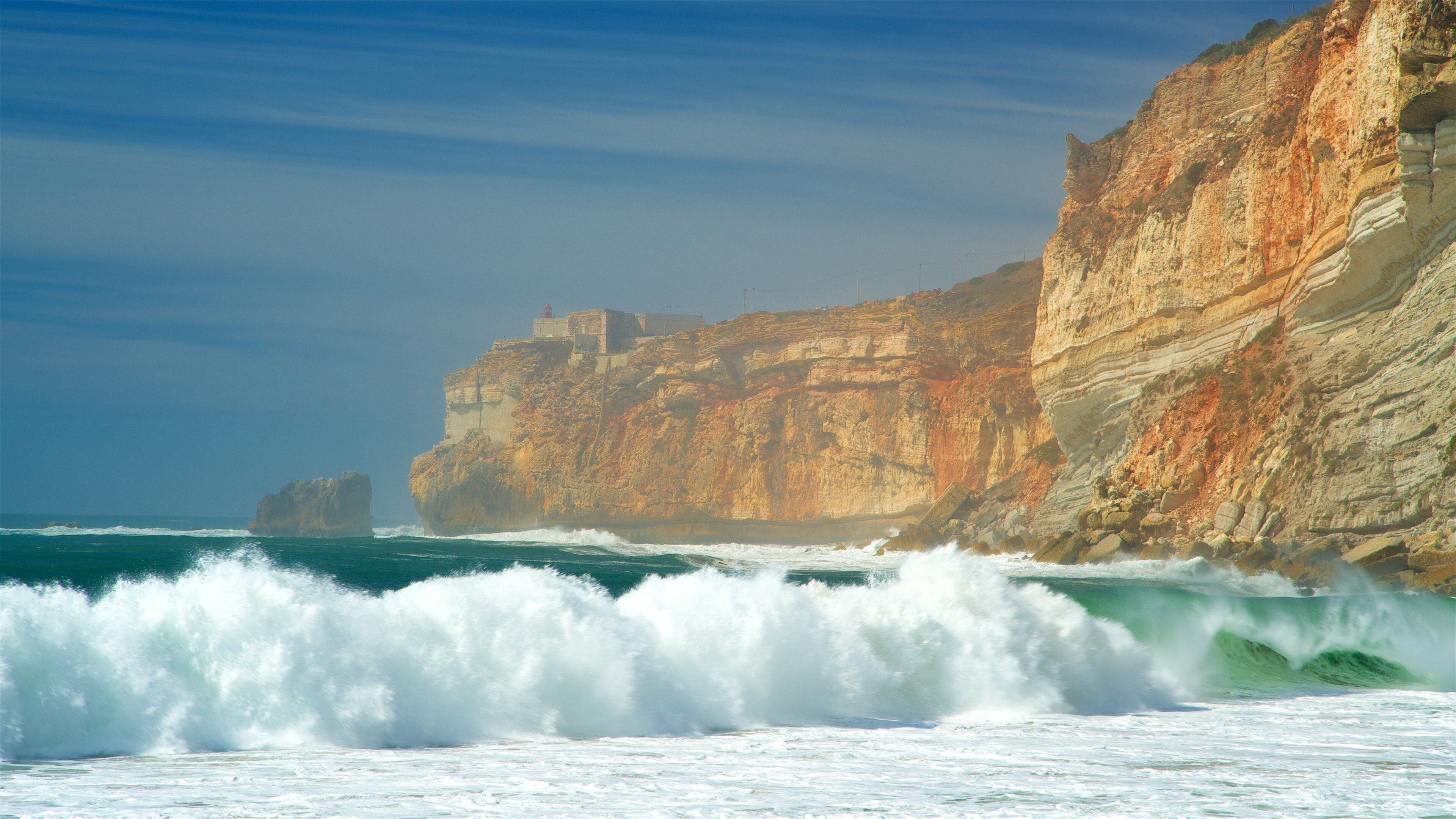
Shore break at the base of the Sítio cliff — the 95 m → 0 m ramp compressed into a few hundred horizontal meters. The same ramp that throws the winter wave also drives the upwelling that feeds the sardines.· trvl-media / Expedia Group
· Water Stories
Three things that happen on a 26-meter wave
The records are a spreadsheet. What the surfers are actually doing in the water is — by an order of magnitude — the most dangerous thing anyone does in sport.
i · The Inflection
From a local bodyboarder's email, 2005
The modern Nazaré era begins with an email from a Nazarené bodyboarder named Dino Casimiro to the Hawaiian big-wave surfer Garrett McNamara. Casimiro had grown up watching the winter sets break below the Sítio cliff and understood, without any technical background, that something unusual was happening in the water offshore. He sent a series of photographs with the note that McNamara might want to come take a look. McNamara ignored the first several. He eventually replied. He flew out in 2010 to see for himself.
On 1 November 2011, McNamara was towed by jet-ski into a wave at Praia do Norte later measured by Guinness at 23.77 meters (78 feet) — at that moment the largest wave ever surfed under any recognized standard. The photograph of McNamara as a speck at the base of the wave, with the Forte lighthouse visible on the cliff beside it, went globally viral within a week. Within six months Praia do Norte had a permanent water-taxi service, a jet-ski launch at the fortress, camera drones on every swell day, and a European big-wave community that had never previously existed. The email was the beginning of all of it.
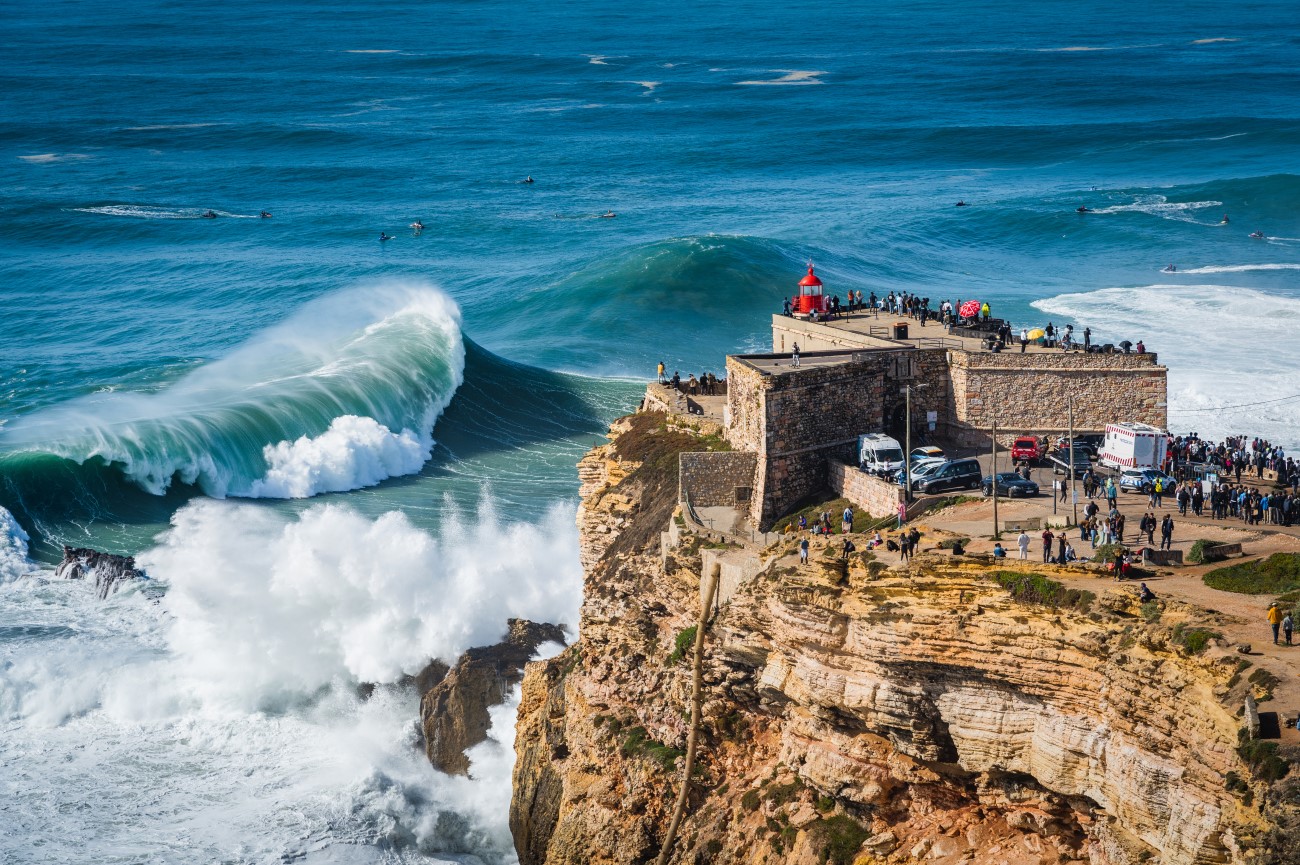
Praia do Norte on a mid-sized swell day. Surfers are visible offshore; crowd at the fortress ramparts.· Revigorate
ii · The Wipeout
What a Nazaré hold-down physically is
A wipeout at Praia do Norte is not a single event. The wave breaks, the surfer is separated from the board, the surfer is driven under the surface and along the seabed for a distance that depends on the wave's energy. The problem is the second wave. The sets here arrive in trains of three to six, roughly fifteen-to-twenty seconds apart. A hold-down from the first wave ends as the next wave arrives, which means the surfer surfaces into the next breaking face and goes back down. Two-wave hold-downs of 45 seconds or more are routine at Nazaré. This is why every serious big-wave surfer at this break wears an inflatable flotation vest with a CO₂ canister triggered by a ripcord — the vest is the difference between a 90-second unconscious rescue and a drowning.
Two wipeouts define the sport's understanding of Nazaré.
In October 2013, Brazilian surfer Maya Gabeira was towed into a wave estimated at around 25 meters and separated from her board on take-off. She received two two-wave hold-downs. When fellow surfer Carlos Burle reached her on a jet-ski she was unconscious and floating face-down; he dragged her to the beach and administered CPR on the sand below the fortress. She survived with a broken fibula and nerve damage. She returned, rebuilt her technique, and in 2018 set the women's world record at Nazaré at 20.7 meters; she extended it in 2020 to 22.4 meters. The wave that nearly killed her is the one her career is now built on.
On 5 January 2023, Brazilian big-wave pioneer Márcio Freire — one of the original Hawaiian paddle-in "Mad Dogs" group that first surfed Jaws without tow assistance in the early 2000s — died at Praia do Norte during a freesurfing session. He was 47. He was attempting a tow-in ride during an unusually clean mid-size swell. The exact mechanism of his death is not public, but the immediate cause was drowning following a hold-down. It was the first fatality at Nazaré in big-wave surfing history. The Forte flew its flag at half-mast for a week. The surf-community's relationship with this break was not the same afterwards.
iii · The Water-Safety Operation
Nobody paddles in at Nazaré
The wave face moves too fast for human arms — every ride here is a jet-ski tow at roughly 50 km/h, released at the moment the swell peaks. Each surfer is shadowed by a second ski with a rescue sled, keyed to the same 90-second wipeout-to-pickup margin that separates an unconscious surfer who recovers from one who doesn't. There is a small permanent water-safety community — Brazilian, Portuguese, Hawaiian — who live here October through February and run as paired teams. Surfing Nazaré → for the full tow protocol, the wetsuit-by-month chart, the records anthology, and the only big-wave comparison that makes sense (Jaws).
A tow-in ride at Praia do Norte. The small white object visible behind and above the surfer is the rescue jet-ski.· Alohamansurfer
· Three Beaches Under One Name
The map says Nazaré. The ground says something else.
Nazaré looks like one coastal town. On arrival it is three distinct places — two beaches and a clifftop — with three different oceans and three different purposes.
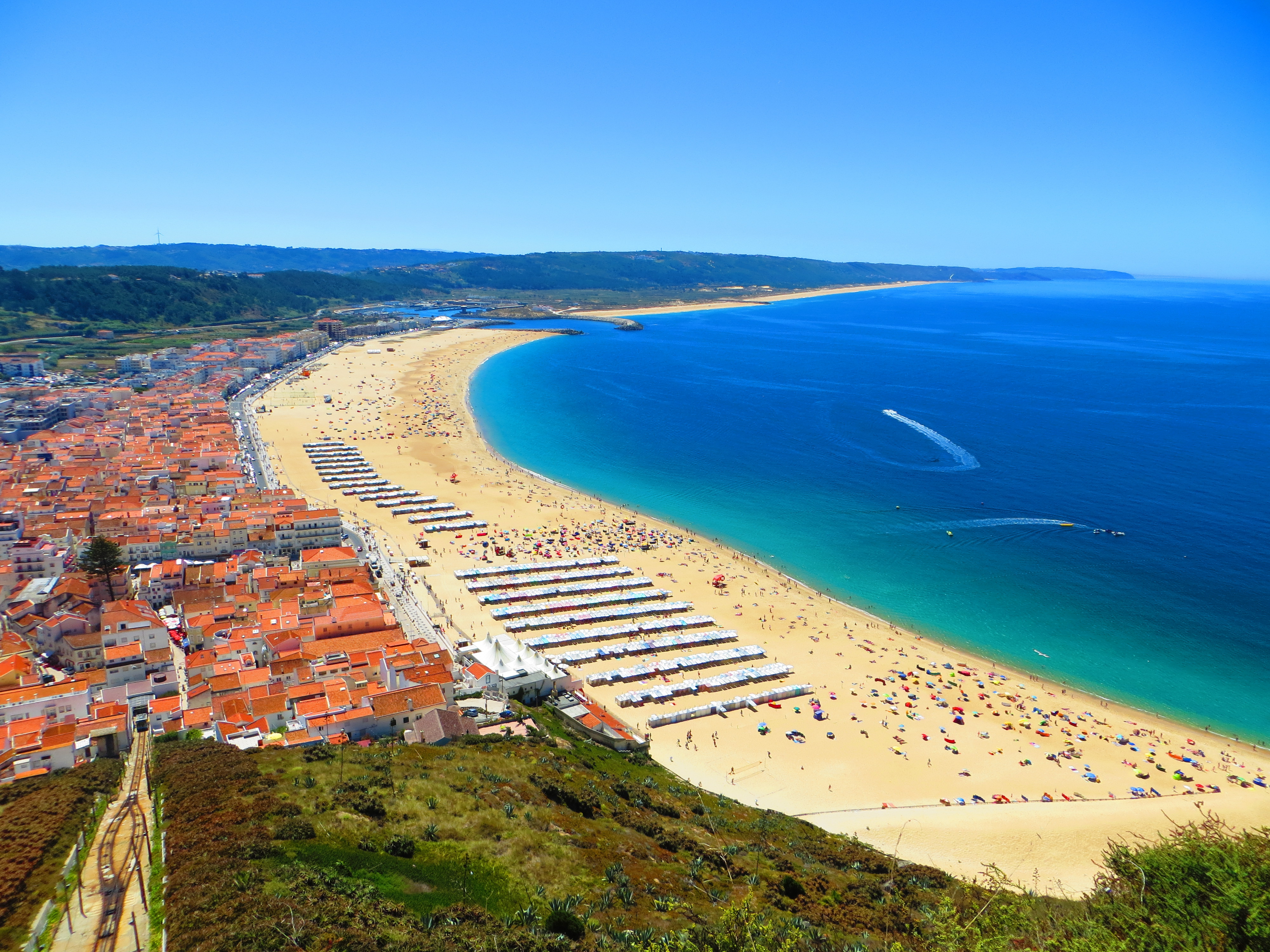
Praia da Nazaré — the village beach, the working fishery side of the headland. Calm, lifeguarded, family-safe. This is not the beach that the records are broken on.· panoramio contributor (Wikimedia Commons)
NORTE
Praia do Norte
The big-wave beach. 1.5 km of sand directly below the Sítio headland. October–February the waves here routinely reach 8–15 m; on peak swells, 20+ m. Outside swell season (April–September) it can be a sleepy empty beach with 3-meter shore break — still not great for casual swimming. Parking lot at the northern end gives the best view of the break.
Best for
Watching the big waves from the cliff (the Forte viewpoint is directly above); surfing only if you are at the top of the sport; photography
Take care
Do NOT swim at Praia do Norte. The rip currents are lethal even in summer.
VILA
Praia da Nazaré (village beach)
The working fishing beach in front of the old town. Protected by the Sítio headland to the north. Calm water, gentle slope, the wooden drying racks (estendal) for sardines are the iconic feature. The beach is used by both tourists and fishermen; there are dedicated areas for fishing-boat pulls.
Best for
Family swimming, photographing the sardine-drying racks, lunch at the kiosks, fish market right behind
Take care
The estendal — the wooden racks with fish drying in the sun — are a working practice, not a display. Ask before photographing the women working them.
SITIO
Sítio (upper town)
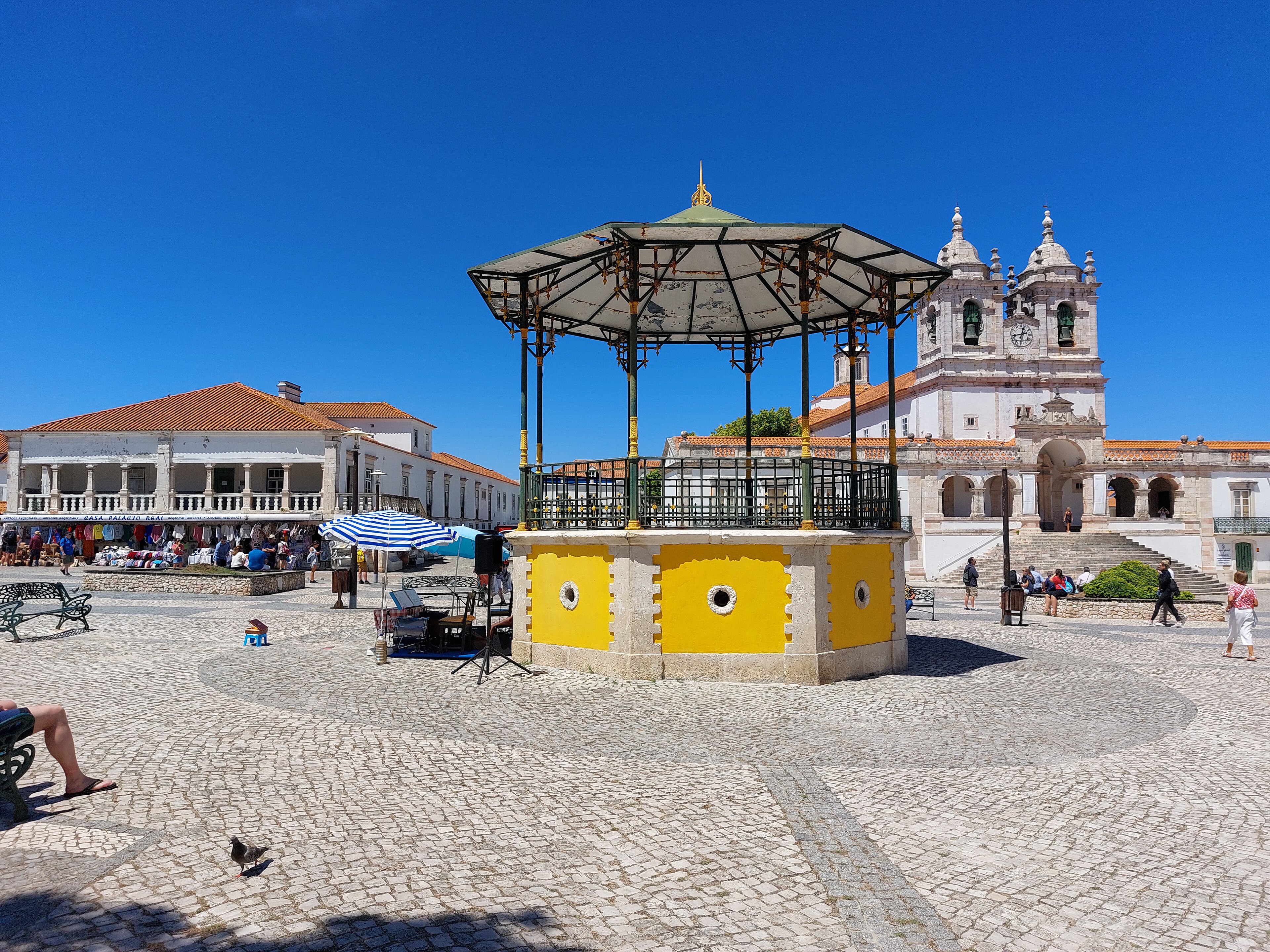
The clifftop neighborhood — 120 m above the lower village. Reached by the Funicular, the 175-step Capuchinhos stair, or winding road. Home to the Santuário da Nossa Senhora, the Forte de São Miguel Arcanjo lighthouse, the Surf Museum, and the café-filled main square.
Best for
The best viewpoint in town. The 4 p.m. cliff promenade. Sunday mass at the sanctuary.
Take care
In winter during big-wave sessions, the cliff at the Forte fills with hundreds of spectators. Arrive by 11 a.m.
· A Day Here
What it feels like, hour by hour, in December
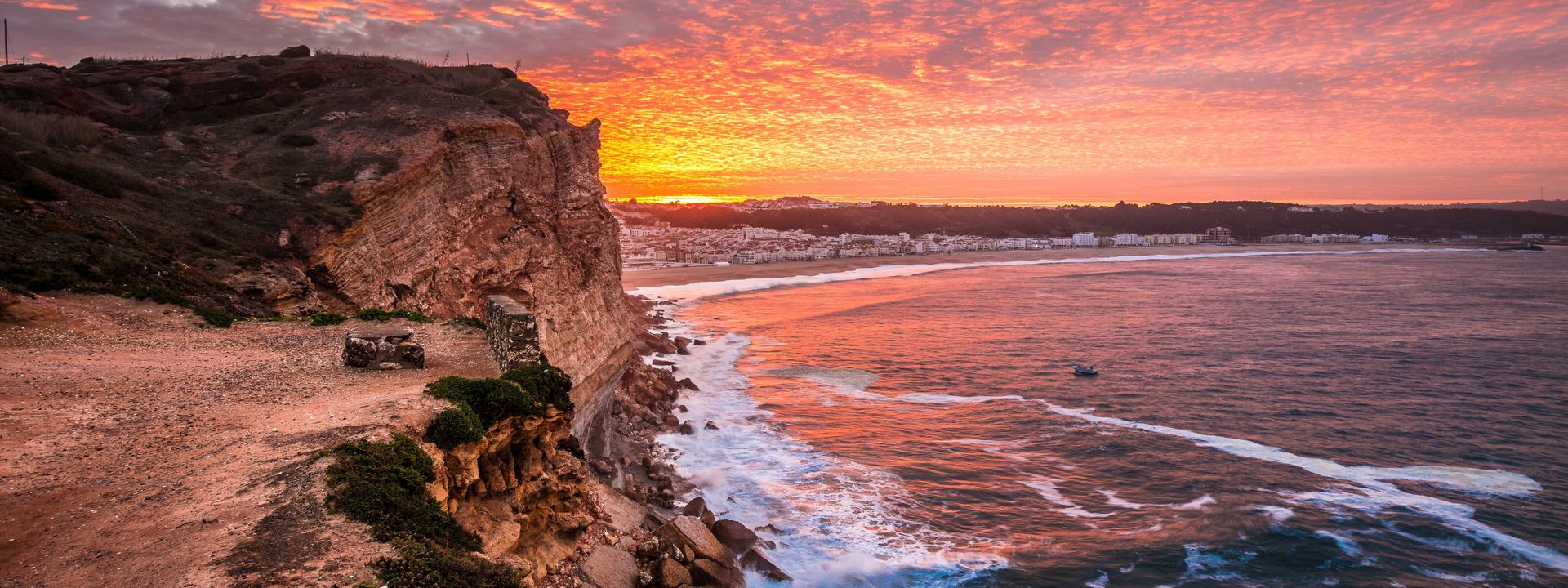
The Sítio cliff at sunset. December through March the money session is the 4 p.m. hour; the copper light on the wave faces is the signature of every famous Nazaré photograph.· Center-Portugal / Visit Centro
Dawn
The fishermen at the Praia da Nazaré port — the village's harbour, on the south side of the headland — are out before dawn if the weather allows. The men who surf Praia do Norte are parking their jet-skis at the Forte launch at first light. The Atlantic at Nazaré in December, 8 a.m., is a specific shade of grey that is almost blue and almost not. Surfers in 5mm wetsuits do gear checks from the cliff-top parking. The lighthouse is still lit. Coffee at O Pirata on Avenida da República opens at 6 a.m. for the fishing-fleet crews.
Midday
From 11 a.m. — if it's a swell day — the cliff top at the Forte fills with spectators. Drones over the water. Camera setups the size of small cars. In-the-know locals bring lawn chairs and thermoses. The surfers are maybe two hundred meters offshore, looking from here the size of pin-heads against waves that make the lighthouse look small. The shouts from the crowd when someone rides a set wave are audible from the Praia do Norte parking lot. Down in the village, Rua das Flores has the lunch crowd. The fisherwomen are setting out the afternoon's drying racks of sardines.
Golden
Late afternoon in winter, the sun is already low, and the light on the wave faces turns copper and then orange. The last session of the day is the money session — the famous photographs are mostly from the 4 p.m. to 5 p.m. window in December and January. The restaurants in Praia (lower town) begin to fill. Taberna d'Adélia has the first arrivals. The fisherwomen are packing up; the dried fish goes into storage. The funicular up to Sítio runs every ten minutes.
Night
The Praia da Nazaré waterfront is lit. The old lighthouse is visible from the village. Kiosks on Avenida Marginal stay open for tourists; locals eat dinner at 8 p.m. sharp. The Sítio church courtyard is quiet — occasionally a small group returning from the 7 p.m. mass at the Santuário de Nossa Senhora da Nazaré. If there's a big-wave forecast the next day, the surfers are in bed by 10 p.m.; jet-ski training requires first light. Offshore the wind shifts, the canyon begins to do what the canyon does, and the swell that arrives at Praia do Norte at 6 a.m. tomorrow is already rolling past the Azores right now.
· The Village
Arte xávega, seven skirts, and the people who still work this water
The fishery is older than the country it sits in. The practices that made Nazaré Nazaré are not in a museum.
Arte xávega — the 400-year method
Before jet-skis, before wetsuits, before the name of this village was known outside Portugal, Nazaré fished by the arte xávega — a beach-seine method in which an enormous net was rowed out in a long open boat, circled around a sardine shoal, and then dragged back to the sand by teams of oxen (replaced in the 20th century by tractors) pulling from ropes attached to both ends of the net. The arte xávega required the whole village: six to ten men in the boat, twenty or more on the beach, the ox-teams, the women who sorted the catch at the shoreline. It worked here because the canyon-driven upwelling brought sardine shoals close enough to shore to be netted from the beach.
The catch was divided by a formal share system called repartição. One share went to the mestre (the boat's master), multiple shares to the companha (the working crew), a share to the boat owner for the vessel's depreciation, and a portion — the quinhão dos pobres, the poor's share — reserved for widows, the disabled, and the village's poorest families. The share system is a reason the village has a particular texture: for centuries the fishery was not a private industry; it was a communally-distributed one.
Praia da Nazaré — the village beach where the arte xávega ran for four centuries. The wooden estendal racks are visible at the shoreline; the method that built this economy ended in the 1970s but the nets still come in on the same sand.· Luis Ascenso
The estendal — how a sardine actually dries
Walk the Praia da Nazaré between June and October and the single most-photographed practice of this village is in progress in front of you. Sardines are split along the belly (not gutted — the backbone is left in), brined briefly in salt water, dry-salted, and laid skin-side-down on wooden racks — the estendal — on the open sand. The racks are oriented along an east-west axis so that the Atlantic wind and the afternoon sun both reach the fish faces. The drying cycle is two to three days in the hot months, five to seven in early autumn, and ends when the fish snaps cleanly between the fingers. The finished product is the sardinha seca: intensely salty, grilled over charcoal, eaten whole with the head on and the fingers.
The women who work the estendal — almost all over 60, almost all in the traditional seven-skirt dress — are working, not performing. The practice was submitted by the Portuguese Ministry of Culture in 2023 as a candidate for UNESCO Intangible Cultural Heritage of Humanity, along with the dress. If you stop to watch, the etiquette is: buy sardines if you eat fish, ask before taking photographs, do not photograph the women's faces without eye contact. This is someone's afternoon, not a museum diorama.
The seven-skirt dress — corrected
The tourist-brochure explanation of the sete saias is that Nazarené women wore seven skirts "one for each day of the week." This is almost certainly apocryphal. The working explanation is more prosaic and more specific to the headland: a woman working the beach in December on the Portuguese Atlantic needed wind layers against the onshore gusts, cushions to kneel on the sand while sorting catch, fabric to bundle fish and firewood as she walked back up to the village, and insulation against the cold spray on an unprotected cliff. Seven layers of cotton and wool did the whole job. The seven became symbolic after it became practical — the number was canonised in Rafael Bordalo Pinheiro's ceramic figurines in the 1880s, which fixed the image of the Nazarené fisherwoman in the national imagination.
Santuário de Nossa Senhora da Nazaré — the 14th-century Marian sanctuary on the Sítio clifftop. The pilgrimage every 8 September is 900 years continuous.· Bernard Gagnon
Sítio, the upper town, 120 meters above the fishery.· Threeohsix
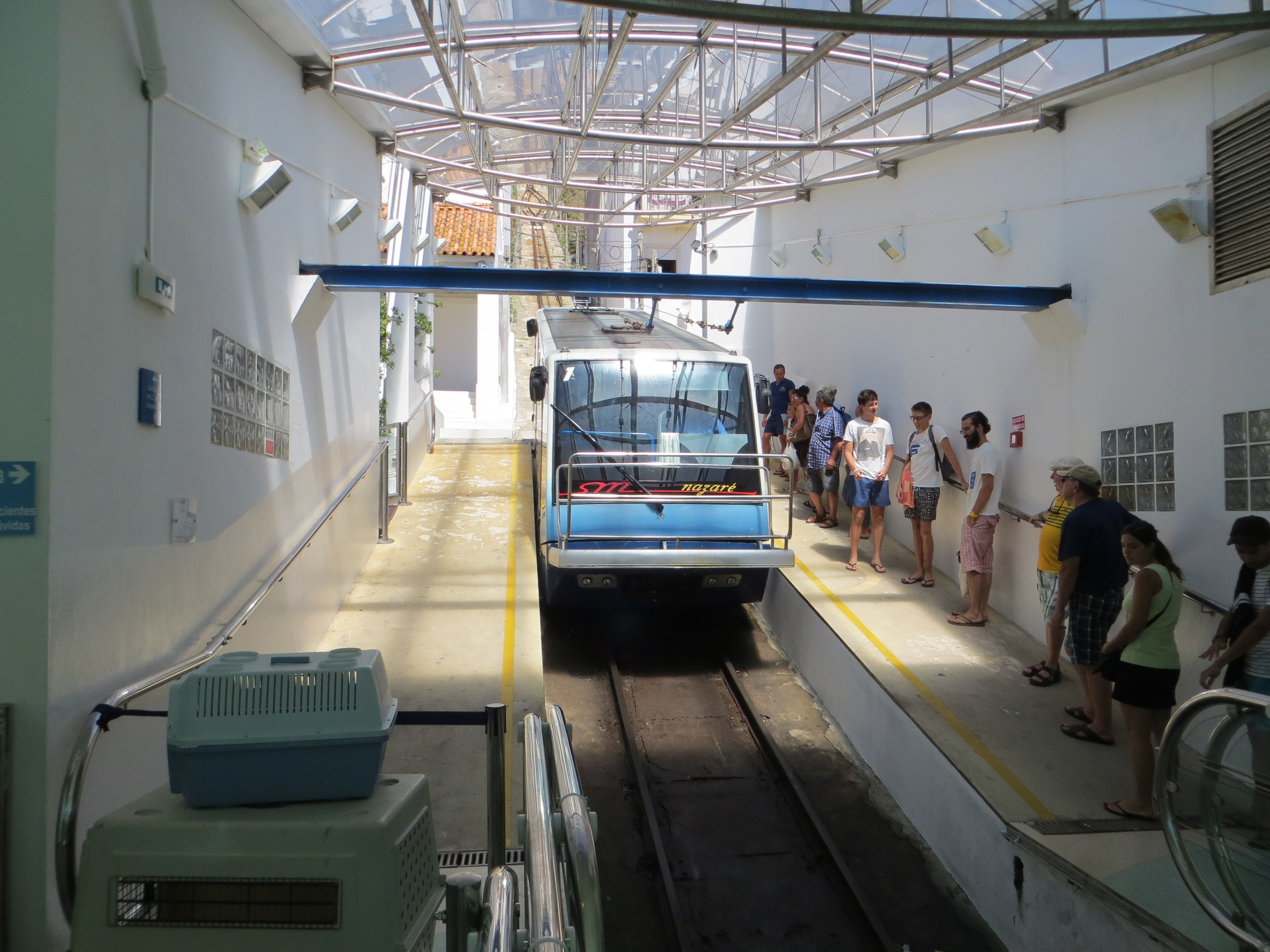
The Funicular da Nazaré, 1889. 318 meters of inclined rail; 120 meters of vertical rise in two minutes.· Mister No
· Named
People who show up on this page by name, each for a specific reason: Dom Fuas Roupinho, the 12th-century nobleman whose horse stopped at the cliff (the founding legend); Rafael Bordalo Pinheiro, the 19th-century caricaturist and ceramicist who made the fisherwomen figures that fixed the village's national image (Fábrica de Faianças das Caldas da Rainha, still in operation); Manuel Guimarães, who shot a neorealist film here in 1952 that is preserved at Cinemateca Portuguesa; Amália Rodrigues, whose 1954 recording of O Barco Negro is the canonical Nazaré fado; Fernando Pessoa, who visited and referenced the coast in his ocean-inflected writing; Dino Casimiro, the Nazarené bodyboarder whose 2005 email to Garrett McNamara began the modern big-wave era; Garrett McNamara, Sebastian Steudtner, Maya Gabeira, Kai Lenny, Justine Dupont, Michelle des Bouillons, Lucas Chianca, Nic von Rupp, Pedro "Scooby" Vianna — the adopted Nazarenés of the surf community, resident October to February; Márcio Freire, who died in this water in January 2023. The fisher and municipal community of Nazaré is under-represented in English-language sources; the Visiting and Sanctuary spokes will carry named interviews.
· History
Eleven turning points
The 900-year shape of Nazaré in eleven beats — the canyon-that-fed-the-village, the canyon-that-made-it-globally-famous, and the eight things in between.
1182 · cultural
Lenda da Nazaré
According to local tradition, Dom Fuas Roupinho — the Portuguese nobleman in charge of the Knights Templar at nearby Porto de Mós — is hunting a deer through heavy fog when his horse stops dead at the edge of the Sítio cliff. The legend says the Virgin Mary, housed in a small chapel at the site, saved him from plunging into the Atlantic. He dismounts, gives thanks, and orders the founding of a larger sanctuary on the spot. This is the founding story of Sítio and the origin of the Nossa Senhora da Nazaré cult.
Construction of the current Marian sanctuary at the Sítio clifftop begins under King Ferdinand I. The church houses the Nossa Senhora da Nazaré statue, traditionally identified as a 4th-century Byzantine carving said to have been carried to Iberia from the Holy Land during the 8th-century Islamic conquests. Pilgrimages begin almost immediately.
A small fortress built at the tip of the Sítio headland by Portuguese king Sebastião to defend the anchorage against Barbary and English corsairs. Named for the Archangel Michael. Will be modified through the 17th–19th centuries; converted into a lighthouse in 1903.
Portuguese caricaturist and ceramicist Bordalo Pinheiro's paintings of Nazarené fisherwomen in their traditional seven-skirt dress become the iconic early-20th-century image of Portuguese coastal culture. His ceramic figures of these women are still made at the Fábrica de Faianças das Caldas da Rainha.
A 318-meter inclined funicular links the lower village (Praia) to the upper village (Sítio) — a 120-meter vertical rise in 2 minutes. Replaces the old 175-step Capuchinhos stairway as the primary connection between the two parts of town. Still running; €2.20 round trip.
Dino Casimiro — a local Nazarené bodyboarder — sends a series of emails to Hawaiian big-wave surfer Garrett McNamara with photos of the Praia do Norte waves, suggesting the place might be worth looking at. McNamara ignores the first several. Eventually responds. Travels to Nazaré in 2010 to see for himself. The small-town email correspondence is the origin of the modern big-wave era at Nazaré.
2011 · Nov · sport
Garrett McNamara rides a 78-foot wave
On 1 November 2011, Hawaiian surfer Garrett McNamara is towed by jet-ski into a wave at Praia do Norte that is later measured at 23.77 m (78 ft). The Guinness Book of World Records certifies it as the largest wave ever surfed. The photograph of McNamara against the wave, with the Forte de São Miguel visible, goes globally viral. Nazaré becomes a big-wave destination within six months.
The Forte de São Miguel Arcanjo is converted by the Câmara Municipal de Nazaré into a surf museum. Exhibits include surf equipment from the McNamara era, photographs of the biggest rides, and the bathymetric science of the canyon. Admission €2. Open year-round.
2020 · Oct · sport
Sebastian Steudtner sets the current world record
German surfer Sebastian Steudtner surfs a 26.21-meter (86-ft) wave at Nazaré — the current official Guinness world record for the largest wave ever ridden. Later analysis at the University of Alcalá estimated the actual height closer to 28.6 m. Steudtner is now one of the Nazaré-resident core big-wave group.
The documentary series 100 Foot Wave, directed by Chris Smith, premieres on HBO. Three seasons run through 2024. The show centers on McNamara and the core Nazaré group — Kai Lenny, Maya Gabeira, Pedro 'Scooby' Vianna, Justine Dupont — and makes Nazaré's story available to a non-surf general audience for the first time. It wins four Primetime Emmy Awards.
Nazaré named a UNESCO Intangible Cultural Heritage candidate
The traditional Nazaré fisherwomen's dress (sete saias) and the estendal sardine-drying practice are formally submitted to UNESCO for consideration as protected Intangible Cultural Heritage of Humanity. The Portuguese Ministry of Culture leads the file.
· In the Culture
The three cultural objects that are actually doing the work
Bordalo Pinheiro's ceramic figurines, 1884 — still being made
In 1884 the Portuguese caricaturist and ceramicist Rafael Bordalo Pinheiro, working from his new factory at Caldas da Rainha (Fábrica de Faianças das Caldas da Rainha), produced a series of small ceramic figurines of Nazarené fisherwomen in the seven-skirt dress — and by doing so, fixed the image of the Portuguese coastal woman in the national imagination for the next 140 years. The figures you see in every Portuguese souvenir shop — brown-skinned, weathered, a basket on the head, the seven layered skirts — are direct lineal descendants. The factory is still operating. The figurines are still being pressed in the same molds. The image of the Nazaré fisherwoman that a foreign tourist buys in 2026 is the same image a Porto schoolchild was taught to admire in 1890. Very few places on Earth have an export that durable, that continuous, or that specific to one village of women.
O Barco Negro, 1954 — the fado that named the village
Portuguese fado — the national song form — has a sub-genre called fado do mar (sea fado), concerned with the emotional weight of fishing-village life and specifically with the saudade of wives whose husbands went to sea and did not return. The canonical recording of this sub-genre is Amália Rodrigues's 1954 version of O Barco Negro — "The Black Boat" — written by David Mourão-Ferreira with music by Caco Velho. The lyrics describe a Nazarené widow watching for the black boat that will bring her husband's body back. The song made Nazaré's specific grief legible to Portuguese listeners in a way no other cultural artifact has done. It was sung at the funeral of every Portuguese fisherman for forty years. When Manuel Guimarães shot his 1952 neorealist film Nazaré — preserved at Cinemateca Portuguesa — he used fado do mar as the soundtrack. This is what Nazaré sounded like before it became what it is now.
100 Foot Wave + the tourism poster, 2011–present
Since 2011 Nazaré has been Portugal's international cover image. The country's tourism agency, Turismo de Portugal, built the whole of its international advertising campaign around a single composition: wave, lighthouse, fortress, impossible scale. HBO's 100 Foot Wave (Chris Smith, 2021) ran three seasons and won four Primetime Emmy Awards. The WSL Tow Surfing Challenge has been held here annually since 2022. Dana Brown's 2024 Rise of the Giants centered the current generation of women big-wave surfers and premiered at Tribeca. The photograph that did all of this — McNamara against the wave with the Forte visible — is now one of the most-reproduced single images in the history of sport. The contemporary Nazaré is the first cultural artifact in the village's history that is made about Nazaré by people from everywhere else. The fisherwomen's figures were made by a Portuguese man. The fado was sung by a Portuguese woman. The documentary is American. The difference matters.
· The Village Beneath the Wave
What the tourism numbers cost
Every legendary page is incomplete without the weight it carries. For Nazaré, that weight is a 900-year-old working fishery priced out of the village it built.
The tension at Nazaré is what happens to a 900-year-old Portuguese fishing village when the world decides it is suddenly the most interesting beach on Earth.
The numbers are specific: annual visitor count at Nazaré rose from roughly 600,000 in 2010 (per the Portuguese Tourism Board's Leiria statistics) to over 2 million in 2023. The fishing-fleet registered in Nazaré's port, by contrast, has continued its centuries-long contraction — fewer than 80 active vessels in 2023, down from over 400 in the 1960s. The Atlantic fishery has been in decline throughout the EU; Nazaré's decline is structural and older than the surf boom. But the surf economy has arrived into a village that was already losing one of its two economic anchors, and the result is specific: short-term-let apartments where fishermen's families used to live, seven-euro bicas at seafront cafés where the coffee is priced for Brazilian filmmakers, and a traffic pattern on Avenida Marginal that the village was never designed for.
The local government — Câmara Municipal de Nazaré — has done more than most small municipalities to protect the village's texture. The Sítio clifftop has been designated a heritage zone; new construction requires approval; the Museu do Surf de Nazaré (inside the Forte) was deliberately built to centralize the surf-tourism revenue into municipal rather than private hands. The fisherwomen — the women in the seven-skirt dress who sell fish on the Praia da Nazaré — are a protected cultural practice. The traditional sun-drying of sardines (*estendal*) is now a registered intangible-heritage practice of the region.
None of this undoes the change. A young person who grew up in Nazaré today will face a housing market priced for global tourists, a job market that increasingly requires English, and a cultural environment where their grandmother's dress and their uncle's fishing expertise are both simultaneously museums and present-tense practices. The surfers are not leaving; the swells are, if anything, getting bigger with the climate-shifted Atlantic.
The honest version of what to do as a visitor is simple: stay overnight, spend money in places that employ locals rather than absentee owners, buy dried fish at the estendal if you eat fish, tip generously at the cafés, learn five Portuguese words, and know that you are a guest in a place that has been working for 900 years and could, in one more generation, stop working. Nazaré is spectacular. It is also precarious. Those are the same fact.
· When to come
Four seasons, four versions of the village
Oct–Feb · Big-wave season
Spectator weather. The Forte fills on swell-day mornings; the WSL Tow Challenge calls a 72-hour window when the forecast aligns. This is the Nazaré that the photographs are of — and the only time to actually see it work. Forecast windows live on Surfing Nazaré →.
Mar–Jun · Empty-village season
The swells are gone, the buses haven’t arrived, the light is long. The fishery still works. The funicular still runs every ten minutes. The version of Nazaré that the locals like.
Jul–Aug · Domestic summer
Portuguese family beach holiday — Praia da Nazaré crowds with umbrellas, the Avenida Marginal kiosks run late, the estendal puts out twice as much fish. Practical guidance lives on Visiting Nazaré →.
Sep 8 · Festas da Senhora
Close to 100,000 pilgrims to the Sítio sanctuary for the oldest continuously-celebrated Marian pilgrimage in Iberia — processions from the Ermida da Memória, folkloric performances, fireworks. The whole story — the 1182 Lenda, Dom Fuas, the 14th-century Santuário — lives on The Sanctuary →.
· On the Silver Coast
The coast Nazaré is the middle of
Costa de Prata carries most of Portugal's pre-Discoveries cultural history. Five places within an hour, ordered roughly south-to-north along the coast.
10 km north
São Martinho do Porto
The Atlantic's most perfectly-shaped natural harbor — an almost-closed circular bay with a narrow opening to the sea. Calm water year-round. The anti-Nazaré: families, paddle-boards, a rose-pink sunset view that Tripadvisor has decided is the point. Visit in the morning before coach tours arrive.
15 km inland
Alcobaça
The 12th-century Cistercian monastery of Santa Maria de Alcobaça — a UNESCO World Heritage site and one of the most important Gothic buildings in Iberia. Inside: the tombs of Dom Pedro I and Inês de Castro, facing each other — the central tragedy of medieval Portuguese literature. If you read one thing before you visit, read Camões's account of the murder of Inês in Canto III of *Os Lusíadas*.
50 km south
Peniche
Nazaré's pair, the one no one mentions. Peniche hosts the WSL MEO Pro — the country's World Championship Tour event at Supertubos, a beach break that produces some of the cleanest barrels in Europe. Nazaré is the poster for Portuguese surfing; Peniche is the factory. Fifteen years ago Portugal was a minor European surf destination. Today it is the surfing capital of the continent. Both coasts did that work.
25 km south
Óbidos
The walled medieval town given as a wedding gift by Dom Dinis to his queen in the 13th century and retained as the queens' property of Portugal for 650 years thereafter. Walk the ramparts. Drink the ginjinha — sour cherry liqueur served in a small chocolate cup that you eat afterwards. The most-photographed small town in Portugal.
25 km inland
Batalha
The Monastery of Batalha — a UNESCO-listed late-Gothic / Manueline masterpiece commissioned in 1385 to commemorate Portugal's victory over Castile at the Battle of Aljubarrota. The Manueline style — a Portuguese decorative architecture of rope-twists and sea motifs — begins here. If you came to Portugal for the age-of-discoveries story, this building is where the country's self-image as an Atlantic maritime power was first put in stone.
Written by Erin Rose. Canyon physics: Oliveira et al. (2013), JGR: Oceans; University of Lisbon; IPMA. Big-wave measurements: WSL Big Wave Awards, Guinness, University of Alcalá remeasurement. Ethnographic detail on the arte xávega and estendal follows the regional fisheries literature; the sete-saias reading is a working correction of the "one for each day" tourist explanation and follows the preponderance of textile-history evidence. Márcio Freire's death on 5 January 2023 is named because the page cannot cover this break seriously without it. The fisher and municipal community of Nazaré is under-represented in English-language sources; the Travel and Local spokes will correct this with named interviews. Version v0.9. Corrections welcome — particularly on Portuguese-language framings and on the named practices of the estendal.