1 · Read the swell
Pipeline's lineup is unusually technical to read. The three reef sections (First, Second, Third) produce different wave shapes at different swell sizes, and the peak can shift between reefs during a single session as the swell grows or ebbs. Adjacent breaks — Backdoor (right-breaking) and Off-the-Wall (left, next peak east) — share wave energy with Pipeline and take off from overlapping positions. A surfer reading the lineup correctly is, at any moment, judging: which peak will break, in which direction, from what depth, and whether to paddle for it or let it go.
2 · Take off late and deep
The technical signature of a good Pipeline ride is a late, deep takeoff. The surfer paddles into the wave from behind the peak — from a position closer to the breaking edge than at most breaks — and drops in on the face as the lip begins to throw. Doing this successfully puts the surfer in a position where the barrel will form around them on the fall, yielding the canonical deep-tube ride. Doing it unsuccessfully drops the surfer onto the reef from a height of 2–4 meters, sometimes with the wave already collapsing on top.
3 · Hold the line inside the barrel
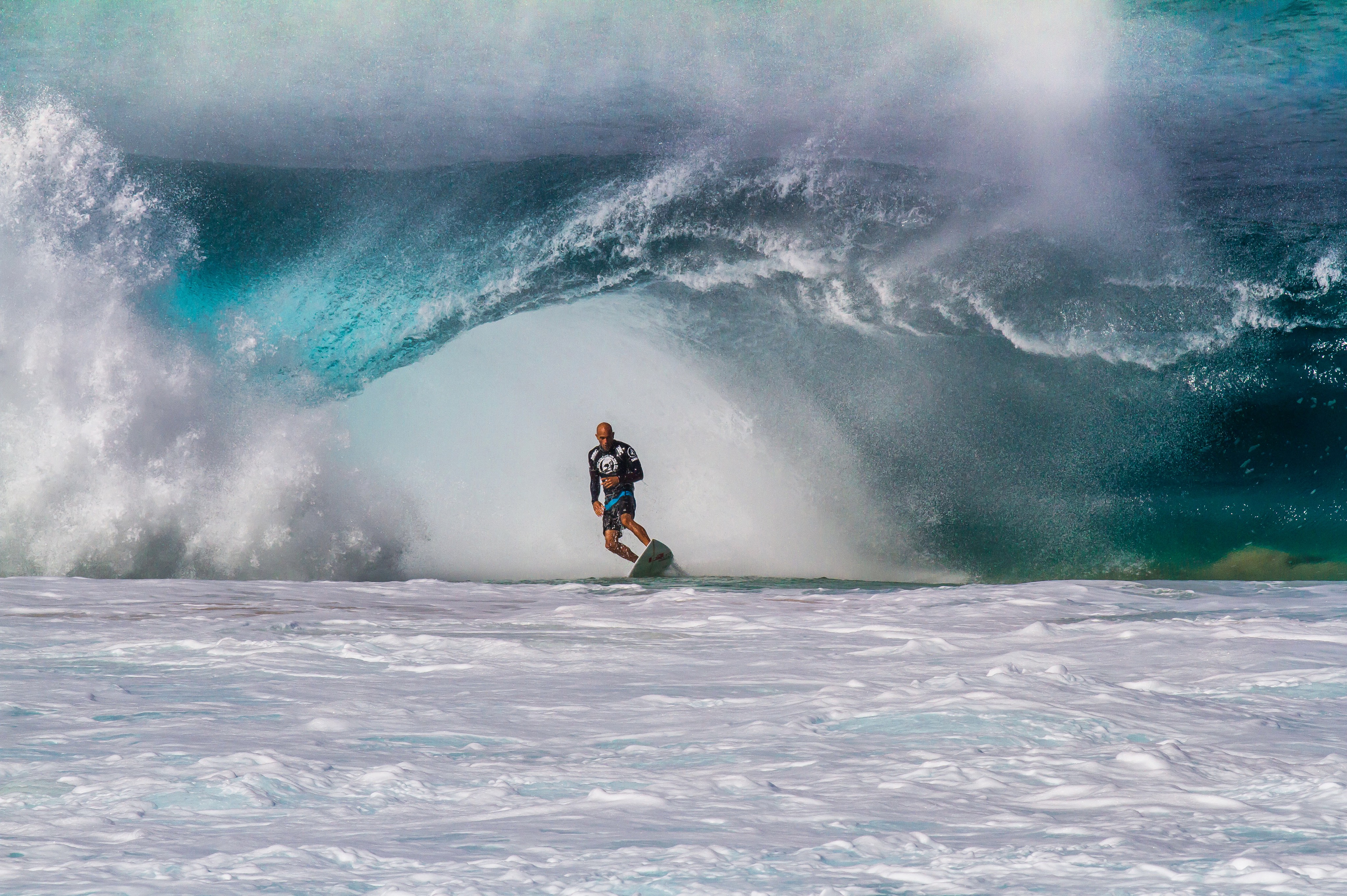
Once inside the barrel, the surfer's line is compressed between the wave's face (behind them, peeling) and the breaking lip (above and in front of them, closing the tube). The line must be high enough on the face that the surfer isn't caught by the bottom, and fast enough along the peel that the closing lip doesn't catch them. This is the specific technique that Pipeline specialists — Gerry Lopez, Kelly Slater, John John Florence — are known for. It is also the technique that is most difficult to learn: the only way to develop it is to practice it at Pipeline, which is in the nature of the break a scarce and dangerous learning environment.
4 · Exit before the close-out
The ride ends when the barrel either dissipates (the wave opens) or closes out (the lip catches the face). On a good ride the surfer exits through the opening end of the barrel, pumping down the wave face until it closes out naturally. On a bad ride the close-out happens first: the lip lands on the surfer and the ride ends in the impact zone. Exit timing — reading whether the barrel is going to open or close on your line — is what separates the elite from the near-elite. It is also the decision point where the fatalities most often originate.