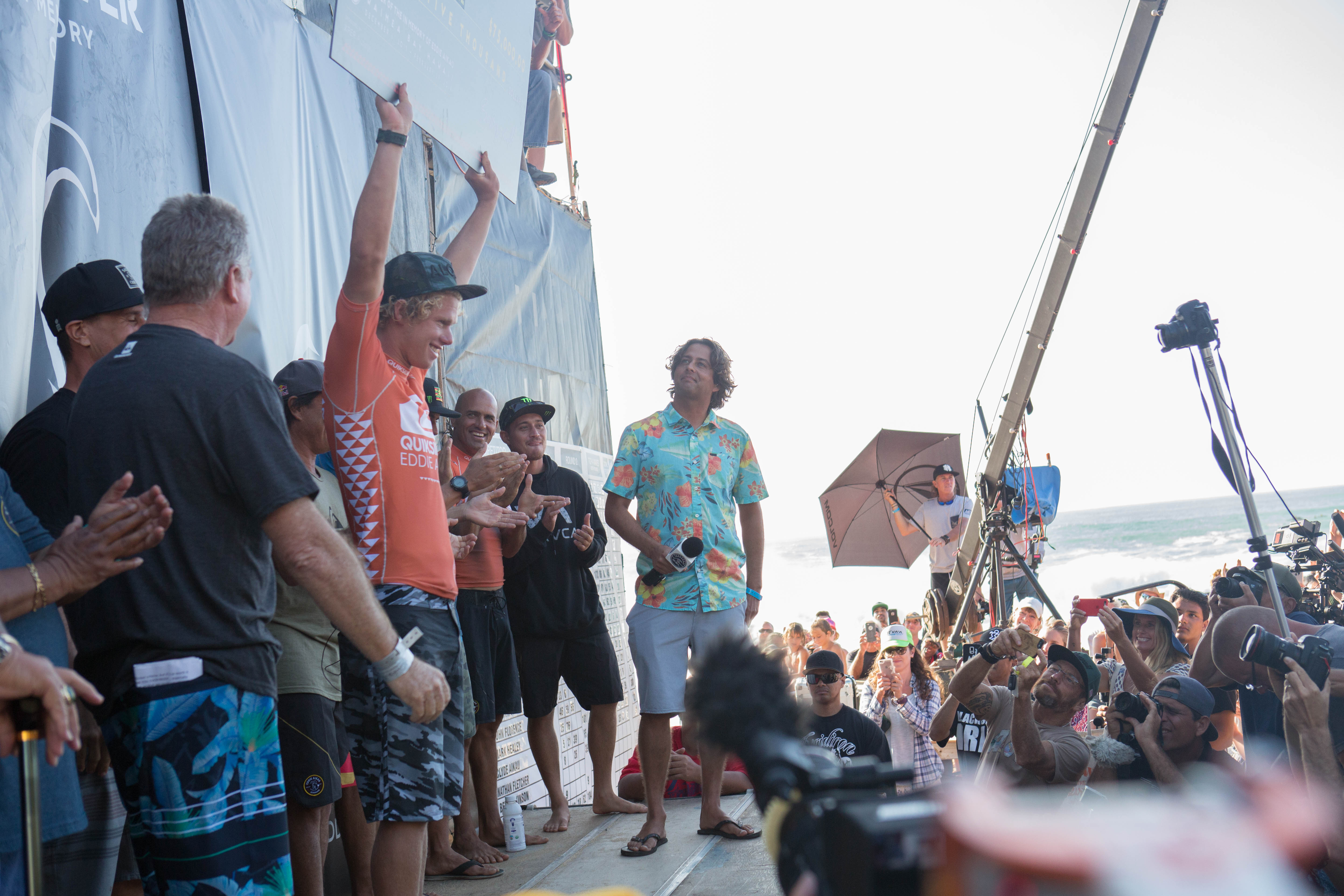
· The Eddie
Waimea Bay, Eddie Aikau, and the paddle-in big-wave tradition
Five kilometers west of Pipeline is a bay that hosts a different kind of surf — open-faced big waves, paddle-in rather than tow-in, rooted in Hawaiian watermen tradition. Its signature event is an invitational contest named for a man who died in 1978 trying to save other surfers. It has only been held ten times since 1985.
The Native Hawaiian lifeguard and big-wave surfer the event is named for
Before the contest, before the 'Eddie would go' slogan, before the t-shirts: a specific man from a specific family lived on this coast, saved hundreds of lives, and died at sea in 1978 attempting another rescue. Understanding the Eddie means understanding him first.
The lifeguard
Edward Ryon Makuahanai 'Eddie' Aikauwas born in Kahului, Maui, in 1946, and moved with his family to Oʻahu in the early 1950s. He grew up in Chinatown, Honolulu, then moved to the North Shore as a teenager. In 1968, at age 22, he was hired as Waimea Bay's first lifeguard — the first person paid to work this beach in that capacity. At the time, the North Shore big-wave season was considered effectively un-lifeguardable. The official municipal position was that experienced surfers accepted the risk; what happened to them was not a public-safety matter.
Aikau rejected this premise. Over the ten years 1968–1978, he is credited with over 500 documented rescues at Waimea and adjacent North Shore beaches, including rescues in conditions in which the Honolulu Fire Department lifeguards had formally refused to enter the water. The phrase "Eddie would go" — later shortened to a slogan — originally meant, very literally: Eddie Aikau will attempt the rescue that other lifeguards judge too dangerous. He did. Every reliable account is that he meant it, and did it, as a matter of personal ethics about his responsibility to the people in his water.
The surfer
Eddie was also, independent of his lifeguard work, one of the dominant North Shore big-wave surfers of the 1970s. He won the Duke Kahanamoku Invitational Surfing Championships in 1977 — the most prestigious Hawaiian surf contest of the pre-ASP era. He was known for paddling into waves others would not, riding the largest Waimea days under his own power, and maintaining a clean traditional Hawaiian longboard style at a time when the sport was being re-defined by shorter-board shortboarders. His contest style was not flashy; his free-surfing style was unmistakable.
The Hōkūleʻa
In March 1978, Eddie joined the crew of the Polynesian Voyaging Society's traditional double-hulled voyaging canoe Hōkūleʻa for what was planned as its first Tahiti-to-Hawaiʻi return voyage using non-instrument traditional navigation. The departure from Hawaiʻi was on 16 March 1978. Twelve hours into the voyage, in heavy seas roughly 15 miles south of Molokaʻi, the Hōkūleʻa swamped and capsized. The fifteen-person crew clung to the overturned hulls through the night.
At dawn the canoe had drifted without rescue. Eddie — the experienced big-water Hawaiian in the crew — took a surfboard and paddled alone toward Lānaʻi, approximately 12 nautical miles away, to seek help. He was last seen paddling into the channel. The remaining crew was rescued later that day by a Hawaiian Air Lines jet that spotted the canoe. Eddie was not among them. Massive search-and-rescue efforts over the following week — among the largest Hawaiian civilian searches ever mounted — never recovered his body. He is presumed to have drowned within a day of his departure.
He was 31 years old.
A contest that only runs when the waves are big enough — which means almost never
The Eddie Aikau Big Wave Invitational is an unusual contest: not held on a schedule, not guaranteed in any given year, and only run when the bay delivers minimum 20-foot open-face waves. It has only run ten times since 1985. Its rarity is the point.
The contest's rule
The Eddie has a single hard condition: it runs only when Waimea Bay delivers a minimum of 20-foot open-face waves (roughly 6 m) — a condition that has typically required a genuine open-ocean North Pacific storm system to deliver a multi-day swell. The waiting period opens in early December and runs through late February. In any given year, conditions meeting the threshold may occur zero, one, or two times. Meeting the threshold on a day when the contest's invited field (28 men, plus women's field added in the 2022 era) is available is a further coordination challenge.
Ten runs in forty years
Since the contest's inauguration in December 1985, the Eddie has run only ten times through 2024:
- 1986 — inaugural running; winner: Clyde Aikau (Eddie's younger brother)
- 1990 — winner: Keone Downing
- 1999 — winner: Noah Johnson
- 2001 — winner: Ross Clarke-Jones
- 2002 — winner: Kelly Slater
- 2004 — winner: Bruce Irons
- 2009 — winner: Greg Long
- 2016 — winner: John John Florence
- 2023 — winner: Luke Shepardson (Waimea lifeguard; the hometown surfer)
- 2024 — winner: Landon McNamara
Between these runs, entire years and sometimes multiple consecutive years pass without the contest being held. The gap between 2016 and 2023 — seven years — is the longest contest drought in the event's history; the gap between 2009 and 2016 was nearly as long. The contest is defined by its waiting, not its running.
Paddle-in only
The Eddie is paddle-in only — tow-in surfing is prohibited. This distinguishes it from Nazaré's modern big-wave contests (tow-in required) and from the general 21st-century big-wave discipline (which has largely migrated toward tow-in for waves over roughly 40 feet). The Eddie's paddle-in rule preserves the Hawaiian big-wave tradition of the 1950s–70s, when paddle-in was the only method available and the sport's vocabulary was built around it. It is also what makes the 20-foot ceiling meaningful: surfers must be physically strong enough to catch the wave under their own power.
Summer bay, winter arena, always a Hawaiian sacred site
Waimea Bay has a completely different character across the seasons. In summer (May–September) it is a placid family swimming beach with a famous 6-meter cliff-jumping rock that has been used by generations of Hawaiians and visitors; the bay is often completely glassy, the water turquoise, lifeguards on standard duty. Families picnic on the grass above the sand.
In winter (November–March) the bay is closed to swimmers and becomes the arena for big-wave surfing. The shoreline break can reach 4–6 meters on ordinary winter days; the offshore peak, 20+ feet (6+ meters) open-face on Eddie-level days. The spectator culture is substantial: Waimea attracts 2,000–5,000 spectators on ordinary big-wave days, more on contest days. The viewing is from the grass slope above the bay.
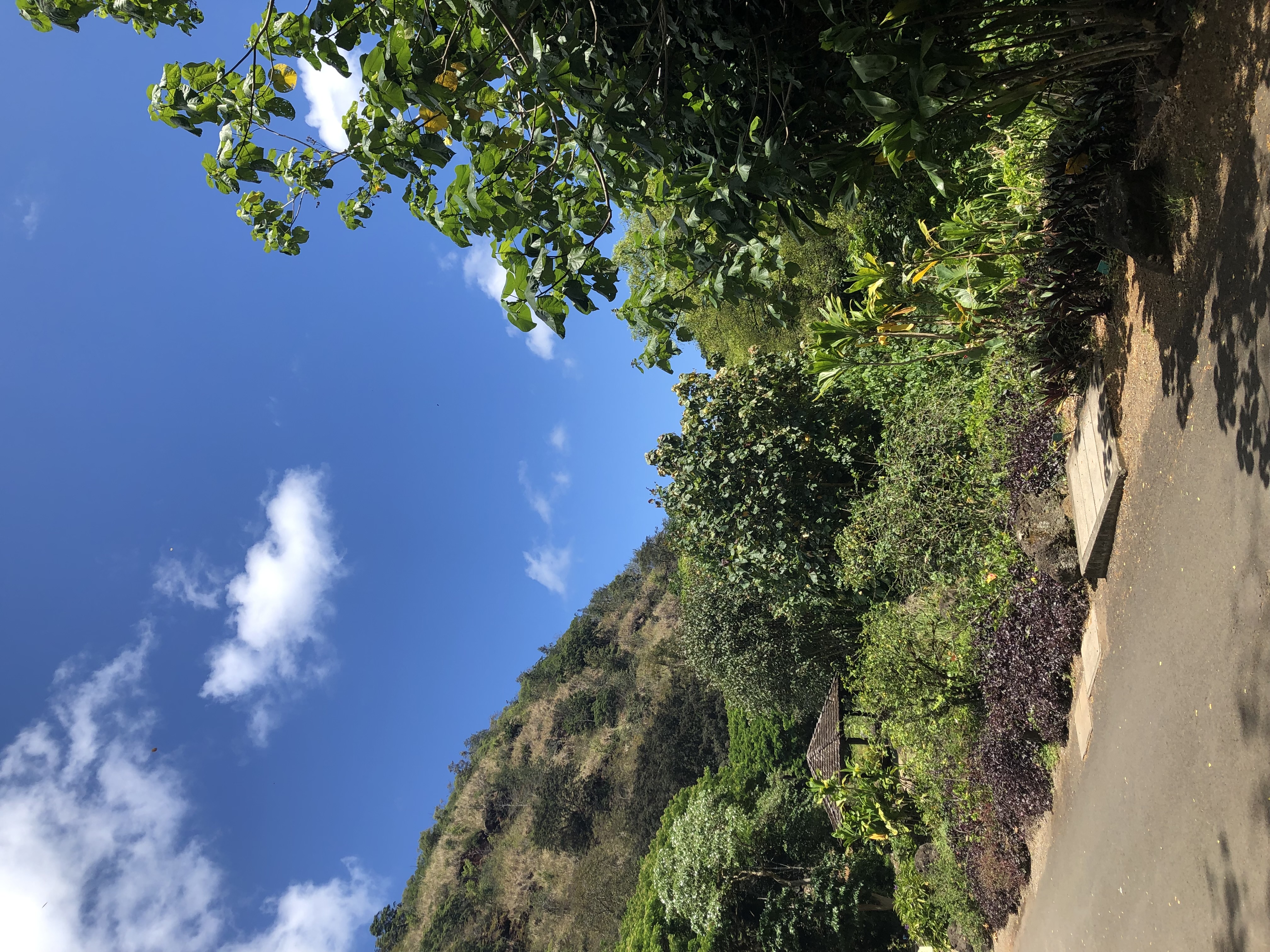
The bay is also a Hawaiian sacred site. Waimea Valley, the inland continuation of the bay, contains at least seventeen archaeological sites including Hale o Lono Heiau (a traditional Hawaiian temple) and a system of loʻi kalo (terraced taro fields) that were in continuous use from pre-contact Hawaiʻi until the late 19th century. The valley is now administered as a nature reserve and cultural-heritage site by Hiʻipaka LLC, a Hawaiian-family-owned nonprofit, which operates guided cultural walks. A visitor to Waimea Bay who has time for the valley gets a much fuller picture of the place than the contest context alone provides.
What you can actually do there
- Summer: swim in the bay, jump off the rock. The cliff jump is a rite of passage. The rock is lower than it looks; confirm the lifeguard considers it safe before attempting it.
- Winter: watch from the grass slope. Do not enter the water. Waimea's winter shorebreak is lethal for non-expert swimmers.
- Waimea Valley cultural walk — 45 min guided walk or self-guided loop; $25. The Hawaiian archaeological sites are unusually intact for a Oʻahu cultural-heritage site this accessible.
- Hiʻipaka Waterfall — at the head of the valley, a 14-meter plunge pool. Swimming is permitted. The hike in is short and largely paved.
The rest of Pipeline
Pipeline →
The proving-ground wave. The Pipe Masters. The reef. The deaths.
Surfing Pipeline →
How the wave actually works, the Pipe Masters contest as the WSL Championship Tour's season-opener, the reef mechanics, and the fatalities that are part of the break's identity.
The North Shore →
The 7-Mile Miracle — from Haleʻiwa through Chun's Reef, Laniākea, Waimea, and Sunset to Turtle Bay. The full North Shore circuit as a day-trip from Waikīkī.
Mālama North Shore →
The Hawaiian sacred sites of the 7-Mile Miracle — Puʻu o Mahuka Heiau, Waimea Valley, the named Hawaiian places under the English surf-break names — and how to visit Hawaiian land respectfully.
Written by Erin Rose. Eddie Aikau biographical material follows Stuart Holmes Coleman's Eddie Would Go (Mutual Publishing, 2001) — the canonical biography. Hōkūleʻa voyage detail from the Polynesian Voyaging Society's archive. Contest history from the Eddie Aikau Foundation and the World Surf League. Hiʻipaka / Waimea Valley visitor information via waimeavalley.net. Eddie's 31-year-old age-at-death is per his family's published memorial. Corrections welcome, especially on Portuguese-language framings and on the named practices of Nazaré. Version v0.9.